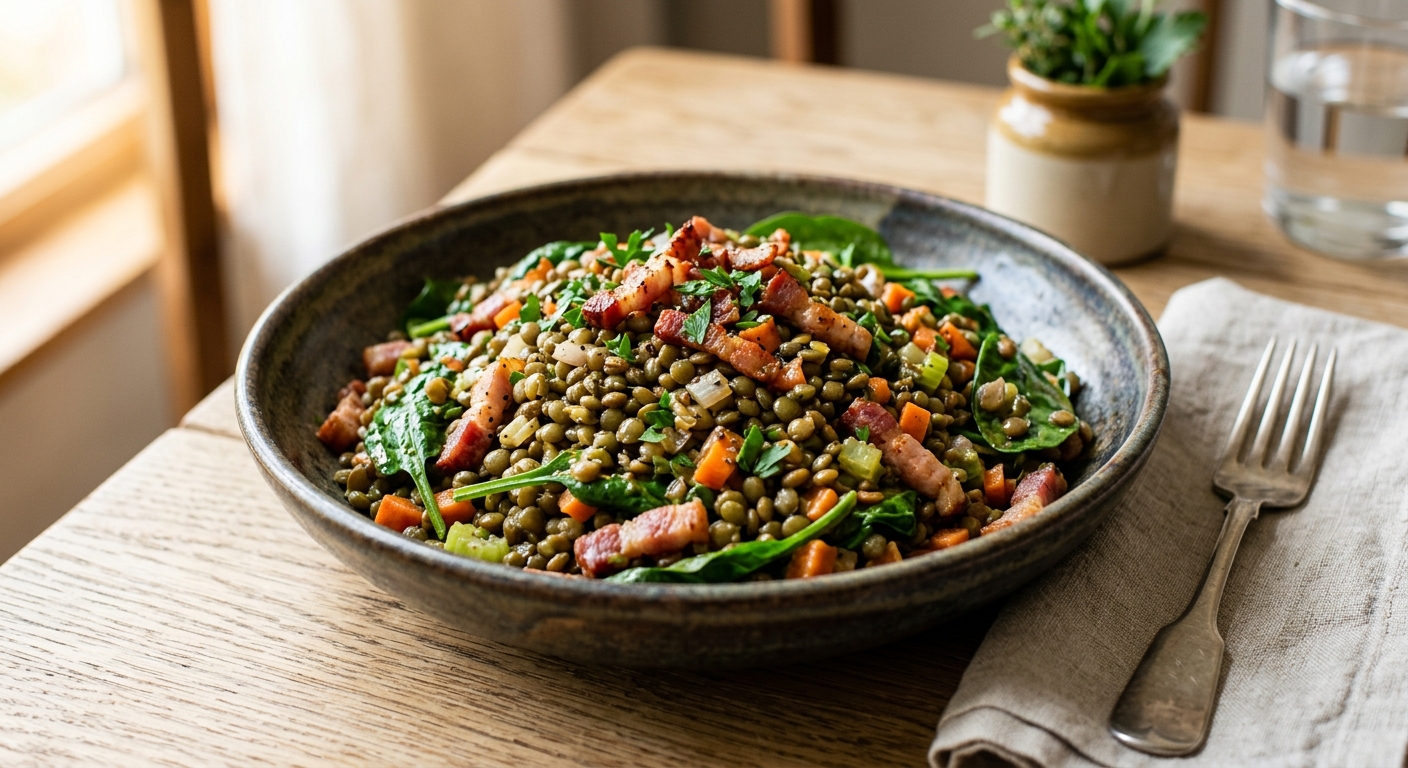
There is a reason this dish has been a staple of French brasserie cooking for generations. The combination of earthy Puy-style lentils, smoky cured pork, and a bright mustard dressing is one of those rare flavor marriages that feels both rustic and refined at once. What the brasserie cooks may not have known, however, is just how extraordinary this humble bowl is from a micronutrient standpoint. A single serving provides more than a third of your daily iron needs, over half your daily folate, and meaningful amounts of thiamine, B6, and B12, all in a dish that takes under an hour to prepare.
The key to this recipe is the lentil. We call specifically for French green lentils, also sold as Lentilles du Puy or Puy-style lentils. Unlike red lentils, which dissolve into a puree, green lentils hold their shape under heat, giving the salad a satisfying, toothsome bite. They are also denser in polyphenols and resistant starch than their red counterparts, which moderates the glycemic response and feeds beneficial gut bacteria. The bacon is not just a flavor accent; its heme iron dramatically improves the absorption of the non-heme iron in the lentils, a phenomenon nutritionists call the meat factor, making this pairing as scientifically smart as it is delicious.
The Dijon vinaigrette does double duty. Mustard emulsifies the dressing so it clings to every lentil, and the acidity of the red wine vinegar brightens the earthy base while helping solubilize iron for better absorption. Wilted spinach stirred in at the end adds another 15% of daily iron and a hefty dose of folate, pushing this bowl firmly into the territory of a genuinely functional meal. Whether you build it on the stovetop in under an hour, set it in a slow cooker before work, or pressure-cook it in 30 minutes flat, the result is warm, bold, and precisely calibrated.
4
servings
Ingredients
- 300 gFrench green lentils (Puy-style), rinsed and drained
- 180 gsmoked bacon lardons or thick-cut bacon, cut into 1cm pieces
- 3 mediumshallots, finely diced
- 3 clovesgarlic, minced
- 120 gbaby spinach, loosely packed
- 1 mediumcarrot, peeled and finely diced
- 1 stalkcelery, finely diced
- 900 mllow-sodium chicken stock
- 2 tbspextra-virgin olive oil
- 2 tbspwhole-grain Dijon mustard
- 1.5 tbspred wine vinegar
- 1 tspDijon mustard (smooth), for the dressing
- 1 tsphoney
- 1 sprigfresh thyme
- 1 leafbay leaf
- 2 tbspfresh flat-leaf parsley, roughly chopped
- —Colima Sea SaltMicroplastic Free Salt and freshly cracked black pepper to taste
Instructions
Click on an item below to shop for the recommended items for this recipe on Amazon.
As an Amazon Associate, we earn from qualifying purchases.
- Render the bacon: Place a large Dutch oven or heavy-bottomed saucepan over medium heat. Add the bacon lardons in a single layer and cook, stirring occasionally, for 6 to 8 minutes until the fat has rendered and the pieces are golden and crispy. Use a slotted spoon to transfer the bacon to a paper-towel-lined plate, leaving 1 tablespoon of rendered fat in the pot. Discard any excess fat.
- Build the aromatic base: With the pot still over medium heat, add the olive oil to the reserved bacon fat. Add the diced shallots, carrot, and celery. Cook, stirring frequently, for 4 to 5 minutes until the shallots are translucent and the vegetables have softened. Add the minced garlic and cook for a further 60 seconds until fragrant, scraping up any browned bits from the bottom of the pot.
- Cook the lentils: Add the rinsed lentils, thyme sprig, and bay leaf to the pot. Pour in the chicken stock and bring to a rolling boil over high heat. Once boiling, reduce the heat to a gentle simmer, partially cover with a lid, and cook for 22 to 28 minutes, stirring once or twice, until the lentils are tender but still hold their shape. They should have a slight resistance when bitten. Drain any excess stock if necessary, then remove and discard the thyme sprig and bay leaf.
- Make the Dijon vinaigrette: While the lentils cook, whisk together the whole-grain Dijon, smooth Dijon, red wine vinegar, honey, and a pinch of salt in a small bowl. Slowly drizzle in the remaining olive oil while whisking continuously to create a stable emulsion. Season with black pepper.
- Finish and dress: Remove the pot from heat. Immediately fold in the baby spinach in two additions, stirring gently each time until the leaves wilt from the residual heat, about 90 seconds. Pour the vinaigrette over the warm lentils and toss to coat thoroughly. Fold in the reserved crispy bacon and scatter the fresh parsley on top. Taste and adjust salt and pepper. Serve warm directly from the pot.
- Crisp the bacon first: This step cannot be skipped in the slow cooker method, as the appliance cannot brown meat. Heat a skillet over medium-high heat and cook the bacon lardons for 6 to 8 minutes until crispy and golden. Transfer to a paper-towel-lined plate. Pour off all but 1 tablespoon of fat, then add the shallots, carrot, and celery to the same skillet. Saute over medium heat for 3 to 4 minutes until lightly softened. Add the garlic and cook 30 seconds more. Deglaze the skillet with 2 tablespoons of the measured chicken stock, scraping up all the browned bits, then pour the entire contents of the skillet into the slow cooker insert.
- Load the slow cooker: Add the rinsed lentils to the slow cooker along with the thyme sprig, bay leaf, and the remaining chicken stock. Stir briefly to combine. Do not add the bacon, spinach, or dressing at this stage. Place the lid firmly on the slow cooker.
- Cook low and slow: Set the slow cooker to Low and cook for 6 to 7 hours. The lentils should be fully tender and most of the stock absorbed, leaving a small amount of flavorful liquid. Check at the 6-hour mark; if the lentils are tender but sitting in excess liquid, remove the lid and increase to High for a final 20 minutes to reduce.
- Make the Dijon vinaigrette: About 10 minutes before serving, whisk together the whole-grain Dijon, smooth Dijon, red wine vinegar, honey, and a pinch of salt in a small bowl. Drizzle in the olive oil while whisking to emulsify. Season with black pepper.
- Finish in the insert: Remove and discard the thyme sprig and bay leaf. Switch the slow cooker off. Fold in the baby spinach directly into the hot lentils in two batches, stirring until wilted, about 2 minutes. Pour the vinaigrette over the lentils and toss gently. Fold in most of the crispy bacon, reserving a small handful for garnish. Top with the reserved bacon and fresh parsley. Serve warm straight from the insert.
- Saute the bacon and aromatics using the Saute function: Press Saute on the Instant Pot (or heat a stovetop pressure cooker over medium-high heat). Add the bacon lardons and cook, stirring, for 5 to 6 minutes until crispy. Remove with a slotted spoon to a plate. Drain all but 1 tablespoon of fat from the pot. Add the olive oil, shallots, carrot, and celery and saute for 3 minutes until softened. Add the garlic and cook 30 seconds, then press Cancel to stop the Saute function and prevent scorching.
- Deglaze and load: Pour in about 60ml of the chicken stock and use a wooden spoon to scrape the bottom of the insert completely clean of any browned bits. This step is critical to prevent the burn warning. Add the rinsed lentils, thyme sprig, bay leaf, and the remaining chicken stock. Stir once to combine.
- Pressure cook: Secure the lid and set the pressure valve to Sealing. Select Manual (or Pressure Cook) on High Pressure for 12 minutes. The pot will take approximately 8 to 10 minutes to reach full pressure before the countdown begins. When the timer ends, immediately perform a Quick Release by carefully switching the valve to Venting. Wait for all steam to fully release before opening the lid.
- Make the Dijon vinaigrette: While the pressure releases (about 3 to 4 minutes), quickly whisk together the whole-grain Dijon, smooth Dijon, red wine vinegar, honey, and a pinch of salt in a small bowl. Add the olive oil in a thin stream, whisking constantly to emulsify. Season with cracked black pepper.
- Finish and serve: Open the lid and remove the thyme sprig and bay leaf. If any excess stock remains, press Saute on Low for 2 to 3 minutes to reduce. Switch off the pot. Fold in the baby spinach in two batches and stir until wilted from the residual heat, about 90 seconds. Pour the vinaigrette over the lentils and toss to coat evenly. Fold in the reserved crispy bacon and top with fresh parsley. Taste for seasoning and serve immediately while warm.
- Preheat and prepare: Position an oven rack in the lower middle of the oven and preheat to 180C (350F / Gas Mark 4). Place a Dutch oven over medium-high heat on the stovetop. Add the bacon lardons and cook for 6 to 8 minutes until crispy and rendered. Transfer to a plate with a slotted spoon. Drain all but 1 tablespoon of fat from the pot.
- Build the base on the stovetop: Reduce heat to medium. Add the olive oil to the Dutch oven along with the shallots, carrot, and celery. Cook, stirring, for 4 to 5 minutes until softened and just beginning to take on color. Add the garlic and cook for 30 seconds. Stir in the whole-grain Dijon (just 1 tablespoon at this stage) to coat the vegetables; this blooms the mustard flavor directly into the base.
- Add lentils and stock: Add the rinsed lentils, thyme sprig, and bay leaf to the Dutch oven. Pour in the chicken stock and bring to a simmer on the stovetop, about 3 minutes. Season lightly with salt and pepper. Remove from heat, place the lid tightly on the Dutch oven, and transfer to the preheated oven.
- Bake covered then uncovered: Bake covered for 35 minutes. Remove the lid and continue baking for a further 12 to 15 minutes until the stock is mostly absorbed, the lentils are tender, and the top has developed a slightly dry, lightly colored crust. The lentils at the edges may be just faintly caramelized, which is desirable.
- Make the Dijon vinaigrette and finish: Remove the Dutch oven from the oven and let it rest, uncovered, for 5 minutes. Discard the thyme sprig and bay leaf. Whisk together the remaining whole-grain Dijon, smooth Dijon, red wine vinegar, honey, and a pinch of salt in a small bowl, then whisk in the olive oil to emulsify. Fold the baby spinach into the hot lentils in two additions, stirring until wilted. Pour the vinaigrette over the lentils and toss thoroughly. Fold in the reserved crispy bacon, top with fresh parsley, and serve warm directly from the Dutch oven.
Nutrition Breakdown
Per 1 serving (makes 4)
Vitamins & Minerals
% Daily Value based on a 2,000 calorie diet (FDA reference)
🧬 Essential Amino Acids
% of recommended daily intake (RDA) per serving
🛡 Antioxidant Profile
The Nutrition Science
The iron story in this dish operates on two levels. Lentils are one of the most iron-dense plant foods available, providing non-heme iron at roughly 3.3mg per 100g of cooked legume. Non-heme iron is inherently less bioavailable than the heme iron found in animal tissue, with typical absorption rates of 2 to 10 percent under ordinary conditions. However, the bacon in this recipe contributes genuine heme iron and, critically, activates what scientists call the meat factor, a poorly understood but well-documented effect in which digested peptides from muscle protein stimulate non-heme iron uptake by intestinal cells. Studies suggest the meat factor can increase non-heme iron absorption by 50 to 100 percent, making this pairing far more than a culinary tradition.
The Dijon vinaigrette adds another layer of nutritional engineering. Red wine vinegar and the ascorbic acid from the fresh parsley and wilted spinach create an acidic environment in the stomach that keeps iron in its more soluble ferrous (Fe2+) state rather than oxidising to the poorly absorbed ferric (Fe3+) form. Meanwhile, the B vitamin profile of this dish is remarkable in its completeness. Lentils are among the richest plant sources of folate and thiamine, while bacon and the small amount of chicken stock contribute B12, a nutrient almost entirely absent from plant foods. B6, supplied by both lentils and the aromatics, supports the enzyme reactions that actually use folate in DNA synthesis, making these nutrients functionally synergistic.
The resistant starch content of French green lentils deserves particular attention. Unlike refined carbohydrates, resistant starch bypasses small intestine digestion and reaches the colon intact, where it serves as a prebiotic substrate for Bifidobacterium and Lactobacillus species. Fermentation of resistant starch produces short-chain fatty acids, especially butyrate, which is the primary energy source for colonocytes and plays a role in regulating colonic inflammation. This mechanism is one reason lentil-rich diets are consistently associated with reduced colorectal cancer risk in epidemiological studies. The fiber and resistant starch together are also largely responsible for the moderate glycemic load of this dish despite its substantial carbohydrate content.
Pro Tips
- Do not salt the cooking liquid until the lentils are already tender. Adding salt too early toughens the lentil skin by interfering with the pectin in the cell wall, which can add 10 to 15 minutes to your cook time and produce an uneven texture.
- For maximum iron absorption, serve this dish with a small glass of orange juice or a citrus-dressed side salad. The additional vitamin C from 120ml of orange juice can raise non-heme iron absorption by up to 67 percent compared to water, according to research published in the American Journal of Clinical Nutrition.
- The vinaigrette can be made up to 3 days ahead and stored in a sealed jar in the refrigerator. Shake vigorously before using. Leftover dressed lentil salad keeps well for 3 days and can be eaten cold or gently reheated in a saucepan with a splash of water, making it an excellent meal-prep option for the week.




The iron bioavailability angle here is really smart, especially with that vinegar in the Dijon dressing – the acidity genuinely enhances non-heme iron absorption, which most people don’t realize. I’m curious though about the “full spectrum of B vitamins” claim in the excerpt: lentils are fantastic for folate and some B6, but they’re honestly pretty modest sources of B12 unless you’re counting trace amounts. The bacon does add some B vitamins, but I’d love to see the actual numbers broken down to avoid overstating what a single bowl delivers. That said, this is exactly the kind of recipe that makes me excited because the flavor-nutrition combo is genuinely
Oh Sue, French green lentils are such a game changer for this exact reason! They have a lower glycemic load than brown lentils, which I’ve found makes a huge difference in managing my blood sugar and androgens since my PCOS diagnosis. Plus the bacon adds that fat and protein component that slows glucose absorption even more, so you’re getting actual metabolic support alongside the iron and B vitamins. This is the kind of intentional pairing that makes nutrition feel effortless instead of restrictive, and I’m so here for teaching others that approach!
Oh, this is exactly the kind of recipe I’m planning to feature in next month’s class! I used to make a similar lentil salad back in my teaching days, but I’d always use regular brown lentils and skip the bacon because of fat concerns, which honestly made it less satisfying. Your version with the French greens and that Dijon vinaigrette is so much smarter, nutritionally speaking, because those quality fats actually help with iron absorption, something I didn’t fully appreciate until I really dug into the research. I’m curious about your cooking time for the lentils, since I find French green varieties need a lighter touch than the brown ones to keep that lovely texture for a