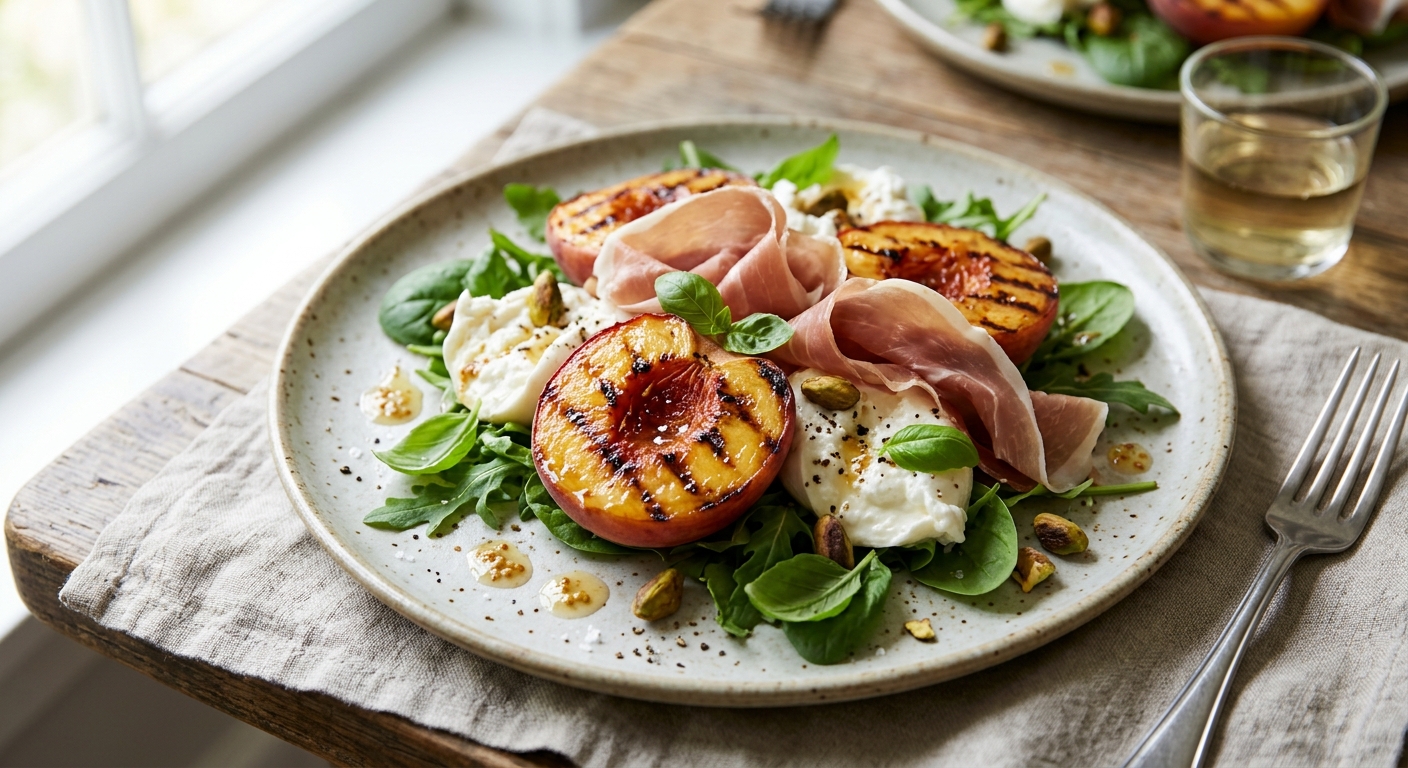
Some dishes are beautiful by accident. This one is beautiful by design. Grilled Peach and Burrata Salad with Prosciutto is the kind of recipe that earns applause at a dinner party and yet comes together in under 30 minutes on a weeknight. Ripe summer peaches are caramelised until their natural sugars concentrate and their flesh turns jammy, then laid over a bed of peppery rocket alongside torn burrata, tissue-thin prosciutto, toasted pistachios, and a honey-lemon vinaigrette that ties every element together. It is a dish built on contrast: hot and cool, salty and sweet, rich and sharp.
What makes this salad genuinely exceptional from a nutritional standpoint is the density of fat-soluble vitamins hiding in plain sight. Peaches are a meaningful source of beta-carotene, the precursor to vitamin A, and their vitamin C content is amplified here by the fresh lemon juice in the dressing. Burrata contributes calcium and riboflavin, prosciutto adds heme iron and a complete amino acid profile, and the rocket brings vitamin K and folate to the table. Together, a single serving clears more than 8% DV for six distinct micronutrients, which is the threshold for what we count as a meaningful contribution at Calibrated Cuisine.
This recipe was designed with flexibility in mind. The stovetop grill pan method delivers the deepest char and the most dramatic presentation. A slow cooker version transforms the peaches into a warm, syrupy compote-style salad that works beautifully in cooler months. The pressure cooker option is the fastest route to intensely softened, flavour-saturated peaches. And the oven broiler method, included as a fourth option, gives you hands-off caramelisation that is ideal when you are cooking for a crowd. No matter which method you choose, the nutritional payload remains consistent, because the peaches, burrata, and prosciutto do the heavy lifting regardless of how the heat is applied.
4
servings
Ingredients
- 4 largeripe but firm peaches, halved and pitted (approximately 600g total)
- 2 tbspextra-virgin olive oil, divided
- 1 tbspraw honey
- 1 tbspfresh lemon juice
- 1 tspapple cider vinegar
- 0.5 tspDijon mustard
- 120 gfresh burrata (2 small balls, drained)
- 80 gprosciutto di Parma, thinly sliced (about 6 slices)
- 80 gwild rocket (arugula)
- 30 gshelled pistachios, roughly chopped and lightly toasted
- 15 gfresh basil leaves, torn
- 10 gfresh mint leaves, torn
- 20 gParmigiano-Reggiano, shaved with a vegetable peeler
- 0.5 tspred chilli flakes
- 1 tspbalsamic glaze, for drizzling
- —Colima Sea SaltMicroplastic Free Salt and freshly cracked black pepper to taste
Instructions
Click on an item below to shop for the recommended items for this recipe on Amazon.
As an Amazon Associate, we earn from qualifying purchases.
- Place a cast iron grill pan over high heat for at least 3 minutes until it is smoking hot. While it heats, halve and pit the peaches, then brush the cut faces lightly with 1 tablespoon of the olive oil and season with a pinch of flaky salt.
- Lay the peach halves cut-side down onto the screaming-hot grill pan without moving them. Press gently with a spatula for full contact. Grill undisturbed for 3 to 4 minutes until deep golden char marks form and the flesh begins to yield when pressed at the edges. Rotate each half 45 degrees and grill for 1 minute more to create a crosshatch pattern, then flip and grill the skin side for 1 minute. The peaches should be tender but still hold their shape. Transfer to a plate and drizzle immediately with the honey while still hot.
- While the peaches rest, whisk together the remaining 1 tablespoon olive oil, lemon juice, apple cider vinegar, Dijon mustard, a pinch of salt, and several grinds of black pepper in a small bowl until emulsified. Taste and adjust acidity.
- Arrange the rocket across a large platter or four individual shallow bowls. Drape the prosciutto slices loosely over the greens in natural folds so they form airy ribbons rather than a flat layer.
- Nestle the warm grilled peach halves among the prosciutto and greens. Tear each burrata ball open over the salad, letting the creamy stracciatella centre spill onto the peaches and rocket. Scatter the toasted pistachios, torn basil, and mint over everything. Shave the Parmigiano-Reggiano over the top with a vegetable peeler, sprinkle with red chilli flakes, finish with a drizzle of balsamic glaze and the whisked vinaigrette, and serve immediately while the peaches are still warm.
- Lightly grease the slow cooker insert with a small amount of olive oil. Place the peach halves cut-side up in a single layer in the insert. Drizzle with the honey, 1 tablespoon of olive oil, lemon juice, and apple cider vinegar. Sprinkle with a pinch of flaky salt. The liquid ingredients will pool in the hollows of the peaches and form a fragrant braising syrup.
- Cover and cook on Low for 1 hour 45 minutes to 2 hours. The peaches are ready when they are very tender throughout and the juices in the insert have reduced slightly into a thin, amber-coloured syrup. They should hold their shape but collapse slightly when lifted. Do not cook on High, as the peaches will turn to mush and the syrup will turn bitter.
- Using a wide spatula, carefully lift each peach half from the slow cooker and transfer to a plate. Whisk the Dijon mustard and remaining tablespoon of olive oil directly into the warm poaching syrup still in the insert, scraping up any caramelised edges. Taste and correct seasoning. This becomes your warm vinaigrette.
- Arrange the rocket across a large platter. Lay the prosciutto loosely over the rocket. Place the slow-cooked peach halves over the top, cut-side up, and spoon several tablespoons of the warm slow cooker vinaigrette over the entire salad to gently wilt the rocket slightly.
- Tear the cold burrata over the warm peaches just before serving, so the contrast of cold creamy cheese against the warm fruit is dramatic and intentional. Scatter pistachios, basil, mint, shaved Parmigiano-Reggiano, and chilli flakes over the top. Finish with the balsamic glaze and serve immediately.
- Pour 60ml (quarter cup) of water into the pressure cooker pot. Add the honey, lemon juice, apple cider vinegar, 1 tablespoon of olive oil, and a pinch of salt, and stir briefly to combine. Place the peach halves cut-side up in a steamer basket or trivet insert above the liquid so they steam-poach rather than boil directly in water.
- Seal the lid, set the valve to Sealing, and cook on Manual High Pressure for 3 minutes. When the cycle completes, perform an immediate quick release by carefully switching the valve to Venting. Open the lid away from you once all steam has escaped. The peaches should be tender throughout with a slightly glossy surface.
- Optional but recommended: transfer the peaches cut-side up onto a foil-lined tray and slide under a preheated broiler for 2 to 3 minutes to caramelise the surface and add a golden colour that pressure cooking cannot provide. Watch carefully as they can burn quickly. Meanwhile, press Saute on the Instant Pot and reduce the cooking liquid in the pot for 2 to 3 minutes until slightly syrupy, then whisk in the Dijon mustard and remaining tablespoon of olive oil to form the vinaigrette.
- While the peaches finish, arrange the rocket on a large platter and drape the prosciutto over the top in loose folds. Place the peach halves among the greens, cut-side up, and spoon the warm pressure cooker vinaigrette over everything.
- Tear the burrata over the salad, scatter the toasted pistachios, basil, mint, and shaved Parmigiano-Reggiano on top, finish with chilli flakes and balsamic glaze, and serve immediately.
- Position an oven rack about 15cm (6 inches) from the broiler element and preheat the broiler on High for 5 minutes. Line a rimmed baking sheet with foil and lightly grease with a little olive oil. Halve and pit the peaches and arrange them cut-side up on the prepared baking sheet.
- In a small bowl, whisk together the honey, 1 tablespoon olive oil, lemon juice, and a pinch of flaky salt. Brush this mixture generously over the cut faces of each peach half, making sure the honey pools slightly in the hollows where the pit was removed.
- Slide the baking sheet under the broiler and broil for 8 to 10 minutes, watching closely after the 6-minute mark. The peaches are done when the cut surfaces are deeply golden and caramelised in patches, the edges begin to bubble with syrup, and the flesh is tender when pierced with a paring knife. If the tops colour too quickly before the flesh is tender, move the tray to a lower rack and continue cooking. Remove from the oven and let the peaches rest on the tray for 3 minutes so the syrup thickens slightly.
- While the peaches broil, whisk together the remaining tablespoon of olive oil, apple cider vinegar, Dijon mustard, and a pinch of salt and pepper in a small bowl until emulsified. Arrange the rocket on a large platter and drape the prosciutto over it in natural folds.
- Use a wide spatula to lift each caramelised peach half from the baking sheet and nestle them among the greens and prosciutto. Tear the burrata over the salad, scatter the pistachios, basil, mint, and shaved Parmigiano-Reggiano over the top, drizzle with the vinaigrette and balsamic glaze, season with chilli flakes and black pepper, and serve immediately while the peaches are still warm.
Nutrition Breakdown
Per 1 serving (makes 4)
Vitamins & Minerals
% Daily Value based on a 2,000 calorie diet (FDA reference)
🧬 Essential Amino Acids
% of recommended daily intake (RDA) per serving
🛡 Antioxidant Profile
The Nutrition Science
The starring nutritional interaction in this salad is between vitamin C and non-heme iron. Rocket and prosciutto both contribute iron, but prosciutto provides heme iron (from myoglobin in muscle tissue), which is absorbed at 15 to 35% efficiency regardless of dietary context. The non-heme iron from rocket is absorbed at a far lower baseline rate of 2 to 20%, but the fresh lemon juice in the vinaigrette, which delivers vitamin C, converts ferric iron (Fe3+) to ferrous iron (Fe2+) in the gastrointestinal tract, increasing non-heme iron absorption by two to three times. This is a textbook example of nutrient synergy: the lemon dressing is not just a flavour decision, it is a bioavailability decision.
The fat content of this dish, primarily from burrata and olive oil, serves a critical nutritional function beyond satiety. Vitamins A and K are fat-soluble, meaning they require dietary fat present in the same meal for efficient absorption in the small intestine. The beta-carotene from the peaches and the vitamin K from the rocket both depend on micellarisation, a process in which bile acids emulsify fat into small droplets that carry fat-soluble compounds through the intestinal wall. Research published in the American Journal of Clinical Nutrition has shown that consuming carotenoids alongside even a modest fat source (as little as 3g) dramatically increases their absorption compared to a fat-free meal. This salad provides over 20g of fat per serving, making it one of the most bioavailable ways to consume these nutrients.
Burrata deserves its own moment in the nutritional spotlight. Often dismissed as an indulgence, it is a meaningful source of riboflavin (vitamin B2), phosphorus, and calcium. Riboflavin is central to mitochondrial energy metabolism, acting as a precursor to FAD and FMN coenzymes that drive the electron transport chain. The calcium in burrata works cooperatively with the vitamin K from rocket: vitamin K2 (produced via conversion from dietary K1) activates osteocalcin, a protein that directs calcium into bone matrix rather than arterial walls. Eating rocket and burrata together is therefore not just a classic Italian flavour pairing, it is a biochemically coherent approach to bone health.
Pro Tips
- Choose peaches that are fragrant and yield slightly under thumb pressure at the shoulder but are not soft at the equator. Overly ripe peaches collapse on the grill and release too much liquid; underripe peaches lack sweetness and caramelise poorly.
- Remove the burrata from its liquid and let it sit at room temperature for 15 minutes before serving. Cold burrata is denser and less creamy; room-temperature burrata tears open dramatically and pools beautifully over the warm fruit.
- Toast the pistachios in a dry skillet over medium heat for 3 to 4 minutes, shaking frequently, until fragrant and lightly golden. The Maillard reaction develops nutty, roasted flavour compounds that provide essential textural and flavour contrast to the soft peaches and creamy cheese.
- Make the vinaigrette first and let it sit while you cook the peaches. The brief resting time allows the mustard to fully emulsify the oil and acid, and the flavours to round out.
- If peaches are out of season, ripe nectarines or firm-fleshed mangoes are the best substitutes and maintain a comparable beta-carotene content. Avoid canned peaches, which lose up to 50% of their vitamin C content during the heat sterilisation process.
Love the vitamin A and C combo here, though I’m curious about the omega profile you’re working with. Prosciutto tends to skew heavily omega-6 due to conventional pork diets, so if you ever experimented with a wild-caught anchovy or sardine version instead, you’d flip that ratio considerably while keeping the umami. The burrata and peaches are stellar on their own merit though.
I appreciate both of your points here, and they’re touching on something I think about a lot in my pharmacy practice. Oliver, you’re right that conventional pork is heavy on omega-6, but I’d gently push back that the vitamin A content in peaches is actually fat-soluble, so that prosciutto fat (even if omega-6 heavy) is doing real work helping with absorption. That said, Priya’s tempeh swap is brilliant from a micronutrient angle too, especially since you’d boost the iron bioavailability with the vitamin C from those peaches. The real win here is just that you’re eating whole foods with natural nutrient density rather than chasing perfect macros
Love your observation about the omega profile, Oliver! I’m definitely thinking about how I could adapt this for my plant-based clients, maybe swapping the prosciutto for crispy tempeh or toasted pumpkin seeds to keep that salty umami element while shifting the fat profile. The peaches and burrata combo is such a nutrition win on its own with that vitamin C and calcium pairing, so there’s definitely room to play with the protein component and honestly experiment with different seed options to get those beneficial fatty acids in there too.