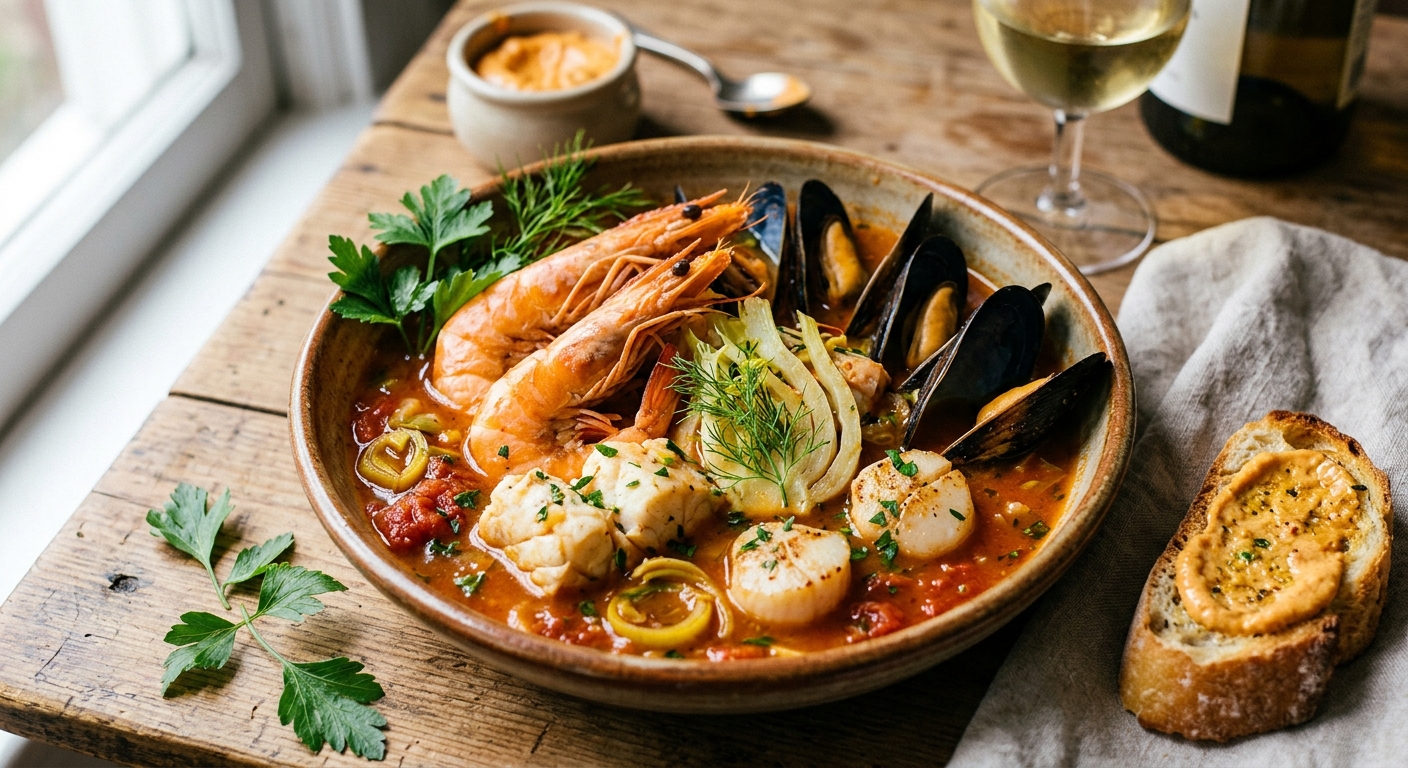
Bouillabaisse was born on the sun-bleached docks of Marseille, where fishermen simmered their unsold catch in seawater with wild fennel and whatever aromatics grew nearby. What began as working-class ingenuity became one of France’s most celebrated dishes, and from a nutritional standpoint, it may also be one of the most brilliantly engineered meals a human being can eat. Every ladleful delivers a cascade of ocean-sourced minerals that are nearly impossible to obtain in such concentration from land-based foods alone.
The secret lies in the seafood matrix itself. Mussels are among the richest dietary sources of manganese and selenium on the planet. Shrimp contribute extraordinary amounts of iodine and phosphorus. Firm white fish such as monkfish or halibut adds a complete essential amino acid profile alongside B12 levels that rival any supplement. The saffron-stained rouille-crowned broth, built on tomatoes, fennel, leek, and white wine, rounds out the dish with lycopene, quercetin, and vitamin C that enhance the bioavailability of the dish’s abundant non-heme iron.
At Calibrated Cuisine, we have reverse-engineered this Provencal classic to retain every gram of its nutritional power while honoring the technique that makes it genuinely spectacular to eat. We provide three distinct cooking methods, each tuned to how the seafood behaves under different heat conditions, so whether you are building flavor slowly on a Sunday afternoon or feeding four people on a Wednesday evening in under thirty minutes, your bouillabaisse will be both calibrated and extraordinary.
4
servings
Ingredients
- 300 gmonkfish fillet (or halibut), cut into 5cm chunks
- 300 gshell-on large shrimp, deveined
- 400 gfresh mussels, scrubbed and debearded
- 250 gsea scallops, patted dry
- 400 gcanned whole San Marzano tomatoes, crushed by hand
- 1 mediumfennel bulb, thinly sliced, fronds reserved
- 1 mediumleek (white and light green parts only), halved lengthwise and sliced
- 4 clovesgarlic, minced
- 1 mediumyellow onion, diced
- 240 mldry white wine (such as Picpoul de Pinet or Sauvignon Blanc)
- 750 mlfish stock or clam juice, low sodium
- 3 tbspextra-virgin olive oil
- 0.5 tspsaffron threads, lightly crumbled
- 1 tspsmoked paprika
- 1 tspfresh thyme leaves (or 0.5 tsp dried)
- 2 stripsfresh orange zest (each about 5cm long)
- 1 tbsptomato paste
- 1 tbspfresh flat-leaf parsley, finely chopped
- 4 slicescrusty sourdough baguette, toasted, for serving
- —Rouille (store-bought or homemade): 4 tbsp
- —Colima Sea SaltMicroplastic Free Salt and cracked black pepper to taste
Instructions
Click on an item below to shop for the recommended items for this recipe on Amazon.
As an Amazon Associate, we earn from qualifying purchases.
- Bloom the saffron: place the crumbled saffron threads in a small bowl with 3 tablespoons of warm (not boiling) fish stock. Let steep for at least 10 minutes while you prepare the aromatics. This releases the water-soluble crocin compounds and intensifies both color and flavor.
- Heat the olive oil in a large Dutch oven or heavy-bottomed pot over medium heat. Add the diced onion, sliced leek, and fennel. Season with a pinch of salt and cook, stirring occasionally, for 8 to 10 minutes until softened and lightly golden at the edges. Do not rush this step; the sweetness of the softened alliums forms the backbone of the broth.
- Add the minced garlic, tomato paste, smoked paprika, and thyme. Stir continuously for 90 seconds until the paste darkens slightly and smells fragrant. Pour in the white wine and scrape up any fond from the bottom of the pot. Let the wine reduce by half, about 3 minutes.
- Add the crushed tomatoes, the saffron with its steeping liquid, the remaining fish stock, and the orange zest strips. Bring to a gentle boil, then reduce to a lively simmer. Cook uncovered for 15 minutes to allow the broth to develop depth and the tomato acidity to mellow.
- Taste the broth and adjust salt and pepper. Add the monkfish chunks first (they take longest), submerging them in the broth. Simmer for 3 minutes. Add the shrimp and scallops and cook for 2 minutes more. Finally, add the mussels, increase heat slightly to medium-high, place the lid on, and steam for 3 to 4 minutes until all mussels have opened. Discard any that remain closed.
- Remove the orange zest strips. Ladle the bouillabaisse into wide, warmed bowls. Garnish with fresh parsley and reserved fennel fronds. Serve immediately with toasted sourdough baguette slices spread generously with rouille, and place a slice of rouille-topped toast directly in each bowl.
- The night before or up to 2 hours ahead, bloom the saffron in 3 tablespoons of warm fish stock and set aside. In a skillet over medium-high heat, warm the olive oil and saute the onion, leek, fennel, and garlic for 6 minutes until just softened and beginning to caramelize. Add the tomato paste, smoked paprika, and thyme and cook for 1 minute. Deglaze with the white wine and let it reduce for 2 minutes. This sauté step is essential for slow cooker bouillabaisse because the low heat environment cannot develop the Maillard flavor compounds that define the dish.
- Transfer the sauteed aromatics directly into the slow cooker insert. Add the crushed tomatoes, the saffron and its liquid, the remaining fish stock, and the orange zest strips. Stir to combine. Cover and cook on Low for 4 hours. The extended gentle heat will draw maximum flavor from the aromatics and marry the tomato and saffron in a way the stovetop cannot fully replicate.
- After 4 hours, remove the lid and taste the broth. Adjust seasoning with salt and cracked black pepper. Remove and discard the orange zest strips. Switch the slow cooker to High. Add the monkfish chunks, pressing them gently below the surface of the broth.
- After 8 minutes on High, add the shrimp, scallops, and mussels. Replace the lid quickly to trap steam. Cook on High for a further 12 to 15 minutes, checking at 12 minutes. The shrimp should be pink and opaque, the scallops just set, and all mussels open. Discard any closed mussels. Because slow cooker lids are tight-fitting, the steam environment is very effective at opening mussels without overcooking them.
- Ladle carefully into wide warmed bowls, making sure each serving has a balanced portion of all seafood types. Garnish with fresh parsley and fennel fronds. Serve with toasted sourdough and rouille on the side.
- Bloom the saffron in 3 tablespoons of warm fish stock for 5 minutes. Set the Instant Pot or electric pressure cooker to Saute mode on Medium heat. Add the olive oil, then the onion, leek, and fennel. Cook, stirring, for 5 minutes until softened. Add the garlic, tomato paste, smoked paprika, and thyme and stir for 1 minute. Pour in the white wine, scraping the bottom of the insert thoroughly to release any stuck bits. Deglaze completely; any residue can trigger a Burn warning under pressure.
- Add the crushed tomatoes, saffron with its steeping liquid, remaining fish stock, and orange zest strips. Stir to combine. Cancel Saute mode. Secure the lid and set the pressure valve to Sealing. Cook on Manual High Pressure for 5 minutes. The pressurized environment extracts maximum depth from the aromatics and melds the flavors in a fraction of the stovetop time.
- When the cook time ends, perform a quick pressure release by carefully switching the valve to Venting. Once the float valve drops, open the lid. The broth will be richly colored and aromatic. Remove the orange zest strips and taste for seasoning, adjusting salt and pepper as needed.
- Switch back to Saute mode on Medium heat and bring the broth to an active simmer. Add the monkfish chunks and cook for 3 minutes. Add the shrimp and scallops and cook for 2 minutes. Add the mussels, place the glass lid (if available) or a splatter screen on top, and cook for 3 to 4 minutes until all mussels open and the shrimp are fully pink. Discard any mussels that have not opened. The Saute function gives you the precise visual control needed to nail the final seafood timing.
- Cancel Saute mode immediately when the seafood is done to prevent carryover cooking. Ladle into warmed bowls, garnish with parsley and fennel fronds, and serve at once with rouille-topped toasted baguette.
Nutrition Breakdown
Per 1 serving (makes 4)
Vitamins & Minerals
% Daily Value based on a 2,000 calorie diet (FDA reference)
🧬 Essential Amino Acids
% of recommended daily intake (RDA) per serving
🛡 Antioxidant Profile
The Nutrition Science
The mineral density of bouillabaisse is rooted in the unique biochemistry of marine organisms. Shellfish such as mussels and shrimp bioaccumulate minerals from seawater at concentrations far exceeding those achievable in any terrestrial food source. Mussels, for instance, filter enormous volumes of mineral-rich water, concentrating manganese and selenium into their tissues at levels that make a single 100g portion a clinically meaningful selenium source. Selenium is a cofactor for glutathione peroxidase, the body’s premier intracellular antioxidant enzyme, and the 124% DV per serving in this dish provides robust substrate for that enzymatic system.
The combination of vitamin C from the tomatoes and fennel alongside the dish’s substantial non-heme iron content is nutritionally synergistic rather than coincidental. Vitamin C reduces ferric iron (Fe3+) to the ferrous form (Fe2+), which is the only form intestinal enterocytes can absorb via the divalent metal transporter DMT-1. Studies show that consuming as little as 25mg of vitamin C alongside a non-heme iron source can increase iron absorption by 67%. This dish provides both the iron and the vitamin C in the same bowl, engineered by a culinary tradition that understood the synergy intuitively long before biochemists articulated the mechanism. The olive oil further enhances the absorption of the fat-soluble carotenoids lycopene and astaxanthin, whose bioavailability from aqueous broth alone would be considerably lower.
Saffron deserves particular scientific attention. Its primary bioactive compounds, crocin, crocetin, and safranal, are carotenoid-class antioxidants with a growing evidence base in human clinical trials. A 2021 meta-analysis in the Journal of Affective Disorders found that saffron supplementation significantly reduced depressive symptoms compared to placebo, with the proposed mechanism involving serotonin reuptake inhibition similar to selective serotonin reuptake inhibitors. While a culinary dose of saffron is smaller than a therapeutic dose, regular dietary inclusion alongside a complete B12 and omega-3 profile, as found in this dish, provides a cumulative neurological benefit that positions bouillabaisse as a genuinely brain-supporting meal.
Pro Tips
- Never allow the broth to reach a rolling boil once seafood is added. A vigorous boil will cause the shrimp and scallops to seize and tighten within seconds. Maintain a brisk but controlled simmer to preserve the silky texture of each protein.
- For maximum saffron impact, crush the threads lightly between your fingers before steeping. The mechanical disruption breaks the stigma cells and releases the crocin more efficiently, giving you deeper color and flavor from the same quantity of saffron.
- The rouille is not optional garnish; it is a nutritional and emulsifying component. The egg yolk and garlic-based sauce adds fat-soluble vitamin E and allicin, and when stirred into the broth creates a richer, slightly thickened texture similar to how a traditional aioli finishes a Provencal fish stew.
Really intrigued by the mineral profile here, especially the iodine density from shellfish. I’m curious about the timing aspect though – would you recommend this as a recovery meal post-ride given the protein and mineral load, or does the broth-heavy nature make it less ideal for replenishing muscle glycogen on harder training days? I’ve found seafood-based meals tend to absorb slower than I need for that immediate post-workout window, but the micronutrient recovery angle might be worth experimenting with on my lower intensity days.
This is such a gorgeous mineral profile, and I’m honestly thinking about how incredible this could be for postpartum recovery too. The iodine and selenium from the shellfish are huge for thyroid support when hormones are all over the place, plus that protein and mineral density helps rebuild blood volume after birth. My question though: do you have the DHA content breakdown for the fish varieties used? I’m always hunting for omega-3 sources beyond salmon that also support infant brain development through breastmilk, and bouillabaisse seems like it could be a win on both fronts if it uses fatty fish. Also curious whether the saffron itself plays any role here beyond flavor, or if there are any
ooh carsten i love this question because honestly ive experimented SO much with seafood timing around my long runs. the broth base is actually perfect for recovery because youre getting both the easily absorbed minerals and sodium for rehydration, plus the protein helps with muscle repair. i usually save something this rich for a few hours post-run once my stomach settles, but the mineral density especially the selenium and zinc makes it one of my go-to anti-inflammatory meals after really hard efforts or back-to-back training days. the iodine is just a bonus for thyroid function when training stress is high. have you tried it post-workout yet or still experimenting with timing?