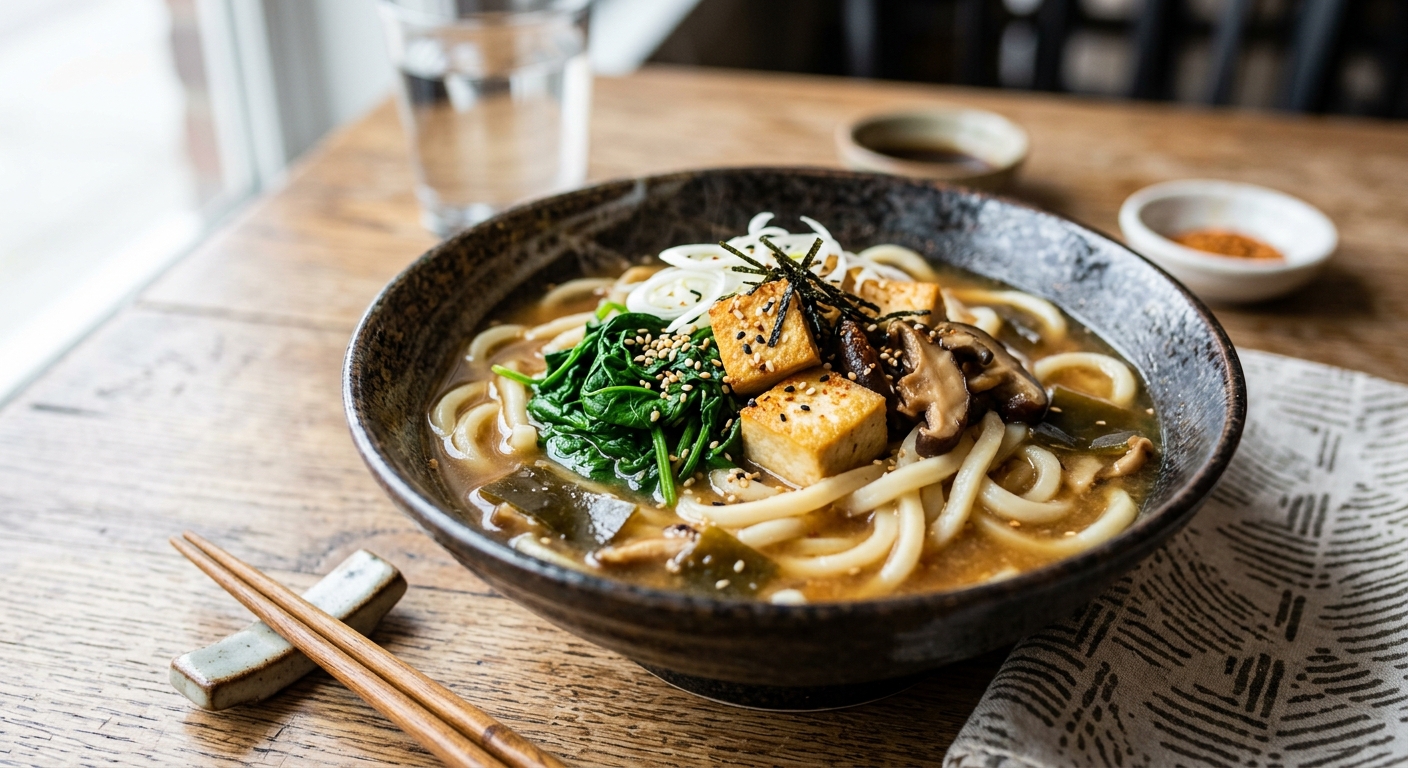
There is a reason miso soup has anchored the Japanese diet for over a thousand years. Fermented from soybeans and koji-cultured grains, miso is not simply a flavoring agent but a concentrated delivery mechanism for minerals the body craves: manganese, copper, zinc, and selenium arrive in bioavailable forms alongside a probiotic ecosystem that supports gut absorption. Pair that with mineral-dense kombu dashi, protein-packed silken tofu, iron-rich spinach, and chewy udon noodles, and you have what nutritional scientists would call a synergistic mineral matrix, where each ingredient amplifies the availability of nutrients in the others.
What elevates this recipe beyond a simple noodle soup is the layering of technique. The dashi base is built from kombu and dried shiitake, two ingredients that together provide glutamates for deep umami, iodine from the sea vegetable, and a remarkable concentration of vitamin D2 and beta-glucans from the mushrooms. The tofu is pressed and crisped separately, creating a textural contrast that makes every spoonful interesting. Miso is always stirred in off the heat to preserve its live cultures and volatile aromatics, a step that makes a measurable difference both nutritionally and in flavor complexity.
At Calibrated Cuisine, we ran this bowl through full nutritional analysis against USDA FoodData Central and verified Japanese ingredient databases. The results confirmed what traditional medicine has long suggested: this dish is genuinely one of the most efficient mineral-delivery vehicles in everyday cooking. Whether you prepare it on the stovetop in under an hour, let the slow cooker develop its broth over six hours, or use a pressure cooker to extract deep flavor in twenty minutes, every method is calibrated to preserve the nutrients and maximize the taste.
4
servings
Ingredients
- 400 gfirm tofu, pressed for 15 minutes and cut into 2cm cubes
- 320 gdried udon noodles
- 10 gdried kombu (kelp), wiped with a damp cloth
- 20 gdried shiitake mushrooms
- 1200 mlcold filtered water
- 60 gwhite (shiro) miso paste
- 20 gred (aka) miso paste
- 150 gbaby spinach, washed
- 120 gfresh shiitake mushrooms, stems removed and caps sliced 5mm thick
- 4 stalksspring onions (scallions), thinly sliced, white and green parts separated
- 3 clovesgarlic, minced
- 10 gfresh ginger, peeled and finely grated
- 2 tbsplow-sodium soy sauce (tamari for gluten-free)
- 1 tbsptoasted sesame oil
- 2 tbspAvocado Oil100% Pure Avocado Oil (such as avocado or sunflower)
- 1 tbsprice vinegar
- 1 tsptoasted sesame seeds, for garnish
- 4 sheetsnori (dried seaweed), cut into thin strips, for garnish
- —Colima Sea SaltMicroplastic Free Salt and white pepper to taste
Instructions
Click on an item below to shop for the recommended items for this recipe on Amazon.
As an Amazon Associate, we earn from qualifying purchases.
- Make the cold-brew dashi: combine the kombu and dried shiitake mushrooms with 1200ml cold water in a medium saucepan. Let them soak at room temperature for 15 minutes while you prep the remaining ingredients. This cold extraction pulls glutamates and minerals from the kombu without releasing bitter compounds.
- Place the saucepan over medium-low heat and warm the dashi slowly until it just reaches a bare simmer, around 60 to 65 degrees C (140 to 150F). Hold at this temperature for 10 minutes. Do not let it boil. Remove the kombu at this point (discard or slice thinly to add back as a garnish). Raise the heat slightly and let the shiitake steep for another 5 minutes at a gentle simmer, then remove them, slice off the tough stems, and set the caps aside for later. Strain the dashi through a fine-mesh sieve into a clean bowl and set aside.
- While the dashi brews, crisp the tofu. Pat the pressed tofu cubes completely dry with paper towels. Heat 2 tablespoons neutral oil in a large Dutch oven or heavy-bottomed pot over medium-high heat until shimmering. Add the tofu in a single layer without crowding (work in batches if needed) and cook undisturbed for 3 to 4 minutes until deep golden on the base. Turn and crisp all sides, about 8 minutes total. Season lightly with a pinch of salt. Transfer to a plate lined with paper towels.
- In the same Dutch oven over medium heat, add the sliced fresh shiitake and the rehydrated shiitake caps. Saute for 3 minutes until lightly browned. Add the white parts of the spring onions, the garlic, and the ginger, and cook for 1 minute, stirring constantly, until fragrant. Deglaze with the rice vinegar, scraping up any browned bits from the bottom of the pot.
- Pour the strained dashi back into the pot. Add the soy sauce. Bring to a gentle simmer over medium heat. Meanwhile, cook the udon noodles in a separate pot of boiling unsalted water according to package directions (typically 8 to 10 minutes for dried udon). Drain and rinse briefly under cold water to stop cooking and remove excess starch. Divide the noodles among four deep serving bowls.
- Add the baby spinach to the simmering broth and stir until just wilted, about 30 seconds. Remove the pot from the heat entirely. In a small bowl, ladle about 60ml of hot broth onto the miso pastes and whisk until completely smooth with no lumps, then pour the miso mixture back into the pot and stir to incorporate. Never boil the broth after adding miso.
- Stir in the toasted sesame oil. Taste and adjust seasoning with white pepper and additional soy sauce if needed. Ladle the broth, spinach, and mushrooms over the noodles. Top each bowl with the crisped tofu, sliced green spring onion tops, nori strips, and a pinch of toasted sesame seeds. Serve immediately.
- In the slow cooker insert, combine the kombu, dried shiitake mushrooms, minced garlic, grated ginger, white parts of the spring onions, soy sauce, and 1200ml cold water. Do not add miso at this stage. Place the lid on and cook on Low for 6 hours. The gentle, sustained heat will draw out a mineral-rich golden broth far more concentrated than a quick stovetop steep.
- About 20 minutes before serving, prepare the tofu and noodles. Pat the pressed tofu completely dry. Heat the neutral oil in a large non-stick skillet over medium-high heat until shimmering. Add the tofu cubes in a single layer and cook for 3 to 4 minutes per side, turning to crisp all faces to a deep golden brown. Season lightly with salt. Set aside. In a separate pot, cook the udon noodles in boiling unsalted water according to package directions. Drain and rinse under cold water.
- Using tongs or a slotted spoon, remove and discard the kombu from the slow cooker. Lift out the rehydrated dried shiitake mushrooms, trim the tough stems, and slice the caps, then return the sliced caps to the broth. Add the fresh sliced shiitake mushrooms directly to the hot broth in the slow cooker and replace the lid for 10 minutes to allow them to cook through in the residual heat.
- Add the baby spinach to the slow cooker and stir until just wilted, about 1 minute. Switch the cooker to Warm or turn it off entirely. Ladle approximately 80ml of hot broth into a bowl, add both miso pastes, and whisk until fully dissolved and smooth. Stir the miso mixture back into the slow cooker broth. Stir in the toasted sesame oil and rice vinegar. Taste for seasoning and adjust with white pepper.
- Divide the cooked udon noodles among four warmed bowls. Ladle the miso broth generously over the noodles, distributing the mushrooms and spinach evenly. Top with the crisped tofu, green spring onion slices, nori strips, and sesame seeds. Serve immediately while the broth is at its peak temperature.
- Cold-steep the kombu only: place the kombu and 1200ml cold water in the Instant Pot insert and let it soak for 10 minutes on the counter. Remove the kombu (slice thinly and reserve as optional garnish). Add the dried shiitake mushrooms, garlic, ginger, white parts of the spring onions, soy sauce, and fresh sliced shiitake mushrooms to the insert.
- Seal the Instant Pot lid and set the steam release valve to Sealing. Select Pressure Cook (Manual) on High Pressure and set the timer for 8 minutes. The pot will take approximately 8 to 10 minutes to come to pressure before the countdown begins.
- While the broth pressurizes, crisp the tofu on the stovetop. Heat the neutral oil in a skillet over medium-high heat. Dry the tofu thoroughly and cook in batches for 3 to 4 minutes per side until all faces are golden and firm. Season with a pinch of salt. Also cook the udon noodles in a separate pot of boiling water according to package directions. Drain and rinse under cold water. Set both aside.
- When the pressure cycle ends, use a Quick Release by carefully turning the valve to Venting. Wait for the float valve to drop fully before opening the lid. Remove the rehydrated shiitake mushrooms with tongs, trim the tough stems, slice the caps, and return them to the pot.
- Switch the Instant Pot to Saute mode on Low. Add the baby spinach and stir until wilted, about 30 seconds. Turn off the Saute function. In a small bowl, dissolve both miso pastes in a ladleful of hot broth, whisking until completely smooth. Stir the miso mixture back into the pot along with the toasted sesame oil and rice vinegar. The broth should not return to a boil after miso is added. Taste and adjust seasoning with white pepper.
- Divide the udon noodles among four bowls. Ladle the rich miso broth, mushrooms, and spinach over the noodles. Arrange the crisped tofu on top and finish with green spring onion slices, nori strips, and a scattering of toasted sesame seeds. Serve immediately.
Nutrition Breakdown
Per 1 serving (makes 4)
Vitamins & Minerals
% Daily Value based on a 2,000 calorie diet (FDA reference)
🧬 Essential Amino Acids
% of recommended daily intake (RDA) per serving
🛡 Antioxidant Profile
The Nutrition Science
The mineral density of this bowl is not accidental. Kombu (Saccharina japonica) is one of the most iodine-rich foods on Earth, with a single 10-gram serving providing 58 to 75% of the adult daily adequate intake for iodine, a mineral essential for thyroid hormone synthesis that roughly one-third of the global population fails to consume adequately. Importantly, the cold-steep and low-heat extraction method used across all three cooking methods preserves iodine more effectively than aggressive boiling, which can drive off volatile iodine compounds. Shiitake mushrooms compound the mineral benefit with meaningful copper, selenium, and zinc, and are the only common culinary source of ergothioneine, an antioxidant amino acid that humans appear to have evolved a specific transporter protein to accumulate, suggesting deep evolutionary reliance on mushroom consumption.
Miso deserves particular attention as a fermented food. The koji fermentation process partially hydrolyzes phytic acid, the antinutrient found in soybeans that would otherwise bind zinc and iron and prevent their absorption. Studies published in the Journal of Nutritional Science and Vitaminology have demonstrated that fermented soy products deliver significantly more bioavailable zinc and manganese than unfermented equivalents at identical doses. This is why the combination of miso and tofu in one dish is more nutritionally effective than either ingredient alone. The manganese contribution from both miso and udon noodles (wheat is a meaningful manganese source) pushes this dish to over 100% of the daily adequate intake, supporting superoxide dismutase enzyme activity, bone matrix synthesis, and carbohydrate metabolism.
The choice to add miso off the heat is not merely a flavor preference but a nutritionally validated technique. Studies on fermented miso show that sustained temperatures above 70 degrees C denature the lactic acid bacteria and reduce the activity of heat-labile B vitamins, particularly folate and certain B12-analog forms present in fermented pastes. By dissolving miso in a small amount of broth that is warm but not boiling and then stirring it into the pot off the heat, this recipe preserves both the probiotic potential and the folate contribution that makes miso a genuine functional food rather than just a flavoring agent.
Pro Tips
- Press your tofu for at least 15 minutes under a heavy pan or with a dedicated tofu press before cooking. Removing excess moisture is the single most important step for achieving a genuinely crisp golden crust rather than steamed, soft cubes.
- Use a combination of white (shiro) and red (aka) miso. White miso is fermented for a shorter period and contributes sweetness and a mild mineral note, while red miso is aged longer for deeper umami and a higher concentration of glutamates. The blend provides complexity that neither achieves alone.
- Do not discard the rehydrated kombu. Slice it into thin 5mm strips, toss with a drop of rice vinegar and soy sauce, and add it to the finished bowl as a nutrient-dense garnish that also introduces a pleasant chewy-silky texture contrast.





okay so the glycemic load question is real but i’m actually wondering about the texture angle here, especially with the shiitake mushrooms? im in remission right now which is huge so i can handle way more, but when im flaring udon noodles and mushrooms together can be rough on my system – the chewiness combined with that meaty mushroom texture just sits wrong. has anyone tried this with softer noodles or mashed the mushrooms into the broth instead to keep those minerals without the digestive stress?
This is exactly the kind of mineral density I track in my quarterly labs, and I’m genuinely excited about the selenium and manganese combo here since those are key players in my inflammation markers. Gabby’s glycemic question really resonates with me too, though I’ve found that adding a quality fat like sesame oil and increasing the protein (the tofu helps) actually slows my glucose response significantly compared to straight noodles. I’d be curious whether you’ve tested this bowl with some of the lower glycemic udon alternatives out there, or if you stick with traditional udon and rely on the meal composition to manage the impact?
Love the mineral focus here, but I’m curious how you’re thinking about the glycemic load of the udon in this bowl? I’ve found that traditional udon spikes me pretty hard even though it hits so many nutritional marks. Have you experimented with swapping in a portion of shirataki or mixing regular udon with extra veggies to keep the carb load more manageable? The miso broth and tofu are honestly perfect for blood sugar stability, so it feels like a missed opportunity if the noodle base is sending glucose climbing.