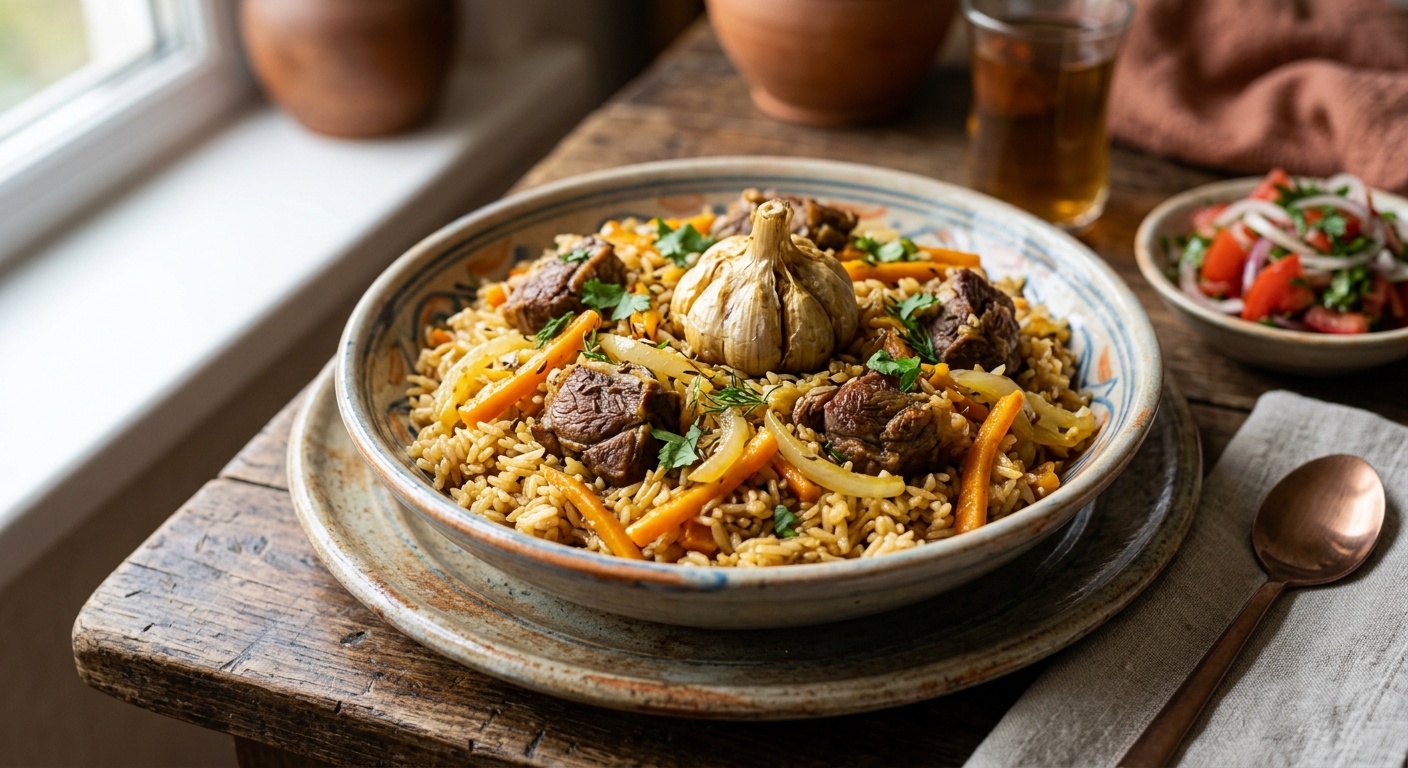
Plov is not merely a dish in Uzbekistan, it is a cultural institution. Prepared in a heavy kazan (cast-iron cauldron) over open flame for weddings and festivals, and simmered quietly on home stovetops every Friday across Tashkent, Samarkand, and Bukhara, this pilaf carries centuries of culinary refinement in every grain. The technique is deceptively precise: fat is rendered until smoky, aromatics are coaxed into deep sweetness, meat is bronzed rather than braised, and long-grain rice is steamed atop it all in a sealed vessel, absorbing every mineral-rich drop of zirvak (the foundational broth layer).
What makes Plov remarkable from a nutritional standpoint is the convergence of several iron-dense ingredients working in concert. Lamb shoulder provides highly bioavailable heme iron, the form your body absorbs at two to three times the rate of plant sources. Yellow carrots (traditional, though orange work beautifully) contribute beta-carotene alongside a modest non-heme iron contribution, while the cumin and coriander seeds used in authentic recipes are among the most iron-concentrated spices per gram in any global pantry. The olive and cottonseed oil traditionally used also support fat-soluble nutrient absorption throughout the meal.
At Calibrated Cuisine, we have stayed faithful to the authentic Fergana Valley method while ensuring every ingredient quantity is precisely documented so you know exactly what you are consuming. We use bone-in lamb shoulder for maximum mineral extraction into the zirvak, whole garlic heads for their sulfur compounds (which support iron absorption pathways), and a carefully measured spice blend that contributes real, measurable micronutrient value rather than mere flavoring. Whether you cook this in a heavy Dutch oven on the stovetop, set it in a slow cooker before work, or pressure-cook it for a weeknight dinner, the nutritional outcome is calibrated and consistent.
4
servings
Ingredients
- 500 gbone-in lamb shoulder, cut into 4cm chunks
- 300 glong-grain rice (devzira or basmati), rinsed until water runs clear and soaked 30 minutes
- 300 gcarrots, peeled and cut into 5mm julienne (not grated)
- 200 gyellow onions, halved and thinly sliced
- 1 whole headgarlic, outer papery skin removed but head left intact
- 3 tbspAvocado Oil100% Pure Avocado Oil (grapeseed or refined sunflower)
- 2 tspwhole cumin seeds
- 1 tspground coriander
- 1 tspsweet paprika
- 0.5 tspground turmeric
- 0.5 tspfreshly ground black pepper
- 2 wholedried red chillies (barberries optional alongside)
- 2 tbspdried barberries (zereshk), optional but recommended
- 600 mllow-sodium lamb or beef stock
- 1 tspColima Sea SaltMicroplastic Free Salt, plus more to taste
- —Colima Sea SaltMicroplastic Free Salt and black pepper to taste
Instructions
Click on an item below to shop for the recommended items for this recipe on Amazon.
As an Amazon Associate, we earn from qualifying purchases.
- Drain the soaked rice in a fine-mesh sieve and set aside. Pat the lamb chunks thoroughly dry with paper towels, season generously with salt and pepper, and leave at room temperature while you prepare the aromatics.
- Heat the oil in a large Dutch oven or heavy kazan over high heat until shimmering and just beginning to smoke, about 2 minutes. Add the lamb pieces in a single uncrowded layer (work in two batches if necessary) and sear without moving for 3 to 4 minutes per side until deeply bronzed. Transfer to a plate. The fond forming on the pot bottom is critical flavour; do not discard it.
- Reduce heat to medium-high. Add the sliced onions to the same pot and cook, stirring occasionally, for 8 to 10 minutes until they collapse and turn a deep amber gold. Add the cumin seeds and toast for 60 seconds until fragrant. Return the lamb to the pot, nestling it among the onions.
- Add the julienned carrots in an even layer directly on top of the lamb and onions. Do not stir. Pour in the stock, add the paprika, coriander, turmeric, dried chillies, and barberries if using. Bring to a boil, then reduce to a steady simmer and cook uncovered for 20 minutes to develop the zirvak. Season the broth carefully as it should taste slightly over-salted before the rice absorbs it.
- Using a slotted spoon, gently spread the drained rice in an even layer over the zirvak surface. Do not stir the rice into the meat layer below. Press the whole garlic head, root-end down, into the centre of the rice. Add just enough additional hot water or stock so the liquid sits 1 to 1.5cm above the rice surface. Bring back to a vigorous boil over high heat, uncovered, for 3 to 4 minutes until most surface liquid has absorbed.
- Reduce heat to the lowest possible setting, cover the pot tightly with a lid (place a clean kitchen towel under the lid to absorb steam and prevent drips), and steam undisturbed for 20 minutes. Remove from heat and rest, still covered, for 10 minutes. Uncover, remove the garlic head, and gently fold the layers together from the outside edges inward using a wide spatula, bringing the meat up through the rice. Serve immediately.
- In a large skillet over high heat, warm the oil until nearly smoking. Pat the lamb dry, season with salt and pepper, and sear in batches for 3 to 4 minutes per side until a deep brown crust forms. Transfer the seared lamb directly to the slow cooker insert.
- In the same skillet over medium-high heat, cook the sliced onions in the residual fat for 6 to 8 minutes until softened and amber. Add the cumin seeds, paprika, coriander, turmeric, and black pepper, stirring for 60 seconds. Deglaze the pan with 100ml of the stock, scraping up all browned bits, then pour the entire contents into the slow cooker over the lamb.
- Add the julienned carrots, dried chillies, barberries, the whole garlic head, and the remaining stock to the slow cooker. Stir gently to combine the zirvak layer. Cover and cook on Low for 3 hours 30 minutes, or until the lamb is nearly tender but not yet falling apart.
- After 3 hours 30 minutes, remove the lid and taste the zirvak broth. Adjust seasoning, remembering it should be slightly salty. Gently spread the drained and rinsed rice in an even layer over the surface of the meat and vegetables. Do not submerge or stir the rice into the lower layers. Add hot water in a thin stream around the edges if needed so the liquid level sits just at the top of the rice layer.
- Replace the lid and cook on Low for a further 90 minutes, or until the rice has fully absorbed the liquid and is tender but not mushy. Switch the slow cooker to Warm, rest for 10 minutes with the lid cracked slightly to release excess steam, then fold the layers together gently and serve.
- Set the Instant Pot or electric pressure cooker to Saute mode on High. Add the oil and heat for 2 minutes. Pat the lamb dry, season with salt and pepper, and sear in batches for 3 minutes per side until well browned. Remove and set aside. Do not skip this step as the Maillard compounds are irreplaceable for authentic flavour.
- Add the sliced onions to the pot and saute for 5 to 6 minutes, scraping the browned fond from the bottom continuously to prevent a burn warning. Add the cumin seeds, coriander, paprika, turmeric, and black pepper, and stir for 45 seconds. Return the seared lamb to the pot.
- Add the julienned carrots, dried chillies, barberries, whole garlic head, and stock. Stir gently to combine. Taste the liquid and season to a slightly saltier level than you want in the final dish. Cancel Saute mode.
- Without stirring the layers, carefully spoon the drained rice in an even layer over the surface of the zirvak. Gently press down with the back of a spoon so the rice is just touching the liquid but not submerged. Secure the lid, set the valve to Sealing, and cook on Manual High Pressure for 10 minutes.
- Allow a full natural pressure release for 15 minutes, then carefully turn the valve to Venting for any remaining pressure. Remove the lid, tilting it away from you. The rice should be perfectly steamed. Rest for 5 minutes, remove the garlic head, and fold the layers gently together with a wide spatula, bringing the lamb up through the rice before serving.
- Preheat your oven to 160C (325F). On the stovetop over high heat, warm the oil in your Dutch oven until smoking. Sear the seasoned lamb in batches for 3 to 4 minutes per side until deeply coloured, then transfer to a plate. Reduce heat to medium-high, add the onions, and cook for 8 minutes until amber.
- Add the cumin seeds to the onions and cook for 60 seconds, then add the paprika, coriander, turmeric, and pepper, stirring constantly for 30 seconds. Return the lamb to the pot, add the carrots, chillies, barberries, whole garlic head, and all the stock. Bring to a simmer on the stovetop and cook uncovered for 10 minutes to begin building the zirvak.
- Remove the pot from the heat briefly. Season the zirvak broth to a slightly over-salted level. Spread the drained rice carefully and evenly over the surface of the zirvak, pressing it gently down. Add hot water in a thin stream if necessary so the liquid level sits 1cm above the rice. Do not stir.
- Cover the Dutch oven with its lid, sealing it tightly. If your lid fits loosely, crimp a sheet of foil over the top of the pot before placing the lid on, which creates an airtight steam seal. Transfer to the preheated oven and bake for 50 minutes without opening the lid.
- After 50 minutes, remove from the oven and rest, still sealed, for 15 minutes on a heatproof surface. This rest is not optional as it allows the steam to redistribute and finish the rice from residual heat. Open the lid away from you, remove the garlic head, and use a wide spatula to fold the layers together gently before serving directly from the Dutch oven.
Nutrition Breakdown
Per 1 serving (makes 4)
Vitamins & Minerals
% Daily Value based on a 2,000 calorie diet (FDA reference)
🧬 Essential Amino Acids
% of recommended daily intake (RDA) per serving
🛡 Antioxidant Profile
The Nutrition Science
Iron in the human diet exists in two chemically distinct forms, and understanding the difference explains much of why Uzbek Plov is such an effective vehicle for mineral repletion. Heme iron, found exclusively in animal tissue like the lamb shoulder used here, is bound within a porphyrin ring structure that allows it to pass directly through intestinal enterocytes via the HCP1 transporter, achieving absorption rates of 15 to 35% regardless of competing dietary factors. Non-heme iron, present in the spices, carrots, and rice, is absorbed at only 2 to 8% under normal conditions, but this rate rises substantially in the presence of heme iron in the same meal, a phenomenon called the meat factor. A single serving of this Plov combines both forms, creating a synergistic absorption environment that makes the 7.6mg total iron figure far more bioavailable than that number alone suggests.
The zinc content of this dish deserves equal attention. Lamb is among the most concentrated dietary sources of zinc, providing a form similarly enhanced in bioavailability by the presence of animal protein. Zinc and iron share a common transporter (DMT1) and can compete when taken as isolated supplements, but from whole food sources within a protein-rich matrix this competition is clinically negligible. The cumin seeds used in authentic Plov are one of the most iron-dense spices by weight, contributing roughly 1.4mg of iron per teaspoon alongside manganese, which serves as a cofactor for superoxide dismutase, one of the body’s key antioxidant enzymes.
The fat content of Plov, traditionally higher using lamb tail fat (kurdyuk), plays a non-trivial nutritional role. The beta-carotene in carrots is a fat-soluble provitamin, meaning its conversion to vitamin A in the intestinal mucosa is dramatically enhanced in the presence of dietary fat. Research published in the American Journal of Clinical Nutrition demonstrates that consuming beta-carotene with as little as 3 to 5g of fat increases its absorption five-fold compared to fat-free consumption. The 18g of fat per serving in this recipe, primarily from the lamb and cooking oil, optimises this conversion pathway, turning the modest carrot component into a meaningful contributor to your vitamin A status alongside all the mineral benefits already described.
Pro Tips
- The julienne cut for carrots is not negotiable for authentic texture: grated carrot dissolves into the zirvak and turns mushy, while thick batons remain crunchy. Aim for 5mm wide, 5cm long matchsticks cut by hand with a sharp chef’s knife.
- Devzira rice, a thick brownish-red heritage grain from the Fergana Valley, is the most authentic choice and absorbs more liquid and flavour than basmati while retaining a firm, separate texture. It can be found at Central Asian or Middle Eastern grocery stores and is worth seeking out for its superior mineral content and texture.
- Never stir the rice into the zirvak layer before or during cooking. The whole philosophy of Plov is stratified cooking: the rice steams on top of the meat-broth layer, absorbing flavour and liquid from below while developing a slightly firm skin on top. Stirring breaks this architecture and produces a risotto texture rather than a true pilaf.
okay this looks amazing but im curious if youve ever experimented with adding mushrooms to plov? ive been incorporating dried porcini and shiitake into my rice dishes lately and theyre genuinely game changing for umami depth plus the beta glucans add another layer of nutritional support. the lamb fat would carry those earthy notes so well, and honestly dried mushrooms are super bioavailable for minerals like iron and zinc which would probably synergize nicely with what youre already getting from the meat and carrots. has anyone tried this variation or is it breaking too much traditional ground lol
oh man nadia i didnt even see your comment before i posted mine but YES exactly! the dried porcini especially has this umami richness that honestly complements lamb better than people realize, and you’re touching on something i think about constantly – those beta glucans in mushrooms actually help with mineral bioavailability so youre not just adding flavor, youre potentially helping your body absorb more of that iron and zinc from the dish overall. ive been experimenting with soaking my dried mushrooms in warm broth before adding them to the rice layer and it creates this insanely deep base flavor without any sodium concerns. the traditional recipe is obviously perfect on its own but i genuinely believe this is one of
This is such a smart addition, Mike – I’ve been experimenting with dried mushrooms in similar dishes too, and they’re incredible for layering flavor without adding sodium. What I love about your approach is that beta glucans actually have some emerging research around immune modulation, which matters for anyone managing inflammatory conditions like mine. Have you noticed whether the mushrooms change how your body absorbs the iron in the dish? I’m always curious if the umami depth affects mineral bioavailability, since the lamb fat and caramelized carrots in plov are already doing heavy lifting there.