
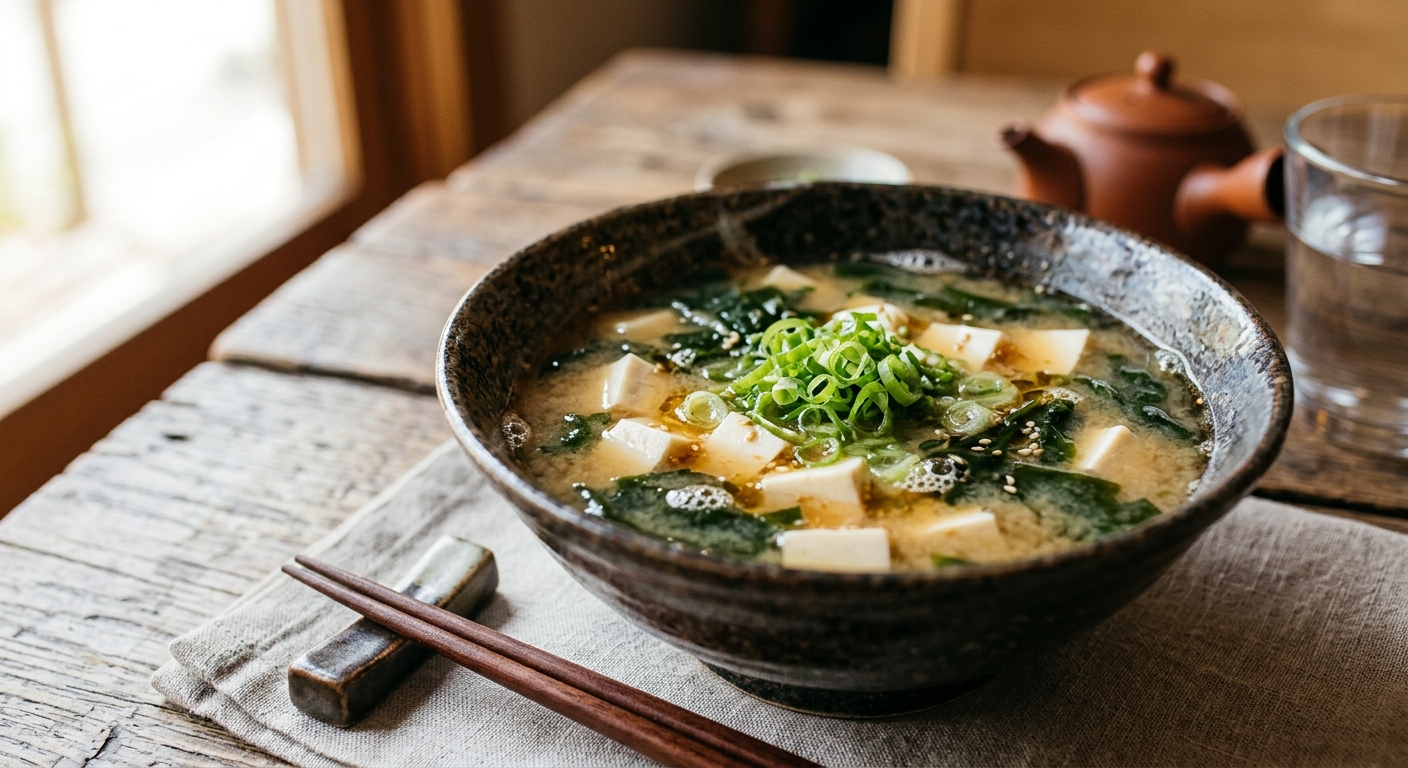
Miso soup is one of the most nutritionally dense low-calorie foods on the planet, and yet it is rarely given the scientific respect it deserves in Western kitchens. At its core, this recipe is a mineral delivery system: wakame seaweed contributes iodine, calcium, magnesium, and folate; silken tofu adds plant-based protein and bone-supporting calcium; and unpasteurized white miso paste brings a living colony of Aspergillus oryzae fermentation cultures that support gut microbiome diversity. Together, these three ingredients create a broth that is far more than the sum of its parts.
The foundation of any great miso soup is the dashi, a two-ingredient stock made from kombu (dried kelp) and katsuobushi (bonito flakes) that takes less than 15 minutes to prepare but delivers a glutamate depth that no bouillon cube can replicate. For a fully plant-based version, a kombu-only dashi still provides remarkable umami and retains all the iodine and mineral content. The critical technique that separates a good miso soup from a great one is temperature control: miso paste must never be boiled, as temperatures above 60 degrees Celsius destroy the live probiotic cultures and volatile aromatic compounds responsible for its signature savory complexity.
Each method in this recipe, whether stovetop, slow cooker, or pressure cooker, is engineered around that single rule. The dashi is always prepared gently, the miso is always dissolved off direct heat, and the tofu and wakame are added at the last possible moment to preserve their texture and nutrient integrity. What you get in the bowl is a soup that qualifies as a genuine functional food: anti-inflammatory, gut-supportive, thyroid-nourishing, and deeply, satisfyingly delicious.
4
servings
Ingredients
- 1200 mlcold filtered water
- 15 gdried kombu (kelp), wiped clean with a damp cloth
- 20 gkatsuobushi (bonito flakes), or omit for vegan dashi
- 60 gwhite shiro miso paste (unpasteurized, refrigerated)
- 300 gsilken tofu, cut into 1.5 cm cubes
- 12 gdried wakame seaweed
- 4 itemgreen onions (scallions), thinly sliced
- 1 tsptoasted sesame oil
- —Colima Sea SaltMicroplastic Free Salt to taste (miso is salty; taste before adding)
Instructions
Click on an item below to shop for the recommended items for this recipe on Amazon.
As an Amazon Associate, we earn from qualifying purchases.
- Place the kombu and 1200 ml cold water in a medium saucepan. Let the kombu cold-steep for a minimum of 10 minutes (or up to 30 minutes for a richer dashi). This cold infusion extracts glutamates without releasing bitter compounds that appear at higher temperatures.
- While the kombu steeps, place the dried wakame in a small bowl of cold water and soak for 5 to 8 minutes until fully rehydrated and tender. Drain, gently squeeze out excess water, and set aside. If the pieces are large, roughly chop them into bite-sized pieces.
- Set the saucepan over medium-low heat. Warm the kombu dashi slowly, watching closely. Just before the water reaches a full simmer (around 60 to 70 degrees Celsius, when small bubbles appear at the base but no rolling boil), use tongs to remove and discard the kombu. Do not boil the kombu or the dashi will turn bitter and slimy.
- If using katsuobushi, increase heat briefly to bring the dashi to a gentle simmer (around 80 degrees Celsius). Add the bonito flakes, stir once, and immediately remove the pan from heat. Allow the flakes to steep for 3 minutes, then strain the dashi through a fine-mesh sieve into a clean bowl. Return the strained dashi to the saucepan. Discard the spent bonito flakes.
- Bring the dashi back to a very gentle heat (do not boil). Add the silken tofu cubes carefully using a spoon to avoid breaking them. Warm through for 2 minutes.
- Remove the pan from heat entirely. In a small bowl, whisk 2 to 3 tablespoons of the hot dashi with the miso paste until fully smooth and lump-free, then pour this slurry back into the saucepan and stir gently to incorporate. Dissolving miso off direct heat is essential to preserve its live cultures and nuanced flavor.
- Add the rehydrated wakame, drizzle in the toasted sesame oil, and ladle immediately into warm bowls. Top with sliced scallions and serve at once.
- Place the kombu pieces and 1200 ml cold water in the slow cooker insert. Do not add miso, tofu, or wakame at this stage. Set the slow cooker to Low and cook for 4 hours. This long, low infusion draws out an extraordinary depth of iodine, glutamates, and minerals from the kombu without ever approaching a temperature that would release bitterness.
- About 15 minutes before serving, place the dried wakame in a bowl of cold water and soak for 5 to 8 minutes until rehydrated. Drain, squeeze gently, chop if needed, and set aside.
- After 4 hours, use tongs to remove and discard the kombu from the slow cooker. If using katsuobushi for a fuller dashi, add the bonito flakes directly to the hot liquid in the slow cooker, replace the lid, and steep on Warm for 5 minutes. Then strain the dashi through a fine-mesh sieve, return the liquid to the slow cooker on Warm, and discard the flakes. For vegan dashi, proceed directly to the next step.
- Switch the slow cooker to the Warm setting. Carefully lower the silken tofu cubes into the kombu dashi and let them warm through for 3 to 4 minutes. The Warm setting maintains a temperature around 70 to 74 degrees Celsius, perfect for heating the tofu without destroying the miso cultures you are about to add.
- Ladle approximately 80 ml of the warm dashi from the slow cooker into a small bowl. Add the miso paste and whisk vigorously until completely smooth and lump-free. Pour the miso slurry back into the slow cooker and stir gently. Add the rehydrated wakame and sesame oil. Stir once, ladle into warm bowls immediately, and top with sliced scallions.
- Place the kombu pieces and 1200 ml cold water in the pressure cooker or Instant Pot insert. Do not add miso, tofu, wakame, or scallions at this stage. Seal the lid and set to high pressure for 5 minutes. Note that the kombu dashi produced under pressure will be darker and more intensely flavored than a stovetop version, which is a desirable quality in this recipe.
- While the pressure cooker comes to pressure and cooks, rehydrate the wakame. Place the dried wakame in a bowl of cold water and soak for 5 to 8 minutes until tender. Drain, squeeze gently, chop into bite-sized pieces if needed, and set aside.
- Once the cook time is complete, perform a quick pressure release (QR) by carefully moving the valve to the venting position. When all pressure has been released and the float valve drops, open the lid. Use tongs to remove and discard the kombu. If using katsuobushi, add the bonito flakes to the hot dashi, replace the lid (do not seal, just rest it on top), and steep for 3 minutes using residual heat only. Strain through a fine-mesh sieve and discard the flakes.
- Switch the Instant Pot to the Saute function on the lowest setting (or use the Keep Warm function if available). Add the silken tofu cubes and allow them to warm in the dashi for 2 minutes. Check the temperature with an instant-read thermometer if possible; you want the liquid around 65 to 70 degrees Celsius, not simmering.
- Cancel the Saute function. Ladle approximately 80 ml of the warm dashi into a small bowl and whisk the miso paste into it until fully dissolved. Pour the slurry back into the pot, add the rehydrated wakame, drizzle with sesame oil, and stir gently. Ladle immediately into bowls, garnish with scallions, and serve.
Nutrition Breakdown
Per 1 serving (makes 4)
Vitamins & Minerals
% Daily Value based on a 2,000 calorie diet (FDA reference)
🧬 Essential Amino Acids
% of recommended daily intake (RDA) per serving
🛡 Antioxidant Profile
The Nutrition Science
The probiotic story of miso centers on the koji mold Aspergillus oryzae, which is cultivated on rice or barley and used to inoculate soybeans for fermentation. During the weeks-to-months-long fermentation process, koji enzymes break down soy proteins into free amino acids, including glutamic acid, which is directly responsible for miso’s intense umami flavor. The resulting paste also contains viable probiotic microorganisms, primarily lactic acid bacteria such as Lactobacillus and Pediococcus species, which studies suggest contribute to gut microbiome diversity, immune modulation, and improved intestinal barrier function. This is why temperature control during cooking is not a culinary preference but a nutritional imperative: above 60 degrees Celsius, these cultures begin to die off rapidly.
Wakame (Undaria pinnatifida) is one of the most mineral-concentrated edible plants available. Just 3 grams of dried wakame contributes meaningful amounts of iodine, which is essential for thyroid hormone synthesis (T3 and T4), as well as calcium, magnesium, and folate. Its signature green pigmentation comes from chlorophyll, but its most scientifically interesting compound is fucoxanthin, a xanthophyll carotenoid unique to marine brown algae. Fucoxanthin has been studied for its ability to activate thermogenesis in white adipose tissue and its potent anti-inflammatory activity via inhibition of NF-kB signaling pathways. Rehydrating dried wakame in cold water rather than hot water preserves these heat-sensitive bioactive compounds.
Silken tofu contributes a complete protein source with all nine essential amino acids, derived from the soybean. Soy protein is one of the few plant proteins with a Protein Digestibility Corrected Amino Acid Score (PDCAAS) equal to animal protein (approaching 1.0). The isoflavones genistein and daidzein in tofu are phytoestrogens that bind weakly to estrogen receptors and also function as direct antioxidants, donating hydrogen atoms to neutralize free radicals. Current evidence from large cohort studies in Asian populations suggests regular consumption of traditional soy foods is associated with reduced incidence of cardiovascular events and improved bone mineral density, effects attributed to both the isoflavone content and the calcium bioavailability of the soy protein matrix.
Pro Tips
- Never boil the soup after adding miso paste. Even a brief rolling boil will kill the probiotic cultures and volatilize the delicate aromatic compounds that give white miso its sweet, savory complexity. Dissolve miso in a small amount of hot (not boiling) dashi first, then stir the slurry into the pot off heat.
- Source refrigerated, unpasteurized white (shiro) miso for maximum probiotic benefit. Shelf-stable miso in foil packets has typically been pasteurized and contains no live cultures. Check the label for the words ‘live cultures’ or ‘unpasteurized’, or purchase from a Japanese grocery store where refrigerated miso is standard.
- Do not discard the spent kombu after making dashi. Slice it into thin strips, toss with a small amount of rice vinegar, soy sauce, and sesame seeds, and serve as a mineral-dense side salad. The kombu has already released most of its iodine into the dashi but retains its fiber, alginate, and a residual mineral content worth eating.


omg wait so does anyone know if the wakame iodine is still bioavailable after rehydrating, or does some of it leach into the soaking water? asking because im trying to get my oldest to absorb more iodine without just relying on iodized salt, and i’ve been curious if i should be drinking that soaking liquid too or if thats wasteful! also lorraine makes such a good point about the histamine load – my youngest actually struggles with that so ive been exploring whether theres a way to get those probiotic benefits from something lower histamine, or if thats just not realistic with fermented foods lol
Oh Felipe, that’s such a sweet memory! I do want to gently flag though that miso is fermented, which means it’s naturally high in histamine – so while those probiotic cultures are amazing for most people, anyone with mast cell issues or histamine intolerance might need to be cautious here. If that applies to you or anyone reading, I’ve had good luck with a lower-histamine miso alternative like chickpea miso (less fermentation time), or doing a quick dashi with kombu and bonito for that same umami and mineral boost without the fermented component. The wakame and tofu are still fantastic choices though!
oh man this is hitting so close to home, my vó used to make a simpler version with just miso and whatever greens she had but the science of whats actually happening in that bowl is wild, right? the live cultures in the miso are literally reshaping your gut bacteria and then the iodine from wakame is working WITH that thriving microbiome to help your thyroid do its thing – its not just soup its like a little biological reset button, i started doing fermented broths in my workshops and people are always shocked when they learn the warm factor matters for keeping those probiotics viable so im wondering do you have tips on tempering the miso at the end to preserve those cultures or does most