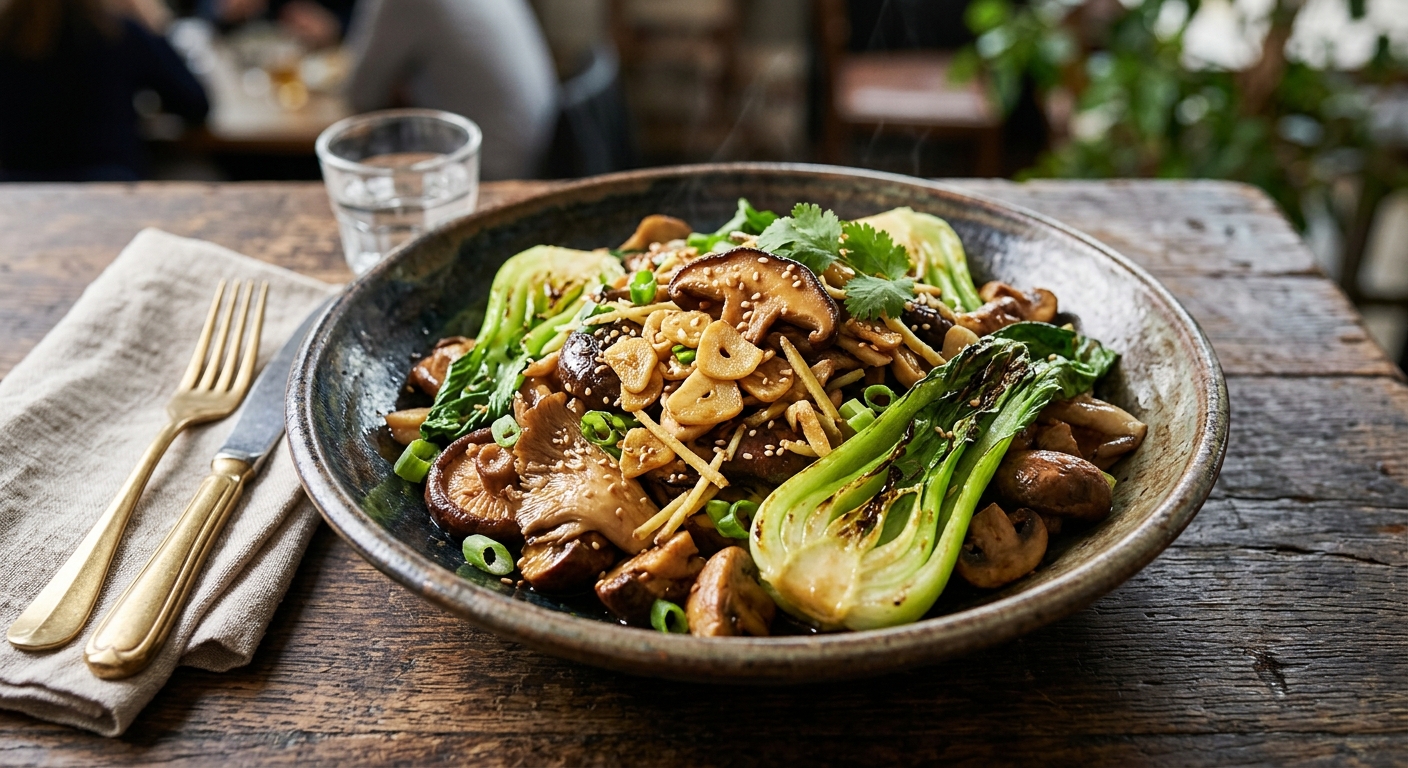
Germanium is one of nutrition’s most quietly fascinating trace elements. While it is not yet classified as an essential nutrient with a formal dietary reference intake, organic germanium compounds found naturally in garlic, shiitake mushrooms, and certain root vegetables have attracted scientific attention for their potential role in oxygen utilisation at the cellular level and immune modulation. Unlike inorganic germanium compounds (which are toxic and found in some supplements), the organic forms present in whole foods are considered safe and are consumed routinely in traditional East Asian diets, where shiitake mushrooms and garlic feature prominently. This stir-fry leans into that culinary tradition deliberately, combining the foods with the highest documented organic germanium content into a single, cohesive dish.
Beyond the germanium story, this recipe is a mineral powerhouse in the most conventional sense. Shiitake mushrooms are among the best dietary sources of copper, providing over 40% of your daily value per serving. Cremini mushrooms contribute meaningful selenium, an antioxidant mineral most people fall short on. Oyster mushrooms add zinc and ergothioneine, a unique antioxidant amino acid that human tissue actively transports and concentrates, suggesting a biological role we are only beginning to understand. Garlic brings organosulfur compounds and manganese, while the addition of bok choy layers in calcium, vitamin K, and vitamin C. Together, these ingredients create a nutritional matrix that is genuinely difficult to replicate with a simpler recipe.
Technique matters enormously here. High-heat stovetop cooking in a wok or cast-iron skillet is the gold standard, producing the Maillard browning that transforms raw mushrooms into something deeply savoury. But we have also developed a slow cooker version that concentrates flavours into a rich, braise-style sauce ideal for meal prep, and a pressure cooker method that delivers deeply infused, silky mushrooms in under 20 minutes. Each approach is genuinely different, and each is genuinely delicious. Serve over brown rice, soba noodles, or cauliflower rice depending on your carbohydrate goals.
4
servings
Ingredients
- 250 gshiitake mushrooms, stems removed, caps sliced 1cm thick
- 200 gcremini (chestnut) mushrooms, quartered
- 150 goyster mushrooms, torn into large pieces
- 10 clovesgarlic, thinly sliced
- 20 gfresh ginger, peeled and finely julienned
- 300 gbok choy, halved lengthwise and washed
- 3 tbsplow-sodium tamari or soy sauce
- 1 tbsptoasted sesame oil
- 2 tbspAvocado Oil100% Pure Avocado Oil or other high-smoke-point oil
- 1 tbsprice vinegar
- 1 tspraw honey or pure maple syrup
- 120 mllow-sodium vegetable broth
- 1 tspcornstarch
- 2 stalksspring onions, finely sliced, for garnish
- 1 tbspwhite sesame seeds, toasted, for garnish
- —Colima Sea SaltMicroplastic Free Salt and white pepper to taste
Instructions
Click on an item below to shop for the recommended items for this recipe on Amazon.
As an Amazon Associate, we earn from qualifying purchases.
- Whisk together the tamari, rice vinegar, honey, vegetable broth, and cornstarch in a small bowl until the cornstarch is fully dissolved. Set the sauce aside near the stove so it is ready the moment you need it.
- Heat your wok or large cast-iron skillet over the highest heat your burner allows for 2 full minutes until the surface begins to smoke lightly. Add the avocado oil and swirl to coat. The pan must be screaming hot before any ingredients go in, or the mushrooms will release water and stew rather than sear.
- Add the shiitake mushrooms in a single layer. Do not stir for 90 seconds, allowing a deep golden crust to form on the cut face. Toss once, let sit another 60 seconds, then transfer to a plate. Working in two more batches, repeat with the cremini mushrooms and then the oyster mushrooms, adding a tiny drizzle of oil between batches only if the pan looks completely dry. Transfer each batch to the holding plate.
- Reduce heat to medium-high. Add the remaining avocado oil, then add the garlic slices. Spread them into a single layer and let them sizzle, undisturbed, for 45 to 60 seconds until the edges turn pale gold. Add the ginger and toss continuously for another 30 seconds until fragrant. Watch carefully as the garlic can go from golden to bitter in seconds at this temperature.
- Return all the seared mushrooms to the wok and toss to combine with the garlic and ginger. Pour the sauce mixture over the mushrooms, stirring constantly as it hits the hot pan. The cornstarch will thicken the sauce in about 30 to 45 seconds, coating every piece in a glossy, savoury glaze.
- Nestle the bok choy halves into the mushroom mixture, cut side down. Cover the wok with a lid or a large baking sheet for 90 seconds, allowing the steam to wilt the bok choy without fully cooking it through. Remove the lid, toss everything together, and check seasoning. Add white pepper and a pinch of salt if needed. Drizzle with toasted sesame oil, toss once more, and remove from heat immediately.
- Transfer to a warm serving platter, scatter spring onion slices and toasted sesame seeds over the top, and serve at once over brown rice or soba noodles.
- In the slow cooker insert, combine the tamari, rice vinegar, honey, and vegetable broth. Stir until the honey is dissolved. Do not add the cornstarch yet as it will not thicken properly during slow cooking.
- Add the shiitake, cremini, and oyster mushrooms to the insert. Scatter the sliced garlic and julienned ginger evenly over the mushrooms. Toss gently to coat everything in the liquid. Do not add the avocado oil or sesame oil at this stage as fat does not contribute to slow-cooker flavour development in the same way it does over direct heat.
- Place the lid on the slow cooker and cook on Low for 3 hours 40 minutes. The mushrooms will shrink significantly and release their own liquid, creating a deep, concentrated braising broth. Avoid lifting the lid during this period as each peek adds approximately 15 minutes to the cooking time.
- When the timer reaches 20 minutes remaining, nestle the bok choy halves into the mushroom mixture, pressing them gently beneath the surface of the liquid. Replace the lid and continue cooking on Low for the final 20 minutes. The bok choy will soften while retaining its bright green colour.
- In a small bowl, whisk the cornstarch with 2 tablespoons of cold water to make a slurry. Switch the slow cooker to High, stir the slurry into the mushroom mixture, and leave uncovered for 10 minutes, stirring once halfway through, until the sauce thickens to a glossy consistency.
- Drizzle the toasted sesame oil over the finished dish and stir gently. Taste and adjust seasoning with white pepper and a small pinch of salt. Serve directly from the insert, garnished with spring onions and sesame seeds. This version is excellent for meal prep and reheats very well over 3 days.
- Select the Saute function on your Instant Pot or electric pressure cooker and set it to High. Once the display reads Hot, add the avocado oil. Add garlic slices in a single layer and saute for 60 to 90 seconds, stirring just once or twice, until fragrant and lightly golden at the edges. Add the ginger and stir for 30 seconds more.
- Add all three varieties of mushrooms to the pot at once. Stir to coat in the oil and aromatics, then spread into an even layer. Allow the mushrooms to sit undisturbed for 2 minutes, using the residual heat from the saute mode to develop some colour on the bottom layer. Stir once, then cancel the Saute function.
- Pour in the vegetable broth and tamari. Stir in the rice vinegar and honey. Do not add cornstarch or sesame oil at this stage. Secure the lid, ensuring the pressure valve is set to Sealing. Select Manual or Pressure Cook on High pressure and set the timer for 5 minutes.
- When the cooking cycle ends, perform a Quick Release by carefully switching the valve to Venting. Once all steam has escaped and the float valve has dropped, open the lid away from you. The mushrooms will be deeply tender and fragrant, sitting in a rich broth.
- Select Saute mode again on Medium or Normal. In a small bowl, whisk the cornstarch with 2 tablespoons of cold water, then stir the slurry into the pot. Add the bok choy halves, nestling them into the liquid. Cook, stirring occasionally, for 3 to 4 minutes until the sauce thickens and the bok choy is just wilted but still vibrant green.
- Cancel Saute, drizzle sesame oil over the dish, and toss gently. Taste and correct seasoning. Serve immediately over brown rice or noodles, topped with spring onions and sesame seeds.
- Preheat your oven to 220C (425F) with the fan on if available. Line two large rimmed baking sheets with parchment paper. Spread the shiitake, cremini, and oyster mushrooms across both sheets in a single layer, keeping space between pieces. Crowding is the enemy of roasting as it causes steaming instead of browning.
- Drizzle the avocado oil evenly over the mushrooms and season with fine sea salt and white pepper. Scatter the garlic slices and ginger over the mushrooms on the sheets. Toss everything directly on the baking sheets with your hands to coat, then redistribute into a single layer. The garlic and ginger will toast alongside the mushrooms, developing a sweeter, more mellow character than in the stovetop version.
- Roast in the hot oven for 15 minutes, then remove the sheets and use a thin metal spatula to flip the mushrooms. Redistribute any garlic that has migrated to the edge back toward the centre. Return the sheets to the oven and roast for another 12 to 15 minutes until the mushrooms are deeply golden, slightly crisped at the edges, and reduced to roughly half their original volume.
- While the mushrooms are in their final roasting phase, prepare the sauce on the stovetop. In a small saucepan over medium heat, combine the tamari, rice vinegar, honey, and vegetable broth. Bring to a gentle simmer, then whisk in the cornstarch slurry (cornstarch mixed with 2 tablespoons cold water). Cook, stirring constantly, for 2 to 3 minutes until the sauce is glossy and thick enough to coat a spoon. Remove from heat and stir in the sesame oil.
- Remove the roasted mushroom sheets from the oven. Arrange the bok choy halves cut side down on one of the now-partially-cleared baking sheets, nestling them among the mushrooms. Return that sheet to the oven for 4 to 5 minutes just until the bok choy is slightly wilted at the base but the leaves remain green.
- Transfer all roasted mushrooms and bok choy to a large bowl. Pour the prepared sauce over the top and toss gently to coat every piece. The sauce will cling beautifully to the caramelised mushroom surfaces. Taste and adjust seasoning, then serve immediately over your grain of choice, garnished with spring onions and sesame seeds.
Nutrition Breakdown
Per 1 serving (makes 4)
Vitamins & Minerals
% Daily Value based on a 2,000 calorie diet (FDA reference)
🧬 Essential Amino Acids
% of recommended daily intake (RDA) per serving
🛡 Antioxidant Profile
The Nutrition Science
Organic germanium in food is found predominantly as germanium-132 (carboxyethylgermanium sesquioxide) and related organo-germanium complexes, most concentrated in shiitake mushrooms (estimated 800 to 2000 parts per billion dry weight), garlic (estimated 750ppb), and ginseng. Unlike the inorganic germanium dioxide used in some industrial supplements, which has been associated with nephrotoxicity, these food-form organic compounds are excreted rapidly and have not been linked to adverse effects in the scientific literature at dietary exposure levels. Proposed mechanisms of action include facilitation of electron transfer in mitochondrial respiratory chains and enhancement of natural killer cell activity, though clinical evidence in humans remains preliminary and further rigorous trials are needed before any therapeutic claims can be made.
The copper content of this dish is where the nutritional science becomes unambiguous. Shiitake mushrooms are among the top five dietary sources of copper in the human diet, and copper is essential for a remarkable range of physiological functions, including the activity of cytochrome c oxidase (the terminal enzyme of the mitochondrial electron transport chain), superoxide dismutase (the primary intracellular antioxidant enzyme), and lysyl oxidase (which crosslinks collagen and elastin in connective tissue). A single serving of this stir-fry approaches the full daily recommended intake for copper, making it exceptional for a single dish. Importantly, the vitamin C from bok choy does not significantly impair copper absorption at these food-form concentrations, contrary to older in vitro research that used pharmacological doses.
Ergothioneine deserves special attention as it represents a genuinely novel area of nutritional science. Humans and other animals possess a dedicated transporter protein (OCTN1, encoded by the SLC22A4 gene) that actively imports ergothioneine from food into tissues, concentrating it in metabolically active organs including the liver, kidneys, bone marrow, and lens of the eye. The existence of this dedicated transporter, which is evolutionarily conserved across many species, strongly implies a biologically important function that we have not yet fully characterised. Current hypotheses centre on mitochondrial protection and heavy metal chelation. Oyster and shiitake mushrooms provide the highest food-form ergothioneine concentrations known, typically 10 to 40mg per 100g dry weight, which makes this stir-fry one of the most meaningful dietary sources available outside of a supplement.
Pro Tips
- Never wash mushrooms under running water; instead wipe them with a dry paper towel or a barely damp cloth. Mushrooms absorb water rapidly and wet mushrooms will steam rather than brown, regardless of how hot your pan is.
- Slice the garlic thinly rather than mincing it for the stovetop and oven methods. Thin slices develop golden, almost chip-like edges that add textural contrast and a sweeter, less pungent flavour than minced garlic, which burns more easily at high heat.
- For maximum organic germanium retention, avoid cooking mushrooms at very high temperatures for extended periods. The stovetop method sears quickly and the pressure cooker uses moist heat at lower effective temperatures, both of which preserve heat-sensitive organosulfur and organogermanium compounds better than prolonged roasting.
- To make this dish suitable for those avoiding soy, substitute the tamari with coconut aminos (use 4 tablespoons instead of 3, as coconut aminos are less salty) and verify your vegetable broth is soy-free.
- Dried shiitake mushrooms, reconstituted in warm water for 30 minutes, contain significantly higher concentrations of ergothioneine and B vitamins than fresh shiitake per gram of cooked weight, and can be substituted for up to half the fresh shiitake in any method. Reserve the soaking water and add it to the broth for an umami intensity upgrade.


This looks amazing and I love how you’re highlighting the mineral profile, especially since so many people overlook how cooking method matters here! Quick question: are you cooking those mushrooms at higher heat to help break down their cell walls and increase bioavailability of the selenium and copper, or keeping it gentler? I’ve found that shiitakes in particular respond really well to a good sear before the stir-fry. Also curious if you’re including any of those greens raw or lightly cooked, since I’m always balancing the goitrogenic factor in my own thyroid support kitchen, and this combo of garlic, ginger, and minerals sounds like exactly the kind of synergistic meal that
yo this is perfect timing for me post WOD recovery honestly. the mushroom variety here is key because youre getting different micronutrient profiles all at once, and paired with the garlic and ginger which are both legit anti-inflammatory? thats chef’s kiss for managing soreness. im curious though if youre sauteing these in any particular fat because that matters for mineral bioavailability, especially with the selenium and zinc absorption. ive been timing my stir fries right after strength days and the combo of complete carbs plus these minerals seems to hit different for glycogen repletion and inflammation management compared to just loading protein.
Love that you’re bringing up cooking method, Tammy! Higher heat definitely helps break down those tough fungal cell walls and makes compounds like ergothioneine more bioavailable, plus it concentrates that umami flavor. I actually recommend my clients sauté their mushrooms hot and fast to get that nice browning rather than steaming them, since you’re also reducing water content which means more mineral density per bite. The garlic roasting is perfect for this too because it mellows out the sulfur compounds while keeping those selenium and germanium benefits intact.