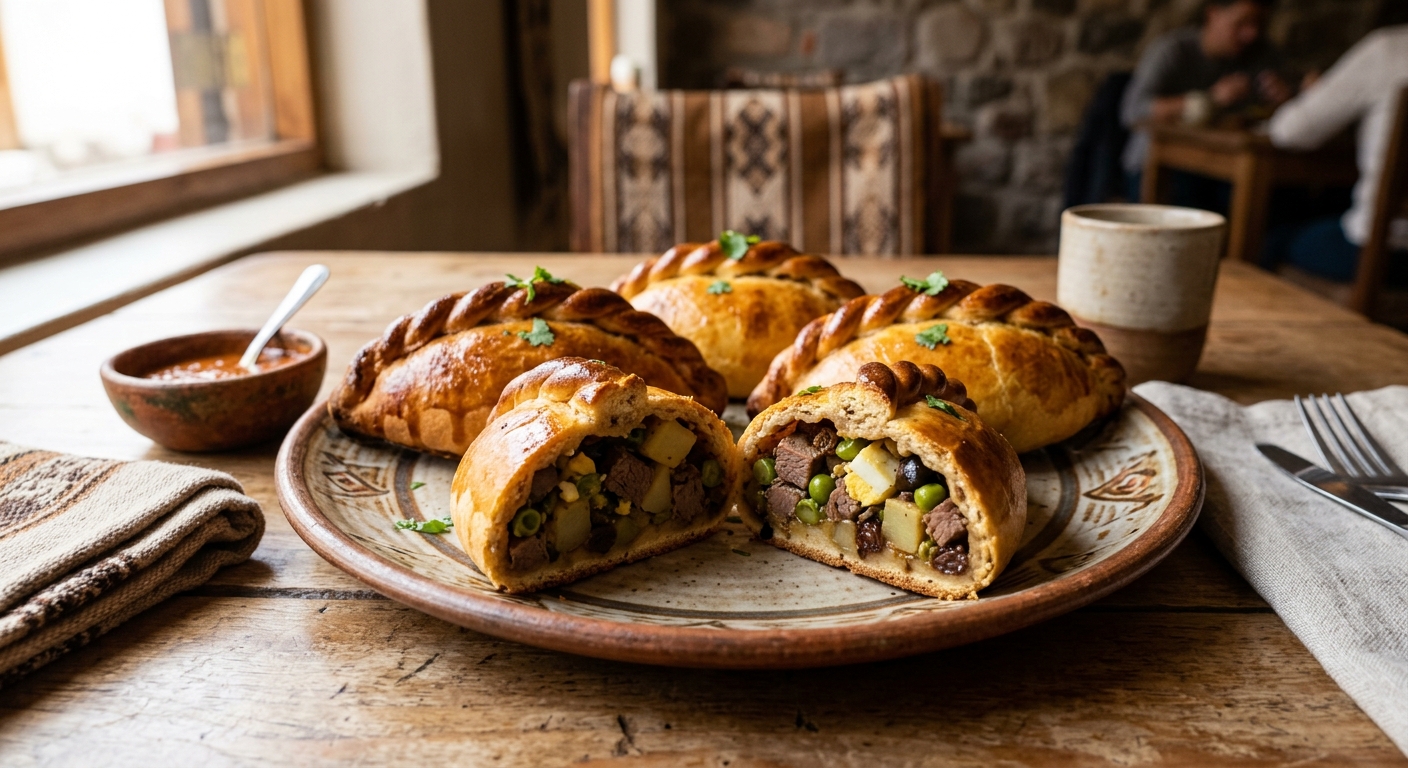
In the cobblestone markets of Sucre and the bustling morning streets of La Paz, salteñas are far more than breakfast. They are a cultural institution, sold from woven baskets by salteñeras who start baking before dawn so the pastries are ready precisely at mid-morning, when Bolivians pause work for what is arguably the world’s most satisfying snack. The defining characteristic of an authentic salteña is its jigote, a slow-cooked, gelatinous filling so abundantly saucy that eating one without dribbling on yourself is considered a local art form. That gelatin, rendered from a long-simmered beef stock, is also the secret to the dish’s exceptional nutrient density.
From a nutritional standpoint, salteñas are a remarkable convergence of high-bioavailability iron sources. Lean beef chuck provides heme iron, the form your body absorbs at rates of 15 to 35%, while the accompanying peas, potatoes, and the small amount of raisin contribute non-heme iron whose absorption is simultaneously boosted by the aji amarillo pepper’s generous vitamin C content. The egg yolk adds a complementary hit of choline and vitamin D, and the dough itself, enriched with lard or butter and a touch of turmeric-derived annatto, supplies fat-soluble vitamins that further enhance mineral uptake. Every bite is a calibrated nutritional event.
This recipe gives you three paths to the filling: a traditional low-and-slow stovetop braise that builds the deepest flavour through evaporation and fond development; a slow cooker method that produces the most gelatinous jigote with zero supervision; and a pressure cooker method that collapses the process to under 40 minutes without sacrificing the unctuous texture. The oven method, included as the fourth option, focuses on what all methods share: baking the assembled pastries to a deep mahogany finish with a lacquered egg-wash glaze. Choose your filling method, then follow the oven steps to bring it all together.
4
servings
Ingredients
- 500 glean beef chuck, cut into 1cm dice
- 250 gwaxy potatoes (e.g. Yukon Gold), peeled and cut into 1cm dice
- 120 gfrozen green peas, thawed
- 3 largeeggs (2 hard-boiled for filling, 1 beaten for egg wash)
- 60 gpitted black olives, quartered
- 40 graisins
- 1 mediumyellow onion, finely diced
- 2 clovesgarlic, minced
- 2 tbspaji amarillo paste (or 1 tsp cayenne plus 1 tsp sweet paprika as substitute)
- 1 tspground cumin
- 1 tspdried oregano
- 0.5 tspsweet paprika
- 1 tbsptomato paste
- 360 mlrich beef stock (preferably homemade or low-sodium)
- 1 tbspunflavoured powdered gelatin (or 2 sheets leaf gelatin)
- 2 tbspAvocado Oil100% Pure Avocado Oil
- 400 gall-purpose flour, plus extra for dusting
- 120 gcold lard or unsalted butter, cubed
- 1 tspColima Sea SaltMicroplastic Free Salt (for dough)
- 1 tbspwhite sugar
- 0.5 tspannatto powder (or turmeric for colour)
- 120 mlcold water
- —Colima Sea SaltMicroplastic Free Salt and freshly ground black pepper to taste
Instructions
Click on an item below to shop for the recommended items for this recipe on Amazon.
As an Amazon Associate, we earn from qualifying purchases.
- Hard-boil 2 eggs: place in cold water, bring to a boil, cook for 10 minutes, then transfer to an ice bath. Peel and chop into rough 1cm pieces. Set aside. Begin the dough: whisk together the flour, 1 tsp salt, sugar, and annatto powder in a large bowl. Cut in the cold lard or butter using your fingertips or a pastry cutter until the mixture resembles coarse breadcrumbs with pea-sized fat pockets. Drizzle in cold water, 2 tbsp at a time, mixing with a fork until the dough just comes together without being sticky. Flatten into a disc, wrap in plastic wrap, and refrigerate for at least 45 minutes.
- Bloom the gelatin: sprinkle powdered gelatin over 60ml of the cold beef stock in a small bowl. Let sit for 5 minutes without stirring. Heat the remaining 300ml of stock in a small saucepan over medium heat until just steaming, then pour over the bloomed gelatin and stir until fully dissolved. Set aside.
- In a large heavy-bottomed skillet or Dutch oven, heat the vegetable oil over medium-high heat until shimmering. Pat the beef dry with paper towels, season with salt and pepper, and add in a single layer without crowding. Sear undisturbed for 3 to 4 minutes until a deep brown crust forms. Flip and sear for another 2 minutes. Transfer beef to a plate, leaving the fat in the pan.
- Reduce heat to medium. Add the diced onion to the same pan and cook, stirring frequently, for 6 to 8 minutes until softened and golden at the edges. Add garlic, aji amarillo paste, cumin, oregano, and paprika. Stir constantly for 90 seconds until the spices are toasted and fragrant. Add the tomato paste and cook for another minute, pressing it against the hot pan to caramelise slightly.
- Return the seared beef to the pan. Pour in the gelatin-fortified stock and stir to scrape up all the browned bits from the bottom. Add the diced potatoes. Bring to a brisk simmer, then reduce heat to medium-low. Cook uncovered for 25 to 30 minutes, stirring occasionally, until the potatoes are just tender and the liquid has reduced to a thick, glossy sauce that coats the back of a spoon heavily. Stir in the peas during the last 5 minutes of cooking.
- Remove from heat. Fold in the chopped hard-boiled eggs, olives, and raisins gently so the eggs remain in distinct pieces. Taste and adjust seasoning aggressively: the filling should be boldly spiced, as the dough will mellow the flavour. Transfer to a shallow baking dish and refrigerate uncovered for at least 1 hour (or up to overnight) until completely cold and gelled into a scoopable, cohesive mass.
- Preheat oven to 200C (400F). Divide the chilled dough into 8 equal balls (approximately 80g each). On a lightly floured surface, roll each ball into an oval roughly 18cm x 13cm and about 3mm thick. Place a generous mound of cold filling (about 3 to 4 tbsp) in the centre of each oval, leaving a 2cm border. Fold the dough over to create a half-moon shape. Pinch the edge firmly between your thumb and index finger in overlapping diagonal folds (the traditional repulgue braid) to seal completely. Place on a parchment-lined baking sheet. Brush generously with beaten egg. Bake for 20 to 25 minutes until deep mahogany brown and the glaze is lacquered. Rest 5 minutes before serving.
- The night before or early morning: hard-boil 2 eggs, cool, peel, and chop. Refrigerate. Make the dough as described in the stovetop method (flour, salt, sugar, annatto, lard, cold water), wrap, and refrigerate. These components will keep overnight.
- In a skillet over medium-high heat, heat the vegetable oil until shimmering. Sear the dry, seasoned beef in batches for 3 to 4 minutes per side to develop colour. Do not skip this step: the Maillard reaction compounds developed by searing dissolve into the slow cooker liquid and are irreplaceable for depth of flavour. Transfer seared beef directly into the slow cooker insert.
- In the same skillet, cook the diced onion over medium heat for 5 minutes until softened. Add garlic, aji amarillo paste, cumin, oregano, and paprika. Stir for 60 seconds. Add tomato paste and cook for 1 minute. Pour in all 360ml of beef stock and stir to deglaze, scraping all browned bits from the pan. Pour this entire mixture over the beef in the slow cooker.
- Add the diced potatoes to the slow cooker. Do NOT add peas, eggs, olives, or raisins yet. Place the lid on securely and cook on Low for 6 to 7 hours. The low setting is critical: high heat will make the beef tough and will not allow the natural gelatin to develop slowly. After 6 hours, check that the potatoes are tender and the beef is completely yielding.
- Use a large spoon to skim any excess fat from the surface. If the liquid seems thin, transfer it to a small saucepan and reduce over high heat for 5 to 10 minutes until it coats a spoon thickly, then return it to the slow cooker insert. Stir in the thawed peas, then remove from heat. Fold in the chopped hard-boiled eggs, olives, and raisins. Season boldly. Transfer to a shallow dish and refrigerate for at least 1 hour until cold and set. Proceed to assemble and bake as described in Step 7 of the stovetop method (200C, 20 to 25 minutes, egg wash, repulgue seal).
- Prepare the hard-boiled eggs (boil separately in a small saucepan, 10 minutes, ice bath, peel, chop) and make the dough (flour, salt, sugar, annatto, lard, cold water). Wrap dough and refrigerate while you prepare the filling. Bloom the gelatin in 60ml cold stock for 5 minutes.
- Set the Instant Pot or pressure cooker to Saute mode on High (or use the stovetop insert directly on a burner if your cooker allows). Heat the oil until shimmering. Sear the seasoned beef in a single layer, working in two batches if necessary, for 3 minutes per side. Press Cancel to end the Saute cycle after the second batch.
- Add the diced onion to the hot pot without adding more oil. Stir for 2 minutes using residual heat. Add garlic, aji amarillo paste, cumin, oregano, paprika, and tomato paste. Stir for 30 seconds. Pour in the remaining 300ml of stock and stir to deglaze thoroughly, making sure no browned bits remain stuck to the bottom (this prevents the burn warning). Stir in the bloomed gelatin mixture. Add the diced potatoes. Do NOT add peas, eggs, olives, or raisins yet.
- Secure the lid and set the pressure valve to Sealing. Cook at High Pressure for 18 minutes. Allow natural pressure release for 10 minutes, then carefully switch the valve to Venting to release remaining steam. Open the lid: the beef should be completely tender and the potatoes cooked through.
- Set the pot back to Saute mode on Normal heat. Cook the filling uncovered, stirring frequently, for 5 to 8 minutes until the sauce reduces to a thick, glossy consistency that mounds slightly on a spoon. Press Cancel. Stir in the thawed peas and cook for 1 minute in the residual heat. Fold in the chopped hard-boiled eggs, olives, and raisins. Season assertively. Transfer to a shallow dish, press plastic wrap directly onto the surface, and refrigerate for at least 45 minutes to 1 hour until cold and set. Assemble and bake as described in Step 7 of the stovetop method (200C, 20 to 25 minutes, egg wash, repulgue seal).
- Preheat the oven to 160C (325F). Hard-boil 2 eggs in a small saucepan on the stovetop (10 minutes from boiling, ice bath, peel, chop). Make the dough (flour, salt, sugar, annatto, lard, cold water), wrap, and refrigerate. Bloom the powdered gelatin in 60ml of cold stock for 5 minutes, then dissolve in the warm remaining stock as described in the stovetop method.
- On the stovetop, heat the oil in a large oven-safe Dutch oven over medium-high heat. Sear the seasoned, dried beef in batches for 3 to 4 minutes per side until deeply browned. Transfer beef to a plate. Add the diced onion to the Dutch oven, reduce heat to medium, and cook for 5 minutes. Add garlic, aji amarillo paste, cumin, oregano, paprika, and tomato paste. Stir for 90 seconds until fragrant.
- Pour in the gelatin-fortified stock, scraping the bottom of the pot to lift all fond. Return the beef and add the diced potatoes. Stir to combine. Bring to a gentle simmer on the stovetop, then cover the Dutch oven tightly with a lid or a double layer of foil crimped firmly around the rim. Transfer to the preheated 160C oven.
- Braise for 1 hour to 1 hour 20 minutes until the beef is completely fork-tender and the potatoes are soft. Remove the lid and return to the oven for a final 15 minutes to reduce and concentrate the sauce. The liquid should be visibly thickened. Remove from the oven and stir in the thawed peas. Fold in the chopped hard-boiled eggs, olives, and raisins. Season boldly. Transfer filling to a shallow dish and refrigerate for at least 1 hour until cold and gelled.
- Increase oven temperature to 200C (400F) and allow it to fully preheat. Divide the chilled dough into 8 balls (approximately 80g each). On a floured surface, roll each into an 18cm x 13cm oval, 3mm thick. Place 3 to 4 tbsp of cold filling in the centre. Fold into a half-moon and seal with the traditional repulgue pinch-braid along the curved edge. Place on a parchment-lined baking sheet. Brush generously with beaten egg. Bake on the middle rack for 22 to 25 minutes, rotating the tray halfway through, until the salteñas are a rich mahogany brown with a glossy, crackled glaze. Rest on a wire rack for 5 minutes before serving.
Nutrition Breakdown
Per 1 serving (makes 4)
Vitamins & Minerals
% Daily Value based on a 2,000 calorie diet (FDA reference)
🧬 Essential Amino Acids
% of recommended daily intake (RDA) per serving
🛡 Antioxidant Profile
The Nutrition Science
The iron story in salteñas is a masterclass in nutrient synergy. Lean beef chuck supplies approximately 3.8mg of heme iron per 125g cooked serving, a form bound to hemoglobin and myoglobin proteins that bypasses the standard non-heme absorption pathway entirely, achieving 15 to 35% uptake regardless of other dietary factors. The peas and raisins contribute additional non-heme iron, and critically, the aji amarillo paste provides 28mg of vitamin C per serving. Vitamin C reduces ferric iron (Fe3+) to the more soluble ferrous form (Fe2+) directly in the intestinal lumen, which has been demonstrated in controlled trials to increase non-heme iron absorption by 2 to 3-fold when consumed in the same meal.
The zinc content (56% DV per serving) deserves equal attention. Zinc from animal sources has a bioavailability of 40 to 50%, compared to 10 to 20% from plant foods, and the quantity here supports a broad range of enzymatic functions, including the activity of over 300 zinc-dependent enzymes involved in DNA synthesis, immune signalling, and tissue repair. Importantly, heme iron and zinc do not compete for the same transporter (DMT-1 is specific to non-heme iron), so this meal delivers both minerals without mutual interference, a combination difficult to achieve at this concentration in a single plant-based dish.
The gelatin-rich jigote filling also contributes glycine and proline, the two dominant amino acids in collagen, which support connective tissue synthesis and have emerging evidence for modulating gut barrier integrity. The egg yolk contributes 195mg of choline per serving, a nutrient that 90% of Americans and a similar proportion of South Americans consume below the adequate intake level. Choline is the direct precursor to acetylcholine (the primary neuromuscular neurotransmitter) and phosphatidylcholine (the dominant phospholipid in every cell membrane), making the humble egg in this recipe far more nutritionally significant than its small volume suggests.
Pro Tips
- The single most important technique for authentic salteñas is ensuring the filling is completely cold and firmly set before assembling. A warm or loose filling will turn to steam inside the pastry and blow through the seal. Chill for a minimum of 1 hour, but overnight is ideal.
- For the traditional repulgue seal, start at one end of the half-moon edge and create overlapping diagonal folds by pressing the dough between your thumb and forefinger at a 45-degree angle, each fold overlapping the last by about 5mm. This decorative braid is not just aesthetic: it creates a multi-layered mechanical seal that withstands the internal pressure of the steaming filling.
- To maximise iron bioavailability, avoid drinking coffee or black tea within 1 hour of eating salteñas. Both beverages contain tannins and chlorogenic acids that bind to non-heme iron in the gut and can reduce its absorption by up to 60%. Water, chicha morada (Peruvian purple corn drink), or orange juice are ideal accompaniments.
oh wow, 38% iron per serving is incredible! im curious though – are you using grass-fed beef for this recipe? i’ve been reading about how the iron bioavailability really depends on the quality of the meat, plus grass-fed has way more heme iron. also wondering if theres any way to sprout or soak the dough to reduce phytic acid, since that can actually inhibit iron absorption? my kids wont usually go for traditional empanadas bc of the texture but the nutritional profile here has me wanting to try it. they surprisingly loved sprouted chickpea hand pies last month so maybe this is the gateway to them accepting more savory pastries lol
ooh sylvia i LOVE that youre thinking about the bioavailability piece because yes grass fed beef is definitely superior for heme iron content, but heres a thought – that beef + the vitamin c from the tomato base in traditional salteñas actually helps your body absorb the non heme iron too so its a beautiful combo either way! and omg the sprouted dough idea is genius, i havent tried that with empanadas yet but i do soak my flour for sourdough and it definitely helps with mineral absorption. for your picky eaters, have you thought about making them smaller or cutting them in half so theres less of that intimidating pastry situation? my middle kid
oh man this is making me think about the whole iron bioavailability angle and honestly the beef quality def matters but i’d be even more curious if you incorporated some mushrooms into the filling – like finely chopped dried porcini or shiitake would add serious heme iron plus those beta-glucans that actually help your gut absorb minerals better, not to mention the umami would complement those black olives perfectly. ive been adding them to meat pies and the texture just disappears into the stew while boosting the micronutrient density even more