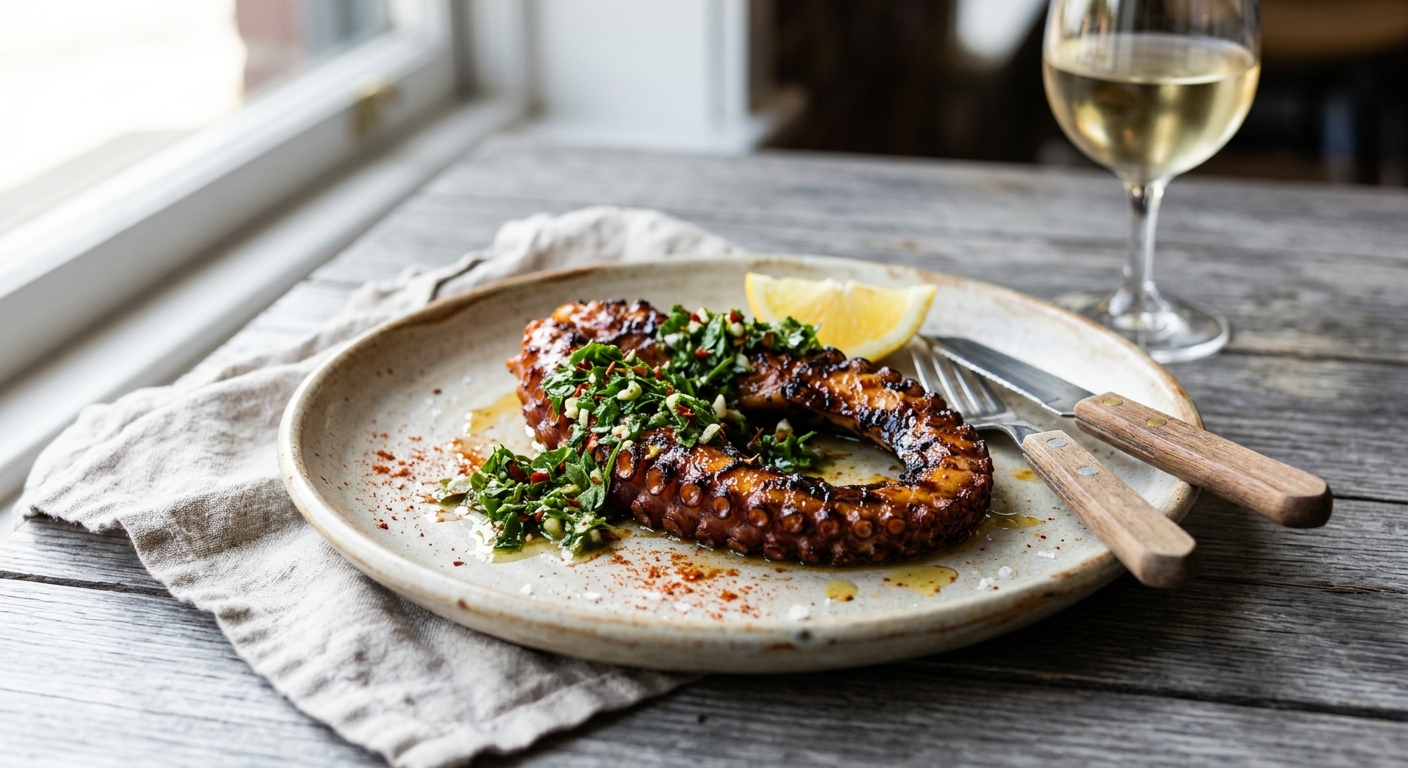
Octopus is one of the most nutritionally underrated proteins in the Western kitchen. While chicken and beef dominate the conversation, a single 200g serving of cooked octopus delivers more zinc than a ribeye, more selenium than most fish, and a remarkable concentration of taurine, the conditionally essential amino acid linked to cardiovascular health, neurological function, and electrolyte regulation. Paired with a bold, herb-forward chimichurri built on flat-leaf parsley, one of the most nutrient-dense herbs per gram on the planet, this dish becomes a genuine mineral matrix on a plate.
The technique here is the real secret. Octopus is famously unforgiving when treated carelessly, turning rubbery and chewy if rushed. But when you master the low-and-slow tenderising phase, whether on the stovetop, in a slow cooker, or under pressure, and then finish it on screaming-hot grill grates or a cast iron pan, the transformation is extraordinary: a silky, almost custardy interior beneath a deeply caramelised, lightly charred crust. The chimichurri is not a garnish but a nutritional partner, adding chlorophyll-bound magnesium, vitamin K1, and anti-inflammatory polyphenols that balance the dish beautifully.
At Calibrated Cuisine, we chose this dish specifically because it addresses micronutrient gaps that are genuinely common in modern diets. Iron, zinc, copper, and selenium frequently fall short of recommended daily intakes, especially in populations that rely heavily on plant-based meals or avoid red meat. Octopus closes those gaps with surgical precision, and the olive-oil-rich chimichurri ensures that fat-soluble antioxidants from the fresh herbs are fully absorbed. This is precision eating that happens to taste spectacular.
4
servings
Ingredients
- 1400 gwhole octopus, cleaned (head and beak removed)
- 3 tbspextra-virgin olive oil, divided
- 1 mediumwhite onion, halved
- 4 clovesgarlic, smashed
- 2 wholedried bay leaves
- 1 tspwhole black peppercorns
- 1 tspColima Sea SaltMicroplastic Free Salt, for poaching
- 1 tspsmoked paprika
- 60 gflat-leaf parsley, leaves and tender stems
- 15 gfresh oregano leaves
- 3 clovesgarlic, finely minced (for chimichurri)
- 1 smallshallot, finely diced
- 2 tbspred wine vinegar
- 1 tspdried red chilli flakes
- 80 mlextra-virgin olive oil (for chimichurri)
- 1 tsplemon zest
- 1 tbspfresh lemon juice
- —Colima Sea SaltMicroplastic Free Salt and cracked black pepper to taste
- —Lemon wedges to serve
Instructions
Click on an item below to shop for the recommended items for this recipe on Amazon.
As an Amazon Associate, we earn from qualifying purchases.
- Fill a large Dutch oven or heavy stockpot with enough cold water to fully submerge the octopus. Add the halved onion, smashed garlic cloves, bay leaves, peppercorns, and 1 tsp sea salt. Bring to a rolling boil over high heat.
- Once boiling, hold the octopus by the mantle (body) and dip just the tentacles into the boiling water for 10 seconds, then lift out. Repeat three times. This step curls the tentacles tightly and helps the skin hold during the long simmer. Fully submerge the octopus, reduce heat to a bare simmer (around 85 to 90 degrees C), cover with a lid slightly ajar, and cook for 55 to 70 minutes until a sharp knife slides into the thickest tentacle with no resistance.
- While the octopus simmers, prepare the chimichurri: finely chop the parsley and oregano by hand (do not use a blender, or the sauce becomes a murky paste). Combine in a bowl with the minced garlic, diced shallot, red wine vinegar, chilli flakes, lemon zest, and lemon juice. Stream in 80ml olive oil while stirring, season generously with salt and pepper, and set aside at room temperature to let the flavours meld for at least 20 minutes.
- When the octopus is tender, transfer it to a cutting board and allow it to rest for 10 minutes. Separate the tentacles from the head with a sharp knife, and halve the head. Pat everything thoroughly dry with paper towels. Drizzle with 2 tbsp olive oil, season with smoked paprika, salt, and pepper.
- Heat a cast iron skillet or heavy grill pan over the highest possible heat until you see the first wisps of smoke. Place the tentacles and head pieces directly on the pan in a single layer, pressing gently with tongs. Sear without moving for 2 to 3 minutes per side until deeply charred grill marks form and the skin is lightly crisped. Work in batches if needed to avoid steaming.
- Transfer to a warm platter, spoon chimichurri generously over the top, and serve immediately with lemon wedges.
- Do not add any water to the slow cooker insert. Place the halved onion, smashed garlic cloves, bay leaves, and peppercorns directly on the bottom of the insert. Lay the cleaned whole octopus on top, folding the tentacles inward if needed to fit. Drizzle with 1 tbsp olive oil and season with 1 tsp sea salt.
- Place the lid on securely and cook on Low for 6 to 7 hours. Do not cook on High, as a rapid boil in the slow cooker will toughen the flesh rather than tenderise it. The octopus is ready when a fork slides effortlessly into the thickest tentacle with zero resistance. The cooker will have filled with a rich, deep-purple broth from the octopus ink sacs.
- While the octopus finishes its final hour, prepare the chimichurri. Hand-chop the parsley and oregano finely. Combine with the minced garlic, diced shallot, red wine vinegar, chilli flakes, lemon zest, and lemon juice in a bowl. Whisk in 80ml olive oil, season well, and rest at room temperature. The extended resting time available during slow cooking means your chimichurri will be particularly well-developed in flavour.
- Carefully remove the octopus from the slow cooker using tongs and transfer to a cutting board. Reserve the cooking liquid if desired. Let the octopus rest and cool for 10 to 15 minutes until comfortable to handle, then separate the tentacles from the head and pat every surface completely dry with paper towels. This drying step is critical: any residual moisture will steam rather than sear.
- Heat a cast iron skillet or heavy grill pan over the highest heat possible. Brush tentacles with the remaining 2 tbsp olive oil and dust with smoked paprika. Sear in batches, pressing firmly with tongs, for 2 to 3 minutes per side until a deep char forms. Plate and finish with chimichurri and lemon wedges.
- Pour 250ml cold water into the pressure cooker pot. Add the halved onion, smashed garlic, bay leaves, peppercorns, and 1 tsp sea salt. Place the cleaned octopus inside, folding the tentacles to fit if using an Instant Pot insert. The octopus does not need to be fully submerged: the pressurised steam environment will cook it evenly.
- Seal the lid and set to High Pressure for 15 minutes. If using an Instant Pot, use the Manual or Pressure Cook function. While the cooker comes to pressure (approximately 10 to 12 minutes), use this window to prepare your chimichurri completely: hand-chop parsley and oregano, combine with minced garlic, shallot, red wine vinegar, chilli flakes, lemon zest, lemon juice, and 80ml olive oil. Season and rest.
- Once the 15-minute cook time ends, allow a full natural pressure release for at least 15 minutes before opening the lid. Open the lid away from you, remove the octopus with tongs, and check tenderness by pressing the thickest tentacle with a finger or inserting a paring knife. It should yield completely with no springback. If it feels firm, reseal and pressure cook for 4 more minutes.
- Transfer the octopus to a cutting board and rest for 8 minutes. Separate the tentacles from the head, halve the head, and pat all surfaces aggressively dry with paper towels. Drizzle with 2 tbsp olive oil and season with smoked paprika, salt, and pepper.
- Heat a cast iron skillet or heavy grill pan until it is smoking. Sear each piece undisturbed for 2 minutes per side to develop maximum char crust. Because the pressure cooker yields especially tender flesh, handle the tentacles gently with tongs to preserve their shape. Arrange on a platter, cover with chimichurri, and serve with lemon wedges.
- Preheat your oven to 160 degrees C (320 degrees F). In a large oven-safe Dutch oven or deep roasting pan with a lid, combine 200ml cold water, the halved onion, smashed garlic, bay leaves, peppercorns, and 1 tsp sea salt. Place the cleaned octopus inside, drizzle with 1 tbsp olive oil, and press a sheet of parchment paper directly onto the surface of the octopus before fitting the lid tightly. The parchment creates a cartouche, trapping steam close to the octopus for superior moisture.
- Braise in the centre of the oven for 1 hour 15 minutes. Do not lift the lid during cooking. The low, even heat of the oven produces a very gentle, uniform braise that is particularly forgiving. After 1 hour 15 minutes, pierce the thickest tentacle with a skewer. It should pass through with no resistance. If resistance remains, reseal and return to the oven for 15 more minutes.
- While the octopus finishes its final 20 minutes, prepare the chimichurri: finely hand-chop the parsley and oregano, combine with minced garlic, shallot, red wine vinegar, chilli flakes, lemon zest, lemon juice, and 80ml olive oil. Season generously with salt and pepper and set aside.
- Remove the Dutch oven from the oven and switch the oven to its highest broiler setting (typically 250 to 260 degrees C). Let the octopus cool in the broth for 10 minutes, then lift it out, separate the tentacles and halve the head. Pat every surface completely dry with paper towels. Arrange pieces in a single layer on a foil-lined baking sheet. Brush generously with the remaining 2 tbsp olive oil and season with smoked paprika, salt, and pepper.
- Position the baking sheet on the highest rack and broil for 5 to 6 minutes per side, watching carefully, until the skin blisters and chars in spots and the edges of the tentacles begin to crisp. The broiler replicates the dry, radiant heat of a grill, producing excellent colour and texture. Remove promptly as the line between perfectly charred and burnt is narrow. Plate immediately, spoon chimichurri over the top, and serve with lemon wedges.
Nutrition Breakdown
Per 1 serving (makes 4)
Vitamins & Minerals
% Daily Value based on a 2,000 calorie diet (FDA reference)
🧬 Essential Amino Acids
% of recommended daily intake (RDA) per serving
🛡 Antioxidant Profile
The Nutrition Science
Octopus sits at the apex of mineral density among common proteins, and the reason lies in its biology. As a mollusc, octopus uses haemocyanin rather than haemoglobin for oxygen transport: a copper-based respiratory pigment that explains its sky-high copper content (over 400% DV per serving). That same marine physiology concentrates selenium far above levels found in terrestrial animals, because oceanic selenium bioavailability is dramatically higher than in most agricultural soils. The practical result is that a single serving provides 138% of your selenium DV, enough to maximally activate all five glutathione peroxidase isoforms that protect cell membranes from oxidative damage.
Taurine deserves special attention. Unlike standard amino acids, taurine is a sulfonic acid found almost exclusively in animal tissue, with the highest concentrations in cephalopods, bivalves, and dark poultry meat. Research published in journals including the European Heart Journal and Advances in Experimental Medicine and Biology has linked adequate taurine status to improved cardiac contractility, lower blood pressure, protection of retinal photoreceptors, and attenuation of exercise-induced muscle damage. A 200g portion of cooked octopus delivers approximately 1200mg of taurine, a meaningful dose given that the estimated adequate intake from diet is considered to be around 400 to 1000mg per day. Plant-based diets provide essentially zero taurine, making octopus a uniquely efficient delivery vehicle for this conditional nutrient.
The chimichurri is not nutritionally incidental. Flat-leaf parsley is gram-for-gram one of the richest dietary sources of vitamin K1, with 60g providing well over 100% of the daily adequate intake. Vitamin K1 activates osteocalcin and matrix Gla protein, proteins responsible for directing calcium into bone rather than into arterial walls. The generous olive oil in the chimichurri ensures fat-soluble vitamins (K1, and any carotenoids from the herbs) are fully absorbed, because all carotenoids and vitamin K require dietary fat for micellar incorporation in the small intestine. The red wine vinegar contributes a modest polyphenol load while its acidity brightens the entire flavour profile, completing a dish that performs as well as it tastes.
Pro Tips
- Ask your fishmonger to clean the octopus for you. Removing the beak (a hard, parrot-like structure at the centre of the tentacles) and the ink sac is straightforward but time-consuming. Most fish counters will do this at no extra charge.
- Freezing a fresh octopus for 24 to 48 hours before cooking is not a myth: the ice crystals that form during freezing mechanically rupture some muscle fibres, producing a noticeably more tender result without any change in flavour or nutrition.
- Do not salt your chimichurri until just before serving if making it more than an hour ahead. Salt draws moisture from the parsley via osmosis, eventually turning a vibrant green sauce into a waterlogged, dull-coloured one. Add the final seasoning in the last 10 minutes.

Love this take on octopus, seriously underrated for athletes looking to diversify their protein sources. The DIAAS score on cephalopods is solid around 0.95, but what really caught my eye is the taurine angle, especially paired with that chimichurri. I’ve started incorporating more octopus with my endurance athletes because the taurine supports cardiac output during high-intensity work, and unlike chicken breast, you’re getting meaningful selenium and zinc in the same meal. Have you noticed whether the grilling method affects the amino acid bioavailability, or is it more about the mineral retention at that heat level?
This is such a great protein choice for my specific needs! One quick flag for anyone with histamine sensitivity like me: octopus is generally low-histamine when fresh, but I’d definitely recommend asking your fishmonger about freshness and avoiding any frozen/thawed options or anything that’s been sitting. The chimichurri is where I get careful, though – fresh parsley and cilantro are fine, but if that recipe uses garlic that’s been sitting around or aged vinegars, those can be histamine triggers. I do a quick substitution with fresh lemon juice and super fresh herbs instead, which keeps all those beautiful minerals intact without the inflammation response.
This is such helpful specificity, Lorraine! I love that you’re thinking about freshness across the whole dish, not just the protein. I actually wonder if the fresh herb emphasis in chimichurri works even better for thyroid support too, since cooking can reduce some of the goitrogenic compounds in raw parsley and cilantro anyway, plus you’re getting all that mineral density from truly fresh ingredients without the histamine load. Your lemon juice swap is brilliant for that reason. Have you found that the freshness factor makes a noticeable difference in how you feel after eating it compared to versions with older ingredients?
Great observation about the goitrogens, Tammy – though I’d gently push back that parsley and cilantro are actually pretty low in goitrogenic compounds compared to cruciferous veggies, so cooking doesn’t move the needle much there. That said, you’re spot on about freshness mattering for mineral bioavailability and histamine load, which directly impacts how quickly your body can use that zinc and selenium from the octopus itself. I’ve noticed athletes who nail the “fresh ingredient” timing (eating within hours of prep) report better recovery markers than those eating the same meal prep from a few days out, so Lorraine’s point about asking your fishmonger is genuinely
Paul’s right about the DIAAS, and I’ll add that the taurine piece is genuinely underappreciated in cardiac prevention work. I’ve seen too many post-MI patients on statins without anyone mentioning they could be eating more cephalopods to support their own taurine synthesis, especially since we know it helps with arrhythmia management. The chimichurri is the smart move too, since those polyphenols from the parsley and cilantro actually potentiate some of the antioxidant benefits you’d want alongside the minerals. This recipe hits differently from a prevention standpoint than your standard salmon prep.
This is exactly the kind of integration I wish we saw more often in cardiology consults. Taurine’s role in reducing arrhythmia burden is solid evidence, yet most cardiologists I work with in the ICU aren’t thinking about it as a dietary intervention alongside their medications. The chimichurri detail shows you understand that micronutrient synergy matters, not just hitting isolated numbers. One thing I’d add for anyone reading: the freshness factor Lorraine mentioned becomes even more critical here because we want that taurine intact, and oxidative stress from age or improper storage will degrade both the taurine and those polyphenols you’re relying on for the antiox