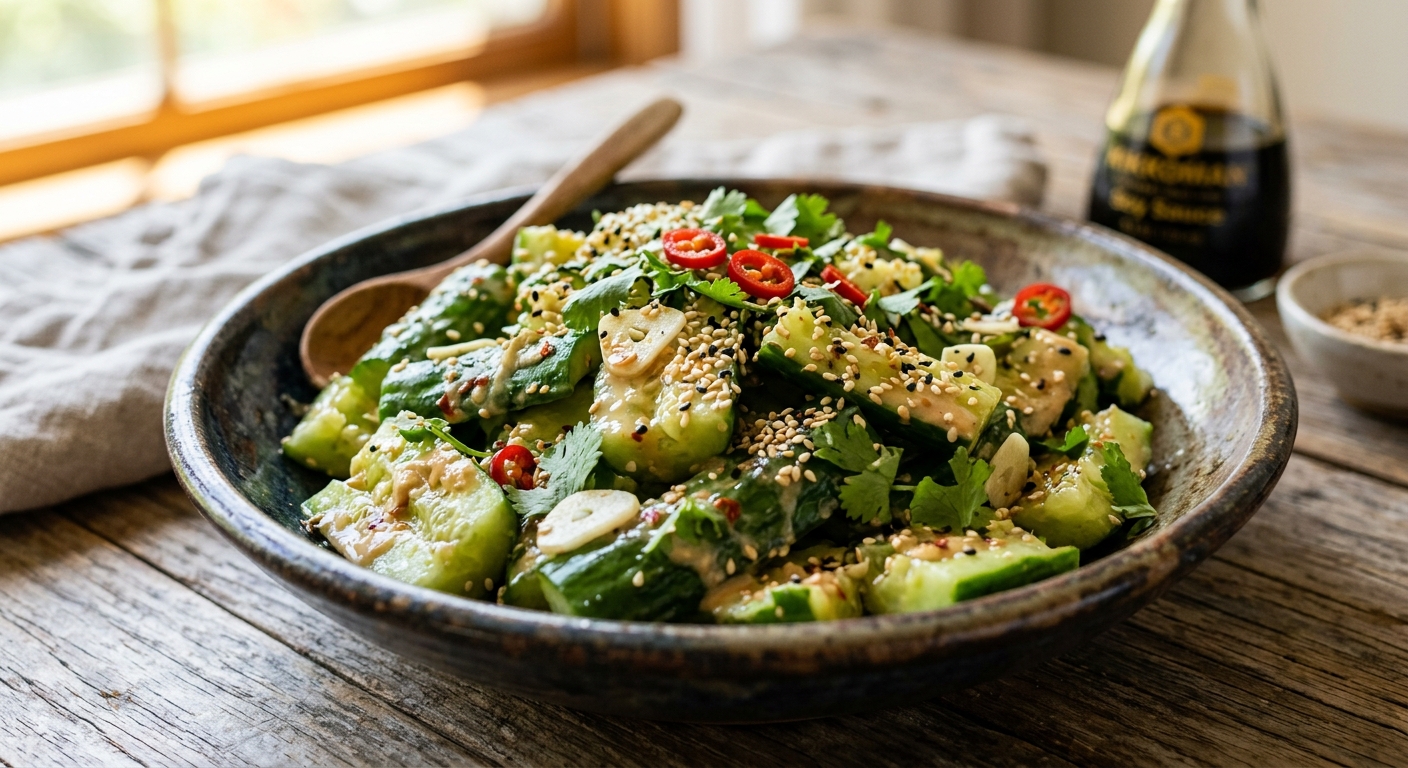
There is something almost alchemical about smashing a cucumber. The technique, borrowed from Chinese home cooking where it is known as pai huang gua, fractures the flesh into craggy, irregular pieces that trap dressing in every crevice. The result is not just texturally superior to sliced cucumber salad, it is scientifically more effective: the ruptured cell walls release more of the cucumber’s internal moisture, concentrating its mineral content on the surface and allowing the sesame-ginger vinaigrette to penetrate deeply. This is flavor physics working in your favor.
From a nutritional standpoint, cucumbers are dramatically underestimated. A 200-gram serving contributes meaningful amounts of potassium (supporting electrolyte balance and blood pressure regulation), molybdenum (a trace mineral critical for sulfur amino acid metabolism), vitamin K (essential for coagulation and bone mineralization), and silica (a compound that supports connective tissue integrity). Paired with tahini and toasted sesame seeds, this salad adds a genuine hit of calcium, magnesium, manganese, and zinc, bringing the mineral profile into territory that most salads simply cannot match. The sesame also introduces a significant dose of sesamin and sesamolin, lignans with documented antioxidant and anti-inflammatory activity.
Yes, this is fundamentally a cold salad, which means the Stovetop method is used to toast and bloom aromatics in the dressing. The Slow Cooker and Pressure Cooker methods use gentle controlled heat to make a deeply infused sesame-garlic-ginger oil that takes this salad from excellent to extraordinary. Each method yields a slightly different flavor profile: the stovetop is bright and immediate, the slow-cooked oil is mellow and deeply aromatic, and the pressure cooker version extracts maximum flavor from the aromatics in minimal time. Choose your method based on how much time you have and how intensely you want that sesame base to sing.
4
servings
Ingredients
- 800 gEnglish cucumbers (about 2 large), washed
- 3 tbsptoasted sesame oil
- 2 tbsptahini (hulled sesame paste)
- 2 tbsprice vinegar (unseasoned)
- 1 tbsplow-sodium soy sauce
- 1 tbsptoasted sesame seeds
- 1 tbspraw honey or maple syrup
- 4 clovesgarlic, finely minced
- 15 gfresh ginger, peeled and finely grated
- 3 stalksscallions, thinly sliced (white and green parts separated)
- 1 tspgochugaru or red pepper flakes (adjust to taste)
- 1 tsptoasted white sesame seeds, for garnish
- 0.5 tsptoasted black sesame seeds, for garnish
- —Colima Sea SaltMicroplastic Free Salt to taste
- —Fresh cilantro or mint leaves, for garnish (optional)
Instructions
Click on an item below to shop for the recommended items for this recipe on Amazon.
As an Amazon Associate, we earn from qualifying purchases.
- Smash the cucumbers: place each cucumber on a cutting board and lay the flat side of a chef’s knife across it. Press firmly and decisively with the heel of your hand until you hear the cucumber crack and split. Repeat along the full length, then cut the smashed cucumbers into rough 3 to 4 cm pieces. Transfer to a colander set over a bowl.
- Salt generously: toss the cucumber pieces with 1 teaspoon of fine sea salt, toss to coat, and let them drain in the colander for 15 minutes. This draws out excess water and concentrates the mineral flavor. After 15 minutes, shake off the liquid and pat the pieces dry with paper towels.
- Bloom the aromatics: heat 1 tablespoon of the sesame oil in a small saucepan over medium heat. When it shimmers, add the minced garlic, grated ginger, the white parts of the scallions, and the gochugaru. Cook, stirring constantly, for 60 to 90 seconds until the garlic is fragrant and just barely golden at the edges. Remove from heat immediately to prevent bitterness.
- Build the dressing: transfer the bloomed aromatics and oil to a small bowl. Whisk in the remaining 2 tablespoons of sesame oil, the tahini, rice vinegar, soy sauce, and honey. If the dressing is too thick, add 1 to 2 teaspoons of cold water and whisk again until emulsified and pourable. Taste and adjust salt, vinegar, or heat.
- Dress and finish: transfer the dried cucumber pieces to a large bowl. Pour the dressing over the cucumbers and toss vigorously to coat every piece. Add the 1 tablespoon of toasted sesame seeds and most of the scallion greens, and toss again. Plate the salad, garnish with white and black sesame seeds, remaining scallion greens, and fresh cilantro or mint if using. Serve immediately for maximum crunch, or refrigerate for up to 30 minutes to let the flavors meld.
- Prepare the cucumber base first: smash all 800g of cucumbers using the flat side of a chef’s knife, pressing firmly until they crack and fracture. Cut into rough 3 to 4 cm chunks. Toss with 1 teaspoon of fine sea salt in a colander, set over a bowl, and leave to drain while you prepare the infused oil.
- Set up the slow cooker confit: place the minced garlic, grated ginger, white scallion parts, gochugaru, and all 3 tablespoons of sesame oil into the slow cooker insert. Stir to combine. Set the slow cooker to Low, put the lid on slightly ajar (to allow steam to escape and prevent the aromatics from steaming rather than infusing), and cook for 2 hours. The oil should remain at a very gentle, barely perceptible simmer, well below frying temperature, so the aromatics soften and release their compounds into the oil slowly.
- Check and finish the oil: after 2 hours, the garlic should be pale gold and completely tender, and the oil will be deeply fragrant. Turn off the slow cooker and allow the infused oil and aromatics to cool to room temperature, about 20 to 30 minutes. Do not rush this step, as adding hot dressing to cucumber will wilt it.
- Build the dressing: transfer the cooled infused oil and all aromatics to a mixing bowl. Whisk in the tahini, rice vinegar, soy sauce, and honey until smooth and emulsified. The dressing will have a noticeably rounder, more complex flavor than the stovetop version. Adjust seasoning and thin with a teaspoon or two of water if needed.
- Finish and assemble: drain the salted cucumbers thoroughly, shaking the colander well, and pat dry. Combine with the dressing, 1 tablespoon toasted sesame seeds, and most of the scallion greens. Toss well and let rest for 5 minutes so the mellow oil has time to coat every surface. Transfer to a serving platter and top with white and black sesame seeds and fresh herbs.
- Salt and drain the cucumbers: smash all cucumbers with the flat of your knife, cut into 3 to 4 cm pieces, and toss with 1 teaspoon of fine sea salt in a colander. Set aside to drain for at least 15 minutes while you work on the dressing.
- Set up the pressure cooker infusion: combine the minced garlic, grated ginger, white scallion parts, gochugaru, and all 3 tablespoons of sesame oil in a small heatproof ramekin or a stainless steel bowl that fits inside your pressure cooker insert. Place a trivet in the bottom of the pressure cooker insert and add 240ml (1 cup) of water to the bottom. Set the ramekin on the trivet (pot-in-pot method). This indirect heat approach prevents the oil from overheating under pressure.
- Pressure cook: seal the lid and cook on Low pressure (not High) for 3 minutes. Allow a natural pressure release for 5 minutes, then carefully release any remaining pressure manually. Remove the lid away from you to avoid the steam, then carefully lift out the ramekin using silicone-tipped tongs. The oil will be vividly fragrant and the aromatics softened and deeply infused.
- Cool and build the dressing: let the infused oil cool for 8 to 10 minutes until warm but not hot to the touch. Whisk in the tahini, rice vinegar, soy sauce, and honey directly in the ramekin or in a separate bowl until a smooth, glossy dressing forms. Taste and adjust seasoning. The dressing will have bold, concentrated garlic and ginger intensity with a clean sesame finish.
- Assemble and serve: drain and pat the cucumbers very dry. Combine with the dressing, 1 tablespoon toasted sesame seeds, and the scallion greens in a large bowl. Toss energetically so every piece is coated. Plate promptly, garnish with white and black sesame seeds and herbs, and serve. Because the dressing is so intensely flavored, this version benefits from a brief 5-minute rest before serving.
Nutrition Breakdown
Per 1 serving (makes 4)
Vitamins & Minerals
% Daily Value based on a 2,000 calorie diet (FDA reference)
🧬 Essential Amino Acids
% of recommended daily intake (RDA) per serving
🛡 Antioxidant Profile
The Nutrition Science
The smashing technique is not merely theatrical. When a cucumber’s cell walls are ruptured mechanically rather than cut cleanly, the result is a dramatically increased surface area with jagged edges and open channels. This means two things nutritionally: first, more of the cucumber’s silica-rich interior is exposed to the dressing, allowing fat-soluble antioxidants in the sesame oil to make contact with the vegetable’s water-soluble mineral compounds. Second, the salting and draining process that follows draws out cellular water through osmosis, concentrating potassium, magnesium, and molybdenum in the remaining flesh while simultaneously improving texture by removing the water that would otherwise dilute the dressing.
Sesame seeds and tahini are among the most mineral-dense foods per calorie available in a standard pantry. A single tablespoon of tahini contains roughly 64mg of calcium, 14mg of magnesium, and measurable copper and zinc. The fat matrix in sesame oil also serves a critical nutritional function: it enhances the bioavailability of fat-soluble antioxidants such as beta-carotene from the cucumber skin and ginger, and it carries sesamin and sesamolin directly into the enterocytes of the small intestine where they exert their antioxidant effects. The rice vinegar in the dressing plays a complementary role, as acidity is known to modestly improve the absorption of non-heme minerals like iron, zinc, and magnesium from plant foods.
Ginger’s primary bioactive compound, 6-gingerol, undergoes a fascinating transformation depending on how it is prepared. In the raw form used in the stovetop method, gingerol dominates and provides sharp anti-inflammatory punch. When the ginger is gently heated in the slow cooker method, some gingerol converts to 6-shogaol, a compound that some research suggests is even more potent as an antioxidant and neuroprotective agent. The pressure cooker method, with its brief but more intense heat, produces a mixture of both compounds. Each method therefore has a genuinely different phytochemical signature, not just a different flavor.
Pro Tips
- Do not skip the salting and draining step. It removes up to 30% of the cucumber’s water weight, which would otherwise dilute the dressing and result in a watery, flat salad. Fifteen minutes is the minimum; 20 to 25 minutes gives even better texture.
- Toast your own sesame seeds if possible. Place raw sesame seeds in a dry skillet over medium heat and shake constantly for 2 to 3 minutes until golden and fragrant. Freshly toasted seeds contain significantly more available sesamin and have a dramatically superior flavor compared to pre-toasted commercial seeds.
- The smashed cucumber salad is best eaten within 2 hours of dressing. After that, the cucumbers continue to release water and the texture softens noticeably. If prepping ahead, keep the drained and dried cucumber pieces refrigerated separately from the dressing and combine just before serving.


oh man this is such a great combo, and i love that you’re highlighting the sesame here because toasted sesame has this incredible mineral density that most people sleep on. ngl though i keep thinking about how a handful of dried shiitake or oyster mushrooms would absolutely transform this into a complete umami + mineral powerhouse – theyre loaded with bioavailable copper and zinc plus those beta-glucans that actually help with nutrient absorption. have you ever experimented with adding any medicinal mushrooms to raw veggie preparations like this, or does that feel like it changes the vibe too much?
okay this is legit perfect timing for me because im always looking for hydration + electrolyte stuff that isnt just coconut water or sports drinks, and the sesame angle is genius for bioavailable minerals. my question though is how does this work as a post wod meal without adding protein? like would you pair it with grilled chicken or fish to make it a legit recovery situation, or is the sesame seeds giving you enough of an amino acid profile to support muscle repair on their own? ive been experimenting with pairing mineral dense veggies with complete proteins and this feels like it could slot in perfectly
Love this framing because cucumber is so often dismissed as “just water” when it’s actually a bioavailable source of silica and those electrolytes you mentioned, especially potassium. The sesame component is what really makes this shine nutritionally though – toasted sesame seeds unlock better mineral absorption than raw ones, plus the lignans have some nice anti-inflammatory synergy going on. I’ve noticed patients on diuretics or ACE inhibitors really benefit from casually including more of these potassium-rich preparations since it helps maintain that delicate balance without needing supplements. Simple prep, massive nutrient density – this is exactly the kind of recipe that actually moves the needle on micronutrient status.