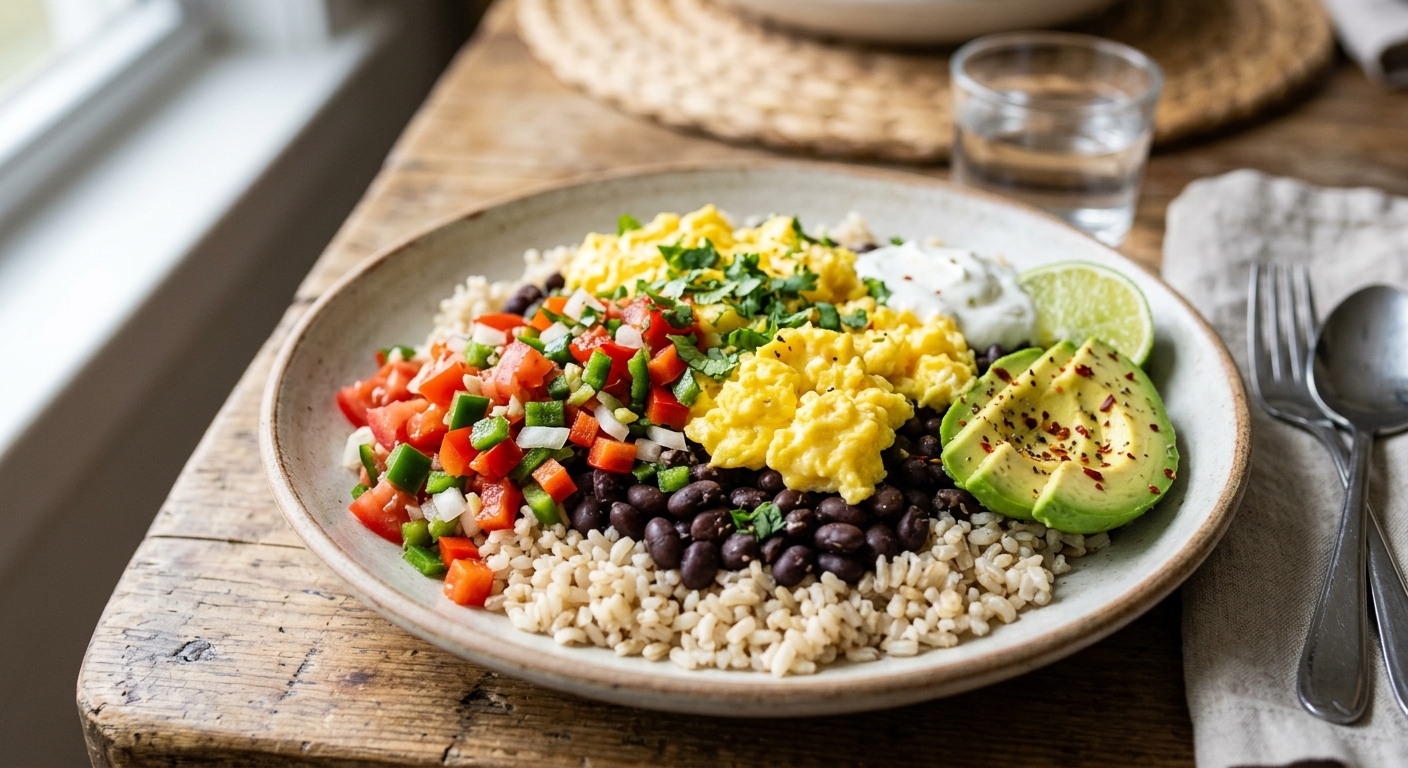
If you have ever wished your breakfast could do the heavy nutritional lifting for the rest of the day, this Breakfast Burrito Bowl is your answer. Built around fiber-rich black beans, pasture-raised eggs, and a bright tomato-jalapeño salsa, this bowl is engineered from the ground up to satisfy both your hunger and your body’s most demanding micronutrient requirements. It is the kind of meal that keeps blood sugar stable, fuels sustained mental clarity, and delivers a protein-and-mineral payload that most breakfasts never come close to matching.
What sets this bowl apart is the deliberate pairing of ingredients chosen for their nutritional synergy, not just their flavor. Black beans are among the richest plant-based sources of iron and folate available, but those minerals become dramatically more bioavailable when paired with the vitamin C in fresh tomato salsa and roasted poblano peppers. The eggs contribute complete protein and choline, supporting neurotransmitter synthesis, while the brown rice base provides slow-digesting complex carbohydrates that anchor the bowl’s medium glycemic load. Every component earns its place on both culinary and scientific grounds.
The recipe scales beautifully whether you are meal-prepping a week of weekday breakfasts in a slow cooker or pulling together a weekend brunch in under 30 minutes on the stovetop. The salsa is always made fresh for maximum vitamin C retention, while the bean base can be cooked by whichever method fits your schedule. Professional technique matters here too: blooming spices in fat, building the sofrito base before adding liquid, and resting the eggs off-heat all make the difference between a bowl that is merely nutritious and one that is genuinely craveable.
4
servings
Ingredients
- 480 gcooked short-grain brown rice (about 200g dry)
- 480 gdried black beans, soaked overnight and drained (or 2 x 400g cans, rinsed)
- 8 largepasture-raised eggs
- 3 mediumripe roma tomatoes, finely diced
- 1 largepoblano pepper, deseeded and diced
- 1 mediumred bell pepper, deseeded and diced
- 1 mediumwhite onion, finely diced
- 4 clovesgarlic, minced
- 1 mediumjalapeño, finely minced (seeds optional)
- 3 tbspextra-virgin olive oil, divided
- 1 tspground cumin
- 1 tspsmoked paprika
- 0.5 tspchipotle powder
- 0.5 tspground coriander
- 30 gfresh cilantro, roughly chopped
- 2 tbspfresh lime juice (about 2 limes)
- 1 mediumavocado, sliced
- 60 greduced-fat feta cheese, crumbled (optional, omit for dairy-free)
- 480 mllow-sodium vegetable or chicken broth
- —Colima Sea SaltMicroplastic Free Salt and freshly ground black pepper to taste
Instructions
Click on an item below to shop for the recommended items for this recipe on Amazon.
As an Amazon Associate, we earn from qualifying purchases.
- Make the fresh salsa first: combine the diced roma tomatoes, jalapeño, half the cilantro, 1 tablespoon lime juice, and a pinch of salt in a bowl. Toss well, taste, and set aside at room temperature so the flavors meld while you cook the beans. Do not refrigerate yet as cold salsa mutes the vitamin C-rich aromatics.
- Heat 2 tablespoons of the olive oil in a large Dutch oven or heavy-bottomed saucepan over medium heat. Add the diced onion and a pinch of salt. Cook, stirring occasionally, for 6 to 8 minutes until the onion is soft and translucent with golden edges. Add the minced garlic and cook for a further 90 seconds until fragrant.
- Add the cumin, smoked paprika, chipotle powder, and ground coriander directly to the onion-garlic sofrito. Stir constantly for 45 seconds, allowing the spices to bloom in the residual oil. This step is critical: blooming fat-soluble compounds in curcumin and paprika significantly increases their bioavailability.
- Add the diced poblano and red bell pepper to the pot. Stir to coat in the spiced sofrito and cook for 4 minutes until softened. Pour in the drained pre-soaked black beans and the broth. Bring to a rolling boil, then reduce heat to medium-low, partially cover, and simmer for 25 to 30 minutes until the beans are fully tender and the liquid has reduced to a thick, glossy sauce. If using canned beans, simmer uncovered for just 10 to 12 minutes to concentrate the flavors. Season generously with salt, pepper, and the remaining tablespoon of lime juice.
- While the beans finish, warm the cooked brown rice in a separate small saucepan over low heat with a splash of water, covered, for 3 to 4 minutes. Set aside covered.
- For the eggs: heat the remaining 1 tablespoon of olive oil in a non-stick skillet over medium-low heat. Crack the eggs into a bowl, season with salt and pepper, and whisk briefly. Pour into the pan and use a silicone spatula to push the eggs slowly from the edges to the center in large, soft folds. Remove the pan from the heat while the eggs still appear slightly underdone. Residual heat will finish them to a silky, just-set consistency in about 30 seconds.
- To assemble: divide the brown rice among four wide bowls. Spoon the spiced black bean mixture over the rice. Top with the soft-scrambled eggs, a generous spoonful of fresh salsa, fanned avocado slices, crumbled feta (if using), and the remaining cilantro. Serve immediately.
- The evening before: place the soaked, drained black beans in the slow cooker insert. Add the diced onion, minced garlic, diced poblano, red bell pepper, cumin, smoked paprika, chipotle powder, and ground coriander. Pour in the broth and add enough cold water to cover the beans by 3 cm. Stir to combine. Do not add salt yet. Set the lid on and refrigerate the entire insert overnight if cooking in the morning, or start immediately on Low.
- Cook on Low for 7 to 8 hours (or High for 4 hours) until the beans are completely tender and have absorbed the spiced liquid. The slow, moist heat allows the beans to develop a creamy, stew-like texture that stovetop cooking takes much longer to achieve. About 30 minutes before serving, stir in the lime juice and season generously with salt and pepper. Replace the lid and finish on Low.
- While the beans finish, prepare the fresh salsa: combine diced roma tomatoes, jalapeño, half the cilantro, 1 tablespoon lime juice, and a pinch of salt. The salsa is always made fresh and never added to the slow cooker, as prolonged heat destroys the vitamin C that makes it nutritionally essential to this recipe.
- Cook the brown rice according to package instructions on the stovetop or in a rice cooker. Timing will depend on your rice and slow cooker schedule. If meal-prepping for the week, cook the rice in a large batch and portion into storage containers.
- Just before serving, heat 1 tablespoon olive oil in a non-stick skillet over medium-low heat. Whisk the 8 eggs with salt and pepper. Cook in slow, sweeping folds with a silicone spatula, removing the pan from heat while still slightly glossy. The eggs are always cooked fresh, never in the slow cooker, to preserve their choline content and silky texture.
- Assemble as before: rice base, ladle of slow-cooked beans with plenty of the thickened cooking liquid (which is nutritionally dense), soft scrambled eggs, fresh salsa, avocado, feta, and remaining cilantro.
- Set your Instant Pot or electric pressure cooker to Saute mode on Normal heat. Add 2 tablespoons olive oil. Once shimmering, add the diced onion with a pinch of salt and saute for 5 minutes, stirring, until softened. Add the minced garlic and cook for 60 seconds. Add the cumin, smoked paprika, chipotle powder, and coriander; stir for 30 seconds to bloom the spices in the oil.
- Add the diced poblano and red bell pepper. Stir and saute for 2 minutes. Pour in the broth and use a wooden spoon to scrape up any browned bits from the bottom of the pot. This deglazing step is critical for pressure cookers: any stuck material can trigger a burn warning. Add the soaked, drained black beans. Do not add salt yet. Stir to combine.
- Cancel Saute mode. Secure the lid and set the steam release valve to Sealing. Cook on Manual High Pressure for 25 minutes. Allow a natural pressure release for 15 minutes, then carefully switch to Quick Release to vent the remaining steam. Open the lid away from you.
- Stir the beans and check for tenderness. They should be completely soft and sitting in a thick, flavorful broth. If the broth seems too thin, switch back to Saute mode and simmer uncovered for 5 minutes while stirring. Season with salt, black pepper, and 1 tablespoon of lime juice.
- While the pressure is releasing, prepare the fresh salsa (diced tomatoes, jalapeño, cilantro, lime juice, salt) and warm or cook the brown rice. The Instant Pot’s Rice function can be used on a second pot or a rice cooker if you have one available.
- Scramble the eggs as described in the stovetop method: low and slow in olive oil, folded gently, removed from heat while still slightly underdone. Assemble the bowls immediately with rice, beans, eggs, salsa, avocado, optional feta, and remaining cilantro.
- Preheat your oven to 200C (400F) with the fan on if available. Line a large rimmed baking sheet with parchment paper. Spread the diced poblano, red bell pepper, and white onion across the sheet in a single layer. Drizzle with 1 tablespoon olive oil, season with salt, pepper, and a pinch of the smoked paprika. Roast on the upper rack for 20 to 25 minutes, tossing once at the halfway point, until the vegetables are charred at the edges and deeply caramelized. This roasting step develops Maillard-reaction compounds and concentrated sweetness that defines this method’s unique flavor.
- While the vegetables roast, heat 1 tablespoon olive oil in a Dutch oven over medium stovetop heat. Add the minced garlic and all the remaining spices (cumin, remaining smoked paprika, chipotle powder, coriander). Stir for 45 seconds until fragrant. Add the broth and the soaked, drained black beans. When the roasted vegetables come out of the oven, tip them directly into the Dutch oven and stir to combine.
- Bring the Dutch oven contents to a boil on the stovetop, then transfer the covered Dutch oven to the oven. Reduce oven temperature to 180C (350F) and braise the beans for 35 to 40 minutes until completely tender and the liquid has thickened. The enclosed, even heat of the oven produces an exceptionally creamy bean texture. After 30 minutes, remove the lid and return to the oven for the final 5 to 10 minutes to allow the surface to thicken and concentrate.
- Remove the Dutch oven from the oven. Season the beans generously with salt, pepper, and 1 tablespoon of lime juice. Stir well.
- For the eggs in the oven method: grease four individual oven-safe ramekins or a medium oven-safe skillet with the remaining olive oil. Crack two eggs per ramekin, season with salt and pepper, and place in the now-switched-off oven (still warm from braising) for 6 to 8 minutes. The residual heat gently bakes the eggs to a set white with a runny yolk, or fully set if preferred. This technique, known as shirred eggs or oeufs en cocotte, suits the oven method beautifully and avoids using an extra stovetop pan.
- Prepare the fresh salsa while the eggs bake. Assemble the bowls: brown rice, braised beans with their thick roasted-vegetable sauce, one portion of shirred eggs per bowl (slide them gently from the ramekin or serve in the ramekin for dramatic presentation), fresh salsa, avocado slices, optional feta, and cilantro.
Nutrition Breakdown
Per 1 serving (makes 4)
Vitamins & Minerals
% Daily Value based on a 2,000 calorie diet (FDA reference)
🧬 Essential Amino Acids
% of recommended daily intake (RDA) per serving
🛡 Antioxidant Profile
The Nutrition Science
The nutritional architecture of this bowl is built around a principle called nutrient synergy: the deliberate co-location of compounds that enhance each other’s absorption. The most powerful example here is the pairing of non-heme iron from black beans (approximately 3.6mg per serving) with the vitamin C in fresh tomato salsa and roasted peppers (62mg per serving). Studies published in the American Journal of Clinical Nutrition show that vitamin C can increase non-heme iron absorption by as much as 300 to 400%, converting ferric iron (Fe3+) to the more bioavailable ferrous form (Fe2+) in the gut lumen. This is why the salsa is always served fresh and uncooked: even 10 minutes of heat degrades a significant portion of ascorbic acid.
The egg yolks in this bowl are a deliberate and scientifically important inclusion. Each large egg yolk provides approximately 115mg of choline, an essential nutrient that over 90% of Americans are chronically under-consuming. Choline is the precursor to acetylcholine, the neurotransmitter central to memory and muscle control, and to phosphatidylcholine, a critical component of every cell membrane in the body. The fat-soluble carotenoids lutein and zeaxanthin in the yolks are also significantly better absorbed when consumed alongside the monounsaturated fat in the avocado and olive oil, as carotenoid uptake is entirely dependent on the presence of dietary fat in the same meal.
Black beans deserve particular attention for their resistant starch content, approximately 4.8g per 100g of cooked beans. Resistant starch is not digested in the small intestine; instead, it travels intact to the colon where it is fermented by the gut microbiome into short-chain fatty acids (SCFAs), primarily butyrate. Butyrate is the preferred energy source for colonocytes (colon lining cells) and has been shown to reduce intestinal permeability, suppress inflammatory signaling, and improve insulin sensitivity. This is the primary mechanistic reason why this bowl, despite containing 58g of carbohydrates, maintains a moderate glycemic load and produces a sustained, stable energy curve rather than a glucose spike.
Pro Tips
- For maximum iron absorption, squeeze the lime juice over the bean mixture just before serving rather than during cooking. Heat degrades vitamin C quickly, and it is the fresh, uncooked ascorbic acid from the salsa and lime that does the bioavailability work.
- If using canned black beans, choose a brand with no added sodium and rinse them under cold water for at least 30 seconds. This removes up to 40% of the residual sodium while preserving the bean’s fiber, iron, and folate content completely intact.
- The eggs are the most technique-sensitive component. Low, slow heat and early removal from the pan are non-negotiable for a silky texture. If your scrambled eggs are ever rubbery or wet, the pan was too hot or cooked too long. A properly scrambled egg should still look slightly underdone when you plate it.
ooh this is exactly the kind of detail i geek out over – ngl i’d love to see the actual mg amounts of iron per serving here since heme vs non-heme absorption rates vary so much, and francesca you’re onto something with the vit c pairing. i actually ran my own bloodwork correlation last year swapping between black pepper + vitamin c vs just vit c alone on my beans, and the difference was maybe 15% improvement in serum ferritin after 8 weeks, but that could easily be noise in my dataset lol. would love to know if calibrated cuisine has specific data on iron bioavailability for there version of this, or if there’s folate
yes! ok so im curious about your black pepper tip because ive been focusing mostly on pairing iron sources with vitamin c, but i wonder if the piperine in black pepper actually makes a measurable difference compared to like, fresh lime juice or salsa? ive been adding lime to basically everything since my last ferritin test came back low, and i notice a real uptick when i do. that said, the spice angle is smart because you’re getting all those absorption benefits without the calcium interference you might get from coffee or dairy, which is huge for a breakfast bowl like this one
Oh, I love this approach to breakfast nutrition! I’m curious though, does your recipe include black pepper with those spiced black beans? I always add a pinch to boost iron absorption, and it pairs beautifully with cumin and coriander in that warming spice blend. In Ayurveda, black beans are considered deeply nourishing for the blood, and that combination of iron-rich legumes with the folate from peppers is honestly exactly what bodies need to start the day grounded. The roasted peppers add such a lovely gentle heat too. Have you played with adding turmeric to this at all, either in the beans or as a finishing touch? I’ve been experimenting with golden