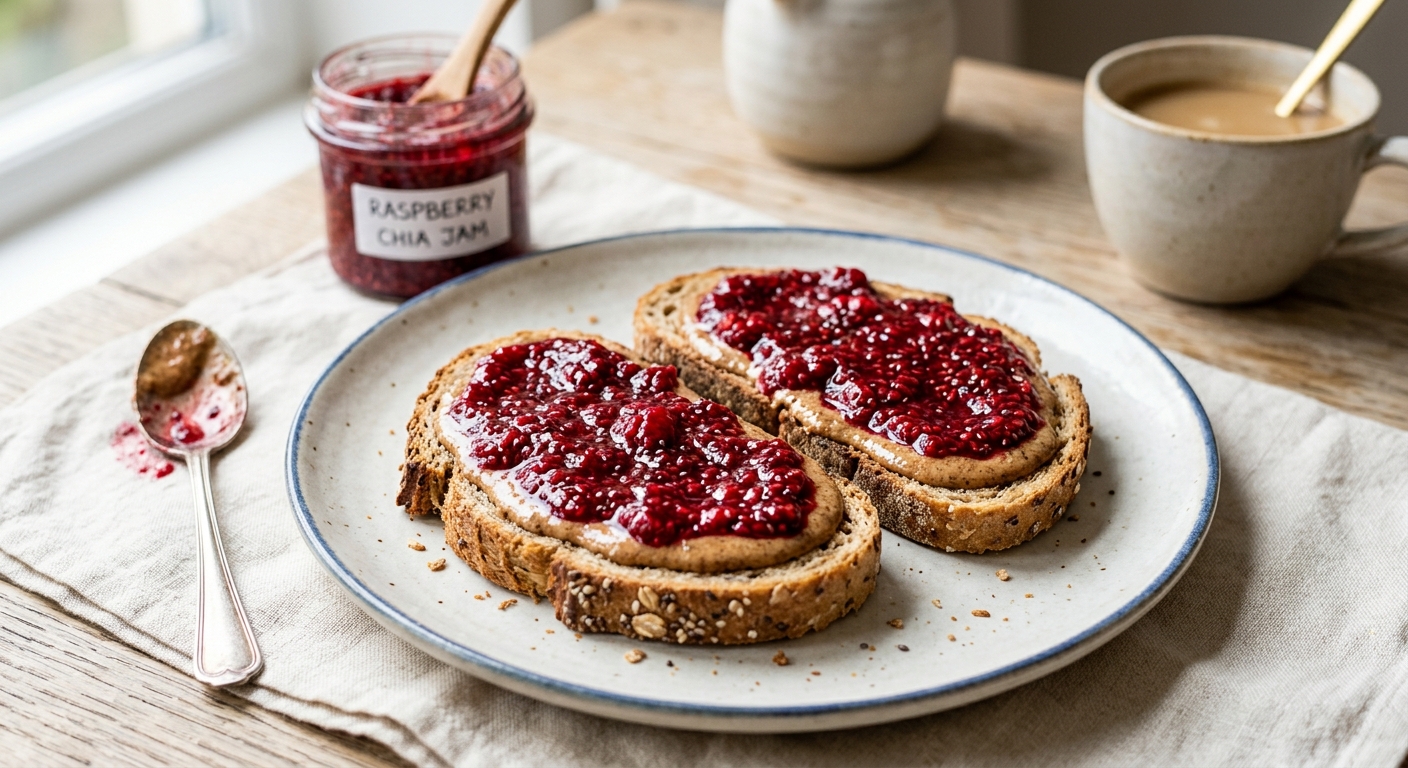
There is something quietly revolutionary about a breakfast that tastes indulgent but works hard for your body at a cellular level. This raspberry chia jam on sourdough with almond butter is exactly that: a deeply flavourful, texturally satisfying meal built from ingredients with well-documented anti-inflammatory credentials. The jam requires no pectin, no refined sugar, and no preservatives. Instead, chia seeds do the thickening work, swelling in the berry liquid to create a luscious, spoonable gel packed with alpha-linolenic acid, the plant-based omega-3 fatty acid that helps moderate the body’s inflammatory signalling pathways.
The choice of sourdough is deliberate and nutritionally meaningful. Long-fermentation sourdough has a significantly lower glycemic index than conventional bread because the lactic acid bacteria partially break down the starch and phytic acid during fermentation. This means slower glucose release, better mineral bioavailability, and a more hospitable environment for your gut microbiome. Paired with almond butter, which contributes vitamin E, magnesium, and monounsaturated fats, the combination creates a breakfast with balanced macronutrients and a glycemic load that will sustain your energy through the morning without a mid-morning crash.
Raspberries are the nutritional star of this recipe. They are among the richest dietary sources of ellagic acid and ellagitannins, polyphenol compounds that have been extensively studied for their ability to inhibit pro-inflammatory cytokines and support cellular repair. Fresh raspberries work beautifully in summer, but frozen raspberries are equally effective here and often higher in antioxidants because they are harvested and flash-frozen at peak ripeness. This recipe is endlessly scalable, stores well in the refrigerator for up to two weeks, and works across stovetop, slow cooker, and pressure cooker methods so it fits into any kitchen routine.
4
servings
Ingredients
- 300 gfresh or frozen raspberries
- 3 tbspchia seeds (white or black)
- 2 tbsppure maple syrup or raw honey
- 1 tbspfresh lemon juice
- 0.5 tsppure vanilla extract
- 4 sliceswhole-grain sourdough bread (approximately 45g per slice)
- 4 tbspnatural almond butter (no added sugar or oil), approximately 64g total
- —Pinch of Colima Sea SaltMicroplastic Free Salt
Instructions
Click on an item below to shop for the recommended items for this recipe on Amazon.
As an Amazon Associate, we earn from qualifying purchases.
- Place the raspberries in a small to medium saucepan over medium heat. If using frozen berries, no thawing is required. Cook, stirring occasionally, for 4 to 5 minutes until the berries collapse and release their juice. A few pops and sizzles as the moisture escapes is normal and desirable.
- Use the back of a wooden spoon or a fork to mash the berries to your preferred texture. For a smoother jam, press more firmly; for a chunky preserve, leave some whole berry pieces intact. Reduce the heat to medium-low.
- Stir in the maple syrup, lemon juice, vanilla extract, and a pinch of sea salt. Taste and adjust sweetness at this point as raspberries vary in natural sugar content.
- Sprinkle in the chia seeds and stir thoroughly to distribute them evenly throughout the berry mixture. Continue cooking on medium-low for 3 to 4 minutes, stirring frequently, until the mixture begins to thicken visibly.
- Remove the pan from heat. The jam will continue to thicken as it cools. Transfer to a clean jar or bowl and allow to cool at room temperature for at least 15 minutes. The final consistency should be spoonable and spreadable, not liquid.
- While the jam rests, toast the sourdough slices to your preferred level of crispness. Spread 1 tablespoon of almond butter on each slice first, then top generously with 2 to 3 tablespoons of the cooled raspberry chia jam. Serve immediately.
- Add the raspberries directly to the slow cooker insert. No liquid is needed. If using frozen raspberries, add them straight from the freezer; the slow cooker will bring them up to temperature gradually, which actually intensifies the berry flavour.
- Drizzle in the maple syrup and lemon juice, then add the vanilla extract and a pinch of sea salt. Stir gently to combine. Place the lid on the slow cooker and cook on High for 1.5 to 2 hours, or Low for 3.5 to 4 hours, until the berries have completely broken down and the mixture is bubbling gently around the edges.
- Remove the lid and use a fork or potato masher to break down any remaining berry pieces. If there is more liquid pooled in the insert than you would like, leave the lid off and cook on High for an additional 20 to 30 minutes to evaporate some moisture and concentrate the flavour.
- Switch the slow cooker to the Warm setting or turn it off. Sprinkle the chia seeds evenly over the surface of the hot berry mixture and stir vigorously for a full 60 seconds to ensure even distribution without clumping. Clumping is the most common slow cooker jam mistake and is prevented by stirring immediately and thoroughly.
- Allow the jam to sit in the warm slow cooker, lid off, for 20 minutes. It will thicken considerably as it cools and the chia seeds hydrate. Transfer to a clean jar and refrigerate if not using immediately. To serve, toast the sourdough, spread with almond butter, and spoon the jam on top.
- Add the raspberries, maple syrup, lemon juice, vanilla extract, and a pinch of sea salt to the inner pot of your pressure cooker or Instant Pot. Stir briefly to combine. Do not add the chia seeds yet as they must not be pressure cooked.
- Secure the lid and set the valve to the Sealing position. Select the Manual or Pressure Cook function and set to High Pressure for 3 minutes. The pot will take approximately 5 to 7 minutes to come to pressure before the countdown begins.
- Once the cooking time is complete, perform a Quick Release by carefully turning the valve to Venting. Stand back from the steam. Open the lid once the pressure pin has dropped completely.
- Set the pressure cooker to the Saute function on Low (or use a hob if your model does not allow this). Use an immersion blender directly in the pot for a smooth jam, or mash with a fork for a textured result. Cook on Saute for 2 to 3 minutes to evaporate any excess liquid, stirring constantly to prevent sticking on the Saute setting.
- Turn off the Saute function. Wait 2 minutes for the vigorous bubbling to subside, then stir in the chia seeds quickly and thoroughly. The residual heat is sufficient to begin hydration without overcooking. Transfer immediately to a jar and allow to set for 15 minutes before spreading. Assemble on toasted sourdough with almond butter.
- Preheat your oven to 190C (375F) with the fan off if possible. Line a small baking dish or oven-safe skillet (approximately 20cm square or equivalent) with parchment paper to prevent sticking and make cleanup easy.
- Spread the raspberries in a single layer in the prepared dish. Drizzle the maple syrup and lemon juice over the berries, then add the vanilla extract and a pinch of sea salt. Toss gently to coat.
- Place the dish in the centre of the preheated oven and roast for 20 to 25 minutes. The berries will collapse, release their juices, and the edges of the mixture will begin to caramelise and deepen in colour. The mixture should be visibly reduced and jammy. Check at 20 minutes to avoid over-reducing.
- Carefully remove the dish from the oven using oven mitts. Use a fork to mash the berries and stir the caramelised edges back into the centre of the mixture. The roasted aroma at this stage should be noticeably deeper and more complex than a simple stovetop jam.
- Allow the berry mixture to cool for exactly 5 minutes so it is hot but no longer boiling. Sprinkle the chia seeds over the surface and stir immediately and thoroughly for 60 seconds, scraping the bottom and sides of the dish. The residual heat activates the chia gel without destroying the omega-3 fatty acids. Cool for a further 15 minutes before spreading over toasted sourdough with almond butter.
Nutrition Breakdown
Per 1 serving (makes 4)
Vitamins & Minerals
% Daily Value based on a 2,000 calorie diet (FDA reference)
🧬 Essential Amino Acids
% of recommended daily intake (RDA) per serving
🛡 Antioxidant Profile
The Nutrition Science
The anti-inflammatory mechanism of this breakfast operates on several simultaneous fronts. Chia seeds (Salvia hispanica) provide approximately 2.1g of alpha-linolenic acid (ALA) per serving, the shortest-chain plant omega-3 fatty acid. While the conversion efficiency of ALA to the longer-chain EPA and DHA is modest in humans (typically 5 to 10%), ALA itself has direct anti-inflammatory activity, including the ability to reduce plasma concentrations of C-reactive protein (CRP) and interleukin-6, two widely used biomarkers of systemic inflammation. The chia seeds also contribute a significant mucilaginous soluble fiber that forms a viscous gel in the gastrointestinal tract, slowing glucose absorption and feeding Bifidobacterium and Lactobacillus species in the colon.
Raspberries contain one of the highest concentrations of ellagitannins among commonly consumed fruits, with fresh raspberries providing approximately 40 to 60mg of ellagic acid equivalents per 100g. Upon ingestion, gut microbiota convert ellagitannins into urolithins, particularly urolithin A, a compound with potent mitophagy-activating properties that helps clear damaged mitochondria from cells. This cellular housekeeping function is increasingly recognised as a key mechanism in reducing age-related inflammation. The anthocyanins in raspberries, responsible for their deep red colour, specifically inhibit the NF-kB transcription factor pathway, a central regulator of the inflammatory gene expression cascade.
Long-fermentation sourdough bread changes the nutritional calculus of carbohydrates significantly. Organic acids produced during fermentation, particularly lactic and acetic acid, lower the bread’s pH and partially gelatinise the starch granules in a way that slows amylase activity in the small intestine. Multiple randomised controlled trials have demonstrated that sourdough bread produces a postprandial glucose response 25 to 35% lower than the same quantity of carbohydrate from standard yeast-leavened bread. Additionally, fermentation substantially reduces phytic acid content, increasing the bioavailability of the magnesium and zinc naturally present in whole-grain flour. Almond butter contributes alpha-tocopherol, the most bioavailable form of vitamin E, which protects the polyunsaturated fatty acids from chia seeds from peroxidation both in the jar and in the body.
Pro Tips
- For the smoothest chia jam, let it rest in the refrigerator overnight rather than just 15 minutes at room temperature. The chia seeds fully hydrate after 8 hours, creating a firmer, more cohesive set that spreads beautifully without running.
- Stir your natural almond butter from the bottom of the jar before measuring. The separated oil on top contains the monounsaturated fats you want distributed evenly through every tablespoon, not left behind in the jar.
- If your raspberries are particularly tart, add the maple syrup in two stages: half during cooking and half after tasting the finished jam, once the chia seeds have been stirred in and the mixture has cooled slightly. Heat amplifies sweetness, so the cold version will always taste less sweet than the hot one.
- To boost the anti-inflammatory profile further, stir a quarter teaspoon of ground turmeric and a small pinch of black pepper into the jam during cooking. The piperine in black pepper increases curcumin bioavailability from turmeric by up to 2000% and the flavour pairs naturally with raspberry.
- The jam keeps refrigerated in a sealed jar for up to 14 days and freezes well for up to 3 months. Freeze in an ice cube tray for single-serving portions you can thaw overnight in the refrigerator.
Love that you’re thinking about postpartum nutrition, Laurie! So chia seeds are great for ALA omega-3s, but you’re right that they don’t have DHA directly, which is the longer-chain omega-3 that’s especially important postpartum. I usually recommend adding walnuts or ground flax to boost the ALA content (your body converts some to DHA, though the conversion rate varies), but honestly for postpartum DHA, algae-based supplements or regular fatty fish might be more reliable if you eat it. The combo of chia plus walnuts on this toast would definitely be a nutrient-dense move though!
Oh, I love this combination so much! I’ve been making something similar for years, and the raspberries have been a game-changer for my joint inflammation, probably because of those anthocyanins. One thing I’d add to Laurie’s question: if you’re really focused on the omega-3s postpartum, a small serving of wild salmon or sardines alongside this breakfast would give you that DHA directly, plus it pairs beautifully with the almond butter richness. I also always stir in a pinch of turmeric into my chia jam itself because it reduces my CRP so noticeably, and honestly the earthy flavor just deepens everything about this dish.
This sounds incredible and I’m definitely trying it this week! Quick question though – do you happen to know the DHA content in those chia seeds, or would you recommend adding something like ground flaxseed or walnuts for a postpartum nutrition boost? I’ve been experimenting with layering omega-3 sources for my own milk supply, and the sourdough fermentation aspect is perfect for gut healing after pregnancy. The prebiotic angle is so smart, especially when new moms are trying to rebuild their microbiome.