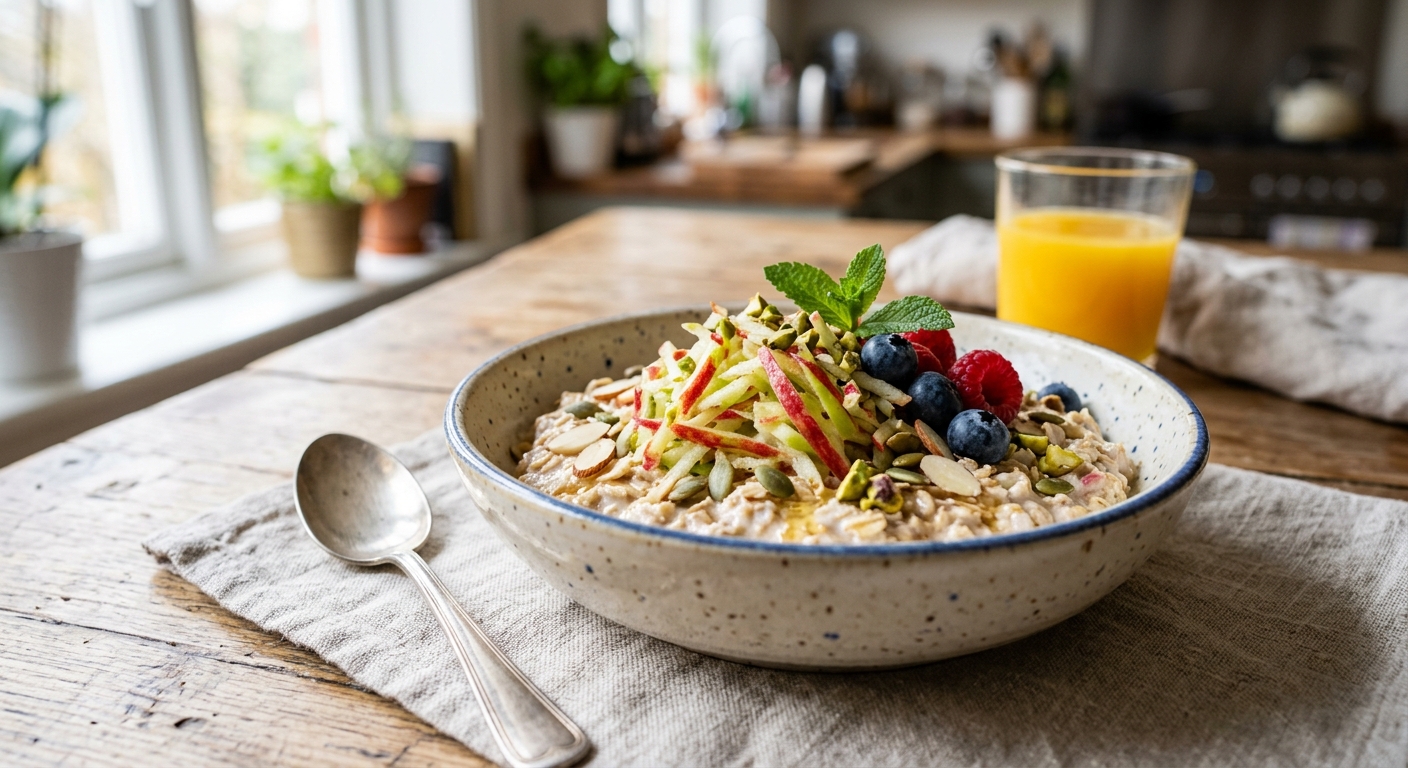
In 1900, Swiss physician Maximilian Bircher-Benner served a dish of soaked oats, grated apple, nuts, and cream to patients at his Zurich sanatorium, convinced that raw, plant-forward food held extraordinary healing power. Over a century later, nutritional science has largely proven him right. Bircher muesli is not merely a nostalgic breakfast curiosity; it is a precisely engineered matrix of slow-release carbohydrates, prebiotic fiber, anti-inflammatory polyphenols, and bioavailable micronutrients that science now confirms support gut health, cardiovascular function, and sustained cognitive energy throughout the morning.
What makes this version stand apart is the technique applied to the apple. Grating the apple rather than slicing it does two critical things: it releases far more of the fruit’s pectin and polyphenolic juice into the oat mixture, accelerating the softening process and dramatically increasing the antioxidant load per bowl; and it distributes apple flavor into every spoonful rather than leaving it in isolated chunks. Combined with a short soak in Greek yogurt and a squeeze of fresh lemon, the result is a silky, almost pudding-like texture that feels indulgent while delivering a genuinely calibrated nutritional payload.
This recipe has been developed for four distinct preparation methods because Bircher muesli is more versatile than its reputation as a cold overnight soak suggests. The stovetop version delivers a warm, porridge-adjacent comfort bowl in under fifteen minutes. The slow cooker produces a deeply creamy, almost caramelized result perfect for batch-cooking on a Sunday evening. The pressure cooker cuts active time to minutes while preserving beta-glucan integrity. And the oven-baked version, inspired by baked oatmeal traditions, transforms the mixture into a sliceable, golden-topped breakfast that holds beautifully for meal prep. Each method is nutritionally equivalent at the macro level, but offers a distinct textural and aromatic experience worth exploring on its own merits.
4
servings
Ingredients
- 300 gold-fashioned rolled oats (not instant)
- 2 largeapples (such as Fuji or Braeburn), cored and coarsely grated, skin on
- 400 gfull-fat plain Greek yogurt
- 250 mlwhole milk (or unsweetened oat milk for dairy-free)
- 120 mlfresh apple juice (no added sugar)
- 2 tbspfresh lemon juice
- 1 tspfinely grated lemon zest
- 3 tbspraw honey or pure maple syrup
- 60 graw walnuts, roughly chopped
- 40 gsunflower seeds
- 30 gground flaxseed
- 1 tspground cinnamon
- 0.25 tspground cardamom
- 60 gdried cranberries or sultanas
- —Fresh berries, extra honey, and a pinch of Colima Sea SaltMicroplastic Free Salt to serve
Instructions
Click on an item below to shop for the recommended items for this recipe on Amazon.
As an Amazon Associate, we earn from qualifying purchases.
- In a medium saucepan, combine the rolled oats, apple juice, milk, and 250ml cold water over medium heat. Stir to combine, then bring slowly to a gentle simmer, stirring frequently with a wooden spoon to prevent sticking. This should take about 5 to 6 minutes.
- Once the oats are simmering and beginning to absorb the liquid, reduce heat to medium-low. Add the ground cinnamon, cardamom, lemon zest, and dried cranberries. Continue stirring gently for 4 to 5 minutes until the mixture thickens to a loose porridge consistency. It should fall slowly from the spoon; it will continue to thicken off the heat.
- Remove the saucepan from heat. Immediately fold in the grated apple and lemon juice. The residual heat will gently cook the apple while preserving a significant portion of its vitamin C and polyphenols. Stir in the honey or maple syrup and taste, adjusting sweetness as needed.
- Allow the mixture to rest, uncovered, for 3 minutes so the oats absorb the apple moisture fully. Meanwhile, in a dry skillet over medium heat, toast the walnuts and sunflower seeds for 2 minutes, stirring constantly, until fragrant. Remove from heat immediately.
- Divide the warm muesli into four bowls. Top each with a generous spoonful of cold Greek yogurt (the temperature contrast is intentional), scatter over the toasted walnuts, sunflower seeds, and ground flaxseed. Finish with fresh berries, a drizzle of honey, and a pinch of flaky salt to heighten the apple and cinnamon notes.
- Lightly grease the insert of a 4 to 6 quart slow cooker with a small amount of butter or coconut oil. This prevents the starchy oat mixture from catching on the edges during the long cook and makes cleanup significantly easier.
- Combine the steel-cut oats (substitute equal weight, 300g, for the rolled oats in this method), apple juice, milk, and 500ml cold water directly in the slow cooker insert. Stir in the cinnamon, cardamom, lemon zest, and dried cranberries. Do not add the grated apple, yogurt, lemon juice, honey, nuts, seeds, or flaxseed at this stage; they are added after cooking to preserve their nutritional integrity and texture.
- Place the lid on the slow cooker and set to Low. Cook for 6 to 7 hours, ideally overnight. The oats will absorb virtually all of the liquid, and the surface will develop a very lightly golden, almost custard-like skin. Do not stir during cooking.
- When the cook time is complete, remove the lid and give the oats a vigorous stir to break up the set surface and redistribute the creamy interior. The mixture should be thick and cohesive. If it seems too thick, stir in 60 to 80ml of warm water or milk until it reaches a consistency you enjoy.
- Stir in the grated apple, lemon juice, and honey. The residual heat from the oats will slightly soften the apple while keeping it fresh-tasting. Taste and adjust sweetness. Allow to rest with the lid ajar for 5 minutes.
- Serve directly from the slow cooker insert. Top each portion with a large spoonful of cold Greek yogurt, the raw walnuts, sunflower seeds, and ground flaxseed. The contrast between the warm, deeply flavored oats and the cold, tangy yogurt is the defining characteristic of this method. Finish with fresh berries and honey.
- Add the rolled oats, apple juice, milk, and 300ml cold water to the inner pot of a 6-quart Instant Pot or electric pressure cooker. Stir in the cinnamon, cardamom, lemon zest, and dried cranberries. Do not add yogurt, grated apple, lemon juice, honey, nuts, seeds, or flaxseed at this stage.
- Secure the lid and set the pressure release valve to the Sealing position. Select the Pressure Cook (or Manual) setting and set to High Pressure for 10 minutes. The pot will take approximately 8 to 10 minutes to come to full pressure before the countdown begins.
- When the cook cycle completes, allow the pressure to release naturally for 10 full minutes. Do not touch the valve. After 10 minutes, carefully turn the valve to Venting to release any remaining steam, then open the lid away from you.
- Stir the oats vigorously; pressure cooking creates a very thick, almost gluey layer at the bottom of the pot. Adding 60ml of warm water or milk and stirring briskly will loosen the texture to a creamy, pourable consistency. Fold in the grated apple, lemon juice, and honey. Taste for seasoning.
- Divide among four bowls immediately while hot. Top each serving with a cold spoonful of Greek yogurt, the raw walnuts, sunflower seeds, and ground flaxseed. Serve within 5 minutes of opening the pot; pressure-cooked oats thicken rapidly as they cool. Garnish with fresh berries and a light drizzle of honey.
- Preheat the oven to 180C (350F) with a rack in the center position. Lightly butter or oil a 9×13 inch (23×33 cm) baking dish or a 9-inch square baking pan for a thicker result.
- In a large mixing bowl, whisk together the Greek yogurt, milk, apple juice, lemon juice, honey, cinnamon, cardamom, and lemon zest until smooth and homogeneous. This wet base will hydrate the oats during baking and gives the baked muesli its custardy interior.
- Fold the rolled oats, grated apple, dried cranberries, sunflower seeds, and ground flaxseed into the yogurt mixture until every oat is coated. Transfer the mixture to the prepared baking dish and spread into an even layer using a spatula. Scatter the chopped walnuts evenly over the surface; they will toast directly on top during baking, creating a contrasting crunchy topping.
- Bake uncovered for 35 to 40 minutes, until the edges are set and lightly golden, the center is just firm to the touch, and the walnut topping is fragrant and visibly toasted. A thin skewer inserted into the center should come out with only a few moist crumbs, not wet batter.
- Remove from the oven and allow to cool in the dish for 10 minutes before serving. This resting period is important; the oats continue to absorb steam and the center finishes setting. Cut into portions and serve warm, topped with cold Greek yogurt spooned over each slice, fresh berries, and a final drizzle of honey. Alternatively, refrigerate the whole baked slab and serve cold or reheated at 160C for 10 minutes throughout the week.
Nutrition Breakdown
Per 1 serving (makes 4)
Vitamins & Minerals
% Daily Value based on a 2,000 calorie diet (FDA reference)
🧬 Essential Amino Acids
% of recommended daily intake (RDA) per serving
🛡 Antioxidant Profile
The Nutrition Science
The anti-inflammatory credentials of Bircher muesli rest on a convergence of mechanisms that individually are well-documented, but together create a synergistic effect rarely matched by a single breakfast food. Beta-glucan, the soluble fiber unique to oats, forms a viscous gel in the upper gastrointestinal tract that physically slows glucose absorption, reduces LDL cholesterol by sequestering bile acids, and feeds Bifidobacterium and Lactobacillus species in the colon. Research published in the American Journal of Clinical Nutrition consistently shows that 3g of beta-glucan daily (this recipe provides 3.8g per serving) reduces LDL cholesterol by 5 to 10 percent over six weeks.
The grated apple contributes far more than flavor. Apple skin contains exceptionally high concentrations of quercetin, a flavonoid that has been shown in multiple cell and animal studies to inhibit NF-kB, the master transcription factor for inflammatory gene expression. Grating the apple with its skin intact, and immediately combining it with lemon juice, serves two precise nutritional functions: the lemon’s ascorbic acid chelates the iron in the oats, rendering it more bioavailable (increasing non-heme iron absorption by up to 67 percent according to iron absorption kinetics research), and it prevents enzymatic browning of the apple polyphenols by inhibiting polyphenol oxidase, preserving quercetin content that would otherwise degrade on contact with air.
Walnuts and ground flaxseed contribute alpha-linolenic acid (ALA), the short-chain plant omega-3 that serves as a substrate for conversion to EPA and DHA, the longer-chain anti-inflammatory fatty acids more commonly associated with fish. While conversion efficiency in humans is modest at 5 to 10 percent, the combined ALA load in this recipe (approximately 2.6g per serving) meaningfully supports the omega-3 to omega-6 ratio, which in a typical Western diet sits at a pro-inflammatory 1:15 but shifts closer to the anti-inflammatory 1:4 target with consistent ALA-rich meals. The selenium in sunflower seeds (33% DV per serving) further supports glutathione peroxidase activity, the body’s primary enzymatic antioxidant defense.
Pro Tips
- Always grate the apple immediately before adding it to the mixture and toss it directly into the lemon juice. Even a two-minute delay allows polyphenol oxidase to degrade a meaningful portion of the quercetin in the flesh.
- For the overnight cold soak (the original Bircher method), combine all ingredients except the toppings in a lidded container the night before, refrigerate, and serve cold the next morning. The texture is distinctly different from any of the cooked methods and is arguably the best for gut microbiome support as the beta-glucan and pectin remain unheated.
- Rolled oats labeled ‘old-fashioned’ or ‘whole rolled’ retain significantly more beta-glucan than quick oats, which are pre-steamed and cut and lose some of their fiber matrix in processing. For the slow cooker method specifically, steel-cut oats are strongly preferred as they hold their texture over the long, moist cook time.

solid breakfast choice but im curious about your folate math here, are you counting the yogurt or mostly the oats and apple? ive always leaned into adding a handful of raw almonds and some pumpkin seeds to bircher specifically for the magnesium and b6, especially if someones doing heavy training and burning through their mineral stores like i do. the lemon juice is smart too, boosts absorption. have you tested whether soaking vs quick assembly changes the bioavailability at all?
Good questions on the mineral angle, Zack. I’d wager the folate is primarily from the oats and apple rather than yogurt, but the real win here for training days is exactly what you’re doing with the seeds and nuts – that magnesium and B6 combo is crucial for power output recovery, especially if you’re doing high-intensity work. I’ve found that adding pumpkin seeds to my post-ride birchers bumps my perceived recovery noticeably by the next morning, though I haven’t done formal blood work to quantify it. The soaking definitely improves bioavailability for minerals like magnesium since it reduces phytic acid, so you’re actually getting more of what
oh this is such a nourishing way to start the day, i love how the overnight soaking actually makes everything more bioavailable so your body can really drink it in. Zack’s question about the folate is so smart – i’ve been curious about that too. what i’ve noticed in my own practice is that when i add those seeds and nuts like you mention, it shifts the whole mineral profile and somehow makes my shoulders sit softer through my sun salutations later, like the nervous system just feels more supported from breakfast on. definitely seems like the oats and apple are doing the heavy lifting on the folate but id love to know if the yogurt cultures are playing a bigger role than we think in terms