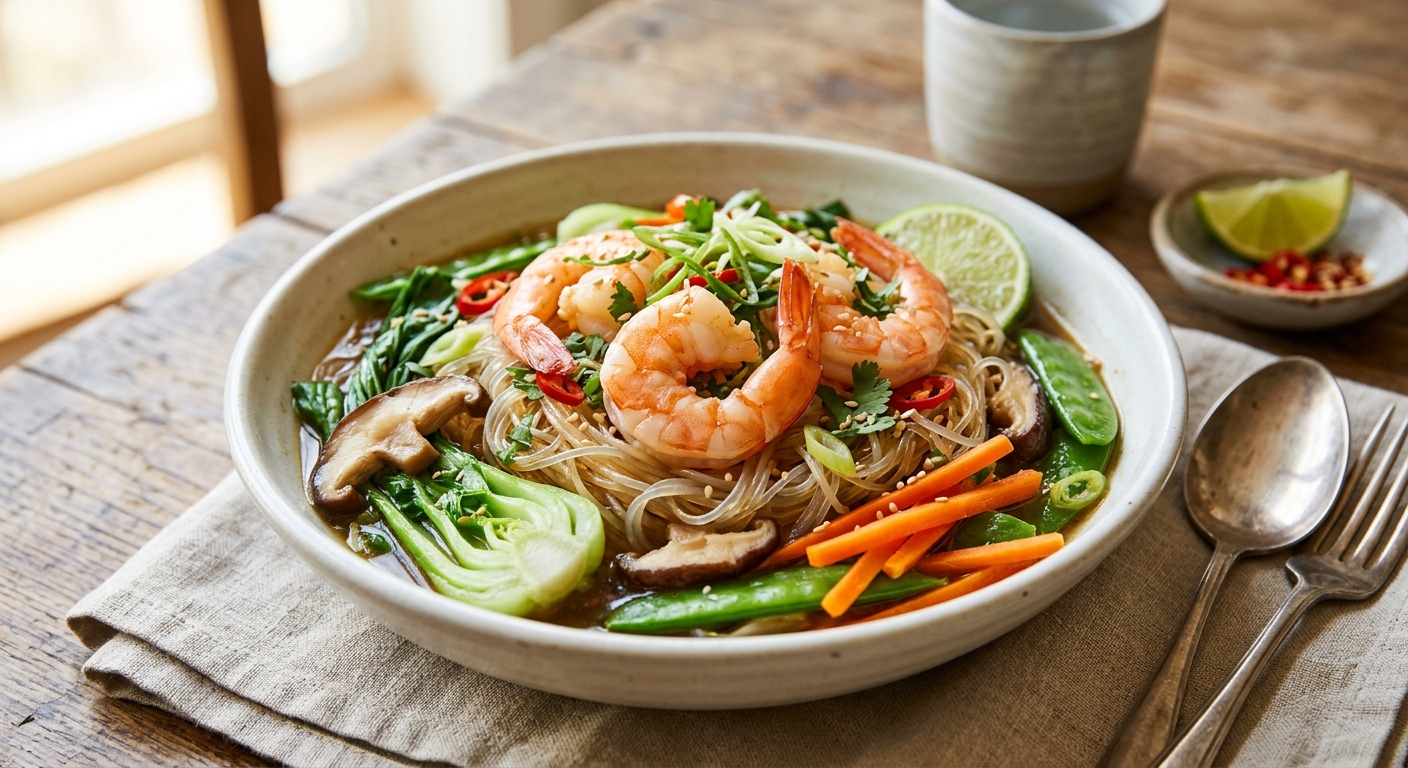
Glass noodles, also known as cellophane or mung bean noodles, are one of the most underrated pantry staples in the world. They absorb surrounding flavors like tiny flavor sponges, transforming a simple broth of garlic, ginger, and fish sauce into a deeply savory, translucent tangle that feels both light and thoroughly satisfying. Paired with wild-caught shrimp, bok choy, shiitake mushrooms, and shredded carrots, this dish becomes a genuine nutritional powerhouse anchored by one standout mineral: selenium.
Selenium is a trace mineral that most people rarely think about, yet it performs critical roles throughout the body. It anchors the active site of glutathione peroxidase, one of your body’s primary antioxidant enzymes, and it is essential for the conversion of the thyroid hormone T4 into its active form T3. Shrimp are among the most concentrated dietary sources of selenium available, providing roughly 35 to 40 micrograms per 100 grams. Combined with shiitake mushrooms, which contribute additional selenium along with a suite of B vitamins, this single bowl delivers approximately 47 micrograms of selenium, putting you well on your way to the 55 microgram daily target set by health authorities.
Beyond selenium, this recipe is carefully constructed to provide meaningful amounts of iodine, zinc, vitamin B12, vitamin K1, and folate. The bok choy brings calcium and a striking hit of vitamin C that aids iron absorption from the shrimp. The shiitake mushrooms supply ergothioneine, a uniquely stable antioxidant that human cells actively transport and accumulate. Every component earns its place nutritionally, and every component also earns its place on the plate: this is a bowl you will genuinely look forward to eating.
4
servings
Ingredients
- 300 graw shrimp, peeled and deveined (21 to 25 count)
- 180 gdried glass noodles (mung bean vermicelli)
- 200 gbok choy, roughly chopped
- 150 gfresh shiitake mushrooms, stems removed and caps sliced
- 120 gcarrots, peeled and julienned
- 80 gsnow peas, trimmed
- 1 litrelow-sodium chicken or seafood stock
- 2 tbspfish sauce
- 1 tbsplow-sodium soy sauce
- 1 tbspsesame oil
- 1 tbspAvocado Oil100% Pure Avocado Oil (avocado or grapeseed)
- 4 clovesgarlic, minced
- 20 gfresh ginger, peeled and grated
- 2 stalkslemongrass, bruised and cut into 5 cm pieces
- 1 tbspoyster sauce
- 1 tspwhite pepper
- 3 stalksgreen onions, thinly sliced, for serving
- 1 smallred chilli, thinly sliced, for serving
- 15 gfresh cilantro leaves, for serving
- 1 tbspfresh lime juice
- —Colima Sea SaltMicroplastic Free Salt to taste
Instructions
Click on an item below to shop for the recommended items for this recipe on Amazon.
As an Amazon Associate, we earn from qualifying purchases.
- Soak the glass noodles in a large bowl of cold water for 15 minutes while you prepare the other ingredients. They should become pliable but not fully soft. Drain and use scissors to cut them into roughly 15 cm lengths so they are easier to serve. Set aside.
- Heat the neutral oil in a large wok or Dutch oven over high heat until shimmering and just beginning to smoke. Add the garlic and ginger and stir-fry for 30 seconds until intensely fragrant, then immediately add the sliced shiitake mushrooms. Spread them in a single layer and let them sear undisturbed for 90 seconds so they develop color, then toss and cook for another minute.
- Add the julienned carrots and the bruised lemongrass stalks to the wok. Stir-fry over high heat for 2 minutes until the carrots just begin to soften at the edges. Pour in the stock and bring to a vigorous boil. Stir in the fish sauce, soy sauce, oyster sauce, and white pepper.
- Reduce the heat to a steady simmer. Add the drained glass noodles directly to the simmering broth. Cook for 3 minutes, stirring gently with tongs to prevent clumping, until the noodles are nearly translucent and have absorbed some of the broth.
- Add the bok choy and snow peas, pressing them lightly into the broth. Cook for 2 minutes, then add the shrimp in a single layer across the surface of the pot. Cover with a lid and cook for 2 to 3 minutes until the shrimp are pink, opaque, and just curled. Do not overcook; shrimp turn rubbery quickly at this stage.
- Remove and discard the lemongrass pieces. Drizzle in the sesame oil and lime juice, and stir gently to combine. Taste and adjust salt if needed. Ladle into deep bowls and top generously with green onions, red chilli slices, and fresh cilantro leaves.
- Do not soak the glass noodles yet. Place the bruised lemongrass, sliced shiitake mushrooms, julienned carrots, minced garlic, grated ginger, fish sauce, soy sauce, oyster sauce, and white pepper directly into the slow cooker insert. Pour the stock over everything and stir briefly to combine.
- Place the lid on the slow cooker and cook on Low for 2 hours and 30 minutes. During this time the lemongrass, ginger, and garlic will fully infuse the broth, and the mushrooms and carrots will become tender throughout.
- While the broth finishes its final 20 minutes, place the glass noodles in a heatproof bowl and pour boiling water over them. Soak for exactly 5 minutes until they are soft and translucent. Drain immediately, rinse under cold water to stop cooking, and use scissors to cut them into 15 cm lengths. Set aside.
- Remove and discard the lemongrass pieces from the slow cooker. Add the bok choy and snow peas to the hot broth, replace the lid, and cook on Low for 15 minutes until the greens are wilted but still vibrant.
- Switch the slow cooker to High. Add the pre-soaked glass noodles and the raw shrimp, distributing the shrimp evenly through the broth. Replace the lid and cook on High for exactly 10 to 12 minutes, checking at 10 minutes, until the shrimp are pink and just opaque. The residual heat of the slow cooker will carry over cooking, so pull the shrimp the moment they lose their translucency.
- Stir in the sesame oil and lime juice. Taste and adjust seasoning with salt. Serve immediately directly from the insert, topped with green onions, red chilli, and cilantro.
- Select the Saute function on your Instant Pot or electric pressure cooker and heat the neutral oil. Once hot, add the garlic and ginger and cook for 1 minute, stirring constantly. Add the shiitake mushrooms and cook for 3 minutes, stirring occasionally, until they release their moisture and begin to brown. Press Cancel to turn off Saute.
- Add the julienned carrots, bruised lemongrass, stock, fish sauce, soy sauce, oyster sauce, and white pepper to the pot. Stir to combine. Secure the lid and set the steam release valve to Sealing. Cook on Manual or Pressure Cook at High Pressure for 3 minutes.
- While the pot pressurizes and cooks, place the glass noodles in a heatproof bowl and cover them with boiling water. Soak for 5 minutes until fully translucent and tender. Drain, rinse under cold water, and cut into 15 cm lengths with scissors.
- When the pressure cooking cycle ends, perform a Quick Release by carefully turning the steam valve to Venting. Once all steam has escaped and the float valve drops, remove the lid. Remove and discard the lemongrass stalks. The broth will be richly flavored and very hot.
- Select Saute again and bring the broth to an active simmer. Add the bok choy and snow peas and cook for 1 minute. Add the pre-soaked glass noodles and gently fold them into the broth. Arrange the raw shrimp on top, pressing them just below the surface. Press Cancel to turn off the heat entirely, then replace the lid (do not seal) and let the residual heat cook the shrimp for 3 to 4 minutes until pink and opaque.
- Remove the lid, stir in the sesame oil and lime juice, and taste for seasoning. Serve immediately, topped with green onions, red chilli, and fresh cilantro.
- Preheat the oven to 200 degrees Celsius (400 degrees Fahrenheit). Soak the glass noodles in cold water for 15 minutes, drain, cut into 15 cm lengths, and set aside. Place the shiitake mushroom slices, julienned carrots, minced garlic, and grated ginger in a large oven-safe Dutch oven. Drizzle with the neutral oil and toss to coat. Spread in an even layer.
- Place the uncovered Dutch oven on the middle rack and roast for 12 minutes, stirring once at the 6-minute mark, until the mushrooms are lightly golden and the carrots have softened and taken on a little color at the edges. This dry-roasting step concentrates the umami in the mushrooms significantly.
- Remove the pot from the oven. Carefully pour in the hot stock (heating it in a saucepan first prevents temperature shock that can crack some ceramic pots). Add the bruised lemongrass, fish sauce, soy sauce, oyster sauce, and white pepper. Stir to combine and scrape up any browned bits from the bottom of the pot.
- Return the covered pot to the oven and bake at 200 degrees Celsius for 10 minutes to bring the broth to temperature and fully meld the flavors. Remove from the oven and carefully remove the lid away from you to avoid steam burns. Discard the lemongrass pieces.
- The broth should be steaming vigorously. Add the bok choy, snow peas, and drained glass noodles, pressing everything gently into the liquid. Arrange the shrimp on top in a single layer. Replace the lid and return to the oven for exactly 5 minutes, until the shrimp are just pink and the bok choy is wilted but still bright green.
- Remove from the oven, uncover, and immediately stir in the sesame oil and lime juice. Serve directly from the Dutch oven at the table, topped with green onions, red chilli, and cilantro.
Nutrition Breakdown
Per 1 serving (makes 4)
Vitamins & Minerals
% Daily Value based on a 2,000 calorie diet (FDA reference)
🧬 Essential Amino Acids
% of recommended daily intake (RDA) per serving
🛡 Antioxidant Profile
The Nutrition Science
Selenium is classed as an essential trace element because the body cannot synthesize it, yet it is incorporated directly into at least 25 distinct selenoproteins that govern processes ranging from antioxidant defense to thyroid hormone metabolism. The most studied of these is glutathione peroxidase (GPx), a family of enzymes that uses selenium at its active site to neutralize hydrogen peroxide and lipid hydroperoxides before they can damage DNA, proteins, and cell membranes. A single serving of this dish delivers approximately 47 micrograms of selenium, predominantly as selenocysteine from the shrimp, which has superior bioavailability (roughly 85 to 90%) compared to plant-based selenium forms.
The synergy between selenium and the vitamin C provided by bok choy and snow peas is particularly relevant here. Vitamin C regenerates oxidized glutathione back to its active reduced form, effectively amplifying the antioxidant capacity that selenium-dependent GPx enzymes provide. Meanwhile, the iodine from shrimp complements selenium in thyroid function: selenoprotein deiodinases (types 1, 2, and 3) are responsible for converting the relatively inactive thyroxine (T4) into the metabolically active triiodothyronine (T3), a conversion that fails when selenium is deficient. Together, the iodine and selenium in this dish provide the two most critical micronutrients for thyroid hormone synthesis and activation in a single meal.
The shiitake mushrooms contribute ergothioneine, a sulfur-containing amino acid derivative that is not synthesized by mammals but is actively taken up from the diet via a highly specific transporter protein (OCTN1) found in mitochondria-rich tissues including the liver, kidneys, and brain. Unlike most dietary antioxidants that are metabolized quickly, ergothioneine accumulates in tissues over weeks and appears to act as a long-term reservoir of antioxidant capacity. Research published in journals including Redox Biology suggests that populations with higher ergothioneine intake correlate with lower rates of cardiovascular and neurodegenerative events, though causation has not yet been fully established.
Pro Tips
- Buy shrimp with shells on and peel them yourself: the shells can be simmered in the stock for 10 minutes before you start cooking to dramatically deepen the seafood flavor and add additional iodine and mineral content to the broth.
- Glass noodles will continue to absorb liquid as the dish sits, so if you are meal prepping, store the noodles and broth separately and combine only when reheating to prevent the noodles from becoming bloated and starchy.
- Frozen wild-caught shrimp from the Gulf of Mexico or the Pacific Northwest tend to have higher selenium content than farmed shrimp, because wild shrimp accumulate selenium from their natural diet of marine algae and small crustaceans.


Oh Felipe, that’s such a beautiful connection to make! I’m genuinely curious about the fermented components in your vó’s version because I’ve been researching how selenium bioavailability works alongside different nutrient profiles, and the traditional fermentation angle is something I don’t see discussed enough in the literature. The selenium in shrimp is already impressive for thyroid peroxidase function, but I wonder if those fermented elements enhanced the mineral absorption even further – that’s actually touching on some ideas I’m exploring for my thesis on phytonutrient synergy. Your family recipe might be doing even more protective work than the basic nutritional panels suggest!
this is exactly the kind of recipe ive been looking for tbh – after my heart attack five years ago my cardiologist kept pushing selenium and iodine for thyroid function, and i started researching how they work togetehr with inflammation markers. been making a modified version in my slow cooker actually, adding the shrimp at the end so they dont get rubbery, and the umami from that broth is just incredible for getting my wife to eat more vegetables without adding salt. ngl the fermented fish sauce angle felipe mentioned is something im dying to understand better because the probiotics aspect combined with the mineral bioavailability could be game-changing for folks like me whos trying to rebuild their gut
oh this hits different for me because my vó used to make this exact dish but with dried shrimp and fermented fish sauce, and i never realized back then that the selenium from the shrimp was working with the probiotics from the fermented sauce to support her immune system – she just knew it made her feel good. love seeing the science catch up to what our grandmas already figured out, and that umami broth is literally feeding your good gut bacteria too which is gonna help absorb all that selenium even better. definitely trying this version soon!