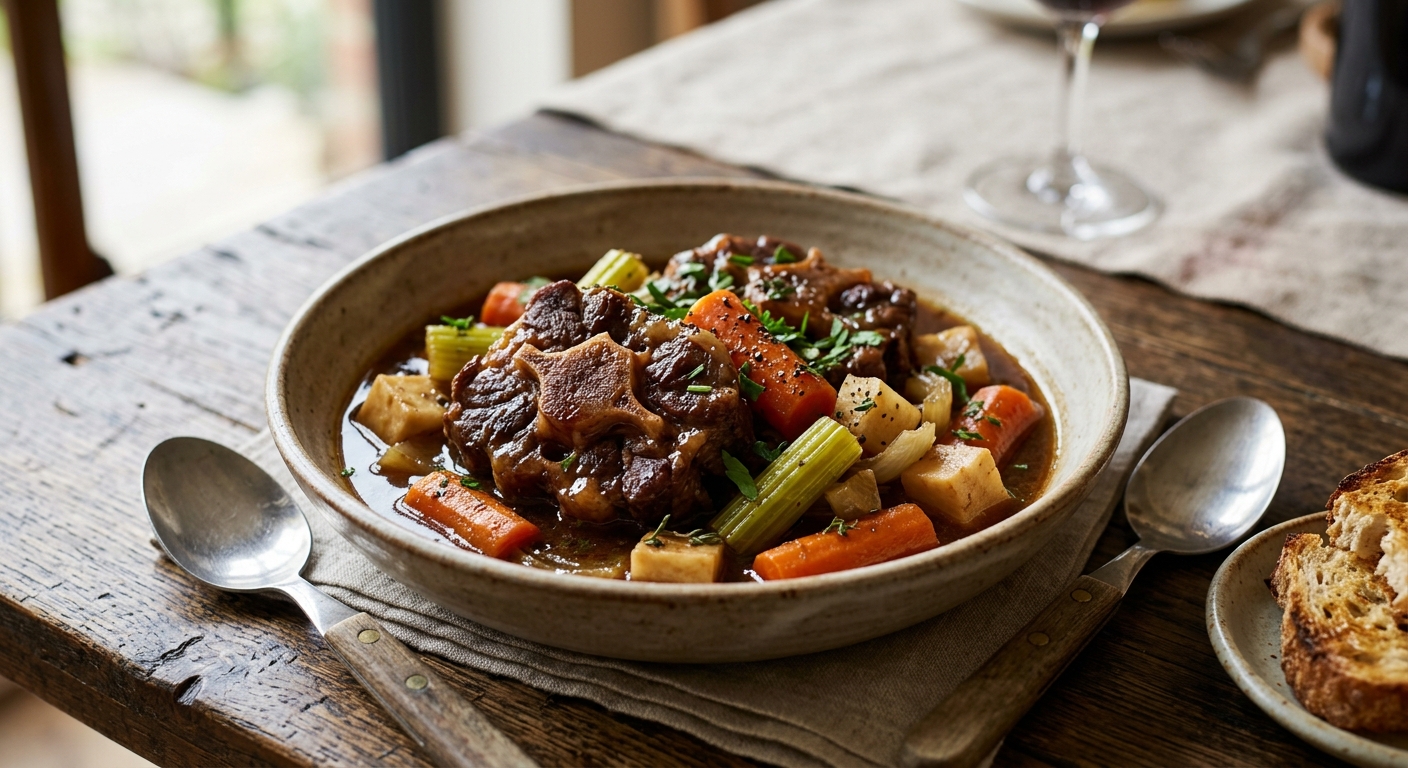
Oxtail is one of the most nutritionally compelling cuts of meat available, yet it remains criminally underutilized in modern kitchens. Rich in cartilage, connective tissue, and marrow, it releases extraordinary quantities of collagen and gelatin during long, slow cooking, along with a concentrated mineral profile that includes calcium, phosphorus, magnesium, zinc, and iron. This is not a trendy supplement in capsule form. This is the real thing, built by slow heat, time, and a handful of aromatic vegetables.
The dish draws on classic French and Caribbean braising traditions, where oxtail has long been prized precisely because of what makes it challenging: its high collagen content. As the cut cooks low and slow, that collagen hydrolyzes into gelatin, which thickens the braising liquid into a luxuriously glossy sauce that coats every piece of meat. The resulting broth is extraordinarily rich in glycine, proline, and hydroxyproline, the amino acids that serve as direct precursors to the body’s own collagen synthesis in cartilage, tendons, and skin.
From a culinary standpoint, the aromatics here do serious nutritional work as well. Tomato paste provides lycopene and vitamin C to support iron absorption. Carrots and celery root contribute beta-carotene and potassium. Red wine adds resveratrol and quercetin. Every element of this recipe is chosen to maximize both flavor depth and the synergistic bioavailability of the nutrients being delivered.
4
servings
Ingredients
- 1400 goxtail pieces (about 4 cm thick), trimmed of excess surface fat
- 2 tbspextra-virgin olive oil
- 1 largeyellow onion, roughly chopped
- 3 mediumcarrots, cut into 3 cm chunks
- 3 stalkscelery, cut into 3 cm pieces
- 200 gcelery root (celeriac), peeled and cut into 3 cm cubes
- 6 clovesgarlic, lightly crushed
- 3 tbsptomato paste
- 250 mldry red wine (such as Merlot or Cabernet Sauvignon)
- 700 mlbeef bone broth (unsalted, homemade or store-bought)
- 2 sprigsfresh rosemary
- 3 sprigsfresh thyme
- 2 wholebay leaves
- 1 tspblack peppercorns, lightly cracked
- 1 tbspapple cider vinegar
- 1 tbsptomato paste
- —Colima Sea SaltMicroplastic Free Salt and freshly ground black pepper to taste
- —Fresh flat-leaf parsley, roughly chopped, to serve
Instructions
Click on an item below to shop for the recommended items for this recipe on Amazon.
As an Amazon Associate, we earn from qualifying purchases.
- Pat oxtail pieces completely dry with paper towels and season generously on all sides with fine sea salt and black pepper. Dry meat browns far more effectively than wet meat, and deep browning here is the single biggest driver of complex flavor in the final dish.
- Heat the olive oil in a large Dutch oven over medium-high heat until shimmering but not smoking. Working in two batches to avoid crowding, sear the oxtail for 3 to 4 minutes per side until a deep mahogany crust forms on all sides. Do not rush this step. Transfer browned pieces to a plate and set aside. Pour off all but 1 tablespoon of fat from the pot.
- Reduce heat to medium. Add the onion, carrots, celery, and celery root to the pot. Cook, stirring occasionally, for 8 to 10 minutes until the vegetables are softened and beginning to caramelize at the edges. Add the crushed garlic and cook for a further 90 seconds until fragrant.
- Push the vegetables to the sides of the pot. Add the tomato paste directly to the center and let it cook, undisturbed, for 2 minutes until it darkens slightly and smells slightly sweet and concentrated. This caramelization removes raw acidity and deepens umami. Stir to combine the paste with the vegetables.
- Pour in the red wine and use a wooden spoon to scrape up all the browned bits from the bottom of the pot. These fond deposits are packed with flavor compounds. Let the wine simmer vigorously for 3 to 4 minutes to cook off the alcohol and reduce by about one third.
- Return the browned oxtail to the pot, nestling the pieces among the vegetables. Pour in the beef bone broth and apple cider vinegar. The liquid should come about two thirds of the way up the oxtail. Add the rosemary, thyme, bay leaves, and cracked peppercorns. Bring to a gentle boil.
- Reduce the heat to the lowest setting that maintains a very gentle simmer, cover tightly, and cook for 3 to 3.5 hours. Check every 45 minutes to make sure the liquid is barely moving, not boiling, and to turn the oxtail pieces. The braise is ready when the meat yields completely to gentle pressure and the collagen has dissolved into the broth, making it visibly glossy and slightly thick.
- Using tongs, transfer the oxtail to a warm platter and cover loosely with foil. Discard the herb sprigs and bay leaves. If you prefer a more refined sauce, strain the braising liquid through a fine-mesh sieve, pressing the vegetables through if desired. For a rustic presentation, simply skim the surface fat with a spoon. Taste and adjust seasoning, then spoon the broth over the oxtail and finish with fresh parsley.
- Pat the oxtail pieces completely dry and season generously with salt and pepper. Heat olive oil in a large skillet over medium-high heat. Sear the oxtail in two batches, 3 to 4 minutes per side, until deeply browned on all surfaces. Transfer directly to the slow cooker insert. Drain excess fat from the skillet, leaving about 1 tablespoon.
- In the same skillet over medium heat, cook the onion, carrots, celery, and celery root for 6 to 8 minutes, stirring occasionally, until softened. Add the garlic and cook for 1 minute. Add the tomato paste to the center of the pan and cook for 90 seconds until darkened. Pour in the red wine and scrape up all browned bits. Simmer for 3 minutes to reduce slightly, then pour the entire contents of the skillet over the oxtail in the slow cooker.
- Pour the beef bone broth and apple cider vinegar over the contents of the slow cooker. The liquid should reach about halfway up the oxtail pieces. Tuck in the rosemary, thyme, bay leaves, and cracked peppercorns. Because the slow cooker traps steam and builds moisture, you need less liquid than the stovetop version. Avoid the temptation to add more.
- Place the lid on the slow cooker and cook on Low for 8 to 10 hours or on High for 5 to 6 hours. Resist lifting the lid during the first 6 hours of Low cooking, as each lid removal adds 20 to 30 minutes of recovery time. The oxtail is done when the meat pulls away from the bone with almost no resistance and the broth appears deep amber and slightly syrupy.
- Carefully transfer the oxtail pieces to a warm serving platter using tongs. Discard the herb sprigs and bay leaves. Pour the braising liquid into a wide saucepan and bring to a brisk simmer over medium-high heat on the stovetop. Reduce for 8 to 12 minutes until slightly concentrated and glossy, as slow cooker braises typically produce more liquid than needed. Skim surface fat, adjust seasoning, and spoon generously over the oxtail. Serve with fresh parsley.
- Set a 6-quart or larger pressure cooker or Instant Pot to Saute mode on High (or use the stovetop pressure cooker over medium-high heat). Pat the oxtail dry, season well, and sear in two batches in the olive oil for 3 to 4 minutes per side until deeply browned. Transfer to a plate. The Instant Pot insert retains heat well, so avoid overcrowding during searing to prevent steaming.
- Without removing the insert, add the onion, carrots, celery, and celery root to the pot with the residual fat. Saute for 5 minutes, stirring occasionally, until softened. Add the garlic and cook for 1 minute. Add the tomato paste and stir for 90 seconds until it darkens. Pour in the red wine and deglaze thoroughly, scraping every bit of fond from the bottom of the insert. This step is especially important in pressure cookers: any stuck-on residue can trigger a burn warning.
- Reduce the Saute mode to Normal. Let the wine reduce for 2 minutes, then add the beef bone broth, apple cider vinegar, rosemary, thyme, bay leaves, and cracked peppercorns. Use only 600 ml of the broth (rather than the full 700 ml), as pressure cooking generates no evaporation. Return the seared oxtail to the pot, arranging pieces in an even layer.
- Secure the lid and set the valve to Sealing. Cook on Manual High Pressure for 55 minutes. Once the cook time is complete, allow the pressure to release naturally for at least 20 minutes before carefully switching the valve to Venting to release any remaining steam. Open the lid away from you.
- Transfer the oxtail to a warm platter. Discard herbs and bay leaves. Set the pot back to Saute on High and reduce the braising liquid for 6 to 10 minutes, stirring occasionally, until it is glossy and coats the back of a spoon. The reduction is faster than the stovetop version because less liquid has evaporated during cooking and the concentration of gelatin is high, meaning the sauce thickens quickly. Taste, adjust seasoning, and serve over the oxtail with fresh parsley.
- Preheat your oven to 160C (325F) with a rack positioned in the lower third of the oven. Pat the oxtail completely dry and season generously with salt and pepper. Heat olive oil in a large Dutch oven or heavy ovenproof braising pot over medium-high heat on the stovetop. Sear the oxtail in two batches for 3 to 4 minutes per side until deeply browned. Transfer to a plate.
- Reduce heat to medium. Add the onion, carrots, celery, and celery root to the pot and cook for 8 minutes until softened and lightly caramelized. Add the garlic and cook for 90 seconds. Press the tomato paste into the center and cook, without stirring, for 2 minutes until it turns a deeper brick-red. Deglaze with the red wine, scraping the pot clean, and let it reduce for 4 minutes.
- Return the oxtail to the pot. Pour over the beef bone broth and apple cider vinegar, add the rosemary, thyme, bay leaves, and peppercorns, and bring the liquid to a gentle simmer on the stovetop. Cut a piece of parchment paper (cartouche) to fit just inside the pot and lay it directly on the surface of the liquid before placing the lid on. This dual cover reduces evaporation while still allowing a small amount of steam to escape, concentrating the broth without drying the meat.
- Transfer the covered pot to the preheated oven. Braise undisturbed for 2 hours, then check the liquid level. The surface of the oxtail should be exposed and beginning to caramelize from the radiant oven heat above the liquid line, while the submerged portion continues to gently braise. If the liquid has reduced below halfway up the meat, add 100 ml of warm water or additional broth.
- Continue braising for a further 45 minutes to 1 hour, lid off for the last 20 minutes to allow the exposed surfaces of the oxtail to deepen in color and the sauce to concentrate. The dish is ready when the meat is completely tender, the bones have begun to loosen naturally, and the braising liquid is glossy, deep amber, and richly aromatic. Remove the pot from the oven, discard the herb sprigs and bay leaves, and rest the oxtail in the liquid for 10 minutes before serving with fresh parsley.
Nutrition Breakdown
Per 1 serving (makes 4)
Vitamins & Minerals
% Daily Value based on a 2,000 calorie diet (FDA reference)
🧬 Essential Amino Acids
% of recommended daily intake (RDA) per serving
🛡 Antioxidant Profile
The Nutrition Science
The nutritional headline of oxtail is collagen, but the science is more precise than that word implies. Oxtail is extraordinarily rich in type I and type III collagen, the fibrillar collagens that form the structural matrix of cartilage, tendons, ligaments, and bone. During prolonged moist-heat cooking, the triple-helix structure of collagen unwinds and hydrolyzes into gelatin, which is then suspended in the braising liquid. When consumed, this gelatin is digested into small peptides, particularly dipeptides containing hydroxyproline, that are absorbed intact through the intestinal wall and accumulate in cartilage tissue. Multiple randomized controlled trials using collagen hydrolysate supplementation have demonstrated reductions in joint pain scores, and food-derived gelatin from bone-in cuts like oxtail delivers the same peptide fractions at therapeutically relevant concentrations.
The mineral content of this dish is supported by a well-understood mechanism: acidic ingredients accelerate the leaching of calcium, phosphorus, and magnesium from the bone matrix into the braising liquid. This is why apple cider vinegar is included in this recipe. Even a modest acidic environment, pH reduced to roughly 5.5 to 6.0 in the braise, increases mineral solubility from bone significantly over the course of a multi-hour cook. Zinc, present at over 100% DV per serving from the oxtail meat itself, is essential as a cofactor for prolyl hydroxylase, the enzyme that hydroxylates proline residues during collagen synthesis. Without adequate zinc, the body cannot produce properly cross-linked collagen regardless of amino acid availability.
The combination of vitamin B12 at 150% DV and complete essential amino acids makes this a rare single-dish source of all the building blocks required for connective tissue and red blood cell synthesis simultaneously. The co-presence of dietary fat from the braising oil and marrow ensures that the fat-soluble antioxidants, particularly lycopene from the tomato paste and beta-carotene from the carrots, are absorbed at their maximum bioavailability, since these carotenoids require micellar solubilization with dietary fat for efficient transport across the enterocyte membrane.
Pro Tips
- For the most mineral-rich broth, ask your butcher for oxtail pieces cut from the thicker upper portion of the tail rather than the thin distal tip sections. The larger vertebrae contain proportionally more marrow and periosteal collagen.
- If time allows, prepare the dish one day ahead and refrigerate overnight. The fat will solidify on the surface and can be lifted off cleanly with a spoon, and the reheated broth will have an even more concentrated, gelled consistency that signals exceptional collagen content.
- The apple cider vinegar is not optional from a nutritional standpoint. Its mild acidity significantly increases the extraction of calcium and phosphorus from the bone matrix into the braising liquid during cooking. The flavor it contributes is imperceptible in the finished dish.


omg YES to this! my kids were actually deficient in zinc and iron (found out the hard way) and slow cooked oxtail became like my secret weapon because theyre actually willing to eat it unlike when i try to sneak in liver lol. the gelatin content is WILD and i love that youre highlighting how it actually rebuilds collagen instead of just taking a pill. quick question for you though – have you played around with adding any magnesium rich ingredients like pumpkin seeds or dark leafy greens to the broth itself, or does that change the flavor profile too much?
Love this post, and Diane I’m so glad you found something your kids actually enjoy because that’s half the battle right there! Oxtail is such a powerhouse that gets slept on in mainstream nutrition talk, but it’s been a cornerstone in so many African and Caribbean kitchens for generations specifically because of that collagen and mineral density you’re talking about. Carey, for inflammation concerns, the slow cooking is actually your friend since low and slow breaks down the connective tissue into gelatin rather than leaving it dense, but you might also try sipping just the broth first during remission to see how your body responds before jumping into the meat itself. The bone marrow and cartilage are where most
okay so this looks amazing but im nervous about the connective tissue content triggering a flare, how do you handle the fat breakdown in your recipe? during remission ive actually done really well with slow cooked bone broths but the collagen and gelatin can be rough on my gut when im even slightly inflamed, so im curious if theres a way to make this more flare-friendly without losing the mineral density youre talking about. the mineral profile alone makes me want to try it though because my iron is always tanked after flares.