
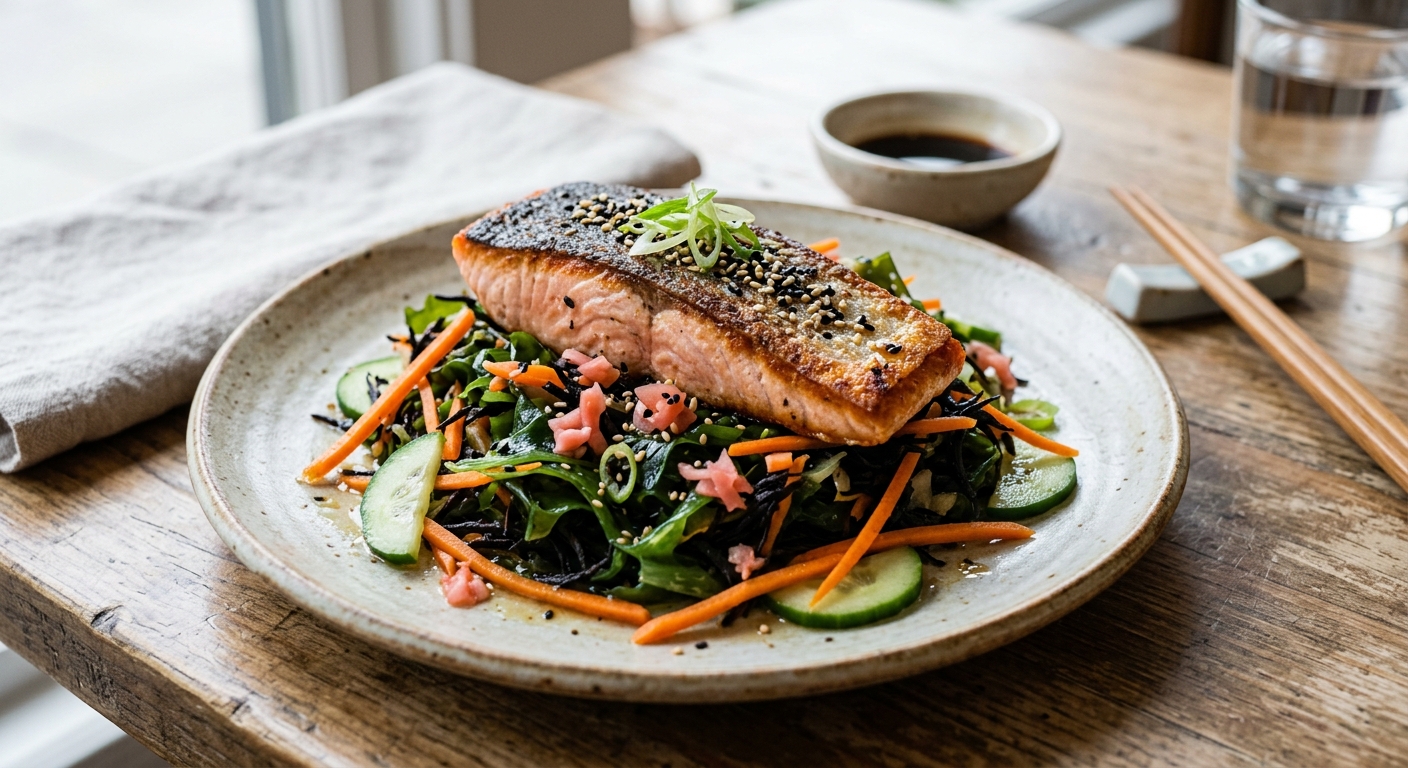
Your thyroid is a 25-gram butterfly-shaped gland that controls the metabolic rate of every cell in your body, yet most people chronically under-fuel it. The two non-negotiable nutrients it depends on are iodine and selenium, and this recipe delivers both in clinically meaningful amounts. Dried wakame seaweed provides roughly 630 micrograms of iodine per serving, sitting comfortably within the safe upper intake range of 1,100 mcg while blowing past the RDA of 150 mcg, and wild Atlantic salmon contributes 36 to 40 micrograms of selenium to activate the deiodinase enzymes that convert inactive T4 thyroid hormone into the metabolically active T3 form.
Beyond thyroid support, this bowl is a study in culinary contrast and nutritional synergy. The umami depth of rehydrated wakame and hijiki seaweed is balanced by the brightness of rice vinegar, the warmth of toasted sesame oil, and the sharp sweetness of pickled ginger. Thinly sliced cucumber and shredded carrots add crunch and beta-carotene, while a sesame-soy dressing ties every element together. The salmon is treated with care in each cooking method, whether seared hard in a cast iron pan for a lacquered crust, gently poached in a slow cooker bath of dashi and mirin, or pressure-steamed to silky perfection in minutes, ensuring that temperature-sensitive omega-3 fatty acids and B vitamins are preserved as much as possible.
This recipe is calibrated for four servings and scales effortlessly. If you are cooking for a weeknight family dinner, the stovetop method is fastest and most theatrical. If you want the salmon ready without watching the stove, the slow cooker poach is almost entirely hands-off. And on days when time is your scarcest resource, the pressure cooker delivers a complete, restaurant-quality bowl in under 25 minutes from cold ingredients to plated dish. Whichever path you choose, you are delivering your thyroid the raw materials it needs to keep your metabolism humming.
4
servings
Ingredients
- 600 gskin-on wild Atlantic salmon fillets (4 x 150g portions)
- 30 gdried wakame seaweed
- 10 gdried hijiki seaweed
- 1 largeEnglish cucumber, halved lengthways and thinly sliced
- 2 mediumcarrots, peeled and julienned or coarsely grated
- 4 tbsppickled ginger (gari), roughly chopped
- 3 tbsplow-sodium soy sauce or tamari
- 3 tbspunseasoned rice vinegar
- 2 tbsptoasted sesame oil
- 1 tbsphoney or pure maple syrup
- 2 tspfresh ginger, finely grated
- 2 clovesgarlic, finely minced
- 2 tbsptoasted sesame seeds (mixed black and white)
- 3 stalksspring onions (scallions), thinly sliced
- 2 tbspAvocado Oil100% Pure Avocado Oil (for searing, stovetop only)
- 500 mldashi stock or low-sodium vegetable broth (for slow cooker and pressure cooker)
- 2 tbspmirin
- 1 tbsplow-sodium soy sauce (extra, for poaching liquid)
- —Colima Sea SaltMicroplastic Free Salt and white pepper to taste
- —1 sheet nori, cut into thin strips, to garnish
- —Chilli flakes or shichimi togarashi to taste (optional)
Instructions
Click on an item below to shop for the recommended items for this recipe on Amazon.
As an Amazon Associate, we earn from qualifying purchases.
- Rehydrate the seaweed: Place the dried wakame and hijiki in two separate bowls of cold water. Let them soak for 10 minutes while you prep the remaining ingredients. Wakame will expand dramatically to about 5 times its dry volume. Drain both seaweeds thoroughly, gently squeeze out excess water, and set aside. If the hijiki strands are very long, give them a rough chop.
- Make the sesame-soy dressing: In a small bowl, whisk together the soy sauce, rice vinegar, toasted sesame oil, honey, grated fresh ginger, and minced garlic until the honey is fully dissolved. Taste and adjust the balance of salt, acid, and sweetness to your preference. Set aside.
- Assemble the cold salad base: In a large mixing bowl, combine the drained wakame, hijiki, sliced cucumber, julienned carrots, pickled ginger, and spring onions. Pour two-thirds of the dressing over the salad and toss gently to coat every strand and slice. Transfer to a serving platter or individual bowls and refrigerate while you cook the salmon.
- Sear the salmon: Pat the salmon fillets completely dry with paper towels, this is the single most important step for achieving a crisp crust. Season the flesh side generously with sea salt and white pepper. Heat a large cast iron or stainless steel skillet over high heat until it begins to smoke lightly. Add the avocado oil and swirl to coat. Lay the salmon fillets skin-side down in the pan. Press each fillet gently for the first 10 seconds with a spatula to prevent curling. Reduce heat to medium-high and cook undisturbed for 4 to 5 minutes until the skin is deep golden and releases cleanly from the pan.
- Flip and finish: Turn each fillet once and cook for a further 2 to 3 minutes for medium, or until the internal temperature reaches 52 to 55 degrees Celsius (125 to 130 F) for a silky, just-cooked centre, or 60 degrees C (140 F) for fully cooked through. Remove from the pan and rest for 2 minutes on a wire rack.
- Plate and serve: Place one salmon fillet, skin-side up to keep it crisp, on top of each seaweed salad portion. Drizzle the remaining dressing over the salmon. Garnish with toasted sesame seeds, nori strips, and a pinch of shichimi togarashi if using. Serve immediately.
- Build the poaching liquid: In the slow cooker insert, combine the dashi stock, mirin, and the extra tablespoon of soy sauce. Stir briefly to mix. Cut a piece of baking paper (parchment) to fit the base of the insert and press it down, this prevents the delicate salmon skin from sticking and makes lifting the fillets out much easier.
- Prep and season the salmon: Pat the salmon fillets dry and season lightly on both sides with sea salt and white pepper. Arrange them in a single layer in the slow cooker, skin-side down, ensuring they do not overlap. The poaching liquid should come about halfway up the sides of the fillets. If your fillets are thick, add a splash more dashi.
- Poach on Low: Cover with the lid and cook on Low for 1 hour 15 minutes to 1 hour 30 minutes. Check at the 1 hour 15 minute mark. The salmon is ready when it is opaque throughout and flakes gently when pressed with a finger but still looks moist and barely set at the centre. Because slow cookers vary, begin checking 15 minutes early to avoid overcooking.
- Prepare the seaweed salad during the final 20 minutes of cooking: Rehydrate the wakame and hijiki in cold water for 10 minutes, drain and squeeze dry. Whisk together the soy sauce, rice vinegar, toasted sesame oil, honey, grated ginger, and garlic to make the dressing. Toss the seaweed with the cucumber, carrots, pickled ginger, spring onions, and two-thirds of the dressing. Divide across four bowls.
- Lift, glaze, and serve: Using the baking paper as a sling or a wide slotted spatula, carefully transfer each salmon fillet onto the dressed salad. Spoon 1 to 2 tablespoons of the warm, aromatic poaching liquid over each fillet as a light broth glaze. Drizzle the remaining sesame dressing over the top. Finish with sesame seeds, nori strips, and chilli flakes to taste.
- Set up the steaming environment: Pour the dashi stock, mirin, and extra soy sauce into the inner pot of your pressure cooker or Instant Pot. Place the metal trivet or a steamer basket inside. The liquid should sit below the trivet without touching the salmon. If you do not have a trivet, fold a long strip of aluminium foil into a thick coil to elevate the fish.
- Season and position the salmon: Pat the salmon fillets dry and season both sides with sea salt and white pepper. Lay them skin-side down on the trivet in a single layer. If they overlap slightly at the tail ends, that is acceptable for this method, as steam surrounds the fish from all sides.
- Pressure cook: Secure the lid and set the valve to Sealing. Select Manual or Pressure Cook on High Pressure and set the timer for 3 minutes. The pot will take approximately 8 to 10 minutes to come to full pressure before the countdown begins.
- Quick release and rest: As soon as the 3-minute timer finishes, carefully switch the valve to Venting for a quick pressure release. This is important because leaving the salmon under residual steam will overcook it. Once the pin drops, open the lid away from you. The salmon should be opaque and just cooked through with a slightly silky centre.
- Assemble the salad while the pressure builds: During the pressurisation phase, soak and drain the wakame and hijiki, then whisk together the sesame dressing ingredients. Toss the seaweed, cucumber, carrots, pickled ginger, and spring onions with two-thirds of the dressing and divide into four bowls.
- Finish and plate: Lift each salmon fillet gently with a wide spatula and place on top of the prepared salad. Ladle a spoonful of the fragrant steaming broth from the pot over each portion for extra umami depth. Drizzle with the remaining dressing, top with sesame seeds, nori strips, and chilli flakes, and serve immediately.
- Preheat and prepare the baking sheet: Place your oven rack in the upper-middle position and preheat to 200 degrees Celsius (400 F) with convection fan if available. Line a rimmed baking sheet with a sheet of aluminium foil, then lay a piece of baking paper on top (the foil conducts heat evenly while the parchment prevents sticking). Lightly brush the parchment with a thin layer of avocado oil.
- Make a roasting glaze: In a small bowl, mix 1 tablespoon of the soy sauce with 1 teaspoon of the honey and 1 teaspoon of the toasted sesame oil. This is a concentrated version of the dressing that will caramelise onto the salmon surface in the oven. Set aside. Make the full sesame dressing separately as per the ingredient list for finishing the salad.
- Season and glaze the salmon for roasting: Pat the salmon fillets completely dry. Season flesh side with sea salt and white pepper. Brush each fillet generously on the flesh side with the roasting glaze. Place the fillets skin-side down on the prepared baking sheet, spacing them at least 2 cm apart so hot air can circulate.
- Roast with a mid-cook glaze: Slide the baking sheet into the oven and roast for 7 minutes. Remove briefly, apply a second brush of the roasting glaze to the flesh side, and return to the oven for a further 5 to 8 minutes. The salmon is done when the glaze is deep golden and slightly sticky, the flesh flakes easily at the thickest point, and the internal temperature reads 55 to 60 degrees Celsius (130 to 140 F) depending on your preferred doneness.
- Prepare the salad base during roasting: While the salmon is in the oven, rehydrate the wakame and hijiki in cold water for 10 minutes, then drain and squeeze dry. Toss with the sliced cucumber, julienned carrots, pickled ginger, and spring onions. Whisk together the remaining dressing ingredients and coat the salad with two-thirds of it. Divide across four plates or bowls.
- Rest, plate, and finish: Remove the salmon from the oven and let it rest on the baking sheet for 2 minutes, this allows the juices to redistribute and the glaze to set. Use a thin spatula to slide under each fillet and place on top of the dressed salad. Drizzle with remaining dressing, top with sesame seeds, nori strips, and optional chilli flakes. Serve warm.
Nutrition Breakdown
Per 1 serving (makes 4)
Vitamins & Minerals
% Daily Value based on a 2,000 calorie diet (FDA reference)
🧬 Essential Amino Acids
% of recommended daily intake (RDA) per serving
🛡 Antioxidant Profile
The Nutrition Science
The thyroid gland synthesises two hormones, thyroxine (T4) and triiodothyronine (T3), using iodine as the literal atomic building block. Each T4 molecule contains four iodine atoms; each T3 molecule contains three. Without adequate iodine, hormone synthesis falls and the pituitary responds by releasing more thyroid-stimulating hormone (TSH), driving thyroid tissue to hypertrophy and producing the swelling known as goitre. The wakame in this recipe delivers approximately 630 micrograms of iodine per serving, safely below the 1,100 mcg tolerable upper intake level established by the Institute of Medicine while providing more than four times the 150 mcg RDA. Crucially, this iodine arrives in an organic matrix alongside sodium alginate, a soluble fibre that moderates absorption rate and reduces the risk of the acute iodine flush that can paradoxically suppress thyroid function (the Wolff-Chaikoff effect) seen with sudden high-dose supplementation.
Selenium is iodine’s metabolic partner and is frequently overlooked in thyroid nutrition. The deiodinase enzymes that convert the relatively inactive T4 into the three-times-more-potent T3 are selenoproteins, meaning selenium is structurally incorporated into their active sites. Wild Atlantic salmon is one of the richest food sources of bioavailable selenium at approximately 36 to 40 micrograms per 150-gram serving, and this recipe reaches approximately 48 micrograms per serving when the sesame and other ingredients are included. The selenium also activates glutathione peroxidase (GPx), which detoxifies the hydrogen peroxide generated during thyroid hormone synthesis, protecting thyroid follicular cells from the oxidative byproduct of their own work.
The omega-3 fatty acids EPA and DHA from the salmon contribute an additional metabolic dimension by reducing the chronic low-grade inflammation that can impair thyroid receptor sensitivity, a condition where circulating T3 is adequate but cells fail to respond to it. Research published in the journal Thyroid has shown that omega-3 supplementation improves peripheral tissue sensitivity to thyroid hormones and reduces TSH in subjects with subclinical hypothyroidism. Combined with fucoxanthin from the wakame, which independently activates uncoupling protein 1 (UCP1) in brown adipose tissue to raise resting metabolic rate, this dish represents a genuinely evidence-based approach to nutritional thyroid support rather than wellness marketing.
Pro Tips
- Seaweed iodine content varies significantly by species and harvest region. Wakame (Undaria pinnatifida) is one of the most predictably dosed at 42 to 50 mcg per gram dry weight, making it a safer choice than kombu, which can exceed 2,000 mcg per gram and push a single serving above the tolerable upper intake level.
- To preserve the maximum omega-3 content in the salmon, avoid cooking beyond an internal temperature of 60 degrees Celsius (140 F). The EPA and DHA in salmon are vulnerable to oxidation above this point, and the silky texture at 55 degrees C is a genuine culinary bonus as well as a nutritional advantage.
- Toast your sesame seeds in a dry pan over medium heat for 2 to 3 minutes, shaking frequently, until fragrant and just turning golden. This releases the volatile aromatic compounds including sesaminol and sesamol and dramatically intensifies their flavour contribution to the dressing compared to pre-toasted store-bought seeds.



oh this is so my kind of recipe! ive been adding nori sheets to our family meals for months now but i never thought to make it the star of a whole bowl like this, and the iodine angle is huge for supporting my oldest’s focus during school. quick question though – do you know if the iodine content changes much when seaweed is raw vs lightly cooked? im curious because my kids will actually eat this when its a fun “sushi bowl” situation but theyd totally reject it if it felt too “healthy” lol. also wondering about the bioavailability with the salmon’s omega-3s layered in there – im guessing the anti-inflammatory benefits stack even better
What a brilliant pairing! I haven’t explored seaweed for iodine support as much as I should, but I’m intrigued by how this recipe layers in so many anti-inflammatory benefits at once, the salmon especially. Since I’ve spent years tinkering with my diet for RA, I know firsthand how much thyroid function affects inflammation markers, CRP, the whole picture. I’m definitely making this with extra ginger (fresh and pickled, if I’m honest) and wondering if you’ve tested how the nori holds up nutritionally through the pickling process, or if you recommend fresh seaweed varieties for maximum iodine bioavailability? This is exactly the kind of functional
Oh this is so interesting that you connected thyroid function to RA inflammation – I’ve been tracking the same pattern with my IBS for years and noticed my gut symptoms spike when my metabolism dips! I’d love to know what you find with the extra ginger since I’ve had amazing results adding both fresh and pickled to meals (the fresh ginger seems to calm inflammation faster for me, but the pickled version has those prebiotic benefits from fermentation). The iodine bioavailability question is brilliant – I haven’t specifically tested nori through pickling, but I’ve noticed that lightly blanching or quick-pickling seems to preserve the iodine better than long fermentation? Definitely tagging