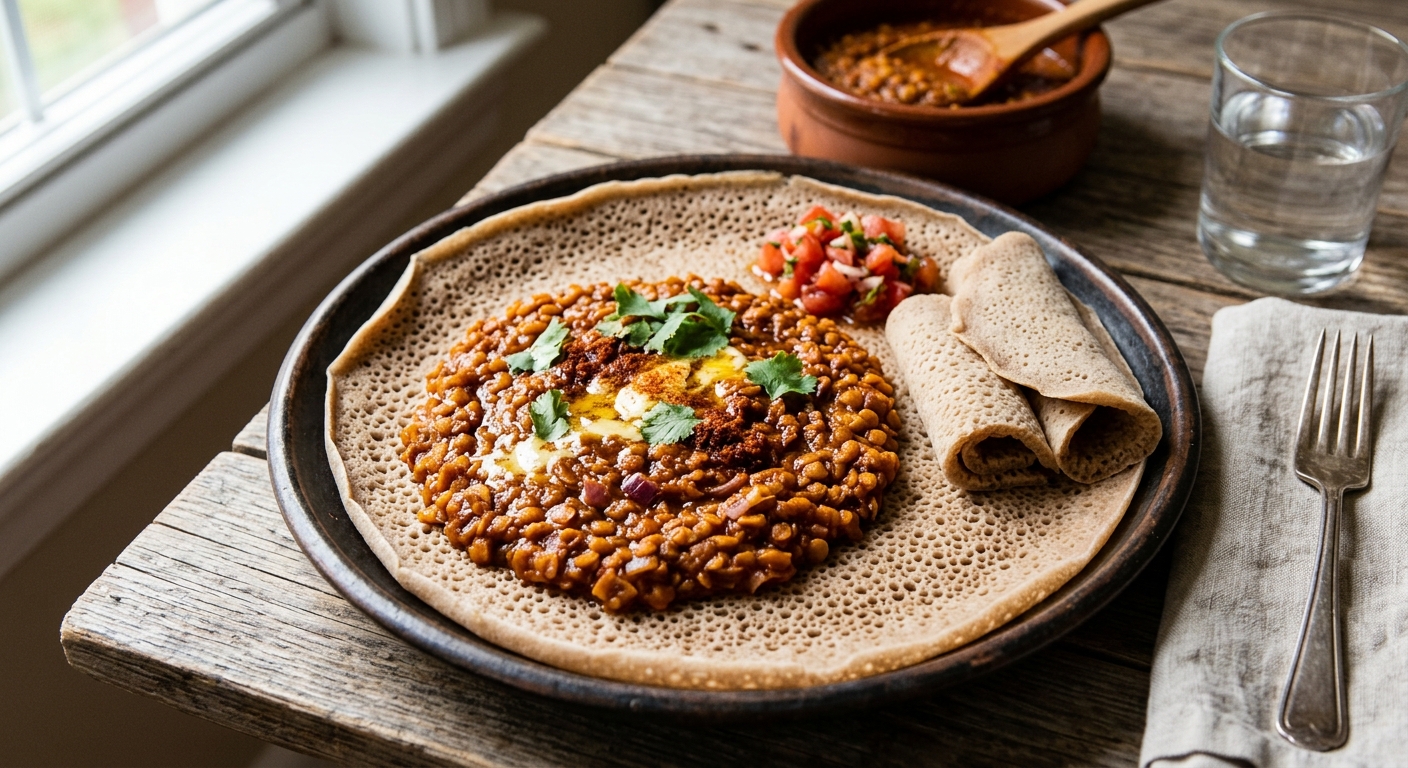
Few dishes on earth achieve the nutritional elegance of Ethiopian misir wot served over injera. The combination is not accidental: generations of Ethiopian cooks discovered that pairing iron-rich lentils with the mild acidity of fermented teff flour injera creates a meal that is both profoundly nourishing and impossibly delicious. The lactic acid in fermented injera batter and the vitamin C contributed by tomatoes and berbere spices work synergistically to enhance non-heme iron absorption, a mechanism food scientists now call a classic absorption-enhancing matrix.
The nutritional story here is dense and layered. One serving of this dish delivers approximately 7.6 mg of iron (42% DV), 380 mcg of folate (95% DV), meaningful amounts of thiamine, riboflavin, B6, and zinc, plus a striking array of polyphenol antioxidants from berbere spice blend, red onion, and tomato. Teff flour, the ancient Ethiopian grain used in injera, is one of the rare plant foods containing all eight essential amino acids in appreciable quantities, while red lentils contribute a complementary amino acid profile that fills teff’s modest lysine shortfall. Together, they form a near-complete protein.
Making injera from scratch requires advance planning, as the batter ferments for 24 to 48 hours, but the process is almost entirely hands-off. For those short on time, store-bought injera works beautifully and still delivers the full nutritional benefit of the teff flour base. The lentil stew, misir wot, is weeknight-friendly in all three cooking formats included here, and each method produces a subtly different texture and depth of flavor that makes the dish worth exploring more than once.
4
servings
Ingredients
- 300 gred lentils, rinsed and picked over
- 250 gteff flour (for injera batter)
- 300 mlwarm water (for injera batter)
- 1 tbspactive sourdough starter or plain yogurt whey (for injera fermentation)
- 3 tbspberbere spice blend
- 3 tbspniter kibbeh (Ethiopian spiced clarified butter) or Avocado Oil100% Pure Avocado Oil for vegan version
- 2 mediumred onions, very finely diced
- 4 clovesgarlic, minced
- 1 tbspfresh ginger, grated
- 2 tbsptomato paste
- 1 mediumripe tomato, finely chopped
- 700 mllow-sodium vegetable broth
- 1 tspground turmeric
- 1 tspground cumin
- 0.5 tspground fenugreek
- 1 tbspfresh lemon juice
- 15 gfresh cilantro, roughly chopped
- 1 tbspextra-virgin olive oil (for finishing)
- —Colima Sea SaltMicroplastic Free Salt and freshly ground black pepper to taste
- —Sliced green onions and lemon wedges, to serve
Instructions
Click on an item below to shop for the recommended items for this recipe on Amazon.
As an Amazon Associate, we earn from qualifying purchases.
- Make the injera batter at least 24 hours ahead (48 hours for more tang): Whisk together the teff flour, warm water, and sourdough starter or yogurt whey in a large bowl until completely smooth with no lumps. Cover loosely with a clean cloth and leave at room temperature (ideally 20 to 24 degrees C) to ferment. The batter is ready when it smells pleasantly sour and small bubbles are visible on the surface. Stir in a pinch of salt and 2 to 3 tablespoons of water to reach a consistency slightly thinner than crepe batter.
- Prepare the onion base for misir wot: Heat the niter kibbeh or oil in a heavy-bottomed Dutch oven or wide saucepan over medium-low heat. Add the diced red onions with a pinch of salt and cook, stirring frequently, for 18 to 22 minutes until the onions are deeply golden, jammy, and reduced to roughly one-third of their original volume. This dry-frying technique is traditional in Ethiopian cooking and builds a natural sweetness and body into the stew without any added sugar.
- Build the spice base: Increase heat to medium. Add the garlic and ginger to the caramelised onions and cook, stirring constantly, for 2 minutes. Add the berbere spice blend, turmeric, cumin, and fenugreek. Stir vigorously for 90 seconds, allowing the spices to toast in the fat and become intensely fragrant. Add the tomato paste and chopped tomato, stirring to combine, and cook for a further 3 minutes until the tomato has broken down and the mixture is deep red and paste-like.
- Cook the lentils: Add the rinsed red lentils to the pot and stir to coat them thoroughly in the spice base. Pour in the vegetable broth, increase heat to bring to a gentle boil, then reduce to a low simmer. Cover partially and cook for 20 to 25 minutes, stirring every 5 to 6 minutes to prevent sticking, until the lentils have fully dissolved into a thick, porridge-like stew. Add a splash of broth or water if it becomes too thick before the lentils are cooked through. Season with salt, pepper, and lemon juice.
- Cook the injera: Heat a large non-stick or well-seasoned cast iron skillet over medium-high heat until a drop of water skitters across the surface. Lightly oil the pan. Pour a ladleful of batter (about 120 ml) from the centre outward in a spiral to form a roughly 25 cm round. Immediately cover with a lid and cook for 2 to 3 minutes until the surface is completely set, no longer shiny, and small holes have formed throughout. Do not flip. Slide onto a plate and repeat with remaining batter, stacking injera with parchment between layers.
- Finish the stew and serve: Drizzle the finished stew with olive oil and scatter over fresh cilantro. Arrange one or two injera per person on large plates or a communal platter, folding or rolling them loosely. Spoon the hot misir wot generously over the centre of the injera. Serve immediately with lemon wedges and sliced green onions. Invite diners to tear pieces of injera and use them to scoop the stew in the traditional manner.
- Prepare the injera batter 24 to 48 hours ahead using the same fermentation method described in the Stovetop instructions. Store covered at room temperature until ready to cook injera.
- Create a flavour-forward spice paste before loading the slow cooker: In a small skillet over medium heat, warm 1 tablespoon of the niter kibbeh or oil and briefly saute the garlic, ginger, berbere, turmeric, cumin, and fenugreek for 90 seconds, stirring constantly. Add the tomato paste and cook for 1 minute more. This quick bloom step is critical when using a slow cooker because raw spices added directly to the pot can taste flat and dusty after hours of low-heat cooking.
- Load the slow cooker: Add the finely diced red onions to the base of the slow cooker insert. Pour in the remaining niter kibbeh or oil, the rinsed red lentils, the bloomed spice paste, the chopped tomato, and the vegetable broth. Stir everything together to combine. The liquid level should comfortably cover the lentils by at least 3 cm since red lentils absorb a significant amount of liquid during the extended cook time.
- Cook low and slow: Place the lid on the slow cooker and cook on Low for 6 to 7 hours or on High for 3 to 3.5 hours. Do not lift the lid during the first 4 hours (or first 2 hours on High), as this releases accumulated steam and can extend cooking time by 20 to 30 minutes. The stew is ready when the lentils have completely broken down into a thick, homogenous consistency and the broth has been largely absorbed. If the stew is thinner than you like, remove the lid for the final 30 minutes on High to reduce.
- Season and prepare injera: Stir in the lemon juice, season generously with salt and pepper, and fold in half the fresh cilantro. While the stew rests on Warm, cook the injera one at a time in a non-stick or cast iron skillet over medium-high heat following the spiral-pour, lid-covered, single-side technique described in the Stovetop steps. Stack finished injera with parchment between rounds.
- Serve: Drizzle the stew with olive oil and the remaining cilantro. Plate injera on a communal platter or individual plates and ladle the slow-cooked misir wot over the top. Offer lemon wedges and green onions on the side.
- Prepare injera batter 24 to 48 hours ahead as described in the Stovetop method. On cooking day, bring the fermented batter to room temperature and adjust its consistency with a little water if it has thickened.
- Use the Saute function (set to Normal or Medium heat) on the Instant Pot. Add the niter kibbeh or oil and, once shimmering, add the diced red onions with a pinch of salt. Saute for 10 to 12 minutes, stirring frequently, until the onions are golden and softened. This shorter caramelisation compared to the stovetop method is acceptable here because the pressure cooking process will further mellow and sweeten the onions during the cook cycle.
- Add the garlic, ginger, berbere, turmeric, cumin, and fenugreek directly to the pot. Stir constantly for 60 seconds until the spices are fragrant and coating the onions. Add the tomato paste and chopped tomato, stir for 1 minute, then press Cancel to stop the Saute function.
- Add the rinsed red lentils and pour in exactly 600 ml of the vegetable broth (slightly less than the stovetop amount to account for the sealed environment). Stir well to deglaze any browned bits from the bottom of the pot, which is essential to avoid triggering a burn warning. Ensure no dry spice clumps remain stuck to the base.
- Secure the lid and set the steam release valve to Sealing. Select Pressure Cook (or Manual) on High pressure for 8 minutes. Once the cycle completes, allow the pressure to release naturally for 10 minutes, then carefully switch the valve to Venting to release any remaining steam. Open the lid away from you.
- Stir the stew vigorously. The lentils should be fully broken down into a thick, porridge-like consistency. If the stew seems too loose, switch back to Saute (Low) and cook uncovered for 3 to 4 minutes, stirring continuously. Stir in the lemon juice, season with salt and pepper, and fold in the cilantro. While the stew rests on Keep Warm, cook injera on a stovetop skillet using the spiral-pour technique. Finish with a drizzle of olive oil and serve over fresh injera with lemon wedges.
- Prepare injera batter 24 to 48 hours ahead as described above. Preheat your oven to 170 degrees C (340 degrees F) with a rack positioned in the lower third of the oven. This lower rack position encourages gentle bottom heat and prevents the surface from drying out too quickly.
- On the stovetop, heat a large oven-safe Dutch oven or heavy braising pot over medium heat. Add the niter kibbeh or oil and the finely diced onions with a pinch of salt. Cook, stirring often, for 15 to 18 minutes until deeply golden and jammy. The stovetop pre-caramelisation is especially important here because the oven’s dry heat finishes rather than initiates this process.
- Increase stovetop heat to medium-high. Add garlic, ginger, berbere, turmeric, cumin, and fenugreek, stirring constantly for 90 seconds. Add the tomato paste and chopped tomato and cook for 3 minutes until the mixture darkens and pulls away slightly from the sides of the pot. This concentrated spice paste will slowly perfume the entire braise as it cooks in the oven.
- Add the rinsed red lentils to the pot and stir to coat in the spice base. Pour in 750 ml of the vegetable broth, a little more than for pressure cooking, as the oven’s dry ambient heat will evaporate more liquid through the lid. Bring to a gentle simmer on the stovetop, then cover the Dutch oven with its lid and transfer to the preheated oven.
- Braise for 55 minutes without disturbing. After 55 minutes, remove the lid and check consistency. The lentils should be fully dissolved into a thick, glossy stew. If it looks soupy, return to the oven uncovered for 10 to 15 additional minutes to reduce and concentrate further. If it looks too thick or has dried at the edges, stir in a splash of broth and replace the lid for 5 more minutes.
- Remove from the oven and stir in the lemon juice, salt, pepper, and half the cilantro. Let the stew rest, covered, for 5 minutes while you cook the injera on the stovetop using the lid-covered, spiral-pour technique. The brief rest allows the stew to reach its ideal thick, scoopable texture. Plate over fresh injera, finish with olive oil, the remaining cilantro, green onions, and lemon wedges.
Nutrition Breakdown
Per 1 serving (makes 4)
Vitamins & Minerals
% Daily Value based on a 2,000 calorie diet (FDA reference)
🧬 Essential Amino Acids
% of recommended daily intake (RDA) per serving
🛡 Antioxidant Profile
The Nutrition Science
The iron in this dish comes predominantly from two non-heme sources: red lentils (approximately 3.3 mg per 75g dry serving) and teff flour (approximately 2.7 mg per 65g serving of injera). Non-heme iron is inherently less bioavailable than heme iron from animal sources, typically absorbed at 2 to 20% depending on the meal matrix. However, Ethiopian culinary tradition intuitively solves this problem at two levels. First, the fermentation of teff batter reduces phytate content by up to 46%, removing the primary antinutrient that inhibits iron chelation in the intestinal lumen. Second, the lactic acid produced by fermentation, along with the tomato and lemon juice in the stew, creates an acidic environment in the stomach that keeps iron in its more soluble and absorbable ferrous (Fe2+) form.
The B-vitamin profile of this dish deserves particular attention. Folate (vitamin B9) is critical for one-carbon metabolism, DNA methylation, and the synthesis of new red blood cells. A single serving provides 380 mcg, nearly the full 400 mcg Dietary Reference Intake for adults. This is supplied primarily by red lentils, which are among the most folate-dense whole foods per calorie in the human diet. The presence of riboflavin (B2) and vitamin B6 alongside folate is nutritionally significant because these three B vitamins operate cooperatively in the methionine cycle, and a deficit in any one of them can limit the activity of the others regardless of individual intake levels.
Teff flour is nutritionally exceptional among staple grains. It contains approximately 11 to 13% protein by dry weight with a notably complete amino acid profile, including meaningful amounts of lysine, a limiting amino acid in most cereals. When combined with the complementary lysine richness of red lentils, the overall meal provides a complete essential amino acid spectrum with every EAA above 72% of the RDA per serving from plant sources alone. Additionally, teff’s resistant starch content (approximately 4.3g per 65g serving) acts as a prebiotic substrate that selectively feeds Bifidobacterium and Lactobacillus species in the colon, producing short-chain fatty acids that reinforce gut barrier integrity and dampen systemic inflammation.
Pro Tips
- To maximise iron absorption, avoid brewing tea or coffee within 1 hour of eating this meal. Tannins and chlorogenic acid in both beverages bind non-heme iron in the gut and can reduce absorption by 60 to 80%.
- If you cannot source niter kibbeh, make a quick approximation by gently melting unsalted butter with a pinch of turmeric, half a cinnamon stick, two cardamom pods, and a clove over low heat for 10 minutes, then straining it. For a fully vegan version, refined coconut oil carries the spices well without overpowering the berbere.
- For the most authentic and elastic injera texture, extend the fermentation time to 48 hours and use 100% teff flour without wheat additions. In cooler climates (below 18 degrees C), place the batter bowl inside your (turned-off) oven with just the oven light on to maintain a warm, stable fermentation environment.
- Store leftover misir wot separately from injera in an airtight container in the refrigerator for up to 4 days. The stew reheats beautifully with a splash of broth and actually intensifies in flavour on day two as the berbere spices continue to bloom.
- Berbere spice blend quality varies enormously between brands. For the best nutritional and flavour impact, look for blends that list chili, fenugreek, coriander, black pepper, ginger, and korarima (Ethiopian cardamom) in the first six ingredients. Avoid blends with salt listed first or that contain anti-caking agents, which dilute both the antioxidant load and the flavour.

omg the iron and folate combo in red lentils is HUGE for us endurance athletes – ive been experimenting with lentil based meals the day before long runs and my energy levels are noticeably more stable through like mile 8 and beyond, which honestly changes everything about how i fuel mid race. definitely trying this injera version because the carbs from the flatbread plus the iron density would be perfect for topping off glycogen stores without that heavy feeling you get from some pre run meals!
Oh Diane, I’m so glad you’re experiencing that energy shift – it’s wonderful what happens when we finally feed our bodies the micronutrients they’re actually asking for! I’m absolutely making this injera recipe for my next class because my students have been asking about plant-based iron sources, and the fact that red lentils pair the iron with vitamin C from those spices and the fermented bread for better absorption just feels like teaching nutrition the delicious way. The tanginess of injera is such a perfect match for bringing out those warm spice notes too, which I remember from trying to recreate Ethiopian food back in the 80s with all the wrong shortcuts – this version honors the real tradition while being so
okay this is RIGHT up my alley and im SO excited about those red lentils!! iron AND folate together is like a power duo for energy, especially since i was always dragging in the afternoons before i got serious about mineral density. my question is how kid friendly is this because my middle one is in a “beige food only” phase and im wondering if i could sneak the lentil stew into something she’d actually eat, or if the injera itself might be a gateway since its kinda fun and squishy? also does the spice level seem adjustable for little palates?