
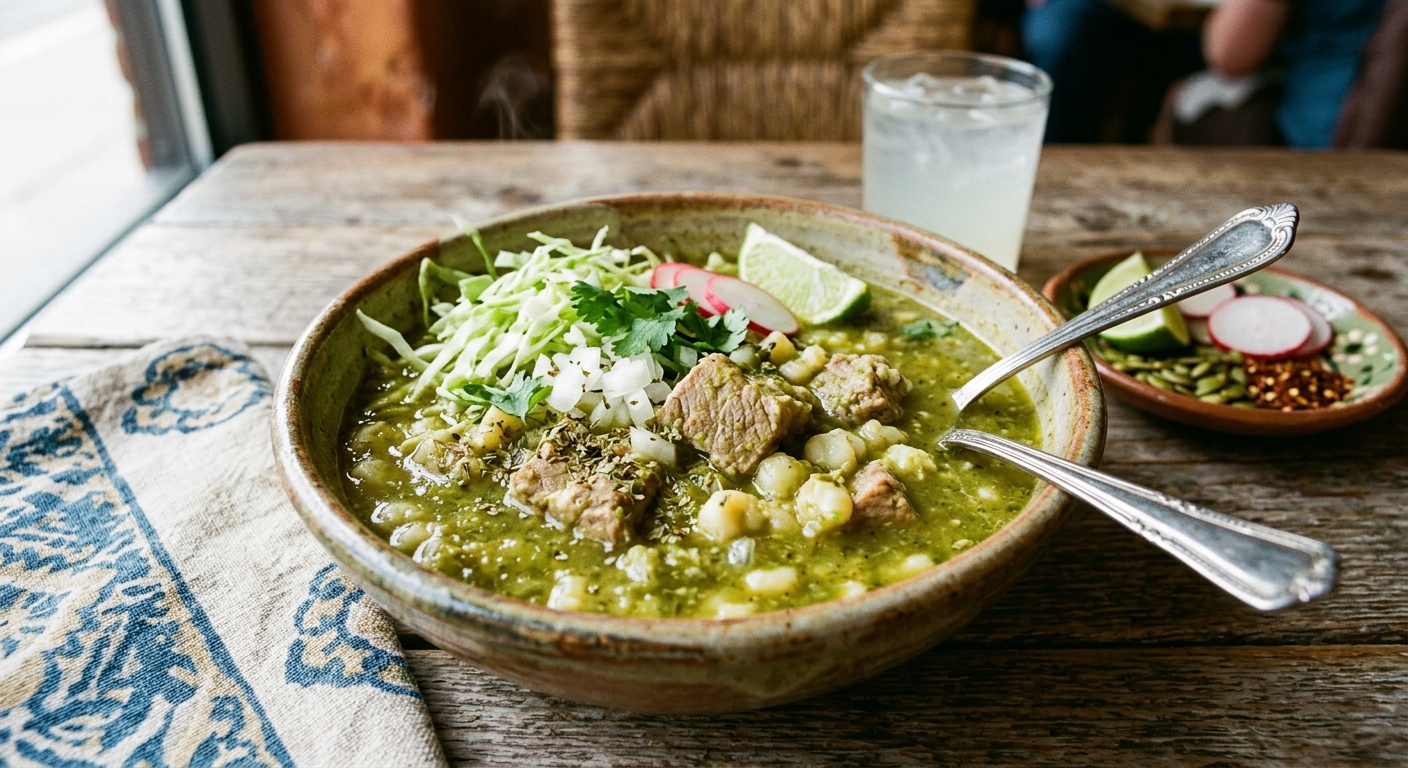
Pozole verde is one of Mexico’s most revered ceremonial dishes, and once you understand its nutritional architecture, it becomes clear why this broth has sustained civilizations for millennia. At its core, the dish hinges on hominy, which is dried maize treated with an alkaline solution of slaked lime in a process called nixtamalization. This ancient technique does something remarkable: it unlocks niacin bound within the corn’s pericarp, dramatically raises calcium bioavailability, and increases the amino acid profile of the grain. The result is a starchy, slightly chewy kernel that is nutritionally far superior to plain dried corn and forms the mineral-dense backbone of every bowl.
The verde component builds an equally impressive micronutrient case. Tomatillos bring a sharp, citrus-edged acidity along with vitamin C, vitamin K, and a suite of withanolides, a class of steroidal lactones with emerging evidence for anti-inflammatory action. Poblano peppers and serrano chiles add capsaicin, quercetin, and meaningful doses of vitamin B6, while a generous handful of pumpkin seeds stirred into the blended green sauce contributes zinc, magnesium, and healthy monounsaturated fats that help the dish achieve its commanding mineral profile. Together, these ingredients create a broth that is bright, herbaceous, slightly spicy, and deeply complex.
The pork shoulder is the final pillar. Braised low and slow until it surrenders into tender, pull-apart strands, it supplies complete protein, heme iron for superior absorption, selenium, and a full complement of B vitamins, particularly B12 and niacin. Combined with the hominy and green sauce, a single generous bowl of pozole verde delivers a nutritional profile that few dishes can match: it genuinely qualifies as a Mineral Matrix meal, hitting meaningful daily value thresholds for zinc, phosphorus, selenium, magnesium, iron, and potassium in one sitting. This is ancestral cooking validated by modern nutrition science.
6
servings
Ingredients
- 700 gboneless pork shoulder, trimmed and cut into 5cm cubes
- 800 gcanned hominy (pozole maize), drained and rinsed
- 500 gfresh tomatillos, husked and halved
- 2 largepoblano peppers, stems removed, roughly chopped
- 2 mediumserrano chiles, stems removed (seed for less heat)
- 1 largewhite onion, quartered (half for broth, half for sauce)
- 6 clovesgarlic, peeled
- 60 graw hulled pumpkin seeds (pepitas)
- 30 gfresh epazote leaves (or 2 tsp dried)
- 20 gfresh cilantro, stems and leaves
- 1 litrelow-sodium chicken or pork broth
- 500 mlwater
- 2 tbspAvocado Oil100% Pure Avocado Oil (avocado or grapeseed)
- 1 tspdried Mexican oregano
- 1 tspground cumin
- 2 tspColima Sea SaltMicroplastic Free Salt, plus more to taste
- —Freshly ground black pepper to taste
- —FOR SERVING: shredded cabbage, sliced radishes, dried oregano, lime wedges, tostadas, sliced avocado, finely diced white onion
Instructions
Click on an item below to shop for the recommended items for this recipe on Amazon.
As an Amazon Associate, we earn from qualifying purchases.
- Pat the pork cubes completely dry with paper towels and season generously on all sides with 1 teaspoon of salt and several grinds of black pepper. Heat a large Dutch oven (at least 6 litres) over medium-high heat, add the oil, and sear the pork in two batches without crowding the pan. Brown deeply on at least two sides, about 3 to 4 minutes per side. Transfer to a plate and set aside. Do not discard the rendered fat.
- Reduce the heat to medium. Add half the quartered onion and 3 garlic cloves to the pot and cook in the residual fat, stirring occasionally, for 3 to 4 minutes until softened and lightly charred at the edges. Pour in the chicken broth and 500ml water, scraping up all the browned fond from the bottom of the pot. Return the seared pork and any resting juices to the pot. Bring to a boil, then reduce to a gentle simmer. Partially cover and cook for 1 hour, skimming any foam or fat from the surface after the first 15 minutes.
- While the pork simmers, prepare the green sauce. Place the tomatillos, poblano peppers, serrano chiles, remaining onion quarter, remaining 3 garlic cloves, and pumpkin seeds on a dry heavy skillet or comal over medium-high heat. Dry-roast, turning occasionally, until the tomatillos are blistered and softened (8 to 10 minutes) and the peppers are charred in spots. Do not add oil. Transfer everything to a blender.
- Add the epazote, cilantro, cumin, oregano, and 1 ladleful (about 150ml) of the simmering pork broth to the blender. Season with the remaining teaspoon of salt. Blend on high until completely smooth, about 60 seconds. The sauce should be a vibrant, opaque green.
- After the pork has simmered for 1 hour, add the drained hominy to the pot. Stir to combine. Pour in the green sauce through a medium-mesh strainer, pressing with a spatula to extract maximum flavour while removing fibrous solids. Alternatively, blend until very smooth and add unstrained for a more rustic, thicker broth. Stir well.
- Continue simmering uncovered for a further 45 to 60 minutes, until the pork is completely tender and shreds easily when pressed with a spoon, and the hominy has bloomed and is soft throughout. Taste and adjust seasoning. If the broth is too thick, add water in 100ml increments. Using two forks or tongs, roughly shred the larger pork pieces directly in the pot.
- Ladle into deep bowls and serve immediately with all garnishes arranged on the side: shredded cabbage, sliced radishes, lime wedges, diced white onion, dried oregano, tostadas, and sliced avocado. Encourage diners to add their own toppings generously.
- Dry the pork cubes thoroughly and season with salt and pepper. In a large skillet over medium-high heat, warm the oil and sear the pork in two batches until deeply browned on two sides, about 3 to 4 minutes per side. Transfer directly to the slow cooker insert. Deglaze the skillet with 250ml of the measured broth, scraping up all the browned bits, and pour that liquid into the slow cooker.
- Add the remaining broth, the water, half the quartered onion (cut into wedges), 3 of the garlic cloves, 1 teaspoon of salt, dried oregano, and cumin to the slow cooker. Add the drained hominy and stir everything together. Cover and cook on Low for 5 to 6 hours or on High for 2 to 2.5 hours, until the pork is just beginning to turn tender but has not yet fully fallen apart.
- When the pork is partially tender, prepare the green sauce. Dry-roast the tomatillos, poblanos, serranos, the remaining onion, remaining garlic, and pumpkin seeds in a dry skillet over medium-high heat, turning occasionally, for 8 to 10 minutes until blistered and softened. Transfer to a blender with the epazote, cilantro, and 150ml of hot broth ladled from the slow cooker. Season with the remaining salt. Blend on high until very smooth.
- Pour the green sauce into the slow cooker and stir to incorporate it into the broth. Replace the lid and continue cooking on Low for a further 90 minutes to 2 hours, or on High for 1 hour. This shorter final phase preserves the sauce’s green colour and fresh herbal flavour rather than cooking it to a dull olive tone.
- When finished, the pork should be fully tender and shredding at the edges. Use two forks to pull the larger chunks apart directly in the insert. Taste and correct seasoning. Serve in deep bowls with all traditional garnishes alongside.
- Set the Instant Pot or electric pressure cooker to Saute mode on High. Add the oil and, once shimmering, sear the pork cubes in two batches until browned on two sides, about 3 to 4 minutes per side. Season with salt and pepper as you go. Remove the pork and set aside. Do not cancel Saute mode.
- Add half the quartered onion and 3 garlic cloves to the pot. Cook for 2 minutes, stirring, until softened. Pour in 200ml of the broth and scrape the bottom of the insert vigorously to release all browned bits. This step is critical to avoid a burn warning during pressurisation. Add the remaining broth, water, drained hominy, cumin, oregano, and remaining teaspoon of salt. Return the pork and any collected juices. Cancel Saute mode.
- While the pressure cooker pressurises, quickly dry-roast the tomatillos, poblanos, serranos, remaining onion, remaining garlic, and pumpkin seeds in a dry skillet on the stovetop over medium-high heat for 7 to 8 minutes until blistered. Transfer to a blender with epazote, cilantro, and 100ml water or reserved broth if available. Blend until completely smooth.
- Seal the pressure cooker lid and set to Manual High Pressure for 35 minutes. Allow a natural pressure release for 15 minutes, then carefully vent any remaining pressure. Open the lid, remove the pork pieces to a board, and shred them coarsely with two forks. Return the shredded pork to the pot.
- Set the pot back to Saute mode on Medium. Pour in the green sauce and stir well. Simmer uncovered for 8 to 10 minutes, stirring occasionally, until the sauce has fully integrated into the broth and the raw herb flavour has mellowed. Taste and correct seasoning. For a brighter final colour, stir in a small handful of finely chopped fresh cilantro just before serving. Ladle into bowls and serve with all garnishes.
- Preheat the oven to 160C (325F) with a rack positioned in the lower third. Pat the pork cubes dry and season with salt and pepper. Heat a large, heavy, oven-safe Dutch oven (at least 6 litres) over medium-high heat on the stovetop. Add the oil and sear the pork in two batches until deeply browned on two sides, about 4 minutes per side. Remove the pork and set aside.
- Reduce the stovetop heat to medium. Add half the onion and 3 garlic cloves to the Dutch oven. Cook for 3 minutes until softened. Add the cumin and oregano and stir for 30 seconds until fragrant. Pour in the broth and water, scraping the bottom thoroughly. Return the pork and any resting juices. Add the drained hominy and stir to combine. Bring the contents to a visible simmer on the stovetop.
- While waiting for the liquid to come to a simmer, dry-roast the tomatillos, poblanos, serranos, remaining onion, remaining garlic, and pumpkin seeds in a separate dry skillet on another burner over medium-high heat, turning every 2 minutes, for 8 to 10 minutes until blistered and softened. Transfer to a blender with epazote, cilantro, the remaining salt, and one ladleful of the hot broth from the Dutch oven. Blend until completely smooth.
- Pour the green sauce into the Dutch oven and stir through the hot liquid. Cover the Dutch oven tightly with its lid (or crimp a layer of foil under the lid for a better seal) and transfer to the preheated oven. Braise undisturbed for 2 hours to 2 hours 30 minutes, until the pork is completely tender and the hominy is bloomed and soft.
- Carefully remove the Dutch oven from the oven and set on the stovetop. Uncover, remove the pork pieces to a board, and shred coarsely. Return the shredded pork to the pot. If the broth is thinner than desired, simmer uncovered on medium heat for 10 to 15 minutes to concentrate. Taste and correct seasoning. Ladle into warmed bowls and serve with all garnishes at the table.
Nutrition Breakdown
Per 1 serving (makes 6)
Vitamins & Minerals
% Daily Value based on a 2,000 calorie diet (FDA reference)
🧬 Essential Amino Acids
% of recommended daily intake (RDA) per serving
🛡 Antioxidant Profile
The Nutrition Science
The nutritional centerpiece of this dish is nixtamalization, a pre-Columbian alkaline processing technique in which dried maize is cooked and steeped in a solution of water and calcium hydroxide (slaked lime). This process fundamentally restructures corn’s nutritional chemistry. Niacin in untreated maize is bound to hemicellulose as niacytin and is largely non-bioavailable. Alkaline treatment hydrolyses these bonds, liberating free niacin and niacinamide. This discovery, or rather its absence in non-nixtamalizing cultures, directly explains pellagra epidemics that swept through communities in Europe and the American South when maize was adopted without the alkaline processing step. Nixtamalized hominy in a bowl of pozole verde delivers over 15% of the daily niacin requirement from the grain alone.
Zinc bioavailability is the second major story. This recipe sources zinc from three synergistic vectors: pork shoulder (the most bioavailable heme-associated zinc), pumpkin seeds (one of the richest plant zinc sources at approximately 2.2mg per 28g serving), and hominy (which after nixtamalization has meaningfully reduced phytate content, the primary anti-nutrient that chelates zinc and inhibits absorption). The vitamin C from tomatillos and poblanos further supports mineral absorption broadly and ensures the non-heme iron from pepitas and hominy is converted to its ferrous (Fe2+) form, raising its absorption rate from roughly 2 to 5 percent up to 15 to 20 percent in the presence of ascorbic acid.
Pork shoulder brings a complete essential amino acid profile with particularly high concentrations of threonine, lysine, and histidine, all of which are limiting amino acids in plant-heavy diets. The combination of pork and hominy creates a complementary protein effect: maize is deficient in lysine (an area where pork excels) while pork is moderate in methionine (an area where hominy contributes). The net effect is a bowl with an amino acid score that approaches or exceeds 100% of the reference protein pattern for nearly every essential amino acid, making pozole verde one of the most complete one-bowl meals in the traditional culinary canon.
Pro Tips
- Do not skip dry-roasting the tomatillos and peppers. The Maillard browning and partial charring develop sulphur compounds and pyrazines that give the verde sauce its characteristic smoky-citrus depth. A blender full of raw tomatillos will taste flat and sharp by comparison.
- Pumpkin seeds in the blended sauce are not just nutritional, they act as a natural emulsifier and thickener, giving the verde broth its characteristic opaque, slightly velvety texture. Toast them in the dry pan until they begin to pop for even more nuttiness.
- Pozole tastes significantly better the next day once the pork collagen, now dissolved into the broth, fully sets the flavour. Make it a day ahead and reheat gently, adding a splash of water if the broth has thickened. The green colour will deepen but the flavour will be remarkable.






This is exactly the kind of recipe I’ve been looking for, especially since my last labs showed I need to dial in my selenium intake more deliberately. I’m curious about your sourcing for the hominy – are you using traditionally nixtamalized corn, and if so, do you know whether it’s been treated with lime or lye? My functional medicine doc mentioned that the nixtamalization process itself is what makes the niacin bioavailable, so I want to make sure I’m getting that full nutritional benefit. The pork shoulder for the mineral density makes perfect sense too, given how much zinc and phosphorus concentrates there.
This is such a beautiful example of how traditional food preparation methods actually unlock bioavailability, not just flavor! I’m curious if you’re finding that your clients respond differently to the mineral content in nixtamalized corn versus regular corn products, since the alkaline treatment really does change how those minerals are absorbed. I’ve been recommending pozole to several vegetarian clients who struggle to hit their selenium targets, and pairing the hominy with pumpkin seeds and nutritional yeast in the broth has been a game changer for making it work plant-based while keeping that same mineral density.
The nixtamalization angle here is spot on, Priya – in my practice I’ve noticed patients absorb calcium and other minerals so much more efficiently from nixtamalized corn, plus the niacin bioavailability jumps dramatically. Fred, worth noting that pork shoulder also contributes meaningful selenium, though the real win is that this broth probably pulls additional minerals from the bone collagen during that slow braise, which supports the absorption of everything else in the bowl. That mineral synergy is what makes traditional pozole so clinically interesting to me.