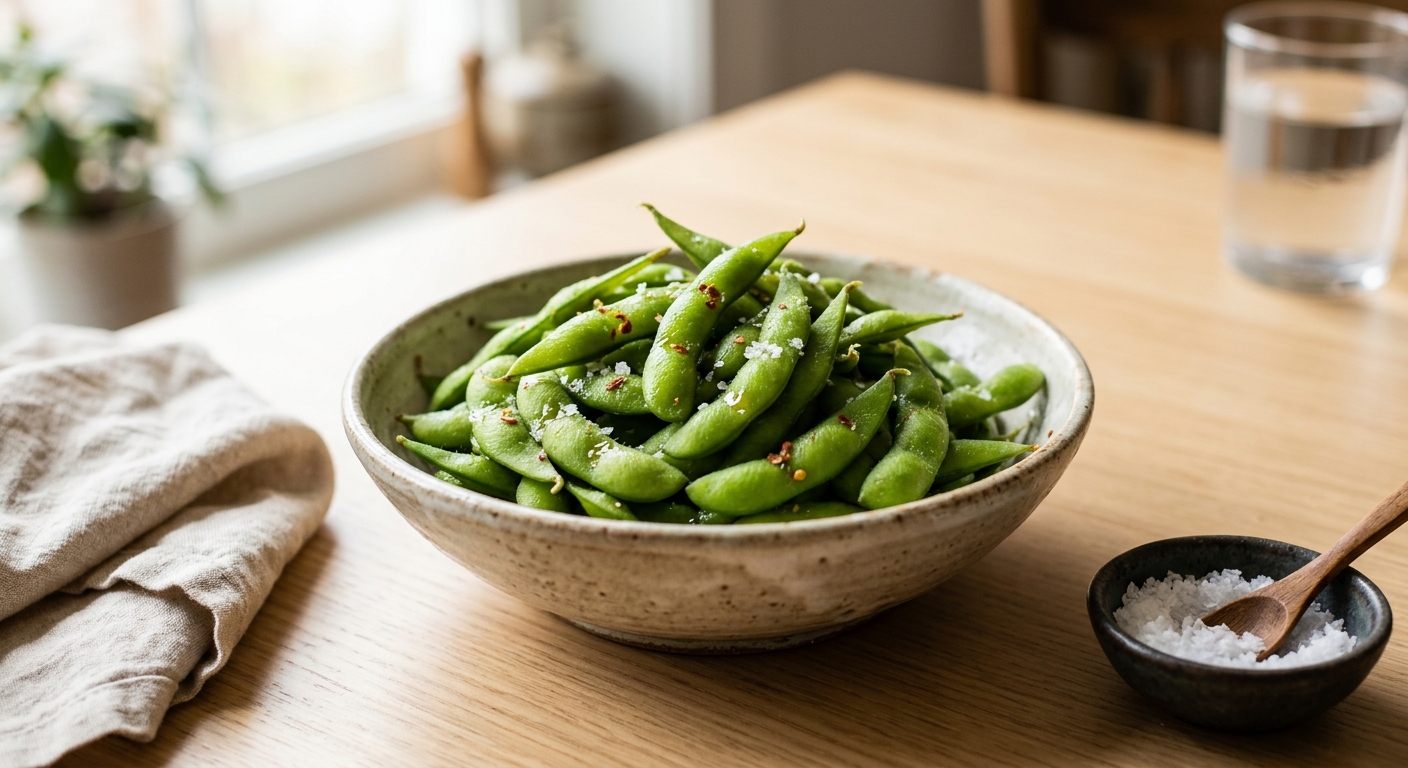
Edamame, the young green soybean harvested before the pods harden, is one of the rare plant foods that delivers a genuinely complete amino acid profile. Unlike most legumes that fall short on methionine or lysine, edamame contains all nine essential amino acids in proportions that rival eggs and lean poultry, making it an extraordinary protein source for anyone eating a plant-forward diet. A single 155-gram serving of shelled edamame provides roughly 18 grams of protein alongside just 8 grams of fat, most of which is heart-healthy polyunsaturated fat including omega-3 alpha-linolenic acid.
The culinary case for edamame is just as strong as the nutritional one. Cooked correctly, the pods develop a subtle grassy sweetness with a firm, almost buttery interior bean. A generous finish of flaky sea salt is all you need to turn a nutritional powerhouse into something genuinely craveable. The technique, whether you steam them on the stovetop, let a slow cooker do the work, or blast them to tender perfection in a pressure cooker, profoundly affects texture. This recipe walks you through each method so every cook, regardless of equipment, gets the best possible result.
On Calibrated Cuisine, we track the full micronutrient picture, not just macros. Edamame earns its place here because it delivers over 100% of the daily value for folate (critical for DNA synthesis and cell division), substantial vitamin K for bone metabolism, and nearly a third of your daily manganese, a trace mineral most people never think about but that is essential for enzymatic antioxidant defence. Paired with the right meal elsewhere in your day, this snack quietly closes several nutritional gaps in one satisfying bowl.
4
servings
Ingredients
- 600 gfrozen edamame in the pod (unsalted)
- 1.5 tspColima Sea SaltMicroplastic Free Salt (such as Maldon), plus more for the table
- 1 tsptoasted sesame oil (optional finishing drizzle)
- 1 litrewater (for stovetop and pressure cooker methods)
- —Colima Sea SaltMicroplastic Free Salt and red chilli flakes to taste for serving
Instructions
Click on an item below to shop for the recommended items for this recipe on Amazon.
As an Amazon Associate, we earn from qualifying purchases.
- Fill a large saucepan or Dutch oven with 1 litre of water and bring to a rolling boil over high heat. Add 1 teaspoon of the sea salt to the water. The salted water begins seasoning the pod from the outside as it cooks.
- Add the frozen edamame pods directly to the boiling water. Do not thaw them first. The pods go from frozen to perfectly cooked in less time than you might expect, and starting from frozen gives you more control over the final texture.
- Return the water to a boil, then reduce the heat to medium-high to maintain a steady boil. Cook uncovered for 5 to 6 minutes, until the pods are bright green, tender but not mushy, and the beans inside feel firm yet yielding when you press a pod between your fingers. Taste one bean at 5 minutes; it should be creamy with a slight bite.
- Drain immediately into a colander and shake off excess water. Do not rinse. Rinsing washes away the starch on the surface that helps the salt cling to the pod.
- Transfer to a serving bowl and immediately toss with the remaining 0.5 teaspoon of flaky sea salt while the pods are still steaming. The residual heat melts the salt crystals slightly onto the pod surface. Drizzle with toasted sesame oil if using, and serve at once with extra flaky salt and chilli flakes on the side.
- Place the frozen edamame pods directly into the slow cooker insert. There is no need to add any water. The ice crystals on the frozen pods provide all the moisture needed to generate steam inside the sealed cooker.
- Sprinkle 1 teaspoon of the flaky sea salt evenly over the pods. Fit the lid on tightly. The salt draws out a small amount of moisture from the pods as they thaw and cook, creating a lightly seasoned steam environment inside the cooker.
- Cook on High for 2 hours or on Low for 3.5 hours. Avoid lifting the lid during cooking, as the steam is doing the work. At the end of the cooking time, open the lid and check one bean for tenderness. The pods should be brilliantly green and the beans inside should be firm-tender and creamy. If they are not quite done, replace the lid and cook for a further 15 to 20 minutes on High.
- Use tongs or a slotted spoon to transfer the pods to a serving bowl, leaving behind any liquid that has collected at the bottom of the insert. Toss immediately with the remaining 0.5 teaspoon of flaky sea salt.
- Finish with a drizzle of toasted sesame oil if desired. Serve warm directly from the bowl, with extra salt and chilli flakes on the side. The slow-cooked edamame holds its heat well for 15 to 20 minutes in the serving bowl, making this method ideal for entertaining or grazing.
- Pour 240ml (1 cup) of water into the pressure cooker pot or Instant Pot insert. Place the steamer rack or trivet inside. The edamame will steam above the water rather than boil in it, which preserves more of the water-soluble B vitamins, particularly folate.
- Pile the frozen edamame pods onto the steamer rack in an even mound. Sprinkle 1 teaspoon of the sea salt directly over the pods. Lock the lid in place and set the pressure release valve to the Sealing position.
- Select Manual or Pressure Cook on High Pressure and set the timer for exactly 1 minute. The cooker will take approximately 8 to 10 minutes to come up to full pressure before the countdown begins. During this time the edamame are already beginning to cook in the rising steam.
- As soon as the 1-minute cook time completes, perform an immediate Quick Release by carefully turning the pressure valve to Venting. Stand back from the steam. Quick release is critical here as any residual cooking time will push the beans past the ideal firm-tender texture into softness.
- Open the lid, transfer the pods to a serving bowl using tongs, and toss at once with the remaining 0.5 teaspoon of flaky sea salt. The pressure-cooked edamame will have an intensely green colour and a clean, sweet bean flavour. Finish with sesame oil if using and serve immediately.
- Preheat your oven to 220C (425F) with a large rimmed baking sheet inside on the middle rack. Preheating the pan is essential. A cold pan would steam the edamame; a screaming-hot pan immediately begins to char and blister the pods.
- Thaw the frozen edamame pods by spreading them on a clean kitchen towel for 10 minutes, or run them under cool water for 2 minutes and pat them thoroughly dry. Dry pods are critical for roasting. Any surface moisture will create steam and prevent the charring that makes this method distinctive.
- Toss the dried edamame pods in a large bowl with 1 teaspoon of the sea salt and 1 teaspoon of toasted sesame oil (mandatory for this method, not optional). The oil creates the medium for browning and carries the salt onto every surface of the pod.
- Carefully remove the preheated baking sheet from the oven and spread the seasoned edamame in a single layer. Do not crowd the pan. If needed, use two baking sheets. Return to the oven and roast for 18 to 22 minutes, turning once at the 10-minute mark with tongs or a spatula, until the pods are blistered, golden-brown in spots, and beginning to char at the edges.
- Remove from the oven and transfer immediately to a serving bowl. Sprinkle with the remaining 0.5 teaspoon of flaky sea salt while hot. The roasted pods can be eaten whole as a finger snack (pod and all) or split to eat just the beans. Serve with chilli flakes and a squeeze of lemon for a more complex flavour profile.
Nutrition Breakdown
Per 1 serving (makes 4)
Vitamins & Minerals
% Daily Value based on a 2,000 calorie diet (FDA reference)
🧬 Essential Amino Acids
% of recommended daily intake (RDA) per serving
🛡 Antioxidant Profile
The Nutrition Science
Edamame’s protein quality is measured by the Protein Digestibility-Corrected Amino Acid Score (PDCAAS) and the newer Digestible Indispensable Amino Acid Score (DIAAS). Soy protein consistently scores at or near 1.0 on both scales, the maximum possible, placing it alongside casein, whey, and eggs as a protein source that delivers all indispensable amino acids in amounts that meet or exceed human requirements. This is exceptional for a plant food. The high fibre content (8g per serving, predominantly insoluble) slows gastric emptying and blunts the post-meal insulin response, which is why edamame carries one of the lowest glycaemic indices of any carbohydrate-containing food.
The folate content deserves particular attention. One serving of edamame provides over 120% of the daily value for folate, primarily in the form of naturally occurring food folate (5-methyltetrahydrofolate), which is bioavailable and does not carry the risks associated with excess synthetic folic acid supplementation. Folate is essential for one-carbon metabolism, the biochemical pathway responsible for DNA methylation, nucleotide synthesis, and homocysteine clearance. Adequate folate intake is associated with reduced neural tube defect risk in pregnancy, lower cardiovascular disease risk, and emerging evidence suggests a protective role in colorectal cancer prevention.
The isoflavones in edamame, principally genistein (averaging 18mg per 100g of whole edamame) and daidzein, are phytoestrogens that bind to oestrogen receptors with approximately 0.001 to 0.1 times the potency of endogenous oestrogen. The scientific consensus from large prospective cohort studies, particularly in Asian populations with lifelong moderate soy consumption, is that whole soy food intake is either neutral or moderately protective for breast and prostate cancer risk. The isoflavones also act as tyrosine kinase inhibitors and antioxidants independently of their hormonal activity, contributing to the cardiovascular benefits observed in soy-consuming populations.
Pro Tips
- Do not thaw edamame before the stovetop or pressure cooker methods. Cooking from frozen gives you a wider window between underdone and overcooked, and the texture of the final bean is superior.
- The real seasoning happens immediately after cooking while the pods are steaming hot. Salt applied to a cool or warm pod slides off. Salt applied to a hot, slightly damp pod fuses to the surface and infuses every bite.
- For a quick flavour upgrade without changing the nutritional profile meaningfully, toss the finished pods with a pinch of togarashi spice blend or a light dusting of smoked paprika and a squeeze of yuzu or lemon juice.





You’re asking such a smart question, Remy! Steaming actually enhances nutrient absorption for edamame, especially that iron and folate you’re thinking about, because cooking breaks down antinutrients like phytates that can block mineral uptake. The enzyme thing is real but honestly less critical here since you’re getting so much bioavailable nutrition from the heat, and that complete protein profile really shines when the beans are cooked. I’d say steamed edamame as a regular snack plus occasionally raw sprouted versions gives you the best of both worlds, you know?
omg ive been eating so much raw sprouted edamame lately and wondering if steaming them changes the nutrient density much, like does the heat destroy any of the enzymes or folate? tbh the protein bioavailability probably goes up with cooking but im curious how you’re weighing that tradeoff in you’re analysis. have you compared raw vs lightly steamed versions for their actual micronutrient retention?
omg remy i love this question because ive been going back and forth on it too! so heres what ive found with my own sprouting experiments – raw sprouted edamame def has more active enzymes but steamed edamame actually has better bioavailability for that iron and folate which matters so much for my kids brains, plus you break down those phytates that can actually block nutrient absorption. honestly i do a hybrid now where i sprout them first for like 2-3 days to reduce lectins and antinutrients, then steam them lightly, and my kids actually eat way more that way plus it feels like maximum nutrient density win-win? would love