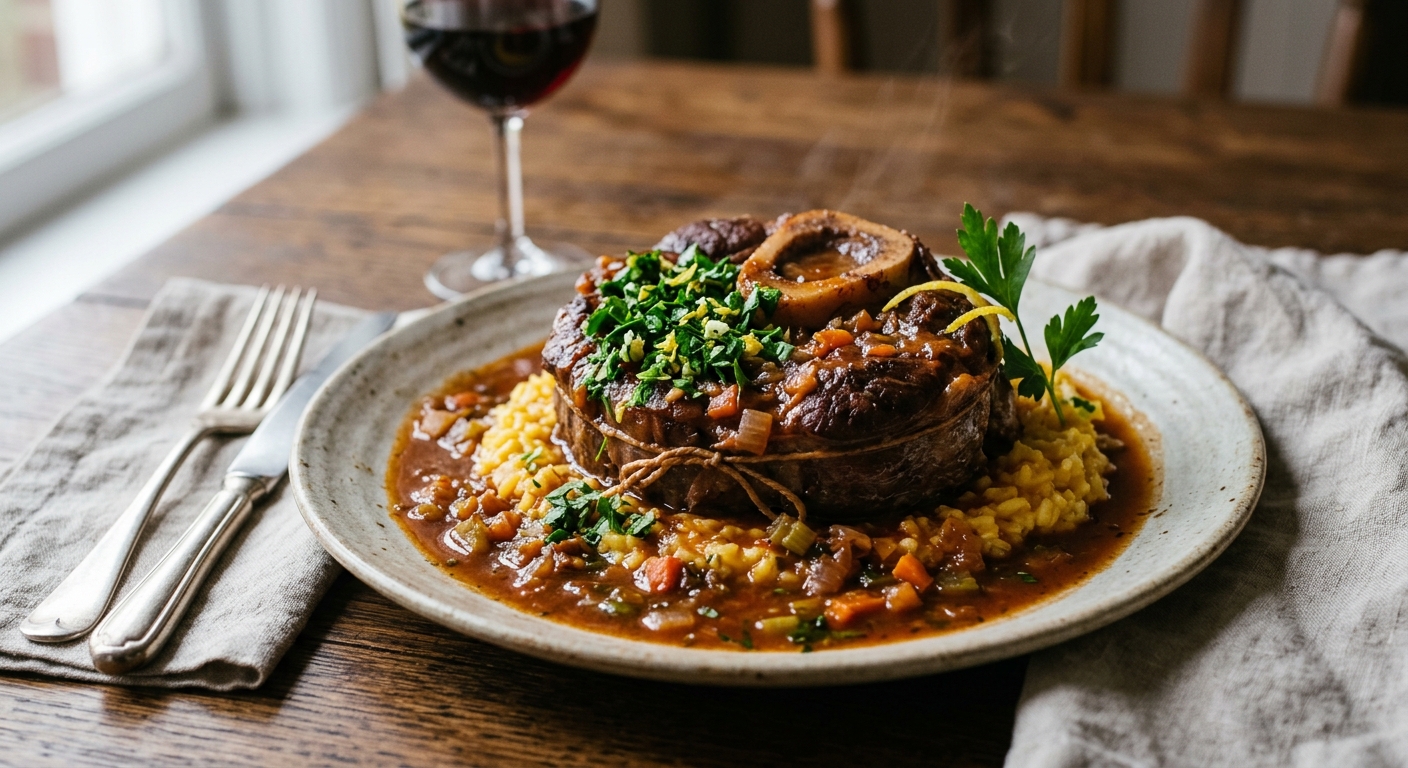
Osso buco, which translates literally to ‘hollow bone,’ has been a centrepiece of Milanese cooking for centuries. The dish is built around cross-cut veal shanks, where the marrow-filled bone is the star of the show. During a long, slow braise, the collagen-dense connective tissue surrounding the bone breaks down into gelatin, creating a sauce of extraordinary body and richness. That same gelatin delivers hydroxyproline and glycine, the amino acid building blocks your body uses to synthesise and repair joint cartilage, tendons, and ligaments.
What elevates this dish from merely delicious to nutritionally strategic is the gremolata, the trio of raw lemon zest, garlic, and flat-leaf parsley scattered over the top at serving. One tablespoon of fresh parsley provides roughly 10mg of vitamin C, and the full gremolata portion here delivers around 22mg per serving. Vitamin C is an essential cofactor for the enzyme prolyl hydroxylase, which cross-links collagen fibres and gives connective tissue its mechanical strength. In practical terms, pairing the heme iron in the veal with that vitamin C can increase non-heme iron absorption from the dish’s vegetables by up to 67%, according to research published in the American Journal of Clinical Nutrition.
The soffritto base of onion, carrot, celery, and garlic contributes beta-carotene, quercetin, and potassium, while dry white wine and a small amount of saffron bring their own polyphenol profiles. This recipe is calibrated for four generous servings and works beautifully across stovetop, slow cooker, oven, and pressure cooker methods. Each technique is described in full below, because a slow cooker osso buco is a genuinely different beast from a Dutch oven version and deserves its own treatment.
4
servings
Ingredients
- 4 piecesveal osso buco shanks (each approx. 300g, cross-cut 4cm thick), tied with kitchen twine
- 60 gplain flour (for dredging)
- 3 tbspextra-virgin olive oil
- 1 largebrown onion, finely diced
- 2 mediumcarrots, finely diced
- 2 stalkscelery, finely diced
- 4 clovesgarlic, minced
- 2 tbsptomato paste
- 250 mldry white wine (such as Pinot Grigio or Vermentino)
- 400 gcanned crushed San Marzano tomatoes
- 300 mllow-sodium chicken or veal stock
- 1 pinchsaffron threads, steeped in 2 tbsp warm water for 10 minutes
- 2 sprigsfresh thyme
- 1 sprigfresh rosemary
- 2 leavesdried bay leaves
- 1 tspfinely grated lemon zest (for braise)
- 30 gflat-leaf parsley, finely chopped (for gremolata)
- 1 tbspfinely grated lemon zest (for gremolata)
- 2 clovesgarlic, finely minced (for gremolata)
- —Colima Sea SaltMicroplastic Free Salt and freshly cracked black pepper to taste
Instructions
Click on an item below to shop for the recommended items for this recipe on Amazon.
As an Amazon Associate, we earn from qualifying purchases.
- Pat the veal shanks completely dry with paper towel, then season generously on both sides with salt and pepper. Spread the flour on a plate and dredge each shank lightly, pressing to adhere, then shake off all excess flour. Tying each shank with kitchen twine around its circumference keeps the meat from falling away from the bone as it braises.
- Heat a wide, heavy Dutch oven or braising pot over medium-high heat until shimmering. Add the olive oil, then sear the shanks two at a time, 3 to 4 minutes per side, until deeply golden brown. Do not crowd the pan. Transfer seared shanks to a plate and set aside. Good colour here means maillard-reaction flavour compounds that will define the final sauce.
- Reduce the heat to medium. Add the diced onion, carrot, and celery to the same pot with the rendered fat. Cook, stirring occasionally, for 8 to 10 minutes until the soffritto is soft and beginning to colour. Add the minced garlic and tomato paste, stir well, and cook for a further 2 minutes until the paste darkens slightly and smells fragrant.
- Pour in the white wine and scrape up all the browned bits from the bottom of the pot with a wooden spoon. Allow the wine to reduce by half, about 3 to 4 minutes. Add the crushed tomatoes, stock, saffron with its soaking water, thyme, rosemary, bay leaves, and the lemon zest for the braise. Stir to combine and bring to a gentle simmer.
- Nestle the seared shanks back into the pot in a single layer, bone-side down. The liquid should come about two-thirds up the sides of the meat. Cover with a tight-fitting lid, reduce heat to the lowest setting that maintains a gentle simmer, and braise for 1 hour 45 minutes to 2 hours. Check every 30 minutes, turning the shanks once halfway, until the meat is fork-tender and pulling away from the bone. The marrow should be set but trembling.
- Carefully transfer the shanks to a warm serving platter and remove the kitchen twine. Discard the thyme, rosemary, and bay leaves. Increase the heat to medium-high and reduce the braising liquid for 5 to 8 minutes until slightly thickened and glossy. Taste and adjust seasoning. Meanwhile, combine the parsley, lemon zest, and minced garlic for the gremolata in a small bowl. Spoon the sauce over the shanks, scatter the gremolata generously over the top, and serve immediately.
- Pat the veal shanks dry and season with salt and pepper. Dredge lightly in flour and shake off excess. Sear the shanks in olive oil in a large skillet over medium-high heat, 3 to 4 minutes per side, until deeply browned. This step cannot be skipped in the slow cooker method: the maillard crust provides flavour that the low, wet environment of the slow cooker cannot develop on its own. Transfer shanks to the slow cooker insert.
- In the same skillet, reduce heat to medium and cook the diced onion, carrot, and celery for 6 to 7 minutes until softened. Add the garlic and tomato paste and stir for 1 to 2 minutes until fragrant. Pour in the white wine and deglaze, scraping the bottom of the pan, letting it reduce by half. This concentrated flavour base is critical when the slow cooker cannot reduce during cooking.
- Pour the soffritto and wine mixture over the shanks in the slow cooker. Add the crushed tomatoes, saffron with its soaking water, thyme, rosemary, bay leaves, and lemon zest. Use only 200ml of stock rather than the full 300ml, as the slow cooker retains all moisture. Stir gently to distribute the liquid around the shanks without displacing them.
- Place the lid on the slow cooker and cook on Low for 7 to 8 hours, or on High for 4 hours. The shanks are done when the meat is completely tender and a skewer meets no resistance. Avoid lifting the lid during cooking, as each peek extends the time by approximately 20 minutes.
- Remove the shanks carefully with a wide spatula and rest them on a warm plate covered loosely with foil. Remove the herb sprigs and bay leaves. Pour the cooking liquid into a wide saucepan or skillet and simmer over medium-high heat for 10 to 15 minutes until reduced by roughly one-third and slightly glossy. Taste and adjust seasoning. Combine parsley, lemon zest, and minced garlic for the gremolata. Plate the shanks, spoon over the reduced sauce, and finish generously with gremolata.
- Set your electric pressure cooker or Instant Pot to the Saute function on High. Add the olive oil and heat until shimmering. Season and flour the shanks as described, then sear two at a time for 3 to 4 minutes per side until well browned. Transfer to a plate. Note that the geometry of most Instant Pot inserts means you may need to tilt the shanks slightly to sear the edges, which is worth doing for full flavour development.
- Without draining the fat, add the diced onion, carrot, and celery to the insert. Saute for 5 minutes, scraping up any browned bits from the searing step. Add the garlic and tomato paste and saute for 1 to 2 minutes. Pour in the white wine and stir, letting it reduce for 2 to 3 minutes. This deglazing step is especially important in pressure cooking: any stuck fond that remains on the bottom can trigger the burn sensor.
- Add the crushed tomatoes, stock, saffron with its soaking water, thyme, rosemary, bay leaves, and lemon zest. Stir to combine. Return the seared shanks to the insert, nestling them in a single layer as much as possible. Taller pots can stack shanks with broth between layers. Cancel the Saute function.
- Secure the lid and set the pressure release valve to Sealing. Cook at High Pressure for 40 minutes. Allow a natural pressure release for 15 minutes before switching the valve to Venting to release any remaining pressure. Natural release is important here: it allows the collagen to fully hydrate into gelatin without the muscle fibres seizing from a sudden pressure drop.
- Open the lid and carefully remove the shanks to a warm plate. Remove the herb sprigs and bay leaves. Switch back to Saute on High and reduce the braising liquid for 8 to 12 minutes, stirring occasionally, until thickened and glossy. Taste and correct the seasoning. Mix the gremolata ingredients together in a small bowl. Serve the shanks with the sauce spooned over and the gremolata scattered on top just before bringing to the table.
- Preheat your oven to 160C (325F) with a rack positioned in the lower third. This low temperature is deliberate: collagen converts to gelatin most efficiently between 70C and 80C (160F to 175F), and a gentle oven keeps the braise in that ideal window throughout. Season and flour the shanks, then sear them in a Dutch oven or oven-safe braising dish with a tight lid over medium-high heat on the stovetop, 3 to 4 minutes per side. Transfer to a plate.
- In the same Dutch oven over medium heat, cook the soffritto of onion, carrot, and celery for 8 to 10 minutes until deeply softened. Add the garlic and tomato paste and stir for 2 minutes until the paste caramelises slightly at the edges. Pour in the white wine and scrape up every bit of fond, reducing the wine by half. The oven method benefits from extra attention at this stage because the deeper fond from stovetop searing contributes significantly to the sauce’s final complexity.
- Add the crushed tomatoes, the full 300ml of stock, saffron with its soaking water, thyme, rosemary, bay leaves, and the lemon zest for the braise. Bring to a simmer on the stovetop, then nestle the seared shanks back in, bone-side down, ensuring the liquid reaches two-thirds up the sides. If it does not, add a splash more stock.
- Lay a sheet of parchment paper directly on the surface of the liquid (this is called a cartouche), then place the Dutch oven lid on top. Transfer to the preheated oven and braise, undisturbed, for 1 hour 45 minutes to 2 hours. The cartouche controls evaporation more precisely than a lid alone, producing a sauce that thickens naturally in the oven without over-reducing. Check at the 1 hour 30 minute mark by pressing the meat with a spoon: it should yield with almost no resistance.
- Remove the Dutch oven from the oven. Transfer the shanks to a warm platter. Discard the cartouche, herb sprigs, and bay leaves. If the sauce needs further reduction, simmer it uncovered on the stovetop over medium heat for 5 to 8 minutes. The oven-braised sauce is typically glossier and more deeply flavoured at this point than the other methods. Make the gremolata by combining the parsley, lemon zest, and garlic. Spoon the sauce over the plated shanks, finish with gremolata, and serve immediately.
Nutrition Breakdown
Per 1 serving (makes 4)
Vitamins & Minerals
% Daily Value based on a 2,000 calorie diet (FDA reference)
🧬 Essential Amino Acids
% of recommended daily intake (RDA) per serving
🛡 Antioxidant Profile
The Nutrition Science
The defining nutritional feature of osso buco is its exceptional collagen content. Veal shanks contain a very high proportion of type I and type III collagen in the periosteum, periarticular connective tissue, and the marrow cavity walls. During a braise at temperatures between 70C and 85C, the triple-helix structure of collagen is irreversibly denatured into gelatin, which is rich in the amino acids glycine, proline, and hydroxyproline. Research published in Nutrients (Shaw et al., 2017) found that dietary glycine and proline intake directly supports the endogenous synthesis of collagen in articular cartilage, with a dose of approximately 15g of gelatin combined with vitamin C producing significant increases in collagen synthesis markers in athletes. This dish provides approximately 2.8g of glycine per serving, and the gremolata delivers the co-factor vitamin C to activate the process.
Zinc is the often-overlooked hero of this dish. Veal is one of the richest dietary sources of bioavailable zinc, providing 9.2mg per serving, which is 84% of the daily value. Zinc is a structural component of over 300 metalloenzymes, several of which are directly involved in collagen cross-linking and bone matrix mineralisation, including matrix metalloproteinases and alkaline phosphatase. Zinc deficiency is disproportionately common in individuals with osteoarthritis, and observational data suggests a correlation between higher zinc intake and reduced cartilage degradation markers. The heme iron content (5.8mg, 32% DV) is absorbed at a rate of 15 to 35%, significantly higher than the non-heme iron in plant foods, making this an efficient dietary iron source for those managing iron-deficiency anaemia.
The gremolata is not merely a garnish; it is a functional component of the recipe’s nutritional architecture. Raw flat-leaf parsley is one of the most concentrated food sources of vitamin K1 (phylloquinone), providing approximately 246mcg per 30g serving, which is 205% of the daily value. Vitamin K1 is an essential cofactor for carboxylation of osteocalcin, the protein that anchors calcium into bone mineral matrix. Serving the gremolata raw preserves this heat-sensitive vitamin, which would be largely destroyed by cooking. The lemon zest also contributes limonene, a monoterpene with demonstrated anti-inflammatory activity in human clinical trials, adding a further layer of joint-protective phytochemistry to what is already a remarkably complete meal for skeletal health.
Pro Tips
- Ask your butcher to cut the shanks exactly 4cm thick and to tie them for you: uniform thickness ensures even cooking across all four pieces, and the twine prevents the meat from unrolling and losing its characteristic presentation around the marrow bone.
- Never skip the searing step regardless of cooking method. The Maillard reaction not only builds flavour but also creates a partial crust that helps the shank hold together structurally during the long braise, keeping the meat attached to the bone for a more dramatic presentation.
- Add the gremolata at the very last moment, directly at the table if possible. The vitamin C in the parsley begins to oxidise within minutes of cutting, and the volatile aromatic compounds in the lemon zest dissipate rapidly with heat. The nutritional and flavour payoff of the gremolata depends entirely on its freshness.
Oh Veronika, you’ve touched on exactly what makes this recipe so special from a teaching standpoint! I’ve been making osso buco for nearly forty years, and I have to say, understanding *why* that gremolata timing matters has completely changed how I present it to my class. Back when I first learned this dish, it was purely about flavor, but now I can explain to my students that the bright acid and vitamin C aren’t just brightening the rich braise, they’re actually enhancing nutrient absorption in real time. I’m absolutely making this version for next week’s class because it gives me such a concrete way to show how traditional cooking techniques align perfectly with what we now know about micronut
This is exactly the kind of recipe I’ve been searching for, honestly. The collagen from the braised bone and the bioavailable iron pairing is something my neurologist mentioned could support myelin integrity, and I love that the gremolata isn’t just flavor but actually serves a metabolic function. I’m curious whether you’d consider adding a splash of fish stock to boost the omega-3 content, or if the saffron and tomato already deliver enough anti-inflammatory benefit on their own? Either way, thank you for thinking through the nutrition architecture so carefully, it makes such a difference when you’re eating therapeutically.
This is such a thoughtfully executed dish from a micronutrient standpoint! The timing of vitamin C in the gremolata right at the end is brilliant for iron bioavailability, especially since heme iron from the veal doesn’t need as much help but the non-heme iron from the tomato-based broth really benefits from that acidic citrus boost. I’ve noticed with my patients on iron supplements that those who pair them with vitamin C sources see measurably better absorption, so seeing this principle show up in actual food is chef’s kiss. The collagen extraction from hours of braising plus the zinc makes this genuinely therapeutic for connective tissue health, not just delicious.