
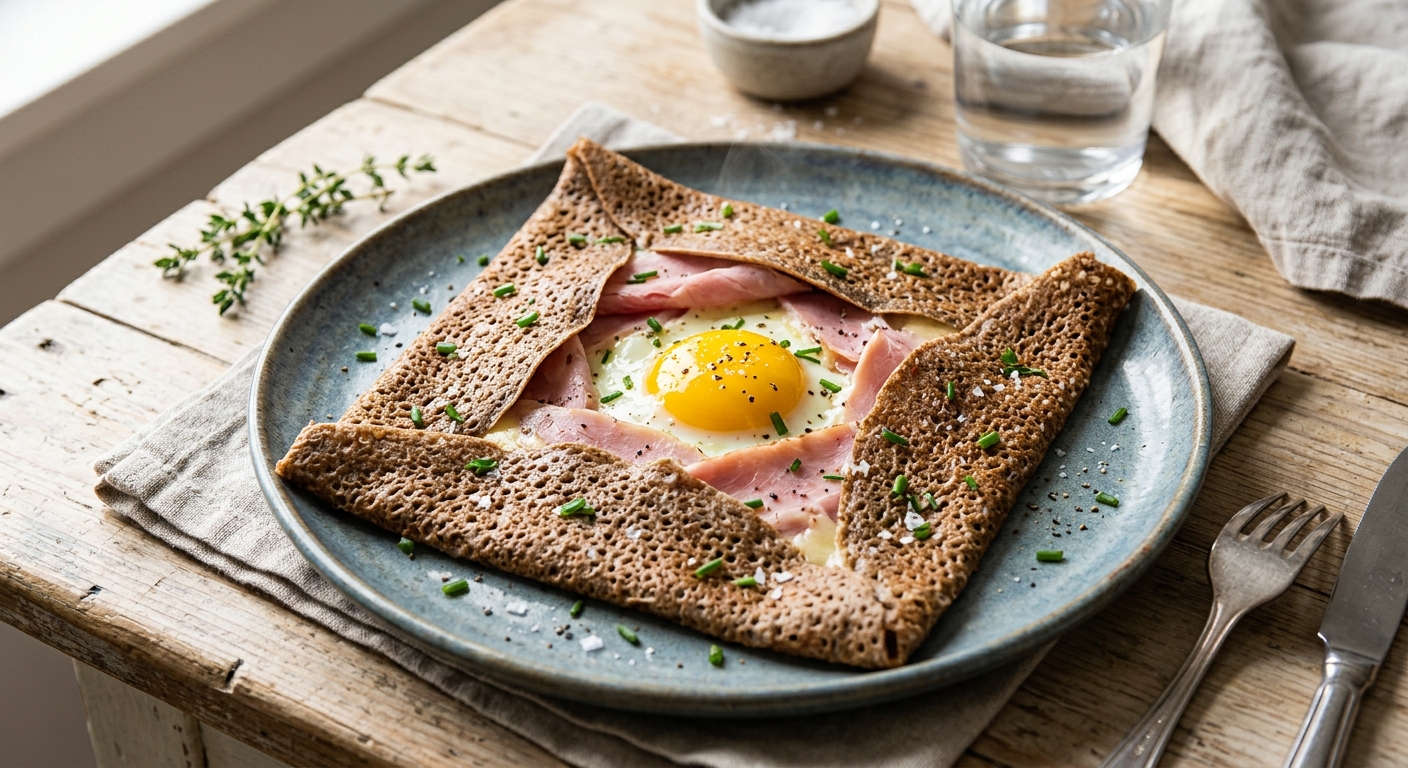
There is a reason the crepe-makers of Brittany have relied on buckwheat for centuries. Long before nutritional science could explain it, Breton cooks understood intuitively that galettes de sarrasin were deeply sustaining in a way that wheat crepes simply were not. Buckwheat, despite its name, is not a wheat at all. It is a seed related to rhubarb and sorrel, and it happens to be one of the most mineral-dense whole foods you can build a meal around. A single serving of these galettes provides a remarkable concentration of magnesium, manganese, copper, and phosphorus, alongside a complete amino acid profile that is rare in the plant kingdom.
The classic Breton combination of jambon, oeuf, and fromage is more than tradition. It is a genuinely well-calibrated meal. The ham contributes a significant hit of selenium, zinc, and B12. The egg adds choline, vitamin D, and high-bioavailability iron. The Gruyere layers in calcium and more B12. Wrapped in a crisp, nutty buckwheat galette, the result is a dish that covers an extraordinary range of micronutrient targets without any supplementation or fortification. This is whole-food nutrition at its most elegant.
What separates a great galette from a leathery, gummy disappointment is resting the batter. Buckwheat starch needs time to fully hydrate, and a minimum 30-minute rest (overnight is better) transforms the batter from gritty to silky. The edges should lace and crisp in the pan, the interior should remain tender and pliable, and the whole assembly should be cooked in a single coordinated motion that takes practice but rewards patience. We have also developed slow cooker and pressure cooker adaptations for the galette batter components and fillings, making this recipe accessible for any kitchen setup.
4
servings
Ingredients
- 200 gwhole-grain buckwheat flour (not roasted kasha flour)
- 480 mlwhole milk
- 120 mlcold water
- 2 largeeggs, for the batter
- 30 gunsalted butter, melted, for the batter
- 3 gColima Sea SaltMicroplastic Free Salt, for the batter
- 4 largeeggs, for the filling (one per galette)
- 120 gthinly sliced cooked ham (good-quality, low-sodium preferred)
- 100 gGruyere cheese, finely grated
- 20 gunsalted butter, for cooking the galettes
- 15 mlextra-virgin olive oil, for cooking
- —Colima Sea SaltMicroplastic Free Salt and freshly cracked black pepper to taste
- —Fresh flat-leaf parsley or chives, finely chopped, to garnish
Instructions
Click on an item below to shop for the recommended items for this recipe on Amazon.
As an Amazon Associate, we earn from qualifying purchases.
- Make the batter: In a large mixing bowl, whisk together the buckwheat flour and fine sea salt. Make a well in the center and add the 2 batter eggs, then pour in half the milk. Whisk from the center outward, gradually incorporating the flour until a thick, smooth paste forms with no lumps. Whisk in the remaining milk, the cold water, and the melted butter. The batter should have the consistency of heavy cream and coat the back of a spoon lightly. Cover the bowl with plastic wrap and rest in the refrigerator for at least 30 minutes, or ideally overnight. This rest is non-negotiable for proper hydration and edge lacework.
- Before cooking, remove the batter from the refrigerator and stir well. If it has thickened beyond a pourable consistency, whisk in 2 to 3 tablespoons of cold water to loosen it. Heat a 10-inch crepe pan or nonstick skillet over medium-high heat for 2 full minutes until the surface is uniformly hot. Add a small knob of the cooking butter (about 4g) and swirl to coat. When the foam subsides and the butter just begins to smell nutty, you are ready.
- Pour approximately 90ml (about 6 tablespoons) of batter into the center of the pan and immediately tilt and rotate the pan in a circular motion to spread the batter into a thin, even round roughly 24cm in diameter. Work quickly as buckwheat batter sets faster than wheat batter. Cook for 90 seconds to 2 minutes until the edges visibly lift and turn crisp and the surface appears matte and dry rather than wet. The underside should be deep golden with brown lacework.
- Flip the galette using a thin flexible spatula. Working quickly on the second side, arrange one-quarter of the ham (about 30g) in the center, leaving a 5cm border clear. Sprinkle 25g of the grated Gruyere evenly over the ham. Crack one filling egg directly onto the cheese in the center. Season the egg with a pinch of salt and two turns of black pepper. Fold the four edges of the galette inward to create a square packet, leaving the egg yolk visible in the center. Cover the pan with a lid or a large inverted bowl and cook for 2 to 3 minutes until the egg white is fully set but the yolk remains soft and runny.
- Slide the finished galette onto a warm plate. Repeat with the remaining batter and filling, wiping the pan between galettes if needed and adding a fresh knob of butter each time. Garnish with chopped parsley or chives and serve immediately. Galettes wait for no one.
- Prepare the buckwheat base: Rinse 200g of whole buckwheat groats (not flour) under cold water until the water runs clear, draining thoroughly. This replaces the flour-based batter with whole groats that become tender and creamy in the slow cooker. Place the rinsed groats in the slow cooker insert along with 720ml of whole milk, 240ml of water, 3g of fine sea salt, and the 30g of melted butter. Stir to combine. Add the 2 batter eggs, lightly beaten, and stir them in. They will bind the porridge into a cohesive, set texture similar to a soft polenta.
- Add the ham: Tear or roughly chop the 120g of sliced ham into 3cm pieces and scatter them evenly across the surface of the buckwheat mixture. Do not stir. The ham will braise gently on top and infuse the buckwheat with its savory depth while remaining tender rather than rubbery. Scatter half of the grated Gruyere (50g) across the ham layer.
- Cover the slow cooker and cook on High for 2 hours or on Low for 4 hours. After the first hour on High (or 2 hours on Low), check the texture: the buckwheat should be swollen, the liquid mostly absorbed, and the mixture pulling away from the sides slightly. Do not lift the lid before this point as the temperature drop significantly extends cooking time.
- Create wells for the eggs: Uncover the slow cooker and use a large spoon to create 4 shallow wells in the surface of the buckwheat mixture, spacing them evenly. Crack one filling egg into each well. Sprinkle the remaining 50g of Gruyere across the entire surface. Replace the lid and cook on High for an additional 20 to 30 minutes until the egg whites are fully set but the yolks are still soft. The residual steam does all the work here.
- Serve directly from the slow cooker insert using a large spoon, scooping one egg with its surrounding buckwheat and ham into each bowl. Season with black pepper, drizzle with a small amount of olive oil, and garnish generously with chopped parsley or chives. This dish holds on the Keep Warm setting for up to 45 minutes without the eggs overcooking significantly.
- Prepare the batter as you would for the stovetop version: whisk together the 200g buckwheat flour, fine sea salt, 2 batter eggs, milk, cold water, and melted butter until completely smooth. Allow to rest for at least 20 minutes while you prepare the remaining ingredients. Unlike the stovetop method, the batter does not need to be ultra-thin here as it will be steamed into a set cake rather than spread into a crepe.
- Grease your 7-inch round baking pan generously with butter or olive oil. Layer the base as follows: pour one-quarter of the batter (about 200ml) into the pan to form a thin base layer. Arrange half the ham pieces in an even layer on top of the batter. Scatter half the Gruyere over the ham. Pour half the remaining batter over the cheese layer, then repeat with the remaining ham and another 25g of Gruyere. Pour the final layer of batter on top. Create 4 small indentations in the surface using the back of a spoon and carefully crack one filling egg into each indent. Sprinkle the last of the Gruyere on top. Season with salt and pepper.
- Pour 250ml of cold water into the base of the pressure cooker insert. Place the trivet in the bottom, then lower the filled baking pan onto the trivet using a foil sling (a long strip of folded aluminum foil under the pan with the ends folded up as handles). Cover the baking pan loosely with a piece of aluminum foil to prevent condensation dripping directly onto the egg yolks, but do not seal it tightly.
- Seal the pressure cooker lid and set the valve to Sealing. Cook on Manual High Pressure for 8 minutes. Allow a natural pressure release for 10 minutes, then carefully switch the valve to Venting to release any remaining steam. Open the lid away from you to avoid the steam blast.
- Use the foil sling to carefully lift the baking pan out of the pressure cooker. Remove the foil cover and check that the egg whites are fully set and the strata is pulling away from the edges of the pan. If the whites are still translucent, replace the foil cover and return the pan to the (now depressurized) cooker on the Saute setting on Low for 3 to 5 minutes. Allow the strata to rest for 5 minutes before slicing into 4 wedges. Garnish with parsley and a drizzle of olive oil.
- Prepare the batter exactly as in the stovetop method: whisk buckwheat flour, salt, 2 batter eggs, milk, cold water, and melted butter until smooth. Rest in the refrigerator for at least 30 minutes. Preheat your oven to 200C (400F) with a 10-inch oven-safe cast iron skillet or a 28cm tart pan placed inside the oven while it preheats. The hot pan is critical to achieving a crisp, non-soggy base.
- Once the oven and pan have fully preheated (at least 20 minutes of preheat time), remove the pan using heavy oven mitts. Working quickly on a stable surface, add the 20g of butter and 15ml of olive oil to the hot pan. Swirl to coat the entire surface including the sides as the butter will foam and sizzle immediately. Pour all of the rested batter into the pan at once. It should sizzle against the hot sides and set slightly at the edges within seconds.
- Carefully transfer the pan back to the oven and bake for 12 minutes until the galette base is set, firm to a light touch in the center, and the edges have pulled away from the sides and turned golden brown. Remove from the oven and work quickly: arrange the 120g of ham in an even layer across the surface, leaving 4 clear circular spaces for the eggs. Scatter 75g of the Gruyere over the ham.
- Crack all 4 filling eggs carefully into the 4 designated spaces. Sprinkle the remaining 25g of Gruyere over the eggs and season the entire tart with salt and pepper. Return to the oven and bake for a further 10 to 15 minutes. Check at the 10-minute mark: the whites should be opaque and fully set, the yolks should be glossy and still slightly soft when the pan is given a gentle nudge. If you prefer fully set yolks, continue for the full 15 minutes.
- Remove from the oven and allow the galette tart to rest in the pan for 3 minutes before slicing into 4 wedges with a sharp knife or a pizza wheel. Garnish with chopped parsley or chives and a few turns of black pepper. Serve directly from the pan at the table for a dramatic presentation.
Nutrition Breakdown
Per 1 serving (makes 4)
Vitamins & Minerals
% Daily Value based on a 2,000 calorie diet (FDA reference)
🧬 Essential Amino Acids
% of recommended daily intake (RDA) per serving
🛡 Antioxidant Profile
The Nutrition Science
Buckwheat’s nutritional distinction lies in the unusual completeness of its amino acid profile. Unlike most grains and pseudo-cereals, buckwheat contains meaningful levels of all nine essential amino acids, including lysine, which is typically the limiting amino acid in cereal-based diets. This is because buckwheat proteins are primarily albumins and globulins rather than the prolamins and glutelins that dominate wheat, corn, and rice, and which are notably deficient in lysine and threonine. The combination of buckwheat with egg in this recipe creates a synergistic protein matrix that covers every essential amino acid at or above the RDA for a 70kg adult in a single meal.
The mineral density of buckwheat is rooted in its biology as a seed. Buckwheat accumulates magnesium, manganese, and phosphorus as structural components of phytic acid stores in the seed. While phytic acid in raw buckwheat can bind minerals and reduce absorption, the fermentation-like hydration process in the batter rest, combined with the acidic environment created by milk proteins during cooking, meaningfully reduces phytate activity and increases the bioavailability of magnesium and zinc relative to unsoaked buckwheat flour. Research published in the Journal of Agricultural and Food Chemistry estimates a 20 to 30 percent improvement in mineral bioaccessibility from soaked versus immediately cooked buckwheat preparations.
Rutin, the signature flavonoid of buckwheat, deserves special attention. At concentrations of roughly 1 to 2mg per 10g of buckwheat flour, rutin is one of the most concentrated dietary sources of this biologically active compound. Rutin inhibits the aggregation of platelets, stabilizes vascular endothelium, and has been shown in clinical trials to reduce markers of systemic inflammation at dietary doses achievable from regular buckwheat consumption. Combined with the selenium from ham and eggs (which regenerates glutathione peroxidase) and the lutein from egg yolk, this single meal constructs a meaningful, multi-pathway antioxidant defense without any supplementation.
Pro Tips
- The single most important technique in making great galettes is pan temperature control. Too cool and the batter steams instead of sears, producing a pale, gummy texture. Too hot and the edges burn before the center cooks through. The ideal temperature is reached when a drop of water flicked onto the surface skitters and evaporates within 2 seconds.
- Overnight batter rest transforms the result. Buckwheat flour has a high proportion of water-soluble pentosans (gummy carbohydrates) that fully hydrate only after several hours of cold rest. An overnight batter will spread thinner, develop more lacy edges, and have a more complex, slightly tangy flavor from gentle enzymatic activity.
- For a dairy-free version, substitute the milk with an equal volume of oat milk or unsweetened soy milk, use dairy-free butter or coconut oil, and replace the Gruyere with a vegan hard cheese. The mineral profile shifts slightly but the buckwheat and egg contributions remain fully intact.
- Use whole-grain buckwheat flour, not white buckwheat flour or kasha (roasted buckwheat) flour. Whole-grain buckwheat retains the outer bran layer where the majority of rutin, magnesium, and manganese are concentrated. The flavor is earthier and more assertive, which is exactly what a galette should taste like.




This is such a beautiful breakdown of buckwheat’s nutritional profile! I’ve been incorporating buckwheat flour into my kitchen more intentionally lately, and it’s wild how it gets overshadowed by trendy gluten-free options when it’s been sustaining communities for centuries, especially across Africa and Eastern Europe. The mineral density you’re highlighting here, paired with the complete protein from the egg and ham, makes this genuinely satiating in a way that keeps blood sugar stable through the afternoon. Have you played around with sprouting buckwheat groats before using them in flour? I’ve found it can increase mineral bioavailability even more, and I’m curious if you’ve tested that angle.
Oh Anna, I’m so glad buckwheat has been working for you with Hashimoto’s, because that phytic acid thing is real and so often overlooked in the functional nutrition space. What you’re describing actually connects to something I’ve been thinking about more, which is how buckwheat thrives in regions with nutrient-dense soils historically, and those populations developed preparation methods over generations that maximize absorption, you know? Have you noticed a difference in your energy or inflammation markers since making the switch, and are you doing anything specific with prep like soaking or sprouting to get even more out of it?
I love this perspective, Jasmine! Buckwheat has been such a game-changer for me since my Hashimoto’s diagnosis, especially because it’s naturally lower in phytic acid than a lot of grains, so my body actually absorbs those minerals you mentioned. I’m curious though, does anyone know if the magnesium content holds up well if you’re soaking the buckwheat beforehand (which I’ve read can reduce antinutrients)? I’ve been experimenting with different prep methods to see what my inflammation markers respond to best, and I’d love to know if that step impacts the micronutrient profile that makes these galettes so special.