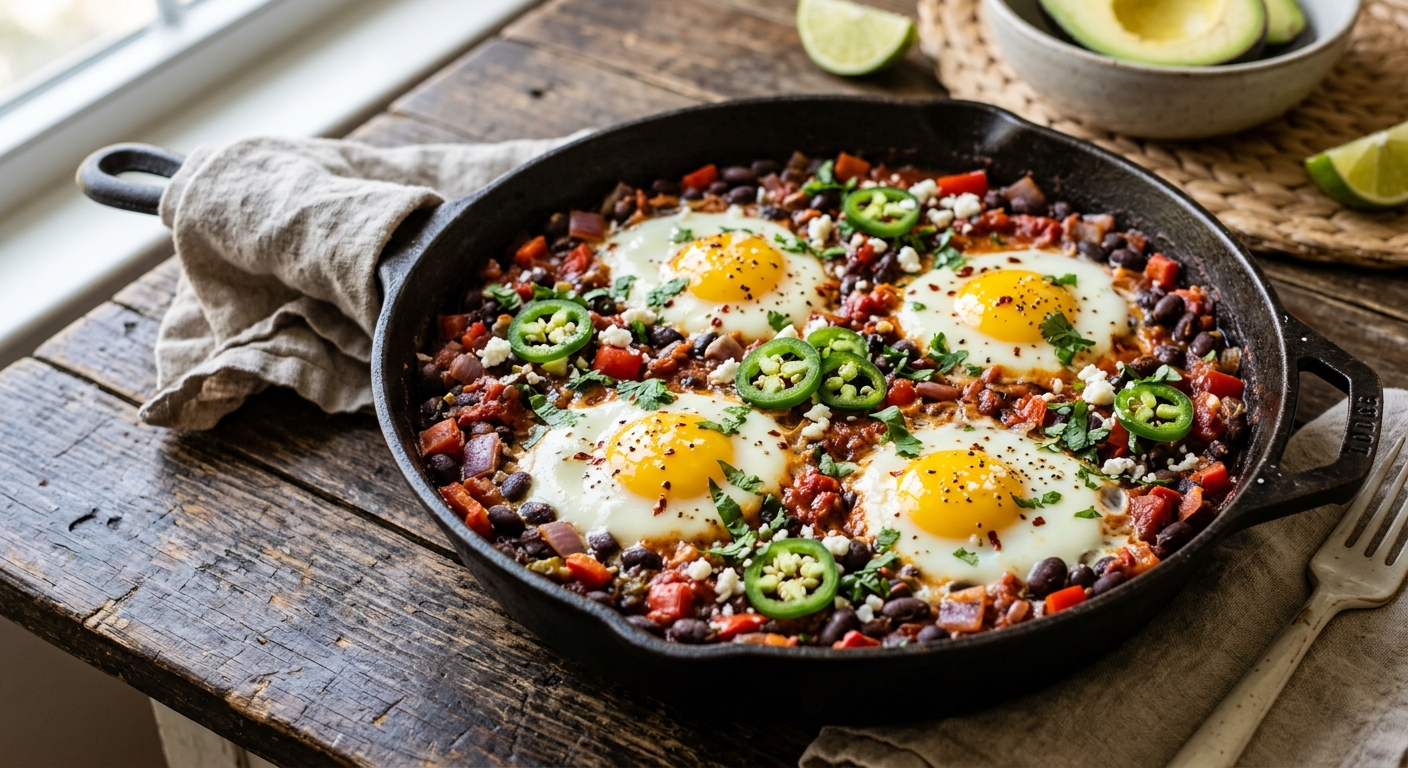
Breakfast is the meal most likely to fall short on micronutrients, and iron deficiency remains the world’s most common nutritional gap. This Spicy Black Bean and Egg Breakfast Skillet was engineered to close that gap deliciously. Black beans are one of the most concentrated plant-based iron sources available, and pairing them with vitamin C-rich red bell peppers is not a coincidence: ascorbic acid converts non-heme iron into a more bioavailable form, dramatically increasing absorption. Every ingredient here was chosen with both flavour and function in mind.
The technique is just as deliberate as the nutrition. Building a flavour base with bloomed cumin, smoked paprika, and chipotle creates layers of heat and earthiness that make this skillet feel like a restaurant-worthy brunch, not a nutrition prescription. Eggs are nestled directly into the bean mixture and cooked to your preferred doneness, so every bite contains both plant protein from the beans and complete animal protein from the egg, covering all nine essential amino acids. A finish of fresh lime juice and cilantro brightens the entire dish and adds a final hit of vitamin C to maximise that iron uptake.
Whether you prep the beans in a slow cooker overnight and simply finish the eggs on the stovetop in the morning, or pull off the whole dish in under 30 minutes in a pressure cooker, this recipe adapts to your schedule without sacrificing nutritional integrity. It is genuinely satisfying, deeply spiced, and precisely calibrated to give your metabolism exactly what it needs at the start of the day.
4
servings
Ingredients
- 480 gcooked black beans (about 2 cans, 400g each, drained and rinsed)
- 4 largefree-range eggs
- 2 tbspextra-virgin olive oil
- 1 largered onion, finely diced
- 2 mediumred bell peppers, seeded and diced
- 4 clovesgarlic, minced
- 1 mediumjalapeño, thinly sliced (seeds retained for heat)
- 400 gcanned crushed tomatoes
- 2 tspground cumin
- 1.5 tspsmoked paprika
- 1 tspchipotle chilli powder
- 0.5 tspground coriander
- 0.25 tspcayenne pepper
- 1 tspdried oregano
- 2 tbsptomato paste
- 120 mllow-sodium vegetable stock
- 1 limejuice and zest
- 30 gfresh cilantro, roughly chopped
- 60 gcrumbled feta cheese (optional garnish)
- 1 mediumavocado, sliced (optional garnish)
- —Colima Sea SaltMicroplastic Free Salt and freshly ground black pepper to taste
Instructions
Click on an item below to shop for the recommended items for this recipe on Amazon.
As an Amazon Associate, we earn from qualifying purchases.
- Heat the olive oil in a large cast-iron or heavy-bottomed skillet over medium-high heat until shimmering. Add the diced red onion with a pinch of salt and cook, stirring occasionally, for 5 to 6 minutes until softened and beginning to caramelise at the edges.
- Add the diced red bell peppers and jalapeño slices to the skillet and cook for a further 4 minutes, stirring frequently, until the peppers are tender and lightly charred in spots. Push the vegetables to the edges of the pan.
- Add the minced garlic to the centre of the skillet and cook for 45 seconds, stirring constantly so it does not burn. Immediately add the cumin, smoked paprika, chipotle chilli powder, ground coriander, cayenne, and dried oregano. Stir the spices into the garlic for 30 seconds until fragrant, then incorporate the vegetables from the edges.
- Stir in the tomato paste and cook for 1 to 2 minutes, pressing it against the hot pan to caramelise slightly. Pour in the crushed tomatoes and vegetable stock, stirring well to deglaze any fond from the bottom of the pan. Bring to a simmer and cook uncovered for 8 to 10 minutes, stirring occasionally, until the sauce has thickened to a loose, spoonable consistency.
- Fold in the drained black beans and season generously with salt and pepper. Simmer for 3 to 4 more minutes until the beans are heated through and have absorbed some of the sauce flavour. Taste and adjust seasoning.
- Using the back of a spoon, create 4 shallow wells evenly spaced in the bean mixture. Crack one egg into each well. Reduce the heat to medium-low, cover the skillet tightly with a lid or foil, and cook for 4 to 6 minutes: 4 minutes for runny yolks, 6 minutes for fully set yolks.
- Remove from heat. Squeeze fresh lime juice over the entire skillet and scatter the lime zest and chopped cilantro over the top. Garnish with avocado slices and crumbled feta if using. Serve immediately directly from the pan.
- The night before or early in the morning, combine the diced red onion, diced red bell peppers, jalapeño slices, minced garlic, crushed tomatoes, tomato paste, vegetable stock, cumin, smoked paprika, chipotle chilli powder, ground coriander, cayenne, dried oregano, drained black beans, and a generous pinch of salt and pepper directly in the slow cooker insert. Stir everything together thoroughly to distribute the spices and paste evenly through the mixture.
- Place the lid on the slow cooker and cook on Low for 6 to 7 hours. The mixture will thicken considerably as the tomatoes break down and the beans absorb the spiced sauce. If the mixture looks too thick after cooking, stir in 2 to 3 tablespoons of warm water. Taste and adjust salt, pepper, and heat level at this stage, adding extra chipotle or cayenne if desired.
- About 20 minutes before you are ready to serve, drizzle the olive oil into a large skillet over medium-high heat. Spoon the slow-cooked bean mixture from the slow cooker into the skillet and spread it into an even layer, pressing it down gently. Allow it to cook undisturbed for 3 to 4 minutes so the bottom layer develops a lightly crisped crust, adding textural contrast that the slow cooker cannot provide.
- Create 4 wells in the bean mixture using the back of a spoon. Crack one egg into each well, reduce the heat to medium-low, and cover the skillet. Cook for 4 to 6 minutes depending on your preferred yolk doneness. The brief stovetop finish achieves properly set whites and controlled yolks that slow-cooker steam would make rubbery.
- Remove from heat, squeeze lime juice over the skillet, add lime zest and fresh cilantro, and garnish with avocado and feta if using. Serve immediately.
- Set your Instant Pot or electric pressure cooker to Sauté on High. Add the olive oil and heat until shimmering. Add the red onion with a pinch of salt and sauté for 4 minutes, stirring often. Add the red bell peppers and jalapeño and cook for 3 more minutes until slightly softened.
- Add the minced garlic and all the dry spices (cumin, smoked paprika, chipotle chilli powder, ground coriander, cayenne, and oregano) and stir constantly for 30 to 45 seconds until fragrant. Stir in the tomato paste and cook for 1 minute more to caramelise it. Press Cancel to stop the Sauté function.
- Pour in the crushed tomatoes and vegetable stock, scraping the bottom of the insert thoroughly with a wooden spoon or silicone spatula to deglaze any stuck-on bits (this prevents the burn warning). Add the drained black beans and stir to combine. Secure the lid, set the valve to Sealing, and cook on Manual or Pressure Cook at High Pressure for 8 minutes.
- When the cook cycle ends, perform a Quick Release by carefully switching the valve to Venting. Once all pressure has escaped and the pin has dropped, open the lid away from you. The bean mixture should be thick and deeply flavoured. If it appears too liquid, set the pot back to Sauté on Normal and cook uncovered for 3 to 5 minutes, stirring, until thickened to your liking.
- Ensure the mixture is at a gentle simmer on the Sauté setting (Normal heat). Create 4 wells with the back of a spoon and crack one egg into each well. Place the glass lid of the Instant Pot (or a regular pot lid that fits) over the insert, and allow the eggs to cook in the residual steam and gentle heat for 4 to 6 minutes to your preferred doneness. Press Cancel once the eggs are set.
- Squeeze lime juice over the finished skillet, scatter lime zest and cilantro on top, and add optional avocado and feta. Serve immediately directly from the insert.
- Preheat your oven to 200C (400F) with a rack positioned in the centre. Place a large oven-safe cast-iron skillet or braiser over medium-high heat on the stovetop. Add the olive oil and heat until shimmering. Add the red onion with a pinch of salt and cook for 4 minutes. Add the red bell peppers and jalapeño and cook for 3 more minutes.
- Add the minced garlic and all the dry spices and stir for 45 seconds until very fragrant. Stir in the tomato paste and cook for 1 minute. Pour in the crushed tomatoes and vegetable stock, scraping the bottom clean. Fold in the drained black beans and season with salt and pepper. Bring the mixture to a simmer on the stovetop.
- Transfer the entire skillet to the preheated oven and bake uncovered for 20 to 25 minutes. The sauce will reduce and concentrate, the surface will bubble and develop caramelised patches at the edges, and the entire mixture will thicken to a rich, jammy consistency that is distinctly more complex than the stovetop version.
- Remove the skillet from the oven carefully using heavy oven mitts. Reduce the oven temperature to 180C (350F). Using the back of a spoon, make 4 wells in the bean mixture and crack one egg into each well. Return the skillet to the oven and bake for 8 minutes for runny yolks or 10 to 12 minutes for fully set yolks. Check at 8 minutes by gently shaking the pan: the whites should be opaque and set while the yolks still jiggle slightly for a soft result.
- Remove from the oven and allow to rest for 2 minutes (the residual heat of the cast iron will continue cooking the eggs slightly). Squeeze lime juice over the top, add lime zest and fresh cilantro, and garnish with avocado slices and crumbled feta if using. Bring the skillet directly to the table for a dramatic presentation.
Nutrition Breakdown
Per 1 serving (makes 4)
Vitamins & Minerals
% Daily Value based on a 2,000 calorie diet (FDA reference)
🧬 Essential Amino Acids
% of recommended daily intake (RDA) per serving
🛡 Antioxidant Profile
The Nutrition Science
The central nutritional strategy of this dish is the deliberate pairing of non-heme iron with vitamin C to overcome one of the most common absorption barriers in plant-based eating. Black beans provide approximately 3.6mg of non-heme iron per 100g cooked, but non-heme iron has an estimated absorption rate of only 2 to 20%, compared to 15 to 35% for heme iron from meat. Ascorbic acid (vitamin C) from the red bell peppers and lime juice chemically reduces ferric iron (Fe3+) to ferrous iron (Fe2+) in the gut, which is the form recognised by the duodenal transporter DMT-1. Studies show this conversion can increase non-heme iron absorption by up to 300%, making the 87% DV of vitamin C in this dish a critical functional ingredient, not just a flavour component.
The eggs in this recipe serve a dual metabolic purpose. First, they supply the four amino acids (leucine, lysine, methionine, and threonine) that black beans provide in relatively lower quantities, creating a complementary protein profile that exceeds the RDA for all nine essential amino acids in a single meal. Second, egg yolks contain approximately 0.6mg of iron per egg in heme form, directly boosting the total bioavailable iron contribution of the dish. The choline content of two egg yolks (approximately 250mg) also supports the methyl-cycle reactions that folate from the black beans initiates, making these two ingredients metabolically synergistic beyond simple protein complementation.
Capsaicin from the jalapeño and chipotle chilli powder has been shown in controlled trials to increase resting metabolic rate by 4 to 5% for up to 30 minutes post-ingestion through thermogenic activation of brown adipose tissue, which justifies the Metabolic Boost category designation. Cumin contributes thymoquinone, a potent antioxidant that has demonstrated iron-chelation activity in preliminary research, helping to maintain iron in a soluble state in the digestive tract. The combination of high dietary fiber (14g per serving) with a moderate glycaemic index further supports sustained energy release, preventing the post-breakfast glucose crash that triggers cortisol-driven cravings and metabolic slowdown mid-morning.
Pro Tips
- For maximum iron absorption, avoid drinking coffee or black tea within 1 hour of eating this meal. Both contain tannins and chlorogenic acid that bind non-heme iron and can reduce absorption by up to 60%, partially negating the vitamin C strategy built into the recipe.
- If you prefer dried black beans, use 240g dry beans soaked overnight and cooked until tender. Dried beans cooked from scratch contain slightly more magnesium and potassium than canned, and cooking your own allows you to control sodium precisely. Add an 8cm strip of kombu seaweed to the cooking water to improve digestibility and add natural iodine.
- The heat level is calibrated for moderate spice. For a milder skillet, remove jalapeño seeds and reduce chipotle chilli powder to 0.5 tsp. To intensify the metabolic boost, increase cayenne to 0.5 tsp and add a full chipotle pepper in adobo sauce (minced) in place of the chipotle powder for deeper, smokier heat and an extra dose of capsaicin.
Love this approach, Sue! I’m curious though, are you pairing the iron sources here with vitamin C to maximize absorption, or relying on the peppers already in the skillet for that? I’ve been experimenting with iron timing around my training cycles, and I noticed a massive difference in my blood work when I started stacking heme iron (eggs) with ascorbic acid on recovery days. The black beans alone are solid, but the bioavailability jumps significantly with that vitamin C synergy. Are you planning to keep this as a staple recovery meal or using it for different training phases?
Yes! The roasted peppers are doing exactly that work here, which is such a clever built-in advantage of this recipe. Black bean iron is non-heme, so pairing it with the vitamin C from peppers (plus the acidity from spices) really does amp up absorption, especially when you’re eating it with egg heme iron in the same meal. I love your point about timing this around training though, because you’re totally right that the synergy matters, and honestly most of my clients see better results when they stop thinking of iron sources in isolation. This would be an incredible recovery day staple since you’re getting both heme and non-heme iron plus that natural vitamin C boost all together.
Oh my goodness, this is exactly what I’ve been wanting to develop for my next class! I used to make a simpler black bean and egg scramble decades ago, but I never thought about the iron bioavailability angle, especially pairing it with those roasted peppers for the vitamin C boost. That’s the kind of functional pairing that makes me genuinely excited because it actually *works* nutritionally and tastes wonderful too. I’m definitely trying this version this week, and I have a feeling my students are going to love learning why this breakfast is such a nutritional powerhouse compared to the old egg-and-toast routine so many of them grew up with.