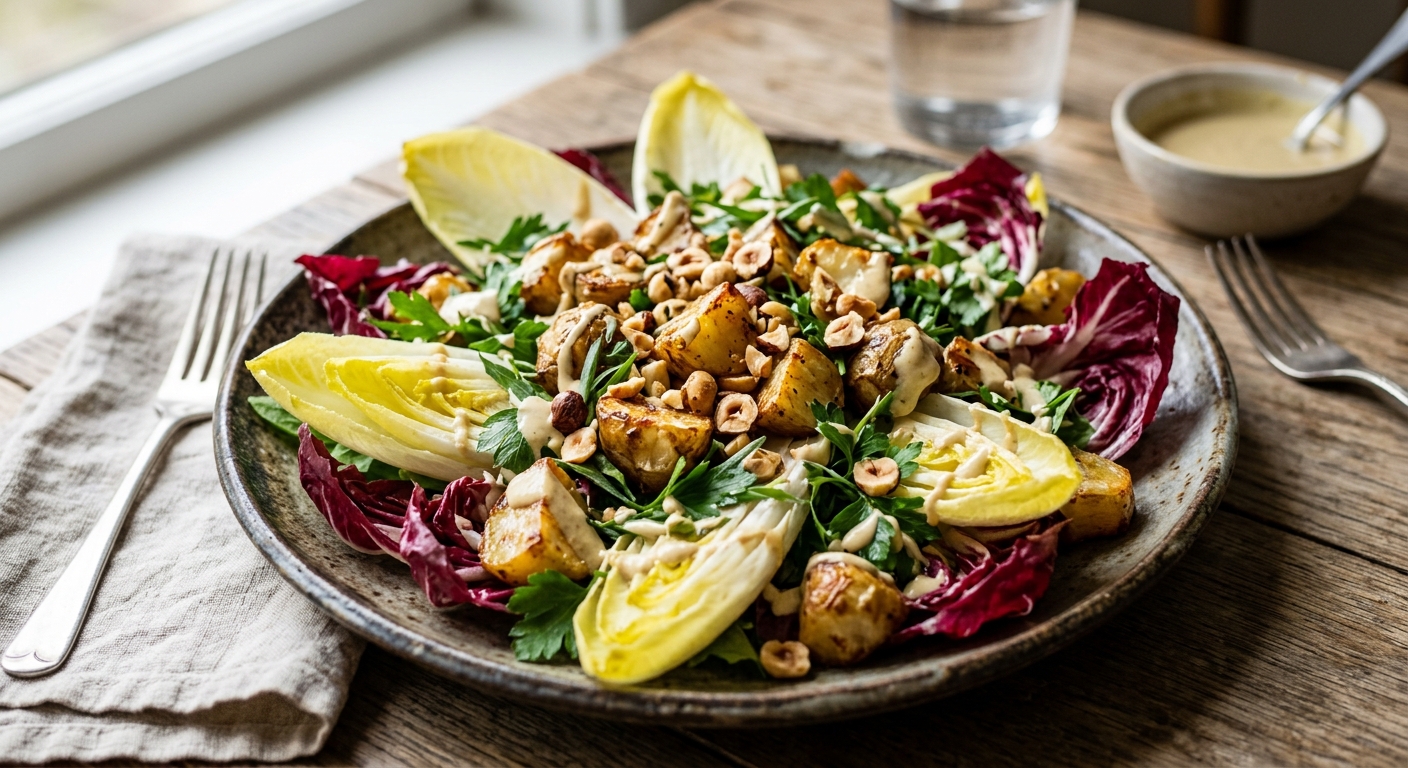
Jerusalem artichokes and chicory are two of the most underappreciated vegetables in modern cooking, yet they sit at the very top of the prebiotic hierarchy. Inulin, the soluble fiber that makes both of these ingredients nutritional legends, is not digested in the small intestine. Instead, it travels intact to the colon where it selectively feeds Bifidobacterium and Lactobacillus species, the beneficial bacteria most closely linked to reduced inflammation, improved insulin sensitivity, and a stronger gut barrier. A single generous serving of this salad delivers an extraordinary 18 to 22 grams of inulin, more than most people consume in an entire week.
Chicory root and its leafy relatives, including Belgian endive and radicchio, contribute not only inulin but also a rich spectrum of polyphenols including chicoric acid and lactucopicrin, the bitter sesquiterpene lactone responsible for chicory’s characteristic flavor. Far from being a flaw, that bitterness is your body signaling the presence of powerful anti-inflammatory compounds. The slight caramelization achieved by roasting Jerusalem artichokes transforms their starchy, almost artichoke-like sweetness into something deeply savory and nutty, creating a contrast with the raw chicory leaves that makes every forkful compelling. The lemon-tahini dressing adds calcium, additional plant protein, and a silky richness that ties the dish together beautifully.
At Calibrated Cuisine, we engineered this salad to work across multiple cooking methods so you can prepare the Jerusalem artichoke component whether you have 20 minutes and an oven or a slow afternoon and a slow cooker. Each method produces a genuinely different texture profile: the oven delivers deep caramelization, the stovetop gives you precise control over browning, the slow cooker yields a silkier, almost confit-like result, and the pressure cooker produces a tender, creamy interior perfect for a warm dressed salad. Choose your method based on what you want on the plate.
4
servings
Ingredients
- 600 gJerusalem artichokes (sunchokes), scrubbed and cut into 3cm chunks
- 2 headschicory (Belgian endive), leaves separated and torn
- 1 small headradicchio, leaves torn into bite-sized pieces
- 80 ghazelnuts, raw, roughly chopped
- 30 gflat-leaf parsley, leaves picked
- 20 gfresh tarragon, leaves picked
- 60 gtahini (hulled sesame paste)
- 3 tbspextra-virgin olive oil, divided
- 3 tbspfresh lemon juice (about 1.5 lemons)
- 1 tsplemon zest
- 1 clovegarlic, minced to a paste
- 2 tspraw honey or pure maple syrup
- 3 tbspwarm water, to thin dressing
- 1 tbspapple cider vinegar
- 40 gpomegranate arils (optional, for serving)
- —Colima Sea SaltMicroplastic Free Salt and freshly cracked black pepper to taste
Instructions
Click on an item below to shop for the recommended items for this recipe on Amazon.
As an Amazon Associate, we earn from qualifying purchases.
- Prepare the dressing first so flavors can meld while you cook. In a small bowl, whisk together the tahini, 2 tablespoons of lemon juice, lemon zest, minced garlic, honey, apple cider vinegar, and warm water until completely smooth and pourable. Season generously with salt. Set aside.
- Pat the Jerusalem artichoke pieces completely dry with paper towels. This is critical for stovetop browning: any surface moisture will cause them to steam rather than sear. Season with salt and black pepper.
- Heat 2 tablespoons of olive oil in a large, heavy-bottomed skillet (cast iron or stainless steel works best) over medium-high heat until the oil shimmers and a piece of sunchoke sizzles immediately on contact. Add the Jerusalem artichoke pieces in a single layer, cut side down. Do not stir. Cook undisturbed for 6 to 7 minutes until a deep golden-brown crust develops on the underside.
- Flip each piece and reduce the heat to medium. Add the remaining 1 tablespoon of olive oil around the edges of the pan. Continue cooking for another 10 to 12 minutes, turning occasionally, until the artichokes are tender when pierced with a knife tip and caramelized on multiple sides. In the final 2 minutes, add the chopped hazelnuts to the pan and toast them, stirring constantly, until fragrant and lightly golden. Remove from heat.
- While the sunchokes are still warm, transfer them to a large mixing bowl. Add the chicory and radicchio leaves, parsley, and tarragon. Drizzle three-quarters of the dressing over the salad and toss gently to combine, being careful not to break up the sunchoke pieces. Taste and adjust seasoning with the remaining lemon juice, salt, or dressing. Finish with pomegranate arils if using and serve immediately.
- Prepare the dressing first. In a small bowl, whisk together the tahini, 2 tablespoons of lemon juice, lemon zest, minced garlic, honey, apple cider vinegar, and warm water until smooth. Season with salt and set aside in the refrigerator.
- Place the Jerusalem artichoke chunks in the slow cooker insert. Drizzle with all 3 tablespoons of olive oil and the remaining 1 tablespoon of lemon juice. Season generously with salt and black pepper. Toss to coat evenly. Do not add any water: the sunchokes will release their own moisture. Spread them in as even a layer as possible.
- Cook on Low for 2.5 to 3 hours. Check at the 2.5-hour mark by pressing a fork against a piece. They should yield immediately with no resistance and have a slightly translucent, golden appearance at the edges. If they need more time, continue in 20-minute increments. Avoid lifting the lid before the 2.5-hour mark as this releases heat and extends cooking time significantly.
- Spread the chopped hazelnuts on a dry skillet over medium heat and toast on the stovetop for 3 to 4 minutes, stirring frequently, until golden and fragrant. This step must be done separately since the slow cooker cannot toast nuts. Set aside to cool.
- Remove the sunchokes from the slow cooker using a slotted spoon, leaving behind any accumulated liquid. Let them cool for 5 minutes until warm but not scalding. In a large bowl, arrange the chicory and radicchio leaves as a base. Nestle the warm confit-style sunchokes over the top. Scatter the toasted hazelnuts, parsley, and tarragon. Drizzle the lemon-tahini dressing generously over everything and finish with pomegranate arils. Serve as a warm salad.
- Prepare the dressing. In a small bowl, whisk together the tahini, 2 tablespoons of lemon juice, lemon zest, minced garlic, honey, apple cider vinegar, and warm water until smooth and creamy. Season with salt. Set aside.
- Place the Jerusalem artichoke chunks in the pressure cooker or Instant Pot insert. Add 120ml (half a cup) of water, 1 tablespoon of olive oil, 1 tablespoon of lemon juice, and a generous pinch of salt. Lock the lid and set the valve to Sealing. Select Manual or Pressure Cook on High Pressure for 5 minutes. It will take approximately 8 to 10 minutes to come up to pressure.
- Once the cooking time is complete, perform a quick pressure release by carefully switching the valve to Venting. Open the lid once the pressure pin drops. The sunchokes will be very tender. Drain them through a colander and pat gently dry with paper towels.
- For added texture, heat the remaining 2 tablespoons of olive oil in a skillet over high heat. Add the drained sunchokes in a single layer and sear without stirring for 2 to 3 minutes until a golden crust forms on one side only. Remove from heat. While the pan is still hot, add the hazelnuts and toss for 60 to 90 seconds until toasted.
- Build the salad in a wide, shallow bowl or platter. Arrange the chicory and radicchio leaves as the base. Place the seared sunchokes across the top, golden side up. Scatter hazelnuts, parsley leaves, and tarragon over the salad. Drizzle the tahini dressing in a zigzag pattern across the entire surface and finish with pomegranate arils, a grind of black pepper, and a small drizzle of extra olive oil if desired.
- Preheat the oven to 210C (410F) with a large rimmed baking sheet inside. Preheating the tray is essential: it creates an immediate sear on the underside of the sunchokes and prevents them from sticking. While the oven heats, prepare the dressing by whisking together tahini, 2 tablespoons of lemon juice, lemon zest, minced garlic, honey, apple cider vinegar, and warm water until smooth. Season with salt and refrigerate.
- In a large bowl, toss the Jerusalem artichoke chunks with 2.5 tablespoons of olive oil, a generous pinch of salt, and plenty of cracked black pepper. Make sure every piece is evenly coated. Carefully remove the hot baking sheet from the oven using oven mitts and immediately spread the sunchokes in a single layer, cut side down, leaving space between each piece. Overcrowding will cause steaming instead of roasting.
- Roast on the middle rack for 20 minutes without opening the oven door. After 20 minutes, remove the tray and use a thin spatula to flip each piece. Return to the oven for a further 12 to 18 minutes until deeply golden, caramelized at the edges, and completely tender when pierced with a skewer. The exterior should have visible browning and slight crispiness.
- In the final 5 minutes of roasting, scatter the chopped hazelnuts directly onto the baking sheet around the sunchokes. Watch carefully as nuts can burn quickly at this temperature. Remove from oven when the hazelnuts are golden and fragrant. Drizzle the remaining half tablespoon of olive oil over everything while still hot.
- Allow the roasted sunchokes and hazelnuts to cool for 5 to 8 minutes. They should still be warm but not hot enough to wilt the greens on contact. In a large wide bowl, combine the chicory and radicchio leaves, parsley, and tarragon. Add the warm sunchokes and hazelnuts. Pour three-quarters of the dressing over the salad, toss gently, and taste. Adjust with more dressing, lemon juice, or salt as needed. Finish with pomegranate arils and serve immediately.
Nutrition Breakdown
Per 1 serving (makes 4)
Vitamins & Minerals
% Daily Value based on a 2,000 calorie diet (FDA reference)
🧬 Essential Amino Acids
% of recommended daily intake (RDA) per serving
🛡 Antioxidant Profile
The Nutrition Science
The metabolic benefits of this salad stem primarily from its extraordinary inulin content. Jerusalem artichokes contain 14 to 19g of inulin per 100g of raw weight, making them the single richest whole-food source of prebiotic fiber available. Inulin is a fructan, a long-chain polymer of fructose molecules linked by beta-2,1 glycosidic bonds that human digestive enzymes cannot hydrolyze. When this fiber reaches the colon, it undergoes rapid fermentation by resident bacteria, producing short-chain fatty acids (SCFAs), primarily butyrate, propionate, and acetate. Butyrate is the preferred energy substrate of colonocytes (the cells lining your colon), and adequate butyrate production is directly associated with reduced colorectal cancer risk, improved mucosal integrity, and downregulation of inflammatory gene expression via inhibition of histone deacetylase (HDAC) enzymes.
Chicory is the original source from which commercial inulin is industrially extracted, and the fresh leaves and roots contain not only inulin but also polyphenolic compounds with distinct metabolic effects. Lactucopicrin, the compound responsible for chicory’s signature bitterness, has been shown in multiple in vitro studies to inhibit alpha-glucosidase, the intestinal enzyme that breaks down dietary starch into glucose. This mechanism is identical to that of acarbose, a pharmaceutical drug used to manage postprandial blood glucose spikes in type 2 diabetes. The practical result is a slower, flatter post-meal glucose curve even when this salad is consumed alongside higher-glycemic foods. The tahini dressing contributes sesame lignans including sesamin and sesamolin, which are converted by gut bacteria to enterolignans, weak phytoestrogens associated with improved lipid profiles and reduced LDL oxidation.
The iron content in this dish (4.8mg, 27% DV) comes primarily from the chicory leaves, tahini, and Jerusalem artichoke skins. Because this is all non-heme iron, bioavailability depends heavily on the presence of vitamin C, which is provided naturally by the lemon juice dressing. Vitamin C reduces ferric iron (Fe3+) to ferrous iron (Fe2+), the form absorbed by the divalent metal transporter 1 (DMT1) in intestinal cells. Consuming the dressing over the chicory ensures these compounds are co-presented in the same meal. The fat from tahini and olive oil also plays an active nutritional role: vitamin K1 (found abundantly in the chicory and parsley, providing 77% DV) is a fat-soluble vitamin, and its absorption increases from approximately 10% in a low-fat meal to over 70% when consumed with adequate dietary fat.
Pro Tips
- Jerusalem artichokes cause bloating in some people when first introduced because the sudden surge of fermentable inulin overwhelms an unaccustomed microbiome. Start with half a serving and increase gradually over two to three weeks as your gut bacteria adapt. Cooking them thoroughly also breaks down some inulin chains, reducing gas production compared to eating them raw.
- Choose Jerusalem artichokes with smooth, firm skin and minimal knobbing for easier preparation. There is no need to peel them: the skin is edible, nutritious, and crisps beautifully when roasted or seared. Simply scrub vigorously under cold water with a vegetable brush.
- The lemon-tahini dressing will thicken in the refrigerator. Store any leftover dressing in a jar and whisk in a teaspoon of warm water before using. It keeps for up to five days and works beautifully as a dip for crudites or a sauce for grilled fish.


This sounds amazing and I’m so curious about the tahini component, since I’m navigating AIP restrictions myself. Does the recipe specify raw tahini or roasted? I’ve found that raw works better for my thyroid since roasting can sometimes affect nutrient absorption, though I know that’s a bit specific to my situation. Also, quick question about the chicory, since I want to make sure the bitterness works with the lemon-tahini – have you noticed whether it pairs better with a more acidic dressing or does the tahini’s richness balance it out nicely? I’ve been dying to incorporate more chicory for the inulin content and this might be exactly what I need.
Love that you’re thinking so carefully about both your thyroid needs and flavor balance, Anna! I’d actually gently push back a bit on the raw tahini myth – roasting sesame seeds actually doesn’t diminish mineral absorption, and the heat can even make compounds like phytates slightly more bioavailable, which helps with calcium and magnesium uptake. That said, if raw works better *for you*, that’s what matters most since individual digestion varies so much. On the chicory pairing, the tahini’s richness is absolutely the secret here – it mellows the bitterness beautifully while the lemon brightness cuts through, so you get this really sophisticated balance rather than an intensely bitter
I love your thoughtful question about tahini preparation, Anna. From an Ayurvedic perspective, roasted sesame actually increases its warming, grounding qualities and enhances absorption of minerals like calcium and magnesium, which many of us need for thyroid balance. That said, if raw feels better in your body, that’s wisdom worth honoring, especially with AIP considerations. I’d be curious whether adding a pinch of black pepper to either version might support nutrient absorption even further, since tahini’s minerals pair beautifully with piperine’s bioavailability magic.