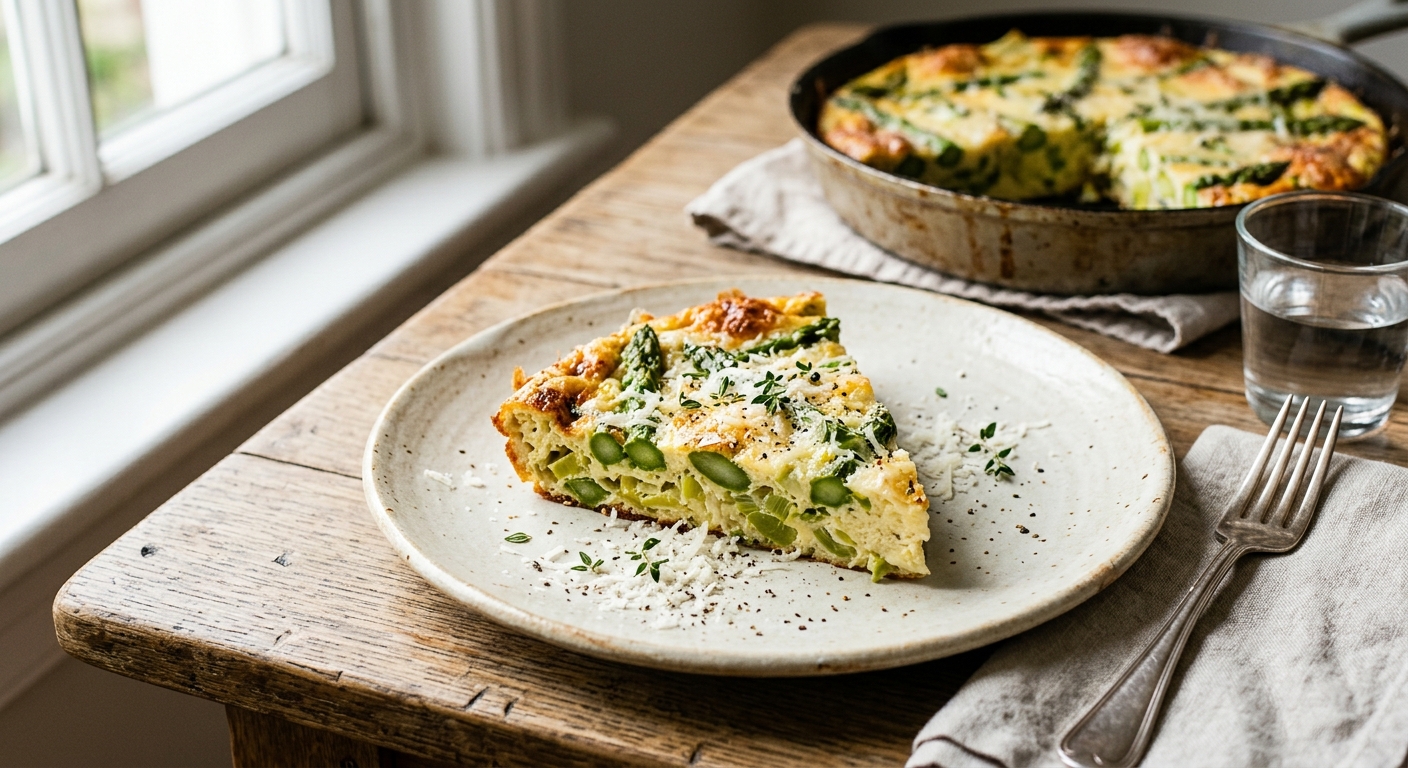
There is something deeply satisfying about a frittata that holds its shape when sliced, reveals a custardy interior, and smells of caramelized alliums and garden-fresh asparagus the moment it hits the table. This Asparagus and Leek Frittata was designed from the ground up with metabolic health in mind, pairing two of the plant kingdom’s most potent prebiotic vegetables with pasture-raised eggs and a finishing layer of aged Pecorino Romano. The result is a breakfast that is simultaneously elegant enough for a weekend brunch and practical enough to meal-prep for the entire week.
The nutritional architecture here is deliberate. Leeks are among the richest dietary sources of fructooligosaccharides and inulin, the prebiotic fibers that selectively stimulate Bifidobacterium and Lactobacillus species in the colon. Asparagus contributes its own inulin alongside remarkable amounts of folate, vitamin K, and the anti-inflammatory flavonoid rutin. Eggs anchor the dish with all nine essential amino acids, choline for liver and brain function, and lutein plus zeaxanthin for eye health. Together, these ingredients create a glycemic load that stays firmly in the low-to-medium range, meaning blood sugar rises gently and energy is sustained for hours rather than minutes.
At Calibrated Cuisine we have developed four distinct cooking methods for this frittata, because technique genuinely changes the outcome. The stovetop-to-oven method produces the most traditional result: a deeply golden crust beneath a barely-set top. The slow cooker yields an almost soufflé-like texture, steamed from beneath, perfect for hands-off mornings. The pressure cooker method is the fastest route to a fully set, moist frittata with no risk of a rubbery bottom. The oven method, starting everything cold in a cast iron skillet, develops the deepest flavor through slow Maillard browning of the leeks. Choose your method, calibrate your morning, and eat well.
4
servings
Ingredients
- 8 largepasture-raised eggs
- 300 gasparagus, woody ends snapped off, cut into 4cm pieces
- 2 mediumleeks (about 350g trimmed weight), white and light-green parts only, halved lengthwise and sliced into 1cm half-moons
- 2 tbspextra-virgin olive oil
- 60 gPecorino Romano, finely grated (or Parmesan)
- 3 tbspwhole milk or unsweetened plant milk
- 2 clovesgarlic, minced
- 1 tspfresh thyme leaves (or 0.5 tsp dried)
- 0.5 tspsmoked paprika
- 0.25 tspfreshly grated nutmeg
- —Colima Sea SaltMicroplastic Free Salt and black pepper to taste
- —Fresh flat-leaf parsley or chives, roughly chopped, to garnish
Instructions
Click on an item below to shop for the recommended items for this recipe on Amazon.
As an Amazon Associate, we earn from qualifying purchases.
- Position an oven rack 20cm from the broiler element and preheat the broiler to high. In a large bowl, whisk the eggs with the milk, half the Pecorino, the smoked paprika, nutmeg, 0.5 tsp fine sea salt, and several grinds of black pepper until the mixture is completely homogeneous and slightly frothy, about 90 seconds. Set aside.
- Heat the olive oil in a 24cm oven-safe, non-stick or well-seasoned cast iron skillet over medium heat. Once the oil shimmers, add the leeks and a pinch of salt. Cook, stirring frequently, for 8 to 10 minutes until the leeks are completely softened, sweet-smelling, and beginning to turn golden at the edges. Add the garlic and thyme, stir for 60 seconds until fragrant.
- Increase heat to medium-high and add the asparagus pieces. Toss to coat in the leek mixture and cook for 3 minutes, turning once, until the asparagus is bright green and just beginning to blister at the tips. Spread the vegetables into an even layer across the skillet.
- Reduce heat back to medium-low. Pour the egg mixture evenly over the vegetables, gently lifting the asparagus spears with a spatula so the egg flows underneath. Do not stir. Cook undisturbed for 5 to 6 minutes until the edges are set and opaque but the centre still wobbles like barely-set jelly.
- Scatter the remaining Pecorino evenly over the surface. Transfer the skillet to the broiler and cook for 2 to 3 minutes, watching closely, until the top is golden, puffed, and just set with no liquid egg visible. Remove immediately. Let the frittata rest in the pan for 3 minutes before running a flexible spatula around the edges and sliding onto a cutting board. Garnish with fresh parsley or chives, slice into wedges, and serve.
- Preheat the oven to 180C (160C fan, 350F). Whisk the eggs with the milk, half the Pecorino, smoked paprika, nutmeg, 0.5 tsp sea salt, and generous black pepper in a large bowl until completely smooth and lightly aerated. Set aside.
- Heat the olive oil in a 24cm oven-safe cast iron skillet over medium heat on the stovetop. Add the leeks with a pinch of salt and cook, stirring occasionally, for 10 to 12 minutes until deeply softened and golden, developing more color than you would in the stovetop-to-broiler method since there is no broiler finish to add color later. Add the garlic and thyme and cook for 90 seconds until fragrant.
- Add the asparagus to the skillet and toss with the leeks for 2 minutes over medium-high heat, just long enough to coat in the aromatics and begin brightening in color. Remove the skillet from the heat and spread the vegetables into a flat, even layer, tucking some asparagus tips upright near the rim for presentation.
- Pour the egg mixture slowly around and over the vegetables, allowing it to settle naturally. Scatter the remaining Pecorino over the top. Transfer the skillet directly to the centre rack of the preheated oven.
- Bake for 25 to 30 minutes until the frittata is puffed at the edges, golden on top, and the centre reads 73C (163F) on an instant-read thermometer or feels firmly set when the pan is gently nudged. If the top colors too quickly after 20 minutes, tent loosely with foil. Remove from the oven, rest for 5 minutes, garnish with fresh herbs, and slice directly from the skillet.
- Cut a piece of baking parchment to fit the base and partway up the sides of your slow cooker insert. Lightly grease the parchment and exposed sides of the insert with a small amount of olive oil to prevent sticking. Whisk the eggs with the milk, half the Pecorino, smoked paprika, nutmeg, 0.5 tsp sea salt, and generous black pepper in a large bowl until smooth. Set aside.
- Heat the olive oil in a skillet over medium heat on the stovetop. Add the leeks and cook for 6 to 7 minutes until softened but not fully caramelized, as they will continue cooking in the slow cooker. Add the garlic and thyme and stir for 45 seconds. Remove from heat. Add the raw asparagus pieces directly to the leeks in the skillet and toss together briefly. There is no need to pre-cook the asparagus as the slow cooker will cook it through.
- Transfer the leek and asparagus mixture into the parchment-lined slow cooker insert, spreading it into an even layer. Pour the egg mixture over the top, pressing any vegetables that float back beneath the surface. Scatter the remaining Pecorino over the top.
- Place a double layer of paper towels (kitchen paper) across the top of the slow cooker before fitting the lid. This absorbs condensation and prevents water droplets from falling onto the frittata surface, which would create wet patches and uneven texture. Set the slow cooker to High.
- Cook on High for 2 to 2.5 hours, checking at the 2-hour mark. The frittata is done when the edges are fully set, the centre springs back lightly when touched, and an instant-read thermometer reads 73C (163F). Do not lift the lid during the first 90 minutes. Once set, optionally slide the parchment sling out of the insert, place the frittata on a baking sheet, and broil for 2 minutes to develop a golden top. Garnish with fresh herbs and serve in wedges.
- Grease a 7-inch springform pan or round baking dish thoroughly with olive oil. Cut a circle of parchment for the base. Whisk the eggs with the milk, half the Pecorino, smoked paprika, nutmeg, 0.5 tsp sea salt, and black pepper in a large bowl until fully combined and slightly foamy. Set aside. Pour 250ml (1 cup) of cold water into the Instant Pot insert and place the trivet inside.
- Heat the remaining olive oil in a skillet on the stovetop over medium-high heat. Add the leeks and cook briskly for 4 to 5 minutes, just until wilted and fragrant rather than fully caramelized, since you want them to retain some texture after pressure cooking. Add the garlic, thyme, and asparagus pieces and toss together for 90 seconds to coat. Season lightly with salt. Remove from heat and allow the mixture to cool for 3 minutes so it does not begin scrambling the eggs when combined.
- Fold the warm vegetable mixture into the egg bowl, stirring gently to distribute evenly. Pour the combined mixture into the prepared pan. Scatter the remaining Pecorino over the surface. Cover the pan tightly with a piece of aluminium foil, crimping the edges down firmly to prevent condensation water from dripping onto the frittata during pressurized cooking.
- Lower the covered pan onto the trivet using a foil sling (fold a long piece of foil into thirds lengthwise, place the pan in the centre, and use the ends as handles). Seal the Instant Pot lid and set the valve to Sealing. Cook on Manual High Pressure for 15 minutes.
- Allow a full natural pressure release for 10 minutes, then carefully switch the valve to Venting to release any remaining steam. Open the lid and lift the pan out using the foil sling. Remove the foil cover. The frittata should be fully set and slightly domed in the centre. If the surface appears wet, rest uncovered for 3 minutes. For a drier, firmer top, slide under a broiler for 2 minutes. Run a knife around the edge, release the springform, garnish with fresh herbs, and serve.
Nutrition Breakdown
Per 1 serving (makes 4)
Vitamins & Minerals
% Daily Value based on a 2,000 calorie diet (FDA reference)
🧬 Essential Amino Acids
% of recommended daily intake (RDA) per serving
🛡 Antioxidant Profile
The Nutrition Science
The prebiotic story of this frittata centres on inulin-type fructans, a class of non-digestible carbohydrates found in both leeks and asparagus. When these fibers reach the colon intact, they are selectively fermented by Bifidobacterium longum and Lactobacillus acidophilus, producing short-chain fatty acids (SCFAs) including butyrate, acetate, and propionate. Butyrate is the primary fuel source for colonocytes (colon lining cells) and has been shown in multiple randomised controlled trials to reduce intestinal permeability, lower systemic inflammation markers including CRP and IL-6, and improve fasting insulin sensitivity. A single serving of this frittata provides approximately 2.8g of fructooligosaccharides, a meaningful contribution toward the 5g per day threshold shown to produce measurable microbiome shifts.
The egg component contributes far more than protein. Each large egg delivers approximately 147mg of choline, a nutrient that over 90% of adults consume below adequate intake levels. Choline is required for the synthesis of phosphatidylcholine (a structural component of every cell membrane), the neurotransmitter acetylcholine, and very-low-density lipoprotein (VLDL) particles that export fat from the liver. Inadequate choline intake is now understood to be a contributing factor in non-alcoholic fatty liver disease (NAFLD), and the 290mg provided per serving of this frittata represents more than half the adequate intake for adult women (425mg) and approaches half that for adult men (550mg). Dietary cholesterol from eggs has been extensively re-evaluated and current evidence, including a 2020 meta-analysis in the European Journal of Nutrition, does not support a link between moderate egg consumption (up to 7 per week) and cardiovascular events in healthy adults.
Vitamin K in this frittata comes from two distinct sources with complementary roles. Asparagus provides phylloquinone (vitamin K1), which activates clotting factor proteins in the liver. The aged Pecorino Romano contributes a small but meaningful amount of menaquinone-4 (vitamin K2), which activates osteocalcin (for bone matrix mineralisation) and matrix Gla-protein (which prevents calcium from depositing in arterial walls). The 72mcg of total vitamin K per serving represents 60% of the daily value and, critically, it is delivered alongside the dietary fat from olive oil and egg yolks that is essential for fat-soluble vitamin absorption. This is not a coincidence of recipe design but an intentional synergy: always consume vitamin K-rich vegetables with a source of fat.
Pro Tips
- Do not skip washing leeks thoroughly. Slice them first, then submerge in a bowl of cold water, swishing vigorously to dislodge any grit trapped between the layers. Lift out with your hands and drain; the sand sinks to the bottom.
- For the creamiest egg texture regardless of method, whisk your eggs at room temperature and avoid over-whisking once the milk is added. Excess air incorporation leads to a spongier, drier set. Forty-five seconds of vigorous whisking after all liquid is in is sufficient.
- Asparagus thickness matters for even cooking. If your spears are thicker than 1cm in diameter, blanch the cut pieces in boiling salted water for 90 seconds and shock in ice water before adding to the pan. Thin pencil asparagus (under 0.7cm) can go in raw even in the slow cooker and pressure cooker methods.


I love this approach to breakfast, especially the emphasis on prebiotics setting the tone for the day. I’ve been experimenting with adding a pinch of black pepper and turmeric to my egg dishes lately (beyond just the frittata itself, even stirring it into the filling), and it’s shifted how my body processes these nutrient-dense meals. The asparagus and leeks are already such powerful prebiotic foods, and that golden turmeric adds another layer of anti-inflammatory support to what’s already a metabolically smart dish. Have you found that certain cooking methods for the leeks affect their inulin content, or does the gentle braising preserve those beneficial fibers?
This is a genuinely smart pairing, and I love that you’re hitting both the prebiotic fiber *and* the choline angle, Laurie. That postpartum angle is really thoughtful, by the way. One small thing though: while asparagus and leeks do contain inulin-type fructans, the amounts are moderate (maybe 2-3g per serving depending on prep), so I’d temper expectations slightly on the “powerful hit” framing. That said, they’re excellent *consistent* sources if you’re eating them regularly, which matters way more than any single meal. The fructan-fermenting bacteria do seem to play a real role in metabolic signaling
This is such a smart postpartum recovery meal, honestly! I’ve been making variations of this since week 3 postpartum because eggs are packed with choline (crucial for baby’s brain development and my own foggy brain), and the asparagus/leek combo is genuinely a galactagogue bonus. My question though, Tiara: does adding the turmeric and black pepper impact the bioavailability of the choline at all, or are you finding it doesn’t matter in the context of a whole egg meal? I’m always hunting for ways to boost nutrient absorption while keeping meals simple enough to actually eat one-handed at 3am, haha.