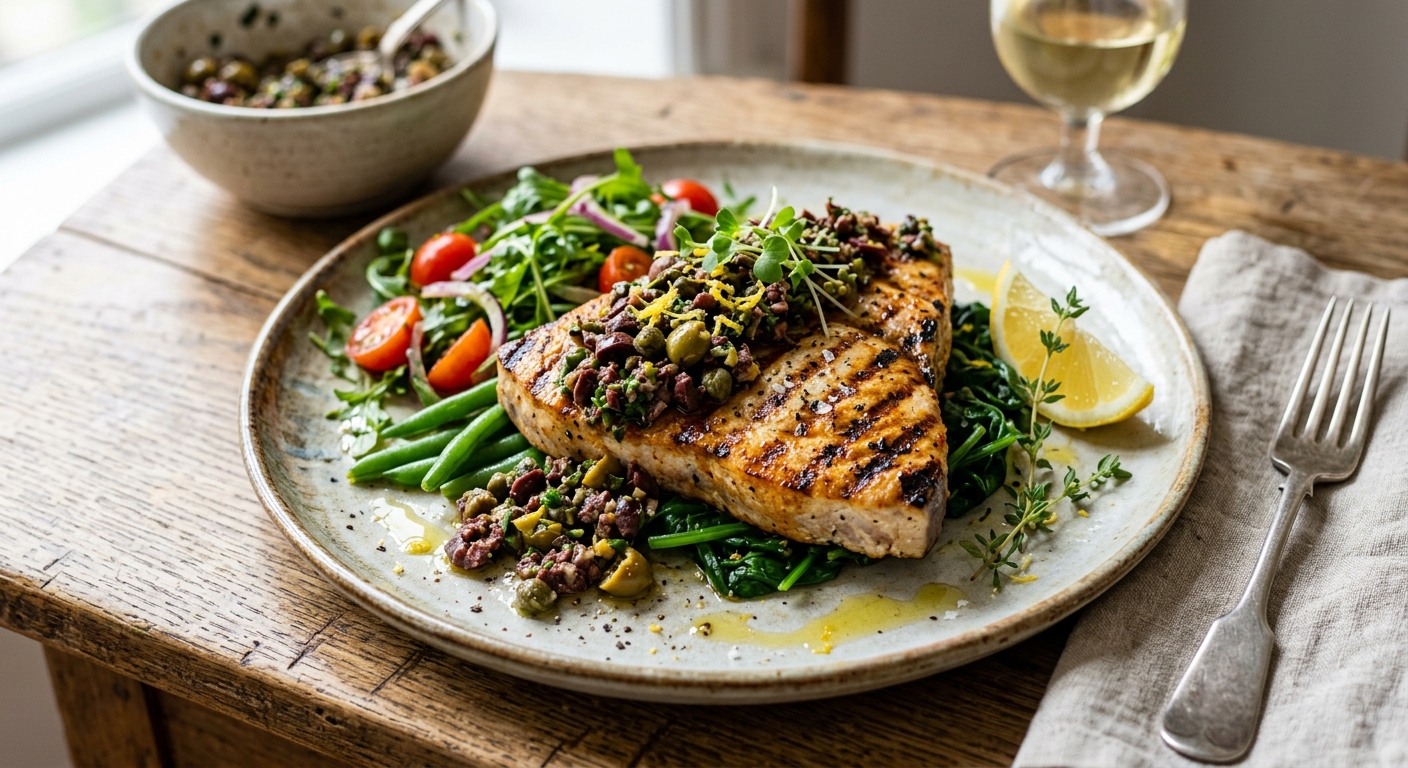
Swordfish has long been the steak of the sea, prized by chefs for its dense, meaty texture and mild, slightly sweet flavor that holds up beautifully to bold accompaniments. Paired with a classic Provencal-style olive tapenade loaded with Kalamata olives, capers, anchovies, and lemon zest, this dish transforms a simple weeknight protein into something genuinely extraordinary. The tapenade takes fewer than 5 minutes to pulse together in a food processor, yet it adds layers of umami depth and bright acidity that make every bite feel considered and complete.
From a nutritional standpoint, this recipe is one of the most efficient anti-inflammatory meals you can put on the table. A single serving of swordfish provides roughly 2,200mg of combined EPA and DHA, the long-chain omega-3 fatty acids that clinical research consistently links to reduced systemic inflammation, improved cardiovascular markers, and enhanced cognitive function. The olive tapenade amplifies this effect: Kalamata olives are dense in oleocanthal, a phenolic compound that inhibits the same COX enzymes targeted by ibuprofen, while capers contribute some of the highest concentrations of quercetin found in any whole food.
At Calibrated Cuisine, we designed this recipe to hit meaningful thresholds across the nutrient panel, not just omega-3s. Each serving delivers over 100% DV of selenium, a critical antioxidant mineral that works synergistically with omega-3s to protect cell membranes from lipid peroxidation, plus exceptional amounts of vitamin B12, niacin, and vitamin D. Whether you cook it on a screaming-hot grill pan, braise it low-and-slow, or finish it in the oven, the nutritional payload remains remarkably intact, and the result is always delicious.
4
servings
Ingredients
- 800 gswordfish steaks, about 2cm thick, skin removed (4 x 200g portions)
- 2 tbspextra-virgin olive oil, divided
- 1 tspsmoked paprika
- 1 tspgarlic powder
- 0.5 tspground cumin
- 1 tsplemon zest
- 160 gpitted Kalamata olives
- 80 gpitted green olives
- 30 gcapers, drained and rinsed
- 4 filletsoil-packed anchovy fillets, drained
- 2 clovesgarlic, roughly chopped
- 3 tbspextra-virgin olive oil (for tapenade)
- 2 tbspfresh lemon juice
- 1 tspfresh thyme leaves
- 2 tbspfresh flat-leaf parsley, finely chopped
- 0.5 tspDijon mustard
- 200 gcherry tomatoes, halved (for serving)
- 60 gbaby rocket (arugula), for serving
- —Colima Sea SaltMicroplastic Free Salt and cracked black pepper to taste
- —Lemon wedges, for serving
Instructions
Click on an item below to shop for the recommended items for this recipe on Amazon.
As an Amazon Associate, we earn from qualifying purchases.
- Make the tapenade first: combine the Kalamata olives, green olives, capers, anchovy fillets, chopped garlic, Dijon mustard, lemon juice, and thyme leaves in a food processor. Pulse 8 to 10 times until the mixture is coarsely chopped but not smooth. You want visible texture, not a paste. Transfer to a bowl, stir in 3 tablespoons of olive oil and the chopped parsley, taste, and season with black pepper. Set aside at room temperature (the tapenade needs no salt given the capers and anchovies).
- Pat the swordfish steaks completely dry with paper towels. Moisture is the enemy of a good sear. In a small bowl, combine smoked paprika, garlic powder, cumin, lemon zest, half a teaspoon of fine sea salt, and a generous amount of black pepper. Rub this spice mixture evenly over both sides of each steak. Drizzle with 1 tablespoon of olive oil and press the rub in gently.
- Place a cast iron grill pan over high heat and allow it to preheat for a full 3 minutes until it just begins to smoke. Add the remaining 1 tablespoon of olive oil and swirl to coat. Carefully lay the swordfish steaks onto the hot pan, pressing gently for a moment to ensure full surface contact with the ridges.
- Cook undisturbed for 4 to 5 minutes on the first side. You will see the flesh turn opaque about halfway up the side of the steak. Resist moving the fish. When it releases cleanly from the pan, flip each steak once using a wide fish spatula. Cook for a further 3 to 4 minutes on the second side. Swordfish is done when it reads 63C (145F) on an instant-read thermometer and flakes gently at the thickest point. Do not overcook: unlike tuna, swordfish dries out quickly past this temperature.
- Transfer the steaks to a warm plate and rest for 2 minutes. While resting, toss the cherry tomatoes and baby rocket with a few drops of olive oil and a pinch of salt. Plate the rocket salad, lay a swordfish steak on top, and spoon 2 to 3 generous tablespoons of tapenade across the center of each steak. Serve immediately with lemon wedges.
- Make the tapenade as directed: pulse Kalamata olives, green olives, capers, anchovy fillets, garlic, Dijon mustard, lemon juice, and thyme in a food processor 8 to 10 times until coarsely chopped. Stir in 3 tablespoons of olive oil and the chopped parsley. Divide the tapenade in half. One half will be used to flavor the fish during cooking; the other half is reserved as a fresh condiment for serving.
- Lightly coat the base of your slow cooker insert with 1 tablespoon of olive oil. Scatter the halved cherry tomatoes across the bottom in an even layer. Season with a pinch of salt and pepper. This tomato layer acts as both an aromatic bed and a moisture source, protecting the fish from direct contact with the hot ceramic base.
- Pat the swordfish steaks dry. Season both sides lightly with the smoked paprika, garlic powder, cumin, lemon zest, and a small pinch of salt. Lay the steaks in a single layer over the tomato bed. If the steaks do not fit in one layer, overlap them slightly at the edges rather than stacking. Spoon half of the tapenade evenly over the top surface of each steak.
- Drizzle the remaining tablespoon of olive oil over the top, then add 2 tablespoons of fresh lemon juice directly into the pot around the fish (not on top). Place the lid on and cook on Low for 1.5 to 2 hours. Check at the 1.5 hour mark: the fish should be opaque throughout and flake when pressed. An instant-read thermometer should read 63C (145F).
- Using a wide spatula and a spoon to support the steak from below, carefully transfer each portion to a shallow bowl or plate. The fish will be tender and delicate. Spoon the tomatoes and cooking juices around the fish. Top each serving with a heaped tablespoon of the reserved fresh tapenade and a handful of baby rocket. Serve with lemon wedges.
- Make the tapenade before you begin cooking: pulse Kalamata olives, green olives, capers, anchovy fillets, garlic, Dijon mustard, lemon juice, and thyme in a food processor 8 to 10 times until coarsely chopped but still textured. Stir in 3 tablespoons of olive oil and the chopped parsley. Set aside. For this method, the tapenade is served entirely as a finishing condiment, not cooked with the fish.
- Pour 240ml (1 cup) of water into the Instant Pot insert. Add 1 tablespoon of olive oil, the lemon zest, and a few sprigs of fresh thyme to the water to build aromatic steam. Place the stainless steel steam rack (trivet) inside the pot.
- Pat the swordfish steaks dry with paper towels. In a small bowl, mix the smoked paprika, garlic powder, cumin, salt, and pepper. Season both sides of each steak with the spice rub, pressing gently to adhere. Arrange the steaks on the steam rack in a single layer, side by side. If they overlap slightly at the edges, that is acceptable; they should not be stacked on top of each other.
- Secure the lid and set the valve to Sealing. Select Pressure Cook (or Manual) on High Pressure and set the timer for 3 minutes. The pot will take approximately 5 to 7 minutes to come to pressure. When the timer ends, immediately turn the valve to Venting for a Quick Release. Open the lid carefully, tilting it away from you to let steam escape.
- Check the internal temperature with an instant-read thermometer: the fish should read 63C (145F) and be opaque throughout. If slightly underdone, replace the lid (without sealing) and let residual heat finish the cooking for 1 to 2 minutes. Transfer steaks with a wide spatula to plates. Arrange baby rocket and cherry tomatoes alongside each steak, then spoon 2 to 3 tablespoons of tapenade generously over the top. Serve immediately with lemon wedges.
- Preheat your oven to 220C (425F) with a rack positioned in the upper-middle position. Make the tapenade: pulse Kalamata olives, green olives, capers, anchovy fillets, garlic, Dijon mustard, lemon juice, and thyme in a food processor 8 to 10 times until coarsely chopped. Stir in 3 tablespoons of olive oil and the chopped parsley. Divide into two portions, one for topping the fish and one for serving.
- Line a rimmed baking sheet with parchment paper. Scatter the halved cherry tomatoes across one side of the baking sheet. Drizzle with half a tablespoon of olive oil, season lightly with salt and pepper, and toss to coat. Push them toward the edges to create space for the fish in the center.
- Pat the swordfish steaks completely dry. Combine smoked paprika, garlic powder, cumin, lemon zest, salt, and pepper in a small bowl. Rub the spice mixture over all surfaces of each steak. Place the steaks on the prepared baking sheet among the tomatoes and drizzle the tops with the remaining olive oil.
- Roast for 7 to 8 minutes. Remove the pan from the oven and spoon half of the tapenade evenly over the top of each steak, pressing it gently to form a thin crust layer. Return the pan to the oven and roast for a further 5 to 6 minutes, until the tapenade crust is fragrant and slightly darkened at the edges and the fish reads 63C (145F) on an instant-read thermometer. The tomatoes should be blistered and jammy.
- Remove from the oven and rest for 2 minutes on the pan. Plate each steak with a generous spoonful of the roasted tomatoes from the pan. Add a handful of fresh baby rocket to each plate. Spoon the reserved fresh tapenade alongside the steak rather than on top, so diners get both the warm baked crust and the bright, fresh condiment in the same bite. Serve with lemon wedges.
Nutrition Breakdown
Per 1 serving (makes 4)
Vitamins & Minerals
% Daily Value based on a 2,000 calorie diet (FDA reference)
🧬 Essential Amino Acids
% of recommended daily intake (RDA) per serving
🛡 Antioxidant Profile
The Nutrition Science
The omega-3 fatty acids EPA (eicosapentaenoic acid) and DHA (docosahexaenoic acid) found abundantly in swordfish are the most bioavailable form of omega-3s known to nutritional science. Unlike ALA from plant sources such as flaxseed, which requires enzymatic conversion in the body at a rate of just 5 to 10 percent, the EPA and DHA in swordfish are immediately usable. These fatty acids are incorporated directly into cell membrane phospholipids, where they reduce membrane rigidity, improve receptor signaling, and serve as precursors to resolvins and protectins, specialized pro-resolving mediators that actively switch off the inflammatory cascade rather than simply slowing it down.
The tapenade is nutritionally active in its own right, not merely a flavoring agent. Kalamata and green olives provide oleocanthal and hydroxytyrosol, two phenolic compounds with robust clinical evidence for cardiovascular and anti-inflammatory benefit. Oleocanthal’s mechanism is particularly well-characterized: it non-selectively inhibits cyclooxygenase enzymes, the same pathway exploited by non-steroidal anti-inflammatory drugs. Capers are among the richest dietary sources of quercetin, delivering concentrations of approximately 180mg per 100g, which is roughly 10 times higher than onions, the most commonly cited quercetin source. Quercetin inhibits NF-kB, a master transcription factor that regulates the expression of dozens of inflammatory genes.
Selenium deserves special attention in this recipe because its anti-inflammatory role is mechanistically tied to the omega-3 content. As polyunsaturated fats are particularly vulnerable to oxidation, the body requires adequate selenium to upregulate glutathione peroxidase, an enzyme that neutralizes lipid hydroperoxides before they can damage surrounding tissue. Swordfish is among the richest dietary sources of selenium in the entire food supply, and this nutrient synergy means that the omega-3s you consume in this dish are far less likely to be oxidized before they reach their target tissues than omega-3s consumed from supplements without adequate antioxidant co-factors.
Pro Tips
- Do not skip patting the swordfish dry before cooking. Surface moisture creates steam, which prevents searing on the stovetop and leads to a steamed rather than roasted finish in the oven. Dry fish browns; wet fish stews.
- The tapenade keeps refrigerated in an airtight container for up to 5 days and improves in flavor after 24 hours as the ingredients meld. Make a double batch and use it on grilled chicken, stirred into pasta, or spread on crusty bread throughout the week.
- Mercury awareness: swordfish is a large predatory fish and contains higher mercury than salmon or sardines. The FDA recommends adults limit swordfish to one serving per week. Pregnant women and young children should substitute salmon or mackerel, which provide comparable omega-3 levels at much lower mercury concentrations.

This sounds like such a nourishing plate, and I love how the tapenade’s polyphenols work so beautifully with the omega-3s from the swordfish. I’m curious though, have you experimented with adding a pinch of turmeric and black pepper to either the tapenade or as a finishing touch? The black pepper really helps with curcumin absorption, and in Ayurveda we see turmeric as deeply complementary to fish preparations for joint and cardiovascular support, beyond just flavor. Even a light golden dusting would amplify the anti-inflammatory benefits you’re already building here.
oh man tiara you’re speaking my language here, and honestly i’ve been doing exactly this with my evening fish meals because i noticed my sleep quality tanked when my joint inflammation was flaring up – turns out thats not unrelated lol. the turmeric/black pepper combo is solid, but heres what got me curious: has anyone looked at whether the warming properties of turmeric in ayurvedic terms might affect melatonin synthesis? im wondering if thats why i get better sleep tracker data on nights i eat this earlier versus right before bed, since the anti inflammatory load seems to help but the digestive activation might be fighting circadian signals. might just be my n=1 sleep depriv
This is literally my kind of plate, Tiara! I actually do add a turmeric and black pepper combo to my tapenade, and honestly it’s a game changer for insulin response – the curcumin plus piperine combo is no joke for managing inflammation and blood sugar stability. Since getting diagnosed with PCOS, I’ve found that pairing omega-3 dense fish like this with polyphenol-rich toppings keeps my androgens way more stable than plain grilled fish alone, so I’m so here for recipes that layer these anti-inflammatory compounds together.
Rosa, this turmeric and black pepper addition in the tapenade is brilliant, and I really appreciate you spelling out the curcumin/piperine synergy because that’s exactly the kind of intentional nutrient stacking that makes such a difference with chronic conditions. I’ve been experimenting with similar layering for MS symptom management, and I find that pairing omega-3s with polyphenols genuinely seems to support better neuroinflammation markers than either component alone. Thank you for being so candid about how food composition actually impacts your PCOS markers, because it normalizes the reality that we’re not just eating for taste or general “wellness,” we’re eating for specific metabolic
Oh, I’m so glad you both brought up the turmeric and black pepper combo, because I’ve been doing exactly this with my fish dishes for years now and it’s made such a measurable difference in my joint inflammation markers! I actually add it directly to my olive oil before drizzling it over the swordfish, so the heat helps activate that curcumin, and I’ve noticed my CRP levels are noticeably lower on weeks when I’m consistent with it. This recipe is already hitting so many of my anti-inflammatory targets with the omega-3s and polyphenols, but I’m definitely stealing this tapenade idea and working in that turmeric-pepper paste, thank you for
This is exactly the kind of nutrient synergy that gets me excited about epigenetics, Irene – you’re essentially stacking methylation donors (the folate in those fresh herbs) with curcumin’s polyphenolic power and piperine’s bioavailability boost, which means your body can actually express the genes that code for those anti-inflammatory pathways instead of leaving them silenced. The fact that you’re seeing measurable CRP shifts tells me you’ve basically created a personalized epigenetic intervention through food, and I’m curious: have you noticed whether consistency matters more than quantity, or does hitting that turmeric-black pepper combo even just 3-4x per week give