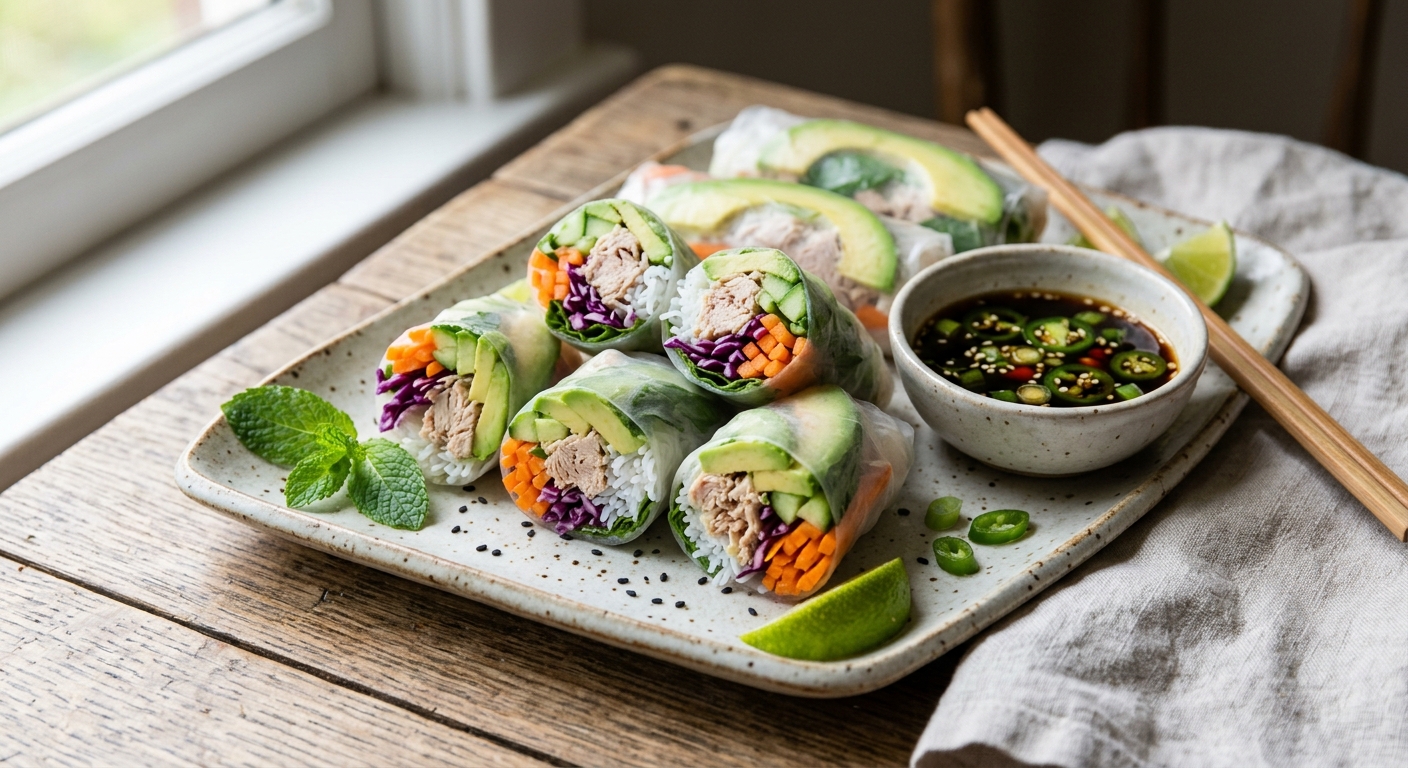
Rice paper rolls sit at the intersection of culinary elegance and nutritional precision. These Avocado and Tuna Rice Paper Rolls are built around two of the most studied anti-inflammatory foods on the planet: wild-caught albacore tuna, dense with EPA and DHA, and ripe Hass avocado, loaded with oleic acid and fat-soluble carotenoids. Together they create a filling that is simultaneously light on the palate and deeply satisfying to the body.
What elevates this recipe beyond the standard lunchbox roll is the deliberate layering of textures and micronutrients. Rice vermicelli adds slow-releasing carbohydrates, shredded purple cabbage contributes anthocyanins and vitamin C, julienned cucumber brings hydration and silica, and a handful of fresh mint and coriander deliver their own impressive phytochemical payloads. A dipping sauce of reduced-sodium tamari, fresh lime, ginger, and a whisper of sesame oil ties the whole assembly together with umami depth.
From a calibration standpoint, a four-roll serving clears the 20% Daily Value threshold for omega-3 fatty acids, selenium, vitamin B12, folate, vitamin K, and potassium, while keeping calories comfortably under 400. The glycemic load is deliberately low, anchored by the moderate portion of rice vermicelli offset by the healthy fat content that slows glucose absorption. This is a lunch that genuinely works for you from the first bite to the last.
4
servings
Ingredients
- 2 cans (160g each drained)wild-caught albacore tuna in spring water, drained and flaked
- 2 largeripe Hass avocados, halved, pitted, and thinly sliced
- 12 sheets22cm rice paper wrappers
- 100 gdry rice vermicelli noodles
- 150 gpurple cabbage, very finely shredded
- 1 largeLebanese cucumber, julienned into 8cm matchsticks
- 2 mediumcarrots, peeled and julienned into 8cm matchsticks
- 1 bunchfresh mint leaves, stems removed
- 1 bunchfresh coriander (cilantro), stems trimmed
- 4 stalksspring onions (scallions), thinly sliced on an angle
- 1 tbspfresh lime juice (for tuna mixture)
- 1 tsptoasted sesame oil (for tuna mixture)
- 3 tbspreduced-sodium tamari (for dipping sauce)
- 2 tbspfresh lime juice (for dipping sauce)
- 1 tbsppure maple syrup or raw honey
- 1 tspfresh ginger, finely grated
- 1 clovegarlic, finely minced
- 1 tsptoasted sesame oil (for dipping sauce)
- 0.5 tspdried chilli flakes (optional)
- —Colima Sea SaltMicroplastic Free Salt and white pepper to taste
- —Warm water in a wide shallow bowl for soaking rice paper
Instructions
Click on an item below to shop for the recommended items for this recipe on Amazon.
As an Amazon Associate, we earn from qualifying purchases.
- Bring a medium saucepan of unsalted water to a rolling boil over high heat. Add the rice vermicelli noodles, turn off the heat, and allow them to soak for 3 to 4 minutes until tender but still springy. Drain immediately into a fine-mesh sieve and rinse under cold running water for 30 seconds to halt cooking and prevent sticking. Shake off excess water, transfer to a bowl, and toss with a few drops of sesame oil to keep the strands separate. Set aside.
- While the noodles soak, prepare the dipping sauce: combine the tamari, lime juice, maple syrup, grated ginger, minced garlic, sesame oil, and chilli flakes (if using) in a small bowl. Whisk until the sweetener dissolves completely. Taste and adjust the balance of sweet, sour, and salty to your preference. Divide into individual dipping bowls and set aside.
- In a separate medium bowl, gently combine the drained and flaked albacore tuna with 1 tablespoon lime juice, 1 teaspoon sesame oil, the sliced spring onions, and a pinch of white pepper. Use a fork to fold everything together, keeping some texture in the tuna rather than mashing it smooth. Season lightly with sea salt and set aside.
- Arrange your rolling station in a logical left-to-right sequence: the wide shallow bowl of warm water, then a clean damp tea towel or silicone mat as your rolling surface, then individual bowls of vermicelli, tuna mixture, avocado slices, cabbage, cucumber, carrot, mint, and coriander.
- To assemble each roll: submerge one rice paper sheet in the warm water for exactly 10 to 15 seconds, moving it in a slow circular motion until it is pliable but not completely soft (it will continue softening on the mat). Lay it flat on your damp surface. In the lower third of the wrapper, layer a small pinch of vermicelli, then 2 to 3 slices of avocado side by side, a generous tablespoon of the tuna mixture, a small pinch of purple cabbage and carrot, a few cucumber matchsticks, 4 to 5 mint leaves, and a few coriander sprigs.
- Fold the bottom edge of the rice paper firmly up and over the filling, pressing gently to compact it. Fold in both sides tightly (like an envelope), then roll forward with steady tension until sealed. Place seam-side down on a serving platter lined with a damp paper towel to prevent sticking. Repeat for all 12 rolls. Serve immediately with the dipping sauce on the side.
- To build a slow-cooker dipping broth, combine the tamari, lime juice, maple syrup, grated ginger, minced garlic, sesame oil, chilli flakes, and 60ml (4 tablespoons) of water in the slow cooker insert. Stir well, set the cooker to Low, and allow the sauce to gently infuse and mellow for 2 hours with the lid slightly ajar. The low, slow heat allows the ginger and garlic to fully bloom into the liquid without turning bitter, producing a rounder and more complex flavour than the raw quick-mix version.
- Approximately 30 minutes before serving time, place the dry rice vermicelli into a heatproof bowl and pour enough just-boiled water over them to submerge completely. Cover with a plate and allow them to soak for 5 minutes until tender. Drain, rinse under cold water, shake dry, and then transfer the noodles to a separate small bowl of warm water inside the slow cooker insert beside the sauce (use a ramekin or small bowl as a water bath vessel) to keep them warm and pliable without overcooking.
- While the sauce finishes infusing, prepare the tuna mixture: gently fold the drained flaked albacore tuna with 1 tablespoon lime juice, 1 teaspoon sesame oil, sliced spring onions, and a pinch of white pepper in a medium bowl. Keep refrigerated until assembly begins.
- Set up the assembly station with all prepped vegetables, avocado (sliced just before serving to prevent browning), herbs, and the warm noodles drained from their water bath and shaken dry. Ladle the infused dipping sauce from the slow cooker into small individual bowls, leaving the cooker on the Warm setting so additional sauce stays at temperature throughout the gathering.
- Assemble the rolls using the same rolling technique as the stovetop method: soak each rice paper sheet in warm water for 10 to 15 seconds until just pliable, lay flat, layer filling in the lower third, fold bottom up over filling, fold in sides, and roll forward firmly. With warm noodles and a warm dipping sauce, this method is particularly well-suited to winter entertaining where you want every element at a pleasant temperature.
- Place the drained, flaked albacore tuna into the pressure cooker insert along with the grated ginger, minced garlic, 1 tablespoon lime juice, 1 teaspoon sesame oil, 1 tablespoon of the tamari from the dipping sauce ingredients, a pinch of white pepper, and 3 tablespoons of water. Stir gently to combine. Seal the lid and set to High Pressure for 3 minutes. This brief pressure cycle forces the ginger and garlic flavours deeply into the flaked tuna, producing an intensity that cold-mixing cannot achieve.
- Once the cook time is complete, use an immediate quick release. Carefully open the lid away from you. The tuna should be hot, fragrant, and lightly sauced. Use a fork to gently stir the mixture, breaking up any clumps. Transfer to a wide shallow bowl and spread it out to cool rapidly to room temperature, about 10 minutes. Taste and adjust seasoning with additional lime juice or sea salt as needed.
- While the tuna cools, prepare the vermicelli using the pressure cooker on the Saute function: add 600ml of water to the now-emptied insert and bring to a simmer using the Saute (High) setting. Add the dry rice vermicelli and cook for 2 minutes, stirring occasionally. Turn off the Saute function, drain the noodles through a fine-mesh sieve, rinse under cold water, and toss with a few drops of sesame oil to prevent sticking.
- Prepare the dipping sauce by combining the remaining tamari, lime juice, maple syrup, and sesame oil in a small bowl. Whisk together. Since the garlic and ginger were used in the tuna infusion, add a fresh small pinch of each to the dipping sauce if you prefer a more pungent dip, or leave it clean and bright for contrast with the deeply flavoured filling.
- Set up the rolling station and assemble the rolls as described in the stovetop method: soak rice paper for 10 to 15 seconds, lay flat, place cooled tuna mixture, avocado slices, vermicelli, cabbage, carrot, cucumber, mint, and coriander in the lower third, then fold and roll firmly. The pressure-infused tuna filling gives these rolls a noticeably deeper, more savoury character that pairs especially well with the clean, citrusy dipping sauce.
- Preheat your oven to 200C (400F) fan-forced, or 220C (425F) conventional. Line a large rimmed baking sheet with baking paper and lightly brush the paper with extra-virgin olive oil to prevent sticking. Prepare the vermicelli using the stovetop method: boil, soak for 3 to 4 minutes, drain, rinse, and cool completely. It is critical that the noodles are well-drained and cool before filling, as excess moisture will cause the rice paper to tear during baking.
- Prepare the dipping sauce by combining tamari, lime juice, maple syrup, grated ginger, minced garlic, sesame oil, and chilli flakes in a small bowl. Set aside. Combine the drained tuna with lime juice, sesame oil, spring onions, and white pepper as in the stovetop method.
- Assemble the rolls for baking using a slightly different technique from the fresh version: soak each rice paper sheet in warm water for only 8 to 10 seconds (slightly less than for fresh rolls) so it is pliable but still has some structural integrity to hold its shape in the oven. Lay the wrapper on a clean board and place a smaller, more compact filling portion in the lower third: a small pinch of vermicelli, 2 slices of avocado, a tablespoon of tuna mixture, a pinch of cabbage and carrot, and just a few mint and coriander leaves. Overfilling will cause bursting during baking.
- Roll firmly and tightly using the same envelope-fold technique: fold the bottom up, fold the sides in, and roll forward with strong consistent tension. Place seam-side down on the prepared baking sheet, spacing rolls at least 3cm apart. Once all 12 rolls are assembled, lightly brush the top and sides of each roll with extra-virgin olive oil using a pastry brush. This is the step that enables browning and crispiness.
- Bake for 10 minutes, then use tongs to carefully flip each roll. Brush the newly exposed undersides with a little more olive oil. Return to the oven for a further 8 to 12 minutes until the rice paper is golden, lightly blistered, and crisp to the touch. Remove from the oven and allow to rest on the tray for 3 minutes before serving (they will continue to crisp as they cool slightly). Serve with the dipping sauce. The crunchy exterior and warm, savoury interior make this variation feel like a completely different dish from the fresh version.
Nutrition Breakdown
Per 1 serving (makes 4)
Vitamins & Minerals
% Daily Value based on a 2,000 calorie diet (FDA reference)
🧬 Essential Amino Acids
% of recommended daily intake (RDA) per serving
🛡 Antioxidant Profile
The Nutrition Science
The anti-inflammatory potency of this dish is rooted in the complementary lipid profiles of its two hero ingredients. Albacore tuna provides preformed long-chain omega-3 fatty acids, specifically eicosapentaenoic acid (EPA) and docosahexaenoic acid (DHA), which are directly incorporated into cell membrane phospholipids. Once there, they competitively displace arachidonic acid and shift eicosanoid production away from the pro-inflammatory Series 2 prostaglandins and Series 4 leukotrienes toward their less inflammatory Series 3 and Series 5 counterparts. Clinical meta-analyses consistently show that regular consumption of 1.5 to 2g of combined EPA and DHA daily is associated with measurable reductions in serum CRP, IL-6, and TNF-alpha, the primary biomarkers of systemic inflammation.
Avocado contributes oleic acid, the same monounsaturated fatty acid that gives extra-virgin olive oil its anti-inflammatory reputation. Oleic acid activates the nuclear receptor PPAR-gamma, which in turn downregulates the NF-kB transcription factor, often described as the master switch of the inflammatory response. Critically, the fat in avocado also enhances the bioavailability of the fat-soluble carotenoids present in the purple cabbage and fresh herbs by up to 15-fold compared to a fat-free meal, making the presence of avocado in this dish nutritionally strategic rather than merely indulgent.
The selenium content from the tuna deserves particular attention. At 68 micrograms per serving, this dish provides over 120% of the daily value for a nutrient that most adults in Western populations fall short of. Selenium is the essential mineral cofactor for the glutathione peroxidase family of enzymes, which neutralise hydrogen peroxide and lipid hydroperoxides inside cells before they can trigger the oxidative cascade that drives both acute inflammation and chronic inflammatory disease. The combination of EPA, DHA, oleic acid, selenium-dependent antioxidant enzymes, and the anthocyanin and quercetin load from the plant components creates a genuinely multi-pathway anti-inflammatory nutritional intervention in a single meal.
Pro Tips
- Slice avocado no more than 10 minutes before rolling and toss the slices immediately in a little fresh lime juice to prevent oxidative browning, which also brightens the flavour.
- The single most important technique for perfect rice paper rolls is under-soaking rather than over-soaking: pull the wrapper from the water when it still feels slightly stiff, as it will soften completely in the 20 to 30 seconds it takes you to arrange your fillings on it.
- For a higher omega-3 yield, choose canned albacore (white) tuna over skipjack (light) tuna, as albacore contains roughly three times the EPA and DHA content per gram of protein.
- Make rolls to order rather than in advance: rice paper tightens and turns rubbery after about 45 minutes at room temperature. If you must prep ahead, wrap each finished roll individually in a sheet of damp baking paper and store in an airtight container in the refrigerator for up to 4 hours.
Love the omega-3 focus here, but I’m curious about the specific EPA/DHA content per roll – canned tuna varies wildly depending on the species and processing method, and I’ve seen anywhere from 200-500mg per serving in my tracking. Have you tested these against a CGM to see the glucose response? I find the fiber from the vegetables actually helps blunt any minor glycemic spike, and the fat content keeps me satiated for hours, but I’d be really interested to know if you have any blood work data on the anti-inflammatory markers from folks eating these regularly.
That’s such a valuable point about the albacore vs skipjack distinction – I’ve noticed the same thing with my tracking, and albacore tends to give me closer to 450-500mg combined EPA/DHA while skipjack sits more around 250-300mg per 100g serving. Have you found that the DHA specifically impacts milk composition more than EPA, or is it the total omega-3 load that matters most for your clients? I’d love to know if you’ve seen any correlation between tuna species choice and measurable outcomes in the infants you work with, since most nutrition literature lumps them together but the bioavailability differences seem pretty significant to me.
Oh Ben, I’m so glad you brought this up because yes, the DHA/EPA variation is WILD and honestly something I obsess over as a lactation consultant. I’ve been comparing albacore versus skipjack tuna and the difference is significant for milk supply and baby’s brain development, so I always specify which type I’m using in my postpartum meal plans now. Have you found a particular brand/species that consistently hits those higher numbers? I’m also wondering if you factored in the avocado’s alpha-linolenic acid here, since it doesn’t directly convert to DHA but it’s still part of the omega-3 picture, especially postpartum when every bit counts for recovery