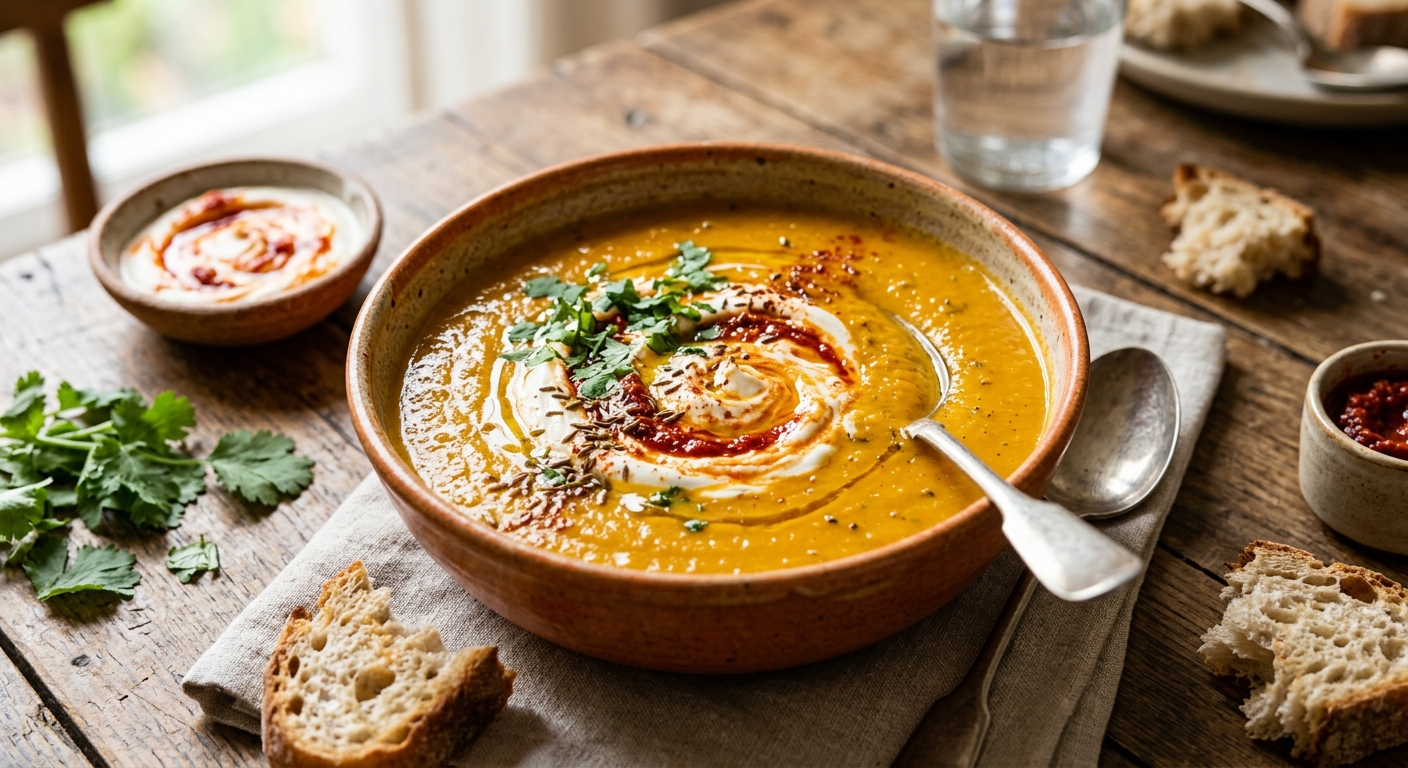
There are soups that nourish, and then there are soups that genuinely transform your nutritional day in a single bowl. This Moroccan Spiced Carrot Soup sits firmly in the second category. Built on a foundation of sweet roasted-orange carrots, red lentils, and a spice-forward soffritto of cumin, coriander, turmeric, and smoked paprika, the soup is finished with a swoosh of harissa-spiked yogurt that adds tang, heat, and a probiotic bonus. Every element has been chosen with both flavour and function in mind, making this one of the most nutrient-dense recipes in the Calibrated Cuisine library.
The nutritional centrepiece is beta-carotene, the fat-soluble precursor to Vitamin A found in extraordinary concentrations in deep-orange carrots. A 600g base of carrots across four servings provides roughly 14mg of beta-carotene per serving, which converts to approximately 1,167mcg of Retinol Activity Equivalents (RAE), or 340% of the adult RDI for Vitamin A. Critically, this soup is finished with two tablespoons of olive oil and served with a full-fat yogurt, because beta-carotene is fat-soluble and its absorption increases dramatically when consumed alongside dietary fat. This is nutritional synergy in action, not an accident.
Beyond Vitamin A, the red lentils elevate this from a light vegetable soup to a genuinely satisfying meal, contributing folate, plant-based iron, and a full complement of essential amino acids. The turmeric brings curcumin, the ginger provides gingerols, and the finishing squeeze of lemon unlocks the iron in the lentils by providing ascorbic acid to convert non-haem iron into its more bioavailable ferrous form. Every step in this recipe has a reason.
4
servings
Ingredients
- 600 gcarrots, peeled and roughly chopped into 2cm pieces
- 150 gred lentils, rinsed and drained
- 1 largeyellow onion, roughly chopped
- 4 clovesgarlic, roughly chopped
- 20 gfresh ginger, peeled and grated
- 2 tbspextra-virgin olive oil
- 2 tspground cumin
- 2 tspground coriander
- 1.5 tspsmoked paprika
- 1 tspground turmeric
- 0.5 tspground cinnamon
- 0.25 tspcayenne pepper
- 400 mlfull-fat coconut milk
- 800 mlgood-quality vegetable stock, low sodium
- 1 tbsptomato paste
- 1 largelemon, juice only
- 150 gfull-fat plain yogurt (or thick Greek yogurt)
- 1.5 tbspharissa paste
- 1 tsphoney
- 2 tbspfresh coriander leaves, to serve
- 2 tbsptoasted pumpkin seeds, to serve
- —Colima Sea SaltMicroplastic Free Salt and freshly cracked black pepper to taste
Instructions
Click on an item below to shop for the recommended items for this recipe on Amazon.
As an Amazon Associate, we earn from qualifying purchases.
- Place a large Dutch oven or heavy-bottomed pot over medium heat. Add the olive oil and heat until it shimmers. Add the chopped onion with a generous pinch of salt and cook, stirring occasionally, for 8 to 10 minutes until the onion is deeply softened and beginning to turn golden at the edges. Do not rush this step; caramelised onion is the flavour foundation of the entire soup.
- Push the onion to the edges of the pot. Add the garlic and grated ginger to the centre and cook for 90 seconds, stirring, until fragrant. Then add the tomato paste and stir it into the aromatics for 1 minute until it darkens slightly in colour.
- Add all the dry spices: cumin, coriander, smoked paprika, turmeric, cinnamon, and cayenne. Stir constantly for 60 to 90 seconds, coating the onion and aromatics in the spice paste. The mixture will look dry and may stick slightly to the pot. This is correct. You are blooming the spices in the residual oil and onion moisture, unlocking their fat-soluble compounds.
- Add the chopped carrots and stir to coat them thoroughly in the spiced base. Pour in the vegetable stock and coconut milk. Scrape the bottom of the pot with a wooden spoon to lift any fond. Add the rinsed red lentils and stir to combine. Bring the soup to a gentle boil, then reduce heat to low, cover partially, and simmer for 25 to 30 minutes until the carrots are completely tender and the lentils have dissolved into the broth.
- Remove the pot from the heat. Using an immersion blender, blend the soup until completely smooth and velvety. Alternatively, transfer in batches to a countertop blender, filling it no more than halfway and holding the lid down firmly with a folded kitchen towel. Blend until silky. Return to the pot.
- Stir in the lemon juice and taste for seasoning. Adjust salt, pepper, and cayenne as needed. If the soup is too thick, thin with a splash of stock or water. In a small bowl, whisk together the yogurt, harissa paste, and honey until smooth.
- Ladle the soup into warmed bowls. Add a generous swirl of harissa yogurt to each bowl. Scatter with fresh coriander leaves and toasted pumpkin seeds. Serve immediately with warm flatbread alongside.
- Optional but highly recommended: heat the olive oil in a small skillet over medium-high heat. Add the onion and cook for 6 minutes until softened. Add the garlic, ginger, and tomato paste and stir for 1 minute. Add all the dry spices and stir for 60 seconds until fragrant. Scrape this entire spiced mixture into the slow cooker insert. If skipping this step, simply add all raw aromatics and spices directly to the slow cooker with the olive oil.
- Add the chopped carrots and rinsed red lentils to the slow cooker insert. Pour over the vegetable stock only (reserve the coconut milk for later; adding it at the start can cause it to separate and take on a slightly cooked, tinned flavour after 8 hours). Stir everything together. Season with salt and pepper. Cover and cook on Low for 7 to 8 hours, or on High for 4 hours, until the carrots are completely soft and the lentils have broken down.
- When cooking is complete, stir in the coconut milk and lemon juice directly into the slow cooker. Allow the coconut milk to warm through in the residual heat for 10 minutes with the lid on.
- Use an immersion blender directly in the slow cooker insert to blend the soup until smooth, being careful of the hot liquid and ceramic edges. Alternatively, ladle into a countertop blender in batches. Blend until completely silky. Return blended soup to the slow cooker on the Warm setting.
- Taste carefully and adjust seasoning. The slow cooker method tends to concentrate flavours slightly, so you may want to add a little extra lemon juice for brightness, and a splash of stock or water if the soup has thickened beyond your preference. Whisk together the yogurt, harissa, and honey in a small bowl. Serve the soup in warmed bowls with the harissa yogurt swirled on top, and finish with coriander and pumpkin seeds.
- Set the Instant Pot or electric pressure cooker to Saute on the Normal or Medium setting. Add the olive oil and heat until shimmering. Add the onion and a pinch of salt and cook for 5 to 6 minutes, stirring, until softened. Add the garlic, ginger, and tomato paste and cook for 1 minute. Add all the dry spices and stir vigorously for 60 seconds. The spice bloom happens quickly at this temperature; watch carefully to avoid burning.
- Add the chopped carrots and stir to coat in the spice base. Add the rinsed red lentils. Pour in the vegetable stock and coconut milk. Scrape the bottom of the pot thoroughly with a wooden spoon or silicone spatula to remove any stuck-on spices, as any residue can trigger the burn warning. The liquid should fully cover the carrots and lentils.
- Cancel the Saute function. Secure the lid and set the valve to Sealing. Cook on Manual High Pressure for 10 minutes. The pot will take approximately 8 to 10 minutes to reach pressure before the countdown begins.
- Once cooking is complete, allow the pressure to release naturally for 10 minutes, then carefully move the valve to Venting to release any remaining pressure. The natural release allows the lentils to finish cooking gently in the residual steam and prevents the soup from splattering through the vent.
- Open the lid carefully, tilting it away from you. The carrots should be completely tender and the lentils fully dissolved. Add the lemon juice and stir. Use an immersion blender directly in the pot to blend until completely smooth. Taste and adjust seasoning. The pressure-cooked version will be robustly flavoured; a little extra lemon juice or a pinch of salt often brightens it. Whisk together the harissa yogurt, ladle into bowls, and finish with coriander and pumpkin seeds.
- Preheat the oven to 220C (200C fan, 425F, Gas 7). Spread the chopped carrots and roughly chopped onion in a single layer on a large rimmed baking sheet. Drizzle with 1.5 tablespoons of the olive oil and season generously with salt and pepper. Toss to coat. Roast for 35 to 40 minutes, turning once halfway through, until the carrots are tender, caramelised, and showing deep golden-brown edges. Some charring on the onion is desirable.
- About 10 minutes before the vegetables come out of the oven, heat the remaining half tablespoon of olive oil in a large Dutch oven over medium heat. Add the garlic, ginger, and tomato paste and cook for 2 minutes, stirring. Add all the dry spices and stir for 60 to 90 seconds until bloomed and fragrant. This quick stovetop bloom of the aromatics builds the flavour base that will marry with the roasted vegetables.
- Add the roasted carrots and onions directly from the baking sheet to the Dutch oven, scraping in all the caramelised pan juices. Pour in the vegetable stock and coconut milk. Add the rinsed red lentils. Stir to combine, bring to a boil over medium-high heat, then reduce to a steady simmer. Cook uncovered for 15 to 18 minutes until the lentils have fully dissolved and the liquid has thickened slightly.
- Remove from heat. Add the lemon juice. Use an immersion blender to blend the soup to a completely smooth, thick puree. Because the roasted carrots have less residual water than stovetop-cooked carrots, the oven version will be noticeably thicker. Thin to your preferred consistency by whisking in hot stock or water, a little at a time, until it flows from a spoon in a slow, velvety ribbon.
- Taste and adjust seasoning. The roasted version may need a touch more salt and lemon to balance the concentrated sweetness of the caramelised carrots. Whisk together the yogurt, harissa, and honey. Ladle into warmed bowls and finish with the harissa yogurt swirl, fresh coriander, and toasted pumpkin seeds. A drizzle of extra-virgin olive oil over the surface is particularly good with this version.
Nutrition Breakdown
Per 1 serving (makes 4)
Vitamins & Minerals
% Daily Value based on a 2,000 calorie diet (FDA reference)
🧬 Essential Amino Acids
% of recommended daily intake (RDA) per serving
🛡 Antioxidant Profile
The Nutrition Science
The science behind this recipe’s Vitamin A potency begins with the carrot itself. Beta-carotene is a provitamin A carotenoid stored in the chromoplasts of the carrot’s cell walls. Cooking ruptures these cell walls and softens the food matrix, dramatically increasing the bioavailability of beta-carotene compared to raw carrots. Studies have shown that the conversion rate from a cooked, pureed, and fat-paired carrot preparation can be 3 to 5 times higher than from raw grated carrot. This is why the soup format, combined with olive oil and coconut milk, is nutritionally superior to a carrot salad for Vitamin A delivery. The body converts beta-carotene to retinol via the enzyme beta-carotene 15,15′-oxygenase (BCOX1), with conversion efficiency regulated homeostatically so that Vitamin A toxicity from dietary carotenoids is not a practical concern.
The turmeric in this recipe provides curcumin, a polyphenolic compound that has been the subject of over 3,000 peer-reviewed studies. Curcumin inhibits NF-kB, a protein complex that controls the transcription of pro-inflammatory cytokines, and has demonstrated antioxidant activity via direct free radical scavenging and upregulation of endogenous antioxidant enzymes including superoxide dismutase and catalase. Curcumin’s own bioavailability is notoriously low in isolation, but it is meaningfully enhanced by piperine (black pepper, included in this recipe’s seasoning), and by the fat-rich environment created by the coconut milk and olive oil, as curcumin is lipophilic.
The lemon juice added at the end of cooking is not merely a seasoning choice. It provides ascorbic acid (Vitamin C), which reduces ferric iron (Fe3+) from the red lentils to ferrous iron (Fe2+) in the gut, which is the only form that can be absorbed by intestinal mucosal cells via the divalent metal transporter DMT1. This simple addition can increase non-haem iron absorption by up to 67% according to research published in the American Journal of Clinical Nutrition. The full-fat yogurt in the harissa topping provides casein and whey proteins that contribute further to amino acid completeness, while also delivering live cultures that support gastrointestinal microbiome health.
Pro Tips
- For the deepest beta-carotene extraction, blend the soup at high speed for a full 90 seconds rather than just until smooth. A longer blend time physically reduces particle size further, improving the bioavailability of carotenoids from any remaining intact cell fragments.
- Make the harissa yogurt up to 24 hours ahead and refrigerate it. The harissa oils migrate into the yogurt overnight, producing a far more complex, integrated flavour than freshly mixed yogurt.
- This soup freezes exceptionally well for up to three months. Freeze it without the yogurt topping. Beta-carotene is heat-stable and survives freezing and reheating with minimal degradation, so the nutritional profile is essentially identical after thawing.

You’ve touched on something I think about constantly with my own cooking, Tiara. I’ve found that fat soluble vitamins like beta-carotene are honestly only half the story if you’re not absorbing them, and I’m really hoping the recipe includes both fat and black pepper since piperine genuinely does boost bioavailability. I’m most interested in whether there’s olive oil in the broth base and if the harissa yogurt is meant to be the primary fat source, or if there’s ghee or coconut milk involved – that would change how my body actually uses all that beautiful vitamin A content.
This sounds absolutely nourishing, and I love that you’re highlighting the beta-carotene density here. One thing I’m curious about – does the recipe include black pepper or any fat in the broth? I ask because beta-carotene is fat-soluble, so pairing it with a quality oil or ghee really enhances absorption, and in Ayurvedic cooking, black pepper is traditionally used alongside warming spices like those Moroccan warmers to support bioavailability. The harissa yogurt is such a smart addition for that purpose too. I’ve been working with clients who were surprised how much their seasonal congestion improved when we started being intentional about these absorption pairings rather
okay so this is exactly the kind of thing i geek out about, and tiara and nadia are spot on about the fat absorption piece. but im also wondering if theres any tryptophan happening here with the red lentils? like theyre a decent source and if theres yogurt involved that adds even more, plus the warming spices might actually help with serotonin production downstream. i tested something similar last week and my sleep tracker actually showed better sleep consistency that night, which could be total coincidence but the combo of tryptophan + magnesium in the lentils + the harissa’s capsaicin creating that gentle satiation is seeming less random to me. does the