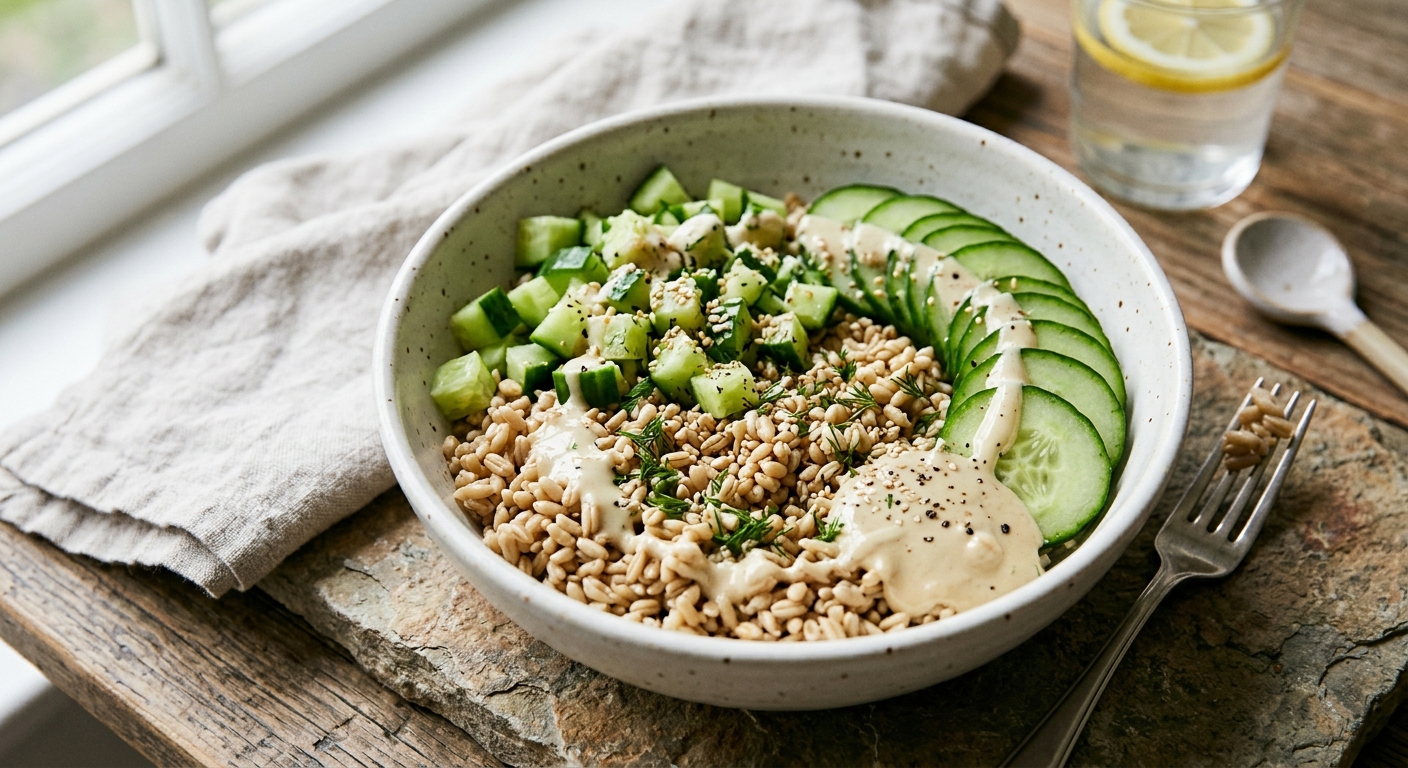
Silica, the ionic form of silicon dioxide found naturally in plant foods, rarely gets the attention it deserves in mainstream nutrition conversations. Yet research published in the Journal of Nutrition, Health and Aging consistently links dietary silicon intake to improved bone mineral density, collagen cross-linking, and arterial flexibility. Whole oat groats are among the richest cereal sources of bioavailable silica, delivering roughly 600 micrograms of silicon per 100g cooked weight, alongside an impressive matrix of magnesium, phosphorus, iron, zinc, and manganese. Paired with fresh cucumber, which contributes an additional 2 to 6mg of silica per 100g alongside hydrating polyphenols, this bowl becomes one of the most silicon-dense meals you can build from everyday ingredients.
What separates this recipe from a standard grain bowl is the deliberate layering of mineral synergists. The tahini base supplies sesame lignans and copper, which activate the enzyme lysyl oxidase responsible for collagen and elastin maturation. Avocado contributes glutathione and monounsaturated fats that enhance fat-soluble nutrient absorption. Toasted pepitas (hulled pumpkin seeds) bring a concentrated hit of zinc and magnesium, both of which are cofactors in the bone mineralisation pathway that silicon initiates. Every component earns its place on the plate not just for flavour, but for measurable biological function.
Oat groats are the least processed form of the oat, retaining their bran, germ, and endosperm intact. That wholeness matters nutritionally: the beta-glucan soluble fibre remains largely undamaged, the silica-bearing outer layers are preserved, and the complex carbohydrate structure keeps the glycemic response moderate despite the generous carbohydrate content. Whether you cook them low and slow in a slow cooker overnight for a warm breakfast bowl, blitz through the process in a pressure cooker on a weeknight, or take the contemplative stovetop approach, the mineral payoff is identical. Choose your method, build your bowl, and give your connective tissue what it has been quietly asking for.
4
servings
Ingredients
- 320 gwhole oat groats, rinsed and soaked 8 hours or overnight
- 1 largeEnglish cucumber (approximately 300g), half thinly sliced and half diced
- 4 tbsphulled tahini
- 3 tbspfresh lemon juice (approximately 2 lemons)
- 1 tbspextra-virgin olive oil
- 1 tspraw apple cider vinegar
- 1 tsppure maple syrup
- 1 clovegarlic, finely grated
- 60 ghulled pepitas (pumpkin seeds), raw
- 2 mediumripe avocados, halved and sliced
- 120 gradishes (approximately 8 small), thinly sliced
- 20 gfresh flat-leaf parsley, roughly chopped
- 15 gfresh mint leaves, torn
- 2 tsptoasted sesame seeds
- 1 tspground cumin
- 0.5 tspsmoked paprika
- 900 mlfiltered water (for stovetop and pressure cooker)
- —Colima Sea SaltMicroplastic Free Salt and cracked black pepper to taste
- —Pinch of chilli flakes (optional, for serving)
Instructions
Click on an item below to shop for the recommended items for this recipe on Amazon.
As an Amazon Associate, we earn from qualifying purchases.
- Drain and rinse the soaked oat groats thoroughly in a fine-mesh sieve under cold running water. Place them in a medium heavy-bottomed saucepan with 900ml of filtered water and 0.5 teaspoon of fine sea salt. Bring to a vigorous boil over high heat, skimming any foam that rises.
- Reduce heat to low, cover with a tight-fitting lid, and simmer gently for 45 to 55 minutes, stirring every 10 minutes to prevent sticking. The groats are done when they are tender but still pleasantly chewy, with most of the water absorbed. If liquid remains, remove the lid and cook uncovered for a final 5 minutes. Remove from heat, fluff with a fork, and let stand covered for 5 minutes.
- While the groats cook, toast the pepitas in a dry small skillet over medium heat for 3 to 4 minutes, tossing frequently, until they are puffed, lightly golden, and beginning to pop. Remove immediately to a plate, season with a pinch of salt and the smoked paprika, and set aside.
- Prepare the lemon-tahini dressing: whisk together the tahini, lemon juice, grated garlic, apple cider vinegar, maple syrup, ground cumin, and 4 tablespoons of warm water until completely smooth and pourable. Season with salt and pepper. The dressing should coat a spoon but flow easily; thin with additional water one tablespoon at a time if needed.
- Assemble the bowls: divide the warm oat groats among four wide, shallow bowls. Arrange the sliced cucumber, diced cucumber, radish slices, and avocado over and alongside the groats in distinct sections rather than mixing, so each component retains its texture. Drizzle generously with the lemon-tahini dressing, scatter the toasted pepitas and sesame seeds over the top, and finish with fresh parsley, torn mint, a light drizzle of extra-virgin olive oil, and chilli flakes if using. Serve immediately.
- Drain and rinse the soaked oat groats. Place them directly into the slow cooker insert with 950ml of filtered water (slightly more than stovetop to account for reduced evaporation), 0.5 teaspoon of fine sea salt, and a small drizzle of olive oil to minimise sticking. Stir briefly to distribute. Do not add the fresh vegetables, dressing, or toppings at this stage.
- Set the slow cooker to Low for 6 to 8 hours (overnight works perfectly) or to High for 3 to 4 hours. Place a double layer of paper towels or a clean kitchen towel under the lid to absorb condensation and prevent excess moisture from dripping back onto the groats, which can make them gummy. Do not lift the lid during cooking.
- About 20 minutes before serving, toast the pepitas in a dry skillet on the stovetop over medium heat for 3 to 4 minutes until puffed and lightly golden. Season with smoked paprika and a pinch of salt. Prepare the lemon-tahini dressing by whisking tahini, lemon juice, grated garlic, apple cider vinegar, maple syrup, cumin, and 4 tablespoons of warm water until smooth and pourable.
- Check the groats: they should be fully tender and creamy, with the water fully absorbed. If the mixture is looser than you prefer, remove the lid, switch to High, and cook uncovered for a further 15 to 20 minutes to evaporate excess liquid. Season the groats directly in the insert with salt and pepper, stirring well.
- Spoon the slow-cooked groats into four bowls. Because the slow cooker produces a warmer, more comforting grain base, lean into that quality by layering the toppings in a way that contrasts temperature: place the cold sliced and diced cucumber, radishes, and avocado directly onto the warm groats just before serving. Finish with the lemon-tahini drizzle, toasted pepitas, sesame seeds, fresh parsley, mint, and a light drizzle of olive oil.
- Drain and rinse the soaked oat groats and add them to the Instant Pot inner pot. Pour in 900ml of filtered water, 0.5 teaspoon of fine sea salt, and 1 teaspoon of extra-virgin olive oil (to prevent foaming). Do not fill the pot beyond the halfway mark, as the groats will expand significantly. Secure the lid and set the pressure-release valve to Sealing.
- Select Manual or Pressure Cook on High Pressure and set the timer for 22 minutes. The pot will take approximately 8 to 10 minutes to come to pressure before the countdown begins. Do not use the Quick Release function, as the sudden pressure drop can cause starchy liquid to spurt through the valve.
- When the 22 minutes are complete, allow a natural pressure release for 10 minutes, then carefully turn the valve to Venting to release any remaining steam. Open the lid away from you. The groats should be tender and cohesive with a slight bite; fluff with a fork and allow to rest uncovered for 2 to 3 minutes to firm up slightly.
- While the pressure is releasing, toast the pepitas in a dry skillet over medium heat for 3 to 4 minutes until puffed and golden. Season with smoked paprika and salt. Prepare the lemon-tahini dressing by whisking together tahini, lemon juice, grated garlic, apple cider vinegar, maple syrup, cumin, and 4 tablespoons of warm water to a smooth, pourable consistency.
- Because the pressure cooker delivers the most structurally intact, individual-grain result, this method best suits a composed, restaurant-style bowl presentation. Portion the groats into four bowls and spread them slightly to create a flat base. Fan the avocado slices across one half, shingle the radish and cucumber slices across the other, scatter the diced cucumber in the centre, and spoon the tahini dressing in a sweeping arc across the entire bowl. Top with pepitas, sesame seeds, parsley, mint, and chilli flakes for maximum visual contrast.
- Preheat the oven to 175C (350F). Drain and rinse the soaked oat groats. In a medium Dutch oven or oven-safe pot with a tight-fitting lid, combine the groats with 950ml of boiling water (starting with boiling water significantly reduces total bake time), 0.5 teaspoon of fine sea salt, and a drizzle of olive oil. Stir to distribute, then bring the contents to a brief simmer over medium heat on the stovetop, about 2 minutes.
- Cover the Dutch oven with its lid and transfer immediately to the centre rack of the preheated oven. Bake undisturbed for 75 minutes. Do not open the lid during this time; the trapped steam is what cooks the groats evenly without constant attention.
- Remove the Dutch oven from the oven using heavy-duty oven mitts. Let it stand covered on the stovetop or a heatproof surface for 10 minutes; this resting period allows residual steam to finish the cooking and the groats to firm up to a perfect chewy texture. Uncover, fluff with a fork, and season generously with salt and cracked black pepper.
- While the groats bake, prepare all accompaniments: toast the pepitas in a dry skillet over medium heat for 3 to 4 minutes, season with smoked paprika and salt, and set aside. Whisk the lemon-tahini dressing from tahini, lemon juice, grated garlic, apple cider vinegar, maple syrup, cumin, and 4 tablespoons of warm water until smooth. Prepare and portion all fresh vegetables.
- The oven method produces a slightly firmer, drier grain than the stovetop, making it especially well-suited to meal-prep bowls that will be stored and reheated. Divide the baked groats among four bowls and assemble with sliced cucumber, diced cucumber, radish, and avocado. Drizzle with lemon-tahini dressing and finish with toasted pepitas, sesame seeds, fresh parsley, mint, a drizzle of olive oil, and chilli flakes.
Nutrition Breakdown
Per 1 serving (makes 4)
Vitamins & Minerals
% Daily Value based on a 2,000 calorie diet (FDA reference)
🧬 Essential Amino Acids
% of recommended daily intake (RDA) per serving
🛡 Antioxidant Profile
The Nutrition Science
Silicon is classified as a bioactive ultratrace element rather than a traditional essential mineral, yet its functional role in connective-tissue metabolism is well documented. Dietary silicon is absorbed primarily as orthosilicic acid (Si(OH)4) in the proximal small intestine, with bioavailability from plant-food sources such as oat groats and cucumber estimated at 50 to 65%, substantially higher than from drinking water or silica supplements. Once absorbed, orthosilicic acid stimulates osteoblast differentiation, upregulates type I collagen gene expression, and activates prolyl hydroxylase, the enzyme that hydroxylates proline residues within collagen triple helices, giving the protein its tensile strength. This is why silicon deficiency in animal models consistently produces brittle bones and fragile cartilage long before calcium or phosphorus levels are meaningfully affected.
The mineral synergy in this bowl is not accidental. Manganese, present at 139% DV from oat groats and pepitas combined, is the obligate cofactor for manganese superoxide dismutase (MnSOD), the primary mitochondrial antioxidant enzyme, and for glycosyltransferases that synthesise the glycosaminoglycan side chains of proteoglycans in cartilage. Copper from tahini activates lysyl oxidase, the enzyme that creates the covalent cross-links between collagen and elastin fibrils that give connective tissue its elastic recoil. Zinc from pepitas drives over 300 metalloenzyme reactions including those of alkaline phosphatase, which liberates inorganic phosphate at sites of active bone mineralisation. Together, these four trace elements form a complete biochemical toolkit for structural tissue maintenance and repair, delivered in a single bowl.
The beta-glucan soluble fibre in oat groats, present at roughly 2.5g per serving in the intact wholegrain form, independently modulates the postprandial insulin response by forming a viscous gel in the small intestine that slows glucose absorption. This gel also acts as a prebiotic substrate for Bacteroides and Lactobacillus species that produce short-chain fatty acids (SCFAs), particularly butyrate and propionate. Butyrate is the preferred fuel for colonocytes and has been shown to upregulate tight-junction proteins that maintain intestinal barrier integrity, indirectly supporting systemic mineral absorption by reducing inflammatory permeability. Choosing whole oat groats over cut or rolled oats is therefore not merely a textural preference; it is a meaningful nutritional decision that preserves the full beta-glucan matrix and the silica-rich bran layer simultaneously.
Pro Tips
- Do not skip the overnight soak: soaking oat groats in cold water for 8 hours activates phytase, an enzyme naturally present in the grain that begins breaking down phytic acid and releasing bound minerals including zinc, iron, and silicon for improved intestinal absorption.
- Buy cucumber as close to harvest as possible and avoid peeling it: the highest concentration of silica and polyphenols in cucumber sits immediately beneath the skin and within the skin itself, so peeled cucumber delivers a fraction of the mineral value.
- The lemon-tahini dressing doubles as a mineral amplifier: the citric acid and vitamin C in lemon juice convert non-haem iron in the oat groats from its less-absorbable ferric (Fe3+) form to the more bioavailable ferrous (Fe2+) form, increasing iron uptake by up to three-fold compared to eating the groats with water alone.



This is such a smart combination, and I love how you’re highlighting silica since it’s honestly one of the most overlooked minerals in functional nutrition conversations. I’d be curious if you’ve experimented with adding leafy greens like collard or mustard greens to boost the mineral density even further, since those traditional soul food staples are absolute silica and calcium powerhouses that often get dismissed as “basic.” The whole food approach here is exactly what we need more of, especially when these ingredients are so accessible and rooted in cultural foodways that have sustained communities for generations.
You’ve touched on something I’ve been noticing too, Jasmine – those traditional greens are genuinely transformative, and I’ve found that adding collards to my morning grain bowls has made a measurable difference in my joint inflammation markers over the past couple years. The silica combined with that bioavailable calcium really does seem to work synergistically, and I appreciate you naming how these foods get undervalued when they shouldn’t be. I’d probably add the greens raw or just wilted into the warm oat base so the silica stays intact, then maybe finish with that tahini drizzle to help with mineral absorption – have you experimented with the serving temperature affecting how your body processes these minerals
This is exactly the kind of mineral-dense combination I’ve been experimenting with in my own kitchen, and I’m realizing silica might be one of those underappreciated methylation cofactors that actually matters more than we talk about in typical nutrition circles. I tried something similar last month with oat groats plus cucumber and added a handful of mustard greens (great call by Jasmine), and I noticed my nails felt stronger within a few weeks, which got me thinking about whether the silica plus the folate from those greens was actually supporting better methylation and thereby improving collagen synthesis. The pepitas add even more to this since they’ve got zinc and magnesium which work as cofact