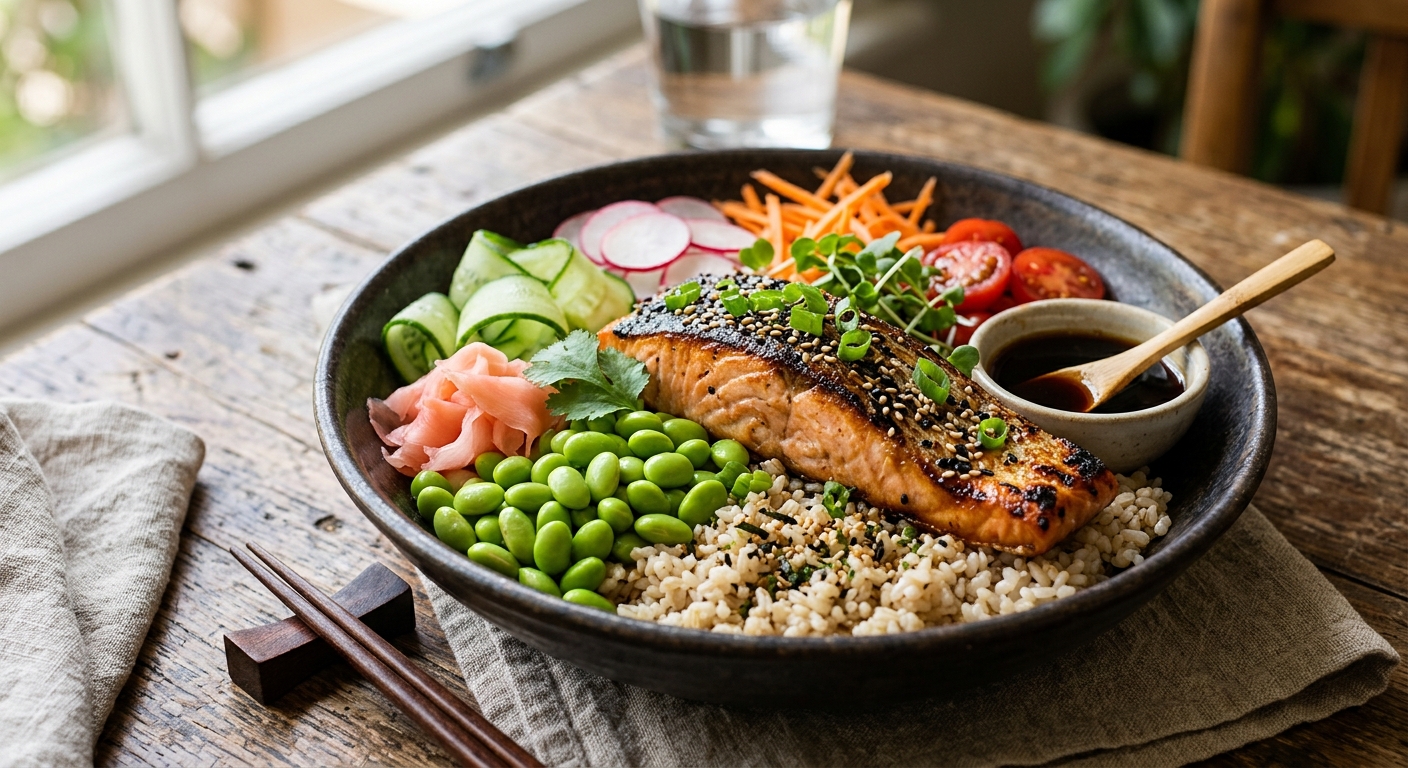
Few single meals can claim to address inflammation from as many biological angles as this teriyaki salmon bowl. Wild-caught salmon brings EPA and DHA omega-3 fatty acids, the molecular precursors to the body’s own anti-inflammatory signalling compounds called resolvins and protectins. Edamame adds isoflavones and complete soy protein, while pickled ginger delivers gingerols and shogaols, compounds shown in clinical trials to suppress pro-inflammatory cytokines including TNF-alpha and IL-6. Together they create a dish that is genuinely greater than the sum of its parts.
The teriyaki glaze here is made from scratch using tamari, fresh ginger, mirin, and a touch of raw honey, avoiding the high-fructose corn syrup found in most bottled versions. Keeping the glaze house-made also lets you control sodium precisely, which matters when you are eating salmon regularly for cardiovascular benefit. The brown rice base adds resistant starch and manganese, while a finishing scatter of toasted sesame seeds contributes sesamol, a lignin antioxidant with its own documented anti-inflammatory properties.
This recipe is designed for four servings and scales cleanly. We offer stovetop, oven, slow cooker, and pressure cooker methods, each calibrated to the unique thermal behaviour of salmon. Because salmon overcooks quickly under high direct heat but thrives with gentle indirect warmth, each method takes a different structural approach rather than simply adjusting time. Read the method notes carefully before choosing your path.
4
servings
Ingredients
- 680 gwild-caught salmon fillet, skin-on, cut into 4 equal portions (about 170g each)
- 300 gshort-grain brown rice, rinsed
- 200 gshelled edamame, fresh or frozen
- 80 gpickled ginger (store-bought or homemade), thinly sliced
- 60 mltamari (gluten-free soy sauce)
- 45 mlmirin
- 30 mlraw honey
- 15 mlrice vinegar
- 20 gfresh ginger, finely grated
- 3 clovesgarlic, finely grated
- 15 mltoasted sesame oil
- 10 gtoasted sesame seeds
- 4 stalksspring onions (scallions), thinly sliced on the diagonal
- 15 mlAvocado Oil100% Pure Avocado Oil
- 5 gcornstarch (cornflour), for thickening glaze
- —Colima Sea SaltMicroplastic Free Salt and white pepper to taste
- —1 sheet toasted nori, cut into thin strips, for garnish (optional)
- —1 small cucumber, sliced into half-moons, for serving
Instructions
Click on an item below to shop for the recommended items for this recipe on Amazon.
As an Amazon Associate, we earn from qualifying purchases.
- Cook the brown rice according to package directions in lightly salted water, typically 40 to 45 minutes. For best texture, bring 750ml of water to a boil, add the rice, reduce to the lowest simmer, cover tightly, and cook until all water is absorbed. Remove from heat and let steam, lid on, for 10 minutes. Fluff with a fork and stir in the toasted sesame oil.
- While the rice cooks, make the teriyaki glaze. Combine tamari, mirin, raw honey, rice vinegar, and grated fresh ginger in a small saucepan over medium heat. Whisk together the cornstarch with 15ml cold water in a small bowl to form a slurry, then whisk into the sauce. Bring to a gentle simmer, stirring constantly, for 2 to 3 minutes until the glaze thickens enough to coat the back of a spoon. Remove from heat, stir in the grated garlic, and set aside. Reserve half the glaze for serving.
- Pat the salmon portions completely dry with paper towels. Season lightly with fine sea salt and white pepper on both sides. Heat avocado oil in a large stainless steel or cast-iron skillet over medium-high heat until shimmering but not smoking.
- Place the salmon portions skin-side up in the pan. Cook undisturbed for 3 to 4 minutes until a golden crust forms. Carefully flip to skin-side down using a thin fish spatula. Reduce heat to medium and brush the flesh side generously with the teriyaki glaze. Cook for a further 3 to 4 minutes, brushing once more with glaze, until the salmon is just cooked through with a slightly translucent centre, or reaches an internal temperature of 52 to 55 degrees Celsius (125 to 130 F) for medium doneness.
- Meanwhile, blanch the edamame in boiling salted water for 2 minutes, then drain and season lightly with sea salt.
- To assemble: divide the sesame brown rice among four bowls. Place a glazed salmon portion on top of each. Arrange the edamame, pickled ginger slices, cucumber half-moons, and nori strips around the salmon. Drizzle the reserved teriyaki glaze over everything. Finish with sliced spring onions and a scatter of toasted sesame seeds.
- Preheat the oven to 200 degrees Celsius (400 F), with a rack in the upper-middle position. Line a rimmed baking sheet with foil and place a wire rack on top; lightly oil the wire rack with avocado oil. Cook the brown rice on the stovetop as directed in Step 1 of the Stovetop method. Fluff and stir in sesame oil once done.
- Make the teriyaki glaze as directed in Stovetop Step 2, but do not reserve any glaze for serving yet. Instead, set aside 3 tablespoons of the finished glaze in a separate bowl specifically for basting during roasting, and reserve the remainder for serving.
- Pat salmon dry and season with sea salt and white pepper. Place salmon portions skin-side down on the oiled wire rack. Brush the tops and sides liberally with the basting glaze. Roast at 200C for 10 minutes.
- Remove the baking sheet from the oven. Switch the oven to broil (grill) on high. Brush the salmon with another coat of glaze, then return to the oven directly under the broiler element for 1 to 2 minutes, watching closely, until the glaze is deeply caramelised and slightly charred at the edges. The salmon should register 52 to 55 degrees Celsius internally for a moist, medium result.
- While the salmon roasts, spread the frozen edamame on a separate small baking sheet, toss with a drizzle of avocado oil and a pinch of salt, and roast in the same oven alongside the salmon for 8 to 10 minutes until lightly blistered. This method adds a nutty depth to the edamame that the blanching method does not provide.
- Assemble the bowls as in Stovetop Step 6, drizzling the reserved glaze (warmed briefly if needed) over each bowl before finishing with spring onions, sesame seeds, pickled ginger, cucumber, and nori.
- Cook the brown rice separately on the stovetop or in a rice cooker according to package directions. The slow cooker is dedicated entirely to the salmon here. Stir sesame oil into the finished rice and keep warm.
- Make the teriyaki glaze as in Stovetop Step 2. Reserve half for serving. Pour the remaining glaze into the base of the slow cooker insert, spreading it into an even layer.
- Pat the salmon portions dry and season lightly with sea salt and white pepper. Place the salmon portions in a single layer, skin-side down, directly on top of the glaze in the slow cooker. Do not stack. Spoon two to three tablespoons of the glaze over the tops of the fillets. Scatter the grated garlic and half the sliced spring onions over the salmon.
- Cook on Low for 1 hour 30 minutes to 2 hours. Check doneness at 1 hour 30 minutes by pressing gently on the thickest part of a fillet. The flesh should flake easily and show no raw translucency at the edges, though the very centre may remain slightly soft. Avoid lifting the lid before 90 minutes to prevent heat loss.
- While the salmon finishes, blanch or steam the edamame for 2 to 3 minutes in boiling salted water, drain, and season with a pinch of salt.
- To serve, gently lift each salmon portion with a wide spatula. The skin may remain stuck to the insert, which is expected. Place the salmon over the rice bowls. Spoon the cooking juices and glaze pooled in the slow cooker over each portion generously. Arrange edamame, pickled ginger, cucumber, and nori around the salmon. Finish with the remaining spring onions, sesame seeds, and reserved glaze.
- Make the teriyaki glaze on the stovetop in a small saucepan as directed in Stovetop Step 2. Reserve half for serving and set aside. This step must be done separately as pressure cooking will not thicken a cornstarch glaze correctly.
- Rinse the brown rice and add it to a 1-litre oven-safe bowl or stainless steel insert pot that fits inside your pressure cooker. Add 450ml cold water and a pinch of salt to the bowl. Place the trivet that came with your pressure cooker into the main insert and add 240ml of water to the base of the insert.
- Pat the salmon dry and season with sea salt and white pepper. Tear four pieces of heavy-duty foil large enough to fold into packets. Place one salmon portion in the centre of each piece of foil. Spoon 1 to 2 tablespoons of the prepared glaze over each fillet, then fold the foil up and over the salmon, crimping tightly to seal into individual packets. Place the foil packets directly on top of the trivet, then carefully lower the rice bowl on top of the packets, using the pot-in-pot method.
- Seal the pressure cooker lid and set the valve to sealing. Cook at high pressure for 22 minutes (which cooks the rice) and then perform a quick pressure release by carefully turning the valve to venting. Once the pressure has fully released, open the lid and use tongs to remove the rice bowl first, then remove the foil packets to a plate.
- Open each foil packet carefully, as steam will escape. The salmon should be fully cooked through and glistening with absorbed glaze. Meanwhile, blanch the edamame in a small saucepan of boiling water for 2 minutes, drain, and season.
- Fluff the rice with a fork and stir in the toasted sesame oil. Divide among four bowls. Slide a salmon fillet from its packet onto each bowl, pouring any accumulated juices from the foil over the top. Arrange edamame, pickled ginger, cucumber slices, and nori strips around the salmon. Drizzle with reserved warm glaze, then finish with spring onions and sesame seeds.
Nutrition Breakdown
Per 1 serving (makes 4)
Vitamins & Minerals
% Daily Value based on a 2,000 calorie diet (FDA reference)
🧬 Essential Amino Acids
% of recommended daily intake (RDA) per serving
🛡 Antioxidant Profile
The Nutrition Science
The anti-inflammatory mechanism of this bowl operates on multiple complementary pathways. The EPA and DHA in wild salmon are elongated omega-3 fatty acids that the body uses to synthesise resolvins, protectins, and maresins, a class of specialised pro-resolving mediators (SPMs) that actively signal the resolution of inflammation rather than simply blocking its initiation. This is biologically distinct from the action of NSAIDs or COX-2 inhibitors, and it explains why regular oily fish consumption is associated with lower circulating CRP and IL-6 even in the absence of pharmaceutical intervention.
Astaxanthin, the pink-red carotenoid synthesised by microalgae and concentrated through the salmon’s diet, is among the most potent naturally occurring antioxidants measured by ORAC assay. Unlike beta-carotene or vitamin E, astaxanthin spans the full lipid bilayer of the cell membrane and can simultaneously quench free radicals on both the inner and outer surfaces, providing what researchers describe as 360-degree antioxidant protection. A 2022 systematic review in the journal Nutrients found that daily astaxanthin supplementation of 3 to 6mg, roughly the amount in one serving of wild sockeye salmon, significantly reduced malondialdehyde (a lipid peroxidation marker) in healthy adults over 8 weeks.
The combination of 6-gingerol from fresh ginger and genistein from edamame creates a synergistic inhibition of the NF-kB transcription pathway, the master regulator of inflammatory gene expression. Both compounds independently downregulate NF-kB, but in combination, the concentration required for meaningful inhibition is lower, a phenomenon called pharmacological synergy. This is why culinary tradition in East Asia of pairing soy-based foods with ginger has a robust molecular logic behind it, one that Western nutritional science has only recently begun to characterise formally.
Pro Tips
- Use wild-caught sockeye or coho salmon over farmed Atlantic salmon where possible. Wild salmon contains up to 3 times more astaxanthin and a significantly better omega-6 to omega-3 ratio, typically 1:7 versus 1:3 in farmed varieties.
- Do not overcook the salmon. The single most common mistake is pushing salmon past 60 degrees Celsius internally. At 52 to 55C, the flesh is just set, deeply moist, and the omega-3 fatty acids remain in a native, biologically active form. Overcooked salmon also oxidises its astaxanthin content, measurably reducing its antioxidant activity.
- Make a double batch of the teriyaki glaze and refrigerate in a sealed jar for up to two weeks. It works beautifully on tofu, roasted broccoli, and soba noodles, and having it ready dramatically reduces the weeknight prep time for this bowl.


solid recipe but im more focused on the zinc and b6 here tbh. wild salmon is great for d3 obviously, but edamame gives you decent zinc plus the b6 youre gonna need to actually utilize all those omegas for hormone synthesis. ive seen clients nail their omega intake but tank their testosterone because theyre neglecting the cofactors. does your version include the sesame seeds? thats where the real mineral density hits.
This is such a smart observation about the cofactor piece, Zack! I’ve definitely noticed in my own healing journey with Hashimoto’s that getting the zinc and B6 balance right actually changes how my body tolerates omega-rich foods, so that hormone synthesis angle really resonates. Quick question though, since I’m navigating AIP: does your approach to sesame seeds work for people who need to avoid them temporarily, or is that mineral density pretty hard to replace? I’ve been experimenting with pumpkin seed swaps for the zinc hit, but I’m curious if you’ve seen that create the same cofactor synergy you’re describing, especially for clients who are in a stricter elimination phase.
oh anna this is such a thoughtful question! pumpkin seeds are genuinely amazing for zinc but heres where it gets interesting from a fermentation angle, right, if you ferment those pumpkin seeds or even soak them overnight you’re actually increasing the bioavailability of that zinc since youre breaking down some of the phytic acid that can bind minerals. ive noticed that fermented seed pastes hit different than raw ones when im thinking about micronutrient absorption, and it might be especially useful during elimination phases when youre already being really intentional about what your body can handle. the cofactor synergy is still there but the fermentation step feels like it gives you even more bang for your buck
oh dude yes, zack you’re totally onto something with the micronutrient synergy angle! and ok i have to say, the pickled ginger in this bowl is doing SO much heavy lifting beyond just flavor, right? fermented ginger is genuinely phenomenal for your gut bacteria diversity which literally impacts how well you absorb all those b vitamins you mentioned. ive been adding ginger to my fermentation projects for like two years now and the difference in digestive comfort is wild, plus theres research showing fermented compounds can actually enhance mineral bioavailability. im obsessed with how this recipe is basically stacking anti inflammatory compounds on top of nutrient utilization boosters, its chef’s kiss
YES okay this micronutrient synergy conversation is exactly what I’ve been researching for my thesis! Zack’s point about B6 and zinc utilization is so crucial, and Kirsten, your fermentation insight just made me realize something, the edamame itself is also packed with magnesium-bound chlorophyll which actually enhances mineral absorption even further. I’ve been diving deep into how phytonutrients work synergistically with other micronutrients, and honestly this bowl is like a masterclass in that? The ginger’s anti-inflammatory compounds plus the salmon’s omega-3s PLUS the bioavailable magnesium from those edamame greens all working