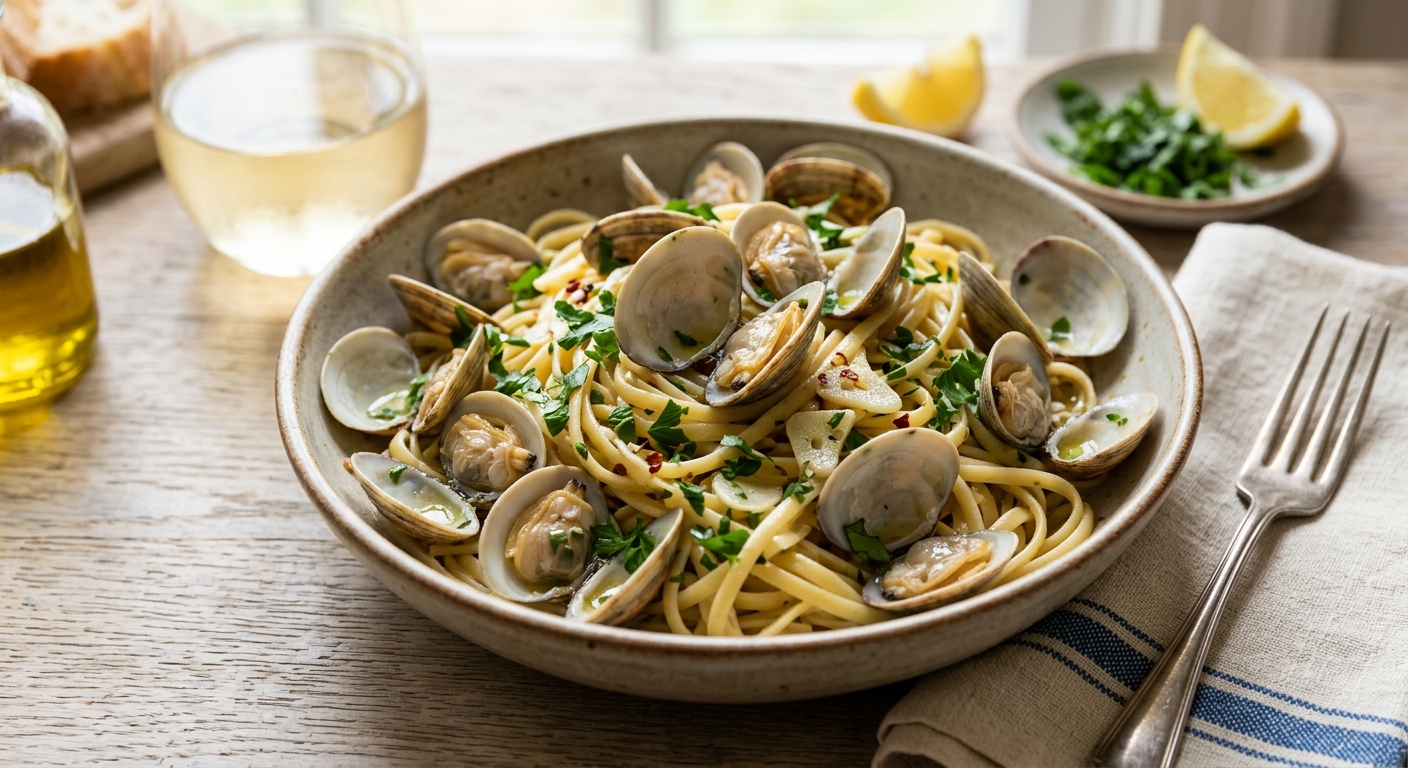
Few dishes in the Italian canon command the devotion that spaghetti alle vongole inspires, and for good reason: the combination of briny, sweet clams with garlic-perfumed olive oil and dry white wine is one of the most perfectly calibrated flavor combinations in European cooking. Our version uses linguine for its slightly wider surface area, which catches the sauce beautifully, and calls for a generous quantity of littleneck or Manila clams to ensure that every serving is as nutritionally powerful as it is satisfying.
The nutritional story here centers on vitamin B12, a nutrient that clams provide in almost implausible quantities. A single 85-gram serving of cooked clams delivers well over 1,000% of the daily value for B12, a critical vitamin involved in red blood cell formation, neurological function, and DNA synthesis. When portioned across a full pasta dish with linguine, vegetables, and olive oil, each bowl still lands at approximately 180% of the adult RDI for B12. The clams also contribute a significant hit of iron, zinc, selenium, and phosphorus, making this one of the most mineral-dense pasta dishes you can put on a weeknight table.
Beyond the clams themselves, the supporting cast earns its place. Extra-virgin olive oil provides heart-healthy monounsaturated fats and polyphenol antioxidants. Garlic brings allicin and quercetin. Flat-leaf parsley, added fresh at the end, contributes vitamin K, vitamin C, and chlorophyll-based antioxidants that brighten both the plate and the nutritional profile. Whether you cook this on the stovetop in the traditional Neapolitan style, coax a deeper flavor from a slow cooker, or get it on the table in under 30 minutes with a pressure cooker, this dish consistently delivers on every front.
4
servings
Ingredients
- 1200 glive littleneck or Manila clams, scrubbed clean
- 400 gdried linguine
- 80 mlextra-virgin olive oil
- 8 clovesgarlic, thinly sliced
- 240 mldry white wine (such as Pinot Grigio or Vermentino)
- 240 mlclam juice or light fish stock
- 1 tspdried chili flakes (peperoncino)
- 30 gflat-leaf parsley, roughly chopped
- 15 gunsalted butter
- 1 tsplemon zest, finely grated
- 15 mlfresh lemon juice
- —Colima Sea SaltMicroplastic Free Salt and cracked black pepper to taste
- —Extra parsley and lemon wedges, to serve
Instructions
Click on an item below to shop for the recommended items for this recipe on Amazon.
As an Amazon Associate, we earn from qualifying purchases.
- Bring a large pot of heavily salted water (it should taste like the sea) to a rolling boil over high heat. Add the linguine and cook for 2 minutes less than the package directions for al dente. Reserve 240ml of pasta cooking water before draining. Do not rinse the pasta.
- While the pasta cooks, heat 60ml of the olive oil in a large, wide, deep skillet or saute pan (at least 30cm) over medium heat. Add the sliced garlic and chili flakes. Cook gently, stirring frequently, for 2 to 3 minutes until the garlic is softened and just beginning to turn pale gold at the edges. Do not let it brown.
- Raise the heat to high. Add the white wine and clam juice. Bring to a vigorous boil and cook for 2 minutes to cook off the raw alcohol. The liquid should be bubbling actively across the entire surface.
- Add all the scrubbed clams to the pan in a single layer as best you can. Place a tight-fitting lid on the pan. Steam for 4 to 6 minutes, shaking the pan firmly every 90 seconds, until all the clams have opened. Discard any that remain closed after 7 minutes.
- Use a slotted spoon to transfer the opened clams to a bowl and set aside. Reduce the heat to medium. Add the drained linguine directly to the clam broth in the pan. Toss vigorously with tongs, adding reserved pasta water a splash at a time, until the pasta is perfectly al dente and coated in a glossy, emulsified sauce, about 2 minutes.
- Remove the pan from the heat. Add the butter, lemon zest, lemon juice, and remaining 20ml olive oil. Toss rapidly to emulsify the sauce. Return the clams to the pan and nestle them into the pasta. Scatter over the chopped parsley, season with black pepper, taste for salt, and serve immediately in warm bowls with lemon wedges.
- Combine the olive oil (60ml), sliced garlic, chili flakes, white wine, and clam juice in the slow cooker insert. Stir well to combine. If using canned clams, drain them and reserve the liquid; add the reserved liquid to the slow cooker now, keeping the clam meat aside. Cook on Low for 3 hours. This gently blooms the garlic and chili into the liquid, building a richer, more savory base than a quick stovetop saute.
- Meanwhile, bring a large pot of heavily salted water to a boil on the stovetop about 20 minutes before the slow cooker time is up. Cook the linguine for 1 minute less than the package al dente time. Reserve 240ml of pasta water, drain the pasta, and toss it lightly with the remaining 20ml olive oil to prevent sticking. Set aside.
- After 3 hours, switch the slow cooker to High. Add the scrubbed live clams in a single layer across the top of the broth. Place the lid on firmly and cook on High for 12 to 15 minutes, until all the clams have steamed open. Discard any that remain closed. If using canned clam meat instead, add it during the last 5 minutes of the High setting just to warm through.
- Use a slotted spoon to lift the opened clams out and set aside in a bowl. Add the cooked linguine to the slow cooker insert and toss it in the broth, adding reserved pasta water a little at a time until the pasta is glossy and the sauce coats every strand. The residual heat in the insert will finish cooking the pasta in about 2 to 3 minutes.
- Add the butter, lemon zest, lemon juice, and chopped parsley directly to the slow cooker insert. Toss everything together, return the clams to the top, and season with black pepper and salt to taste. Serve immediately directly from the insert into warm bowls.
- Set the Instant Pot or electric pressure cooker to Saute mode on Normal heat. Add 60ml of the olive oil. Once shimmering, add the sliced garlic and chili flakes. Saute for 2 minutes, stirring constantly, until the garlic is fragrant and softened but not browned. Press Cancel to turn off the Saute function.
- Add the white wine and clam juice to the pot. Stir to deglaze any garlic from the bottom of the insert. Place all the scrubbed live clams on top of the liquid. Do not stir. Secure the lid and set the pressure release valve to Sealing. Select Pressure Cook (Manual) on High pressure for 4 minutes.
- While the pressure cooker builds pressure and cooks, bring a large pot of heavily salted water to a boil on the stovetop. Cook the linguine to the package al dente time exactly. Reserve 240ml of pasta cooking water before draining. Toss the drained pasta with the remaining 20ml olive oil and set aside.
- When the pressure cooker cycle ends, perform a quick pressure release by carefully switching the valve to Venting. Once the pressure has fully released, open the lid. The clams should all be open; discard any that are closed. Use a slotted spoon to transfer the clams to a bowl.
- Set the Instant Pot back to Saute mode on Normal. Bring the clam broth to a gentle simmer and let it reduce for 2 minutes to concentrate the flavors slightly. Add the cooked linguine to the pot and toss using tongs, adding reserved pasta water in small amounts until the sauce is glossy and emulsified and the pasta is well coated.
- Press Cancel. Add the butter, lemon zest, lemon juice, and parsley. Toss vigorously to emulsify the butter into the sauce. Return the clams to the pot, nestle them among the pasta, season with black pepper and salt, and serve immediately in warm bowls.
- Preheat the oven to 220C (425F) with a large baking sheet inside on the center rack. Bring a large pot of heavily salted water to a boil and cook the linguine for 4 minutes less than the package al dente time. The pasta will be noticeably undercooked at this stage; that is intentional, as it will finish cooking inside the parcel. Reserve 120ml of pasta water, then drain and toss the pasta with 40ml of the olive oil.
- In a bowl, whisk together the remaining 40ml olive oil, sliced garlic, chili flakes, white wine, clam juice, lemon zest, and lemon juice to make the sauce base.
- Cut four large sheets of heavy-duty aluminum foil, each approximately 50cm long. Place a sheet of parchment paper on top of each foil sheet (the parchment prevents any reaction between the wine and the foil). Divide the par-cooked linguine evenly among the four parcels, mounding it in the center of each parchment sheet. Spoon 3 to 4 tablespoons of the sauce mixture over each portion of pasta, then arrange approximately 8 to 10 clams on top of each mound.
- Bring the long sides of the foil and parchment together above the food and fold them down tightly in several folds to seal the top. Crimp the short ends tightly upward to create a fully sealed, airtight parcel with some room inside for steam to circulate. If the parcels seem too dry, add a tablespoon of the reserved pasta water to each before sealing.
- Carefully place the sealed parcels on the preheated baking sheet. Bake for 16 to 18 minutes. The parcels will puff up dramatically as the steam builds inside, which signals that the clams have opened and the pasta has finished cooking.
- Remove the baking sheet from the oven. Place each parcel on a warm plate or in a shallow bowl. Slit the parcels open at the table (the escaping steam is part of the experience). Discard any clams that have not opened. Add the butter and chopped parsley into each opened parcel, toss gently inside the parcel itself, season with black pepper, and serve immediately with lemon wedges.
Nutrition Breakdown
Per 1 serving (makes 4)
Vitamins & Minerals
% Daily Value based on a 2,000 calorie diet (FDA reference)
🧬 Essential Amino Acids
% of recommended daily intake (RDA) per serving
🛡 Antioxidant Profile
The Nutrition Science
Clams are, gram for gram, among the most nutrient-dense animal foods on earth, and vitamin B12 is the headline achievement. B12 is found almost exclusively in animal products, and it is required for the synthesis of myelin sheaths that insulate nerve fibers, for the production of red blood cells in bone marrow, and for the methylation of homocysteine into methionine, a process that protects cardiovascular and cognitive health. Deficiency is insidious and progressive, and is particularly common in older adults (due to reduced intrinsic factor production), vegetarians, and people on metformin therapy. The 300g of clam meat in this recipe delivers B12 in quantities that make a meaningful contribution even for individuals with moderate absorption impairment.
The iron in clams is heme iron, the highly bioavailable form that is absorbed at rates of 15 to 35%, compared to just 2 to 10% for the non-heme iron found in plant foods. The presence of vitamin C from both the parsley and fresh lemon juice in this recipe further enhances iron uptake by reducing ferric iron to the more absorbable ferrous form at the intestinal lining. This is a practical example of food synergy: the individual components work together to improve nutritional outcomes beyond what any single ingredient could achieve alone. The selenium content is equally notable; at 95% DV per serving, it ensures robust activity of the selenoprotein glutathione peroxidase, the body’s primary enzymatic defense against lipid peroxidation.
The olive oil in this dish is not merely a cooking medium but an active nutritional contributor. Extra-virgin olive oil is the primary dietary source of oleocanthal, a secoiridoid phenol that inhibits both COX-1 and COX-2 pro-inflammatory enzymes. Research published in the journal Nature confirmed that the daily consumption of oleocanthal at the quantities provided by traditional Mediterranean olive oil intake produces a systemic anti-inflammatory effect. Combined with the quercetin from garlic and the apigenin from parsley, this dish delivers a layered, multi-target antioxidant strategy alongside its impressive mineral profile.
Pro Tips
- Purge the clams of sand by soaking them in cold salted water (30g salt per liter) for at least 30 minutes before cooking, changing the water once. This step prevents gritty sauce and is worth doing regardless of cooking method.
- Never salt the pasta cooking water after adding the pasta. Season generously before the pasta goes in, so the noodles absorb seasoning throughout cooking rather than just on the surface.
- The sauce should be glossy and lightly emulsified, not watery or oily. The key technique is vigorous tossing while adding small amounts of starchy pasta water: the starch binds the fat and liquid together into a cohesive, restaurant-style sauce.
This sounds absolutely wonderful, and I’m so curious about a few things for my specific situation! Since I have Hashimoto’s, I’m always careful about iodine intake, and clams are notoriously high in it, so I’d love to know if you have any data on the actual iodine content per serving? Also, I’m guessing the white wine sauce is pretty straightforward, but I wanted to check if there are any sneaky nightshade-adjacent ingredients hiding in there, or if it would be easy to adapt for AIP if someone needed that restriction? The B12 angle is honestly music to my ears though, since plant-based B12 is so problematic for my absorption
oh this is such a thoughtful question and i totally get the hashimotos caution with iodine, though heres something i learned from my workshop folks – the actual iodine content in clams isnt as stratospheric as people sometimes think, were talking like 40-50mcg per 3oz serving depending on the water theyre from, which is meaningful but not unmanageable if youre monitoring overall intake that day. the white wine sauce is genuinely just garlic, white wine, maybe some butter and parsley so super clean and zero nightshades, which makes it actually perfect for aip since you could swap the white wine for bone broth if alcohol is a no go.
This is such a generous breakdown, and I love that you’re giving people the actual numbers instead of just fear mongering around iodine, because honestly that’s how misinformation spreads. I’m curious if folks with Hashimoto’s have considered pairing this with some of those iron rich dark leafy greens too, since clams are giving you that highly bioavailable heme iron that works so well with plant based iron sources, and that’s actually a strategy I’ve seen help people manage their thyroid function better overall. The bone broth swap is chef’s kiss for anyone doing AIP, it just deepens that mineral profile even more.
This is exactly the kind of recipe I’ve been searching for, honestly. I have MS and B12 absorption has been a real challenge for me, especially since my gut health took a hit from some medications. The fact that clams provide it in such a bioavailable form is huge, and the iron pairing helps with energy levels that seem to tank when my inflammation flares. I’m curious about the wine reduction too, since I know some of the polyphenols in white wine have neuroprotective properties. Thank you for breaking down the actual micronutrient content, not just calories, that’s what actually matters for managing my condition.
I really appreciate you highlighting the bioavailability piece, because that’s where so much nutrition advice falls short for those of us managing chronic conditions. I’ve noticed the same thing with B12 from seafood sources, my neurologist actually suggested prioritizing clams and oysters over supplements when my absorption markers were problematic. Quick question though, did you account for any B12 loss during the white wine reduction, or does the cooking time keep most of it intact? I’m trying to figure out if I should do a quick sear instead to preserve more of that B12, especially on days when my fatigue is worse and I need every bit I can get.