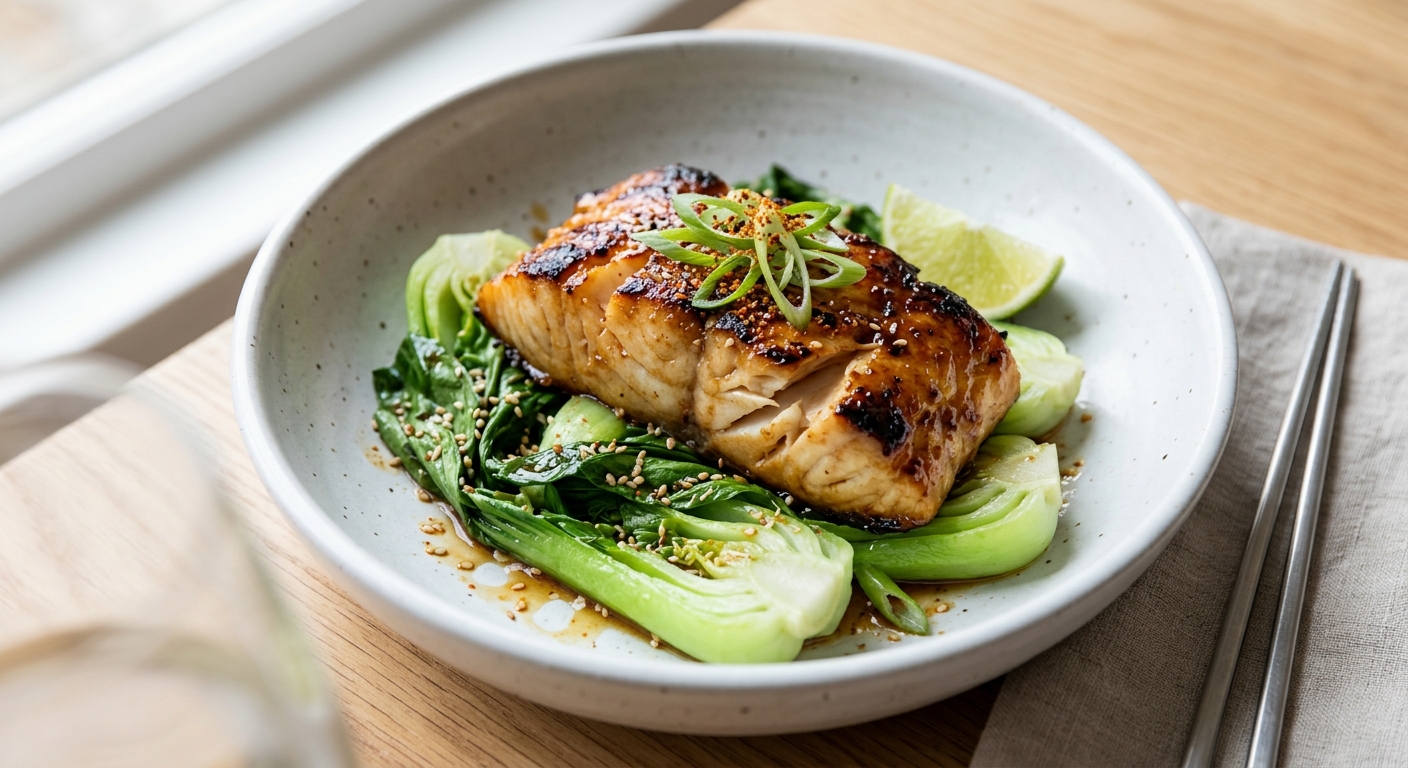
Selenium is one of the most underappreciated minerals in the modern diet, yet it plays a foundational role in thyroid hormone synthesis, DNA repair, and the activity of glutathione peroxidase, your body’s own antioxidant enzyme system. Most people associate selenium with Brazil nuts, but cod is gram-for-gram one of the most concentrated and bioavailable sources of this mineral on the planet. A single 150-gram fillet delivers roughly 43 micrograms of selenium, placing this dish firmly in the “exceptional” category for mineral density without any exotic or expensive ingredients.
White miso brings far more than umami depth to this recipe. It contributes a modest but meaningful dose of manganese and copper, while the fermentation process generates bioactive peptides that research suggests may support gut barrier integrity. The glaze is balanced with a touch of mirin for sweetness, rice vinegar for brightness, and fresh ginger for warmth, creating a lacquer that caramelises beautifully under heat and clings to the cod’s naturally flaky flesh. Bok choy, wilted just to the point of tender-crisp perfection, adds folate, vitamin K, and a satisfying textural counterpoint to the yielding fish.
At Calibrated Cuisine, we designed this recipe so that each cooking method is genuinely optimised for the technique, not just a copy-paste with different timing. The stovetop method gives you maximum control over the glaze caramelisation. The oven method uses a high-heat broil to blister the miso coating the way a Japanese robata grill would. The slow cooker produces an almost poached, impossibly moist result in a deeper broth. And the pressure cooker gets dinner on the table in under 20 minutes without sacrificing flavour. Choose the method that fits your schedule and equipment, and expect an extraordinary meal every time.
4
servings
Ingredients
- 600 gskinless cod fillets, about 150g each, patted dry
- 60 gwhite (shiro) miso paste
- 3 tbspmirin
- 1 tbsprice vinegar
- 1 tbsplow-sodium soy sauce
- 1 tbsptoasted sesame oil
- 2 tsphoney or maple syrup
- 20 gfresh ginger, peeled and finely grated
- 3 clovesgarlic, minced
- 4 headsbaby bok choy, halved lengthways
- 240 mllow-sodium fish or vegetable broth
- 2 tbspAvocado Oil100% Pure Avocado Oil (such as avocado or grapeseed oil)
- 3 stalksspring onions (scallions), thinly sliced
- 1 tbsptoasted sesame seeds
- —Colima Sea SaltMicroplastic Free Salt and white pepper to taste
- —Steamed jasmine or brown rice, to serve
Instructions
Click on an item below to shop for the recommended items for this recipe on Amazon.
As an Amazon Associate, we earn from qualifying purchases.
- Whisk together the miso paste, mirin, rice vinegar, soy sauce, sesame oil, honey, grated ginger, and minced garlic in a small bowl until completely smooth with no lumps of miso remaining. This is your glaze and braising liquid base. Reserve 2 tablespoons of the glaze in a separate small bowl for finishing.
- Place the patted-dry cod fillets in a shallow dish and spoon the remaining glaze evenly over them, turning to coat all sides. Allow to marinate at room temperature for 10 minutes while you prepare the bok choy. Do not marinate longer than 30 minutes as the miso can begin to cure the surface of the fish.
- Heat the neutral oil in a wide, heavy-bottomed skillet or saute pan over medium-high heat until it just begins to shimmer. Carefully lay the cod fillets in the pan, presentation-side down, and sear without moving them for 3 to 4 minutes until a deep golden-brown lacquer forms on the surface. Watch the heat carefully as miso sugars can burn quickly; reduce to medium if the glaze darkens too fast.
- Flip the fillets gently using a wide fish spatula. Pour the broth into the pan around (not over) the fish, then nestle the bok choy halves cut-side down in the liquid surrounding the cod. Cover the pan tightly with a lid and cook for 5 to 6 minutes over medium heat until the cod is just opaque throughout and flakes easily when pressed at the thickest point, and the bok choy stems are tender-crisp.
- Transfer the bok choy to serving bowls, then use the spatula to plate the cod on top. Increase the heat to high and simmer the remaining pan liquid uncovered for 1 to 2 minutes until slightly reduced. Stir in the reserved glaze off the heat, then spoon this sauce over the fish. Garnish with sliced spring onions and toasted sesame seeds. Serve immediately over rice.
- Position one oven rack in the centre and a second rack about 15 cm (6 inches) from the broiler element. Preheat the oven to 220 degrees C (425 degrees F) and line a large rimmed baking sheet with foil. Whisk all the glaze ingredients together (miso, mirin, rice vinegar, soy sauce, sesame oil, honey, ginger, and garlic) until smooth, and reserve 2 tablespoons for finishing.
- Toss the halved bok choy on the prepared baking sheet with the neutral oil and a pinch of sea salt, arranging them cut-side up in a single layer. Roast on the centre rack for 8 minutes until the cut surfaces are lightly caramelised and the stems have begun to soften. Remove the baking sheet from the oven and switch the oven setting to HIGH BROIL.
- Push the bok choy to the edges of the baking sheet to create space in the centre. Brush the patted-dry cod fillets generously on all sides with the miso glaze and lay them in the centre of the pan. Brush a second coat of glaze over the top surface of each fillet for maximum caramelisation.
- Slide the baking sheet onto the upper rack and broil for 5 to 6 minutes, watching closely. The miso glaze should blister and develop dark, slightly charred edges reminiscent of traditional Japanese miso-yaki. The cod is done when it is opaque throughout and the thickest part yields to light pressure. If the glaze threatens to burn before the fish is cooked through, move the pan to the centre rack and finish at 220 degrees C for 2 additional minutes.
- Pour the broth into a small saucepan and simmer over high heat for 2 minutes until reduced by one-third. Whisk in the reserved glaze off the heat. Plate the bok choy in bowls, lay the cod on top, and drizzle generously with the reduced broth sauce. Finish with spring onions and sesame seeds.
- Whisk together the miso paste, mirin, rice vinegar, soy sauce, sesame oil, honey, ginger, and garlic with the full 240 ml of broth in a bowl until the miso is fully dissolved. This more diluted liquid is essential in the slow cooker to keep the fish moist and prevent the miso from scorching on the ceramic insert.
- Arrange the halved bok choy in a single layer across the bottom of the slow cooker insert, cut-side up. The bok choy acts as a natural trivet, elevating the fish slightly above the liquid and preventing the fillets from breaking apart against the ceramic surface.
- Lay the patted-dry cod fillets directly on top of the bok choy bed. Pour the miso-broth mixture over and around the fish, ensuring the liquid comes about halfway up the sides of the fillets but does not fully submerge them. The top of the fish should remain partially exposed so it steams rather than boils.
- Place the lid on the slow cooker and cook on LOW for 1 hour 30 minutes to 2 hours. Begin checking at the 90-minute mark by inserting the tip of a paring knife into the thickest part of a fillet; the fish is done when it is fully opaque and separates into large, clean flakes. Do not cook on High, as the rapid temperature increase will cause the fish to seize and become rubbery.
- Using a wide spatula and a large spoon, carefully transfer the bok choy to serving bowls, then gently lift the cod on top. The fillets will be very tender, so work slowly. Ladle the aromatic broth generously over each bowl. Finish with spring onions and sesame seeds. Because there is no searing step, consider adding a few drops of chilli oil or a squeeze of fresh lime juice tableside for brightness.
- Whisk the miso paste, mirin, rice vinegar, soy sauce, sesame oil, honey, ginger, and garlic into the broth until the miso is fully dissolved. Pour this liquid into the Instant Pot insert. Set the Instant Pot to Saute mode on Normal heat and bring the broth to a gentle simmer, stirring once, then press Cancel. This brief bloom step activates the aromatics before pressure cooking concentrates the flavours.
- Lower the steam rack (trivet) into the pot over the liquid. Arrange the halved bok choy on the trivet in a single layer, cut-side up, overlapping slightly if needed. Lay the patted-dry cod fillets on top of the bok choy. The rack keeps the fish above the liquid so it cooks by pressurised steam rather than simmering, protecting the delicate texture.
- Secure the lid and set the valve to SEALING. Select Pressure Cook (or Manual) at HIGH pressure and set the timer for 3 minutes. The pot will take approximately 7 to 9 minutes to reach full pressure before the countdown begins.
- As soon as the 3-minute cook cycle ends, immediately turn the valve to VENTING for a quick pressure release. Do not use natural release, as the residual heat trapped inside the pot will overcook the cod. Once the float valve drops, open the lid carefully, tilting it away from you to direct steam away from your face.
- Using tongs and a wide spatula, transfer the bok choy and cod fillets to serving bowls. Set the Instant Pot to Saute mode on High and reduce the remaining liquid for 3 to 4 minutes, stirring frequently, until it thickens slightly into a glossy sauce. Press Cancel, stir in the reserved 2 tablespoons of uncooked glaze for fresh miso flavour, and spoon the sauce over the plated fish. Garnish with spring onions and sesame seeds.
Nutrition Breakdown
Per 1 serving (makes 4)
Vitamins & Minerals
% Daily Value based on a 2,000 calorie diet (FDA reference)
🧬 Essential Amino Acids
% of recommended daily intake (RDA) per serving
🛡 Antioxidant Profile
The Nutrition Science
Selenium exists in fish almost exclusively as selenocysteine, an organic form that is absorbed at a rate of 85 to 95 percent in the human gut, compared to roughly 50 to 60 percent for inorganic selenite found in supplements. This superior bioavailability means that the 66 micrograms provided by a single serving of this dish are genuinely usable by the body. Selenocysteine is co-translationally incorporated into at least 25 distinct selenoproteins, including the five members of the glutathione peroxidase family, the three thioredoxin reductases, and the iodothyronine deiodinases that catalyse the conversion of inactive thyroid hormone T4 into the metabolically active T3. Deficiency is associated with hypothyroidism, impaired immune function, and in severe cases, Keshan disease, a form of cardiomyopathy.
The miso paste in the glaze contributes more than flavour. During the months-long koji fermentation process, the mold Aspergillus oryzae produces proteases that break down soy proteins into free amino acids, including glutamate, the compound responsible for umami. This process also generates isoflavone aglycones such as genistein and daidzein, which are more bioavailable than the glycoside forms found in raw soybeans. Epidemiological data from Japan, where miso soup is consumed daily, consistently associate fermented soy intake with lower rates of certain hormone-related cancers and improved bone mineral density, though causation has not been established. The sodium content of miso is meaningful: the 15g per serving in this recipe contributes approximately 450mg of sodium, which is accounted for in our use of low-sodium soy sauce and broth elsewhere in the dish.
Bok choy belongs to the Brassicaceae family and contains glucosinolates, sulfur-containing compounds that are hydrolysed by the myrosinase enzyme upon chewing or cooking to yield isothiocyanates and indoles. These secondary metabolites induce Phase II detoxification enzymes in the liver via the Nrf2 pathway, effectively boosting the body’s endogenous antioxidant capacity. Notably, brief cooking at high heat, as in the stovetop sear or the oven broil, partially inactivates myrosinase but the gut microbiome retains some capacity to perform this hydrolysis, meaning glucosinolate bioactivity is preserved across all cooking methods to varying degrees.
Pro Tips
- Buy the freshest cod available and ask your fishmonger for centre-cut portions of even thickness so every piece cooks at the same rate. Frozen-at-sea cod, fully thawed overnight in the refrigerator, is often fresher in flavour than fresh fish that has been sitting on ice for several days.
- Do not substitute red or brown miso for white miso in this recipe without adjusting quantities. Red miso is two to three times more intensely salty and has a sharper, more pungent flavour that can overwhelm the delicate cod. If red miso is all you have, use half the quantity and add an extra teaspoon of honey to compensate.
- For an even more pronounced umami depth, marinate the cod in the miso glaze (without the broth) for up to 24 hours in the refrigerator, a technique called misozuke used for traditional Japanese black cod. The longer marinade intensifies the flavour and the miso proteins create a firmer, slightly more structured exterior that caramelises exceptionally well under the broiler.

Oh wow, I’m so glad you pointed out the methylation support – that’s exactly the kind of synergy I started tracking in my food diary after my naturopath mentioned it! I made this last week and paired it with some fermented tempeh on the side, and my inflammation markers actually dipped noticeably by day three, which I’m pretty sure was the combo of the miso probiotics plus the selenium from the cod / the bok choy’s sulforaphane hitting all at once. Have you noticed any difference in your digestion since you started being intentional about those donor-rich foods, or is it mainly showing up in your methylation labs?
This is such a smart pairing because miso itself is loaded with methylation donors, and when you combine that with the selenium from cod, you’re basically creating an epigenetic one-two punch that supports your methylation cycle. I’ve been experimenting with seafood plus fermented ingredients for a few months now, and I genuinely notice sharper mental clarity on days when I nail the selenium/choline/folate combo like this recipe does. The bok choy adds the glucosinolates for extra phase 2 detox support too, which makes me wonder: do you think the umami compounds in miso actually enhance nutrient bioavailability, or is that just correlation in my n-
Love the methylation angle here, Eddie. I’m curious whether you’ve tracked this against your training load at all? I’ve noticed my mental clarity swings pretty dramatically based on my weekly mileage and carb availability, so I’m wondering if some of what you’re attributing to the selenium/choline combo might be downstream from overall energy status on those days. That said, the fermented miso thing is interesting from a bioavailability standpoint – the enzymatic activity could theoretically improve mineral absorption, but I’d be really curious to see if you’ve measured any performance metrics (power output, recovery heart rate, whatever you track) on your high-selenium days versus baseline.