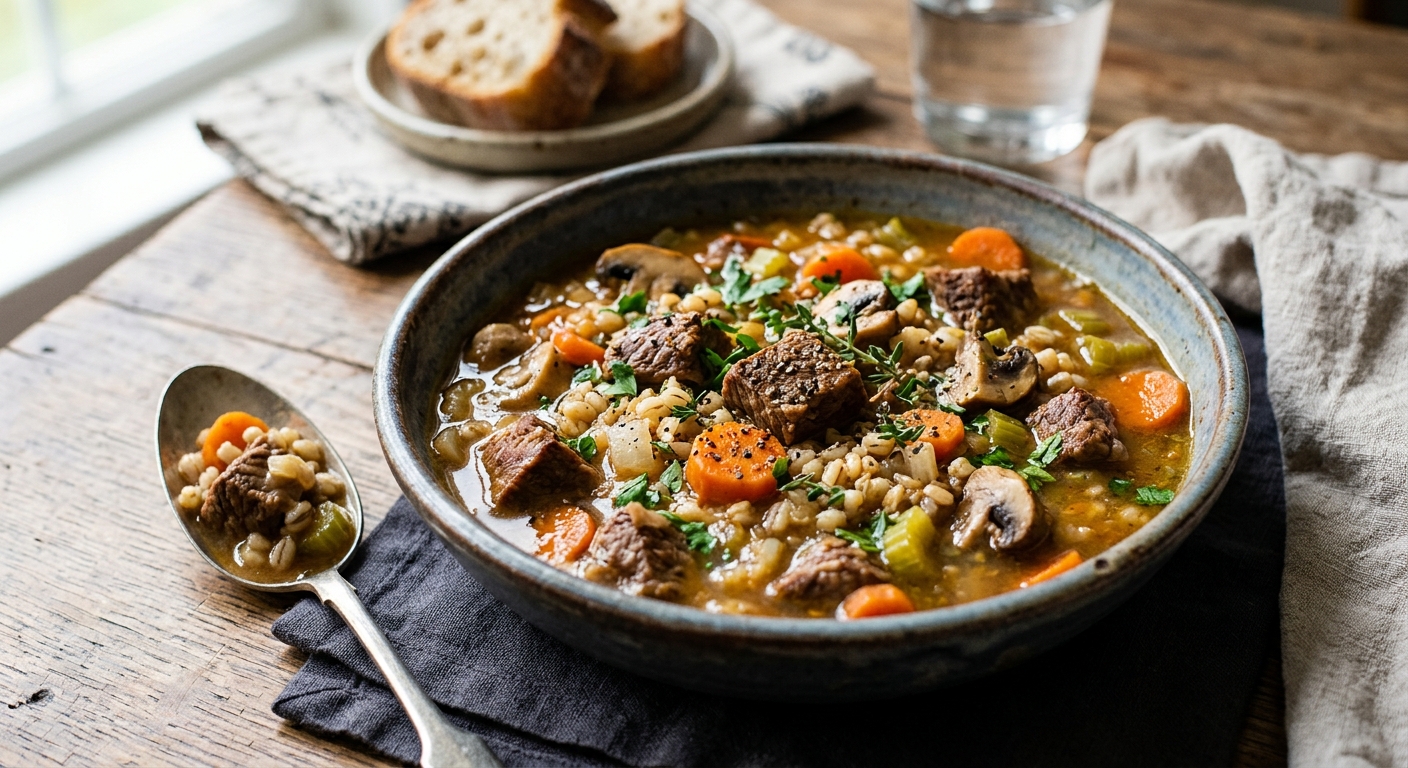
Some dishes earn their place on the weekly rotation not just because they taste extraordinary, but because they work hard for your body at a cellular level. This Beef and Mushroom Barley Stew is exactly that kind of recipe. Slow-coaxed beef chuck breaks down into tender, yielding pieces while cremini mushrooms release their umami-rich glutamates, and pearl barley swells into plump, chewy grains that carry every drop of the herb-scented broth. The result is a stew that tastes like it has been developing for hours, because in the best versions, it has.
The nutritional architecture here is intentional and precise. Beef chuck is one of the most bioavailable sources of heme iron you can put in a pot, delivering the kind of iron your body absorbs at two to three times the rate of plant-based sources. Paired alongside it, the barley contributes beta-glucan, a soluble fiber clinically shown to reduce LDL cholesterol, moderate postprandial blood glucose, and support a diverse gut microbiome. The mushrooms are not merely flavor vehicles either: cremini mushrooms provide a meaningful dose of selenium, copper, and riboflavin while contributing their own umami depth that reduces the need for added sodium. Tomato paste and a splash of red wine add lycopene and resveratrol-adjacent polyphenols to round out the antioxidant profile.
Whether you choose the stovetop method for active, attentive cooking, the slow cooker for a hands-off weekday approach, the pressure cooker for a fast weeknight dinner, or the oven for a deeply caramelized, restaurant-worthy braise, the technique has been calibrated for each vessel. This is not the same recipe poured into four different pots. Each method exploits the unique heat dynamics of its environment to achieve the best possible texture, flavor, and nutritional outcome from these carefully chosen ingredients.
4
servings
Ingredients
- 600 gbeef chuck, cut into 3 cm cubes, patted dry
- 300 gcremini mushrooms, quartered
- 160 gpearl barley, rinsed and drained
- 2 tbspextra-virgin olive oil
- 1 largeyellow onion, finely diced
- 3 clovesgarlic, minced
- 3 mediumcarrots, peeled and cut into 1 cm rounds
- 2 stalkscelery, sliced 1 cm thick
- 2 tbsptomato paste
- 120 mldry red wine (such as Cabernet Sauvignon or Merlot)
- 1 literlow-sodium beef stock
- 1 tbspWorcestershire sauce
- 2 sprigsfresh thyme
- 1 sprigfresh rosemary
- 1 leafbay leaf
- 15 gflat-leaf parsley, roughly chopped, for serving
- —Colima Sea SaltMicroplastic Free Salt and freshly cracked black pepper to taste
Instructions
Click on an item below to shop for the recommended items for this recipe on Amazon.
As an Amazon Associate, we earn from qualifying purchases.
- Season the beef cubes generously on all sides with salt and pepper. Heat 1 tablespoon of the olive oil in a large Dutch oven or heavy-bottomed pot over medium-high heat until shimmering. Working in two batches to avoid crowding, sear the beef for 3 to 4 minutes per side without moving it until a deep mahogany crust forms. Transfer to a plate and repeat with remaining beef. The fond developing on the pot bottom is pure flavor: do not discard it.
- Reduce heat to medium and add the remaining tablespoon of olive oil. Add the onion and celery with a pinch of salt and cook, stirring occasionally, for 5 to 6 minutes until the onion is translucent and beginning to turn golden. Add the garlic and cook for 1 minute until fragrant. Add the quartered cremini mushrooms and increase heat to medium-high. Cook undisturbed for 3 minutes, then stir and cook a further 3 minutes until the mushrooms are deeply browned and their moisture has evaporated.
- Push the vegetables to the sides of the pot and add the tomato paste to the cleared center. Cook the paste, stirring it against the hot pot surface, for 2 minutes until it darkens from bright red to a rusty brick color. This caramelization dramatically deepens the final flavor. Stir the paste into the vegetables.
- Pour in the red wine and scrape up every bit of fond from the pot bottom using a wooden spoon. Let the wine bubble and reduce for 2 minutes until the sharp alcohol aroma softens. Return the seared beef and any resting juices to the pot. Add the beef stock, Worcestershire sauce, thyme sprigs, rosemary sprig, bay leaf, and carrots. Stir to combine.
- Bring to a boil, then reduce heat to low and cover with the lid slightly ajar. Simmer gently for 1 hour, adjusting heat as needed to maintain a slow, steady bubble. After 1 hour, add the rinsed pearl barley, stir well, and continue simmering uncovered for a further 40 to 45 minutes until the barley is tender but still has a slight chew and the stew has thickened to a glossy, spoon-coating consistency.
- Remove the thyme and rosemary sprigs and the bay leaf. Taste and adjust seasoning with salt and pepper. Ladle into warmed bowls and finish with a generous scattering of flat-leaf parsley. The stew will thicken further as it cools; stir in a splash of stock when reheating.
- Pat the beef dry and season generously with salt and pepper. Heat 1 tablespoon olive oil in a large skillet over medium-high heat. Sear the beef in two batches for 3 to 4 minutes per side until deeply browned on at least two faces. Transfer directly to the slow cooker insert. Without wiping the skillet, add the remaining olive oil over medium-high heat, add the mushrooms in a single layer and cook undisturbed for 4 minutes until well browned. Stir once and cook 2 minutes more. Transfer mushrooms to the slow cooker.
- Return the skillet to medium heat. Add the onion, celery, and a pinch of salt. Cook 4 minutes until softened. Add garlic and tomato paste and cook, pressing the paste against the pan, for 2 minutes until darkened. Pour in the red wine and scrape up all the fond. Let bubble for 90 seconds, then add the Worcestershire sauce and pour the entire contents of the skillet into the slow cooker over the beef and mushrooms.
- Add the carrots, beef stock, thyme sprigs, rosemary sprig, and bay leaf to the slow cooker. Stir gently to distribute everything evenly. Do not add the barley yet: adding it at the start would cause it to turn mushy and absorb too much liquid over the long cook.
- Place the lid on the slow cooker and cook on Low for 6 hours. After 6 hours, add the rinsed pearl barley, stir well, replace the lid, and continue cooking on Low for a further 1 to 1.5 hours until the barley is tender with a gentle bite. If your slow cooker runs hot, check the barley at the 45-minute mark to avoid over-softening.
- Remove the herb sprigs and bay leaf. Taste the broth carefully: slow cooking can concentrate certain flavors unevenly, so adjust salt, pepper, and Worcestershire sauce as needed. If the stew is thinner than desired, remove the lid and cook on High for 20 to 30 minutes to reduce. Serve in warmed bowls topped with fresh parsley.
- Set the Instant Pot or electric pressure cooker to Saute mode on High. Add 1 tablespoon of olive oil. Season the beef and sear in two batches for 3 minutes per side until browned, using a splatter guard if needed. Press Cancel and transfer beef to a plate. Switch back to Saute mode, add the remaining olive oil and the mushrooms. Cook without stirring for 3 minutes until browned on one side, then stir and cook 2 minutes more. Remove mushrooms and set aside.
- Still in Saute mode, add the onion and celery to the pot. Cook for 3 minutes, stirring occasionally. Add the garlic and tomato paste, pressing the paste against the hot insert, for 90 seconds until it darkens slightly. Pour in the red wine and scrape the bottom of the insert thoroughly with a wooden spoon to lift any browned bits. This step is critical: any stuck fond left on the insert can trigger a Burn warning during pressurization.
- Press Cancel to end Saute mode. Return the seared beef, mushrooms, and any accumulated juices to the pot. Add the carrots, beef stock, Worcestershire sauce, rinsed pearl barley, thyme sprigs, rosemary sprig, and bay leaf. Stir to combine. The liquid should just cover the ingredients; if not, add a small splash of water or stock. Do not exceed the Max Fill line.
- Secure the lid and set the pressure valve to Sealing. Cook on Manual High Pressure for 25 minutes. Once the cook time ends, allow the pressure to release naturally for 10 minutes before carefully turning the valve to Venting to release any remaining steam.
- Open the lid and remove the herb sprigs and bay leaf. The barley will have expanded considerably and the stew will thicken as it stands for 3 to 5 minutes with the lid off. Stir gently, taste, and adjust seasoning. If the consistency is too thick, stir in a small ladleful of warm stock. Serve immediately in warmed bowls with fresh parsley.
- Preheat your oven to 160 degrees C (325 degrees F). Pat the beef dry and season generously. Heat 1 tablespoon olive oil in a large, oven-safe Dutch oven over medium-high heat on the stovetop. Sear the beef in two batches for 4 minutes per side until a deep crust forms on multiple sides. The longer sear compared to other methods is deliberate: the oven braise benefits from maximum Maillard-reaction surface area. Transfer beef to a plate.
- Reduce heat to medium, add remaining olive oil, and cook the onion and celery for 5 minutes until softened and golden. Add the mushrooms and increase to medium-high; cook undisturbed for 4 minutes, then stir and cook 3 more minutes until all moisture has evaporated and the mushrooms are deeply caramelized. Add garlic and tomato paste; cook, pressing against the pot, for 2 minutes until brick-red.
- Deglaze with the red wine, scraping up all the fond. Add the Worcestershire sauce and let the wine reduce for 2 minutes. Return the beef and juices, then add the carrots, beef stock, thyme, rosemary, and bay leaf. Bring to a gentle simmer on the stovetop. The liquid should come about two-thirds up the sides of the beef, not fully submerge it: this semi-submersed braising technique allows the exposed beef to develop a slightly glazed, concentrated surface as the steam circulates.
- Press a sheet of parchment paper directly onto the surface of the stew (a cartouche), then place the Dutch oven lid on top. Transfer to the center of the preheated oven. Braise for 1 hour and 20 minutes. Remove the lid and the parchment and stir in the rinsed pearl barley, pressing the grains down into the liquid.
- Return the Dutch oven to the oven, uncovered this time, for a further 50 to 55 minutes. The exposed surface will develop a lightly glazed top while the barley cooks through in the oven’s ambient heat. Check at the 40-minute mark: the barley should be tender and the liquid reduced to a rich, glossy consistency. If the top is browning too quickly, loosely tent with foil.
- Remove from the oven and let the stew rest, uncovered, for 10 minutes. This resting period allows residual heat to complete any final thickening and lets the collagen redistribute through the broth. Remove herb sprigs and bay leaf, taste and adjust seasoning, and serve directly from the Dutch oven at the table for a dramatic presentation, scattered with parsley.
Nutrition Breakdown
Per 1 serving (makes 4)
Vitamins & Minerals
% Daily Value based on a 2,000 calorie diet (FDA reference)
🧬 Essential Amino Acids
% of recommended daily intake (RDA) per serving
🛡 Antioxidant Profile
The Nutrition Science
The pairing of beef and barley in this stew is not accidental: it is a nutritional synergy with centuries of empirical validation now supported by modern biochemistry. Beef chuck delivers heme iron in the form of iron-protoporphyrin complexes, which are absorbed via dedicated intestinal receptors at rates of 15 to 35%, compared to just 2 to 10% for non-heme iron from plant sources. A single serving of this stew provides 6.3 mg of iron, representing 35% of the daily value. Critically, the heme iron present in the beef also acts as an enhancer of non-heme iron absorption from the barley and vegetables, a phenomenon known as the meat factor effect.
Pearl barley’s starring nutritional role is its beta-glucan content, a mixed-linkage soluble fiber present at approximately 3 to 5 grams per 100g of dry grain. Beta-glucan forms a viscous gel in the small intestine that slows glucose absorption, attenuates the postprandial insulin response, and binds bile acids for excretion, compelling the liver to convert more circulating LDL cholesterol into new bile acids. The European Food Safety Authority has confirmed that 3g of oat or barley beta-glucan per day is sufficient to produce a clinically meaningful reduction in LDL cholesterol. A serving of this stew provides approximately 2.8g of beta-glucan from the 160g of pearl barley divided across four portions. Combined with the beef’s conjugated linoleic acid content, which has independent anti-inflammatory and lipid-modulating properties, this stew supports cardiovascular health through multiple simultaneous mechanisms.
The mushrooms in this recipe contribute ergothioneine, a thiol-histidine betaine that humans cannot synthesize and must obtain from dietary sources, with mushrooms being by far the most concentrated food source. Ergothioneine is taken up by a specific transporter (OCTN1) and accumulates preferentially in tissues that experience high oxidative load, including the liver, kidneys, and red blood cells. Emerging epidemiological research associates higher ergothioneine intake with lower rates of cognitive decline and cardiovascular events. The selenium contributed primarily by the mushrooms and beef is essential for the function of at least 25 selenoproteins, including the glutathione peroxidase family, thioredoxin reductases, and the deiodinases that regulate thyroid hormone metabolism. At 38 micrograms per serving, this stew provides 69% of the selenium daily value, making it one of the more meaningful single-meal selenium sources achievable without seafood.
Pro Tips
- Cut the beef chuck into uniform 3 cm cubes and pat them completely dry before searing. Surface moisture creates steam that prevents the Maillard reaction, resulting in gray, steamed meat rather than a caramelized crust. Use paper towels and press firmly.
- Add the pearl barley later in the cooking process for all methods except the pressure cooker, where timing is precise. Barley absorbs liquid aggressively and can turn starchy and mushy if it cooks too long. For the stovetop, add it in the final 40 to 45 minutes; for the slow cooker, in the final 1 to 1.5 hours.
- Leftovers improve significantly overnight as the barley continues to absorb the broth and flavors meld. Store cooled stew in an airtight container for up to 4 days in the refrigerator. When reheating, add a splash of stock or water to restore the original consistency, as the barley will have absorbed most of the liquid.


ooh melanie youre speaking my language – ive been tracking how much heme iron actually gets absorbed from beef versus plant sources and honestly the difference is night and day for my ferritin levels. the barley is genius here too bc soluble fiber is so anti inflammatory and doesnt compete with iron absorption like calcium does, so you’re basically getting the best of both worlds in one pot. curious if you add anything with vitamin c to boost that iron uptake even more, like a squeeze of lemon or tomato paste in the broth? thats been my secret weapon for making sure my body actually uses all that good heme iron!
omg this looks perfect for my mid-week recovery meals after long runs – that combo of heme iron from the beef plus the soluble fiber in barley is exactly what i need to replenish glycogen and keep inflammation down without being too heavy on the stomach. ive been experimenting with stews as post-run nutrition instead of just smoothies and this breakdown makes me way more confident im actually getting the micronutrients to support adaptation, not just calories. definitely making this this week and curious if you’ve tested it with any specific barley varieties or if pearl barley is really the best choice for the beta-glucan content?
I love seeing the heme iron and barley combo get the spotlight here! Just want to gently mention that plant-based eaters can absolutely hit those same iron and beta-glucan goals with legumes, whole grains, and mushrooms, especially when paired with vitamin C rich foods to boost absorption (the way cooking tomatoes or adding lemon juice would in a similar stew). I’ve seen clients get really impressive ferritin levels once we dial in those absorption strategies, so it’s less about the source and more about understanding how to optimize what you’re eating. That said, this recipe looks incredibly satisfying and the earthiness of cremini mushrooms with barley is such a smart pairing for anyone, regardless