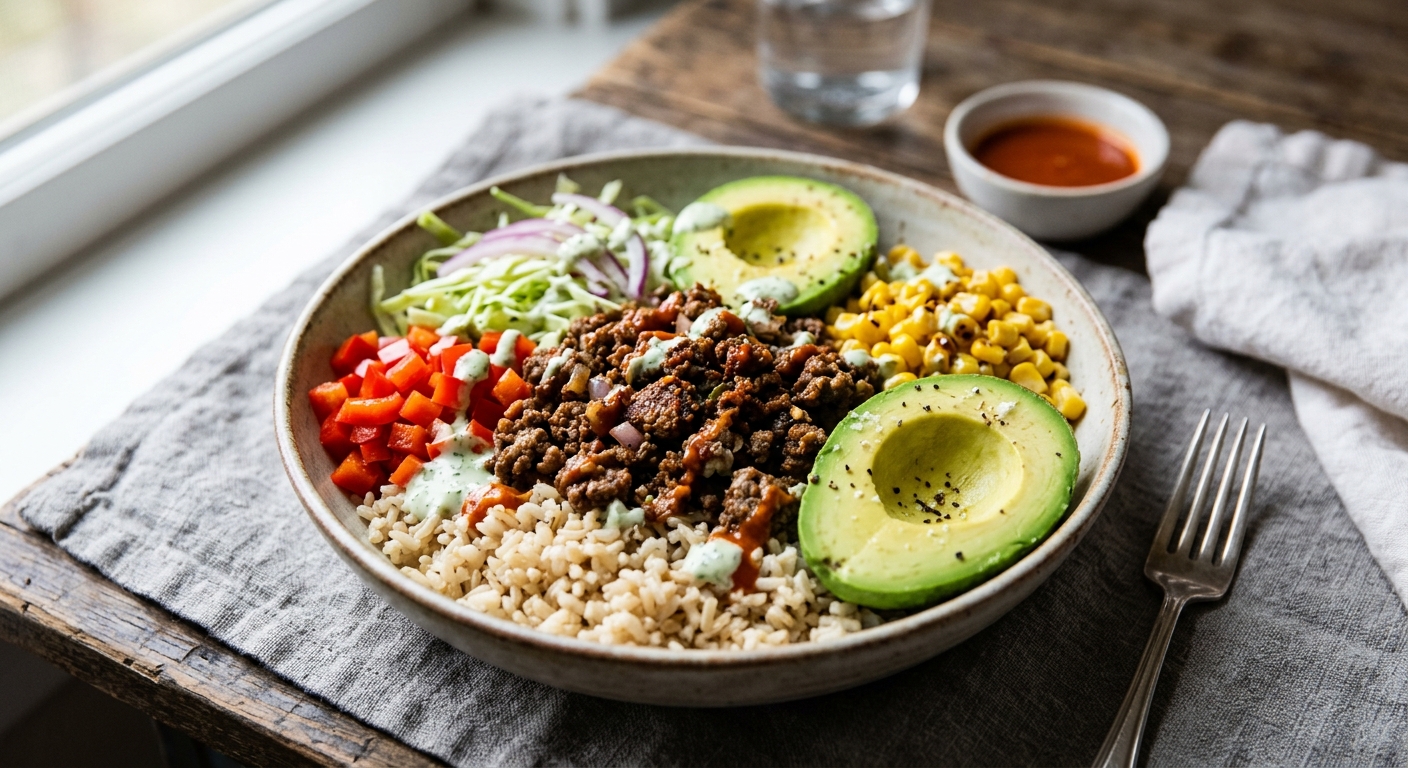
Ground bison has quietly become one of the most nutrient-dense proteins available at mainstream grocery stores, yet it remains dramatically underused in home kitchens. Compared to 80/20 ground beef, ground bison contains roughly 25% fewer calories, nearly 40% less total fat, and substantially lower saturated fat, all while matching or exceeding beef in iron, zinc, and B vitamins. This Bison Burger Bowl was designed to let that exceptional protein shine without burying it under calorie-dense buns and processed condiments. Instead, every component is chosen to amplify the nutritional profile: avocado contributes heart-healthy monounsaturated fats and potassium, brown rice provides slow-digesting complex carbohydrates, and a vibrant lime-cumin slaw supplies folate, vitamin K, and gut-supporting fiber.
What makes this bowl genuinely satisfying rather than just nutritionally virtuous is technique. Bison is leaner than beef, which means it overcooks quickly on high heat and turns dry and grainy if mistreated. On the stovetop, we use a cast iron skillet at medium-high heat for a fast sear that builds a deeply caramelized crust while keeping the interior juicy and just cooked through. In the oven, a sheet pan method allows the bison to cook gently and evenly alongside roasted corn and peppers, concentrating flavors without moisture loss. The slow cooker transforms the bison into a saucy, shredded-style filling reminiscent of a green chile smash, while the pressure cooker produces a braised bison base with bold, infused seasoning in under 20 minutes of active cooking time. Four genuinely different bowls, one extraordinary protein source.
For anyone tracking protein quality alongside quantity, bison scores exceptionally well on the Protein Digestibility Corrected Amino Acid Score (PDCAAS), with a complete essential amino acid profile rivaling that of chicken breast. A single serving of this bowl provides over 40 grams of protein alongside meaningful amounts of iron (critical for oxygen transport), zinc (essential for immune function and protein synthesis), selenium (a key antioxidant mineral), and niacin. Whether you are an athlete optimizing recovery, someone managing iron-deficiency anemia, or simply a home cook who wants a burger experience without nutritional compromise, this bowl was calibrated for you.
4
servings
Ingredients
- 680 gground bison (90/10 lean-to-fat ratio)
- 2 largeripe avocados, halved, pitted, and sliced
- 200 gdry brown rice, rinsed (or 4 cups cooked)
- 240 gfresh or frozen corn kernels
- 1 mediumred bell pepper, finely diced
- 200 ggreen cabbage, thinly shredded
- 1 mediumred onion, half finely diced for the bison, half thinly sliced for slaw
- 3 clovesgarlic, minced
- 2 tbspextra-virgin olive oil, divided
- 2 tbspfresh lime juice (about 1 large lime)
- 1 tbspapple cider vinegar
- 1.5 tspground cumin
- 1 tspsmoked paprika
- 0.5 tspchili powder
- 0.5 tspgarlic powder
- 0.25 tspcayenne pepper (optional, adjust to heat preference)
- 120 mllow-sodium beef or bison broth (for slow cooker and pressure cooker methods)
- 2 tbsptomato paste
- 30 gfresh cilantro, roughly chopped
- 2 tbsppickled jalapeno slices (optional, for serving)
- —Colima Sea SaltMicroplastic Free Salt and freshly cracked black pepper to taste
Instructions
Click on an item below to shop for the recommended items for this recipe on Amazon.
As an Amazon Associate, we earn from qualifying purchases.
- Cook the brown rice according to package directions (approximately 45 minutes, or use pre-cooked rice to save time). While the rice cooks, prepare all remaining components.
- Make the slaw: In a medium bowl, combine the shredded cabbage, thinly sliced red onion, lime juice, apple cider vinegar, a pinch of salt, and 1 teaspoon of cumin. Toss well and set aside at room temperature to lightly pickle while you cook the bison. The acid will slightly soften the cabbage and develop flavor.
- Heat a large cast iron skillet over medium-high heat for at least 2 minutes until thoroughly hot. Add 1 tablespoon of olive oil and swirl to coat. Add the finely diced red onion and red bell pepper. Cook, stirring occasionally, for 3 to 4 minutes until softened and beginning to char at the edges.
- Add the minced garlic and cook for 30 seconds until fragrant. Add the ground bison in one large, flat layer without breaking it up. Let it sear undisturbed for 2 minutes to develop a caramelized crust on the bottom. Then break into large crumbles with a wooden spoon and continue cooking for 4 to 5 minutes, stirring occasionally, until browned throughout and no pink remains.
- Add the tomato paste, smoked paprika, remaining 0.5 teaspoon cumin, chili powder, garlic powder, cayenne (if using), and a generous pinch of salt and pepper. Stir to coat the bison evenly and cook for 1 to 2 minutes until the tomato paste darkens slightly and becomes fragrant. Remove from heat.
- In a separate small dry skillet over high heat, char the corn kernels for 2 to 3 minutes, tossing occasionally, until golden and lightly blistered. Season with a pinch of salt.
- Assemble the bowls: Divide the brown rice among four bowls. Top each with a generous portion of the seasoned bison, charred corn, the lime-cumin slaw, and fanned avocado slices. Drizzle the remaining tablespoon of olive oil over the avocado and finish with fresh cilantro and pickled jalapenos if desired.
- Brown the ground bison before adding it to the slow cooker: this is a critical step for flavor and texture that should not be skipped. Heat 1 tablespoon of olive oil in a skillet over medium-high heat. Add the diced red onion and bell pepper and cook for 3 minutes. Add the garlic and cook 30 seconds. Add the bison and cook, breaking it into crumbles, for 4 to 5 minutes until just browned. Drain any excess liquid from the pan.
- Transfer the browned bison mixture to the slow cooker. Add the tomato paste, beef broth, smoked paprika, cumin, chili powder, garlic powder, cayenne (if using), salt, and pepper. Stir everything together to combine. Add the corn kernels directly into the slow cooker as well so they absorb the seasoning liquid as they cook.
- Place the lid on the slow cooker and cook on Low for 6 to 7 hours. After 6 hours, check the consistency: the mixture should be thick, saucy, and aromatic. If it appears watery, remove the lid and cook on High for an additional 20 minutes to reduce the liquid. Stir and taste, adjusting seasoning with salt, lime juice, or chili powder as needed.
- While the bison finishes, cook the brown rice according to package directions. Prepare the slaw by combining the shredded cabbage, sliced red onion, lime juice, apple cider vinegar, 1 teaspoon cumin, and a pinch of salt. Toss well and let sit for at least 15 minutes so the cabbage softens slightly.
- Assemble the bowls: Spoon brown rice into each bowl. Ladle a generous portion of the slow cooker bison mixture over the rice, making sure to include plenty of the braising juices. Add the slaw, sliced avocado, and fresh cilantro. Drizzle lightly with the remaining olive oil and serve with pickled jalapenos if desired.
- Set the Instant Pot or electric pressure cooker to Saute mode on High. Add 1 tablespoon olive oil. Once hot, add the diced red onion and red bell pepper and cook for 3 to 4 minutes, stirring, until softened. Add the garlic and stir for 30 seconds. Add the ground bison and cook, breaking it up, for 3 to 4 minutes until browned. You are building a fond (the browned bits on the bottom of the pot) that will infuse the entire dish under pressure.
- Add the tomato paste and stir it into the meat for 1 minute until it darkens slightly. Deglaze with the beef broth, scraping up all the browned bits from the bottom of the pot with a wooden spoon. This step is critical: any fond left stuck to the bottom can trigger a burn warning during pressurization.
- Add the smoked paprika, cumin, chili powder, garlic powder, cayenne (if using), salt, pepper, and the corn kernels. Stir to combine. The liquid level should just barely coat the ingredients; add an additional 2 to 3 tablespoons of broth if the pot looks dry.
- Secure the lid and set the pressure release valve to Sealing. Cook on Manual (or Pressure Cook) at High Pressure for 8 minutes. Once the cycle completes, allow a natural pressure release for 5 minutes, then carefully switch the valve to Venting for a quick release of any remaining steam.
- Open the lid and stir the bison mixture. If there is excess liquid, switch back to Saute mode and cook uncovered for 2 to 3 minutes, stirring, until the sauce tightens to a thick, glossy consistency. While the pressure releases, cook the brown rice using the stovetop method and prepare the slaw. Assemble bowls as described: rice base, bison mixture, slaw, avocado slices, cilantro, and a final squeeze of fresh lime juice over the top.
- Preheat the oven to 220C (425F) with a rack in the upper-middle position. Line a large rimmed baking sheet with parchment paper. Cook the brown rice according to package directions. Prepare the slaw (cabbage, sliced onion, lime juice, apple cider vinegar, cumin, salt) and refrigerate while everything else cooks.
- In a large bowl, combine the ground bison with the tomato paste, smoked paprika, cumin, chili powder, garlic powder, cayenne (if using), minced garlic, diced red onion, 1 tablespoon olive oil, salt, and pepper. Mix with your hands or a spoon until the seasonings are evenly distributed throughout the meat. Do not overmix or compress the bison into a dense mass; the goal is well-seasoned loose crumbles.
- Scatter the seasoned bison mixture across one half of the prepared baking sheet, breaking it into large, irregular crumbles no smaller than 2cm. On the other half of the baking sheet, toss the diced red bell pepper and corn kernels with the remaining tablespoon of olive oil and a pinch of salt. Spread everything into a single even layer so the bison and vegetables roast rather than steam.
- Roast for 12 minutes, then remove the baking sheet from the oven. Use a spatula to flip and redistribute the bison crumbles, exposing the less-browned sides to the heat. Return to the oven for another 10 to 13 minutes until the bison is deeply caramelized at the edges, cooked through, and the corn and peppers are lightly charred and sweet.
- Remove from the oven and taste the bison mixture; adjust seasoning with a squeeze of lime juice, additional chili powder, or salt as needed. Assemble the bowls: spoon the brown rice into four bowls, then divide the sheet pan bison and roasted vegetables evenly among them. Top with the chilled lime-cumin slaw and fanned avocado slices. Finish with fresh cilantro, pickled jalapenos, and an optional drizzle of olive oil.
Nutrition Breakdown
Per 1 serving (makes 4)
Vitamins & Minerals
% Daily Value based on a 2,000 calorie diet (FDA reference)
🧬 Essential Amino Acids
% of recommended daily intake (RDA) per serving
🛡 Antioxidant Profile
The Nutrition Science
Bison (American buffalo) has a distinct fatty acid profile compared to grain-finished beef. Because the majority of commercial bison is pasture-raised, its fat contains a higher ratio of omega-3 to omega-6 fatty acids and a greater proportion of conjugated linoleic acid (CLA), a naturally occurring trans fat that, unlike industrial trans fats, has been associated in human studies with reduced body fat accumulation and improved insulin sensitivity. A 170g serving of 90/10 ground bison provides approximately 7 to 8g of total fat, compared to 20 to 23g in equivalent 80/20 ground beef, representing a 60 to 65% reduction in total fat without any sacrifice in protein density. This makes bison one of the most favorable red meat options for individuals who need to maintain high protein intake while managing cardiovascular risk factors.
The iron in bison is heme iron, the most bioavailable form of dietary iron with an absorption rate of 15 to 35%, compared to 2 to 20% for the non-heme iron found in plant foods. This is clinically significant: a single serving of this bowl provides approximately 5mg of heme iron, which contributes more to measurable serum ferritin than an equivalent milligram amount from lentils or spinach. The vitamin C from the red bell pepper and lime juice in this recipe further enhances non-heme iron absorption (from the brown rice and corn) by reducing ferric iron (Fe3+) to the more absorbable ferrous form (Fe2+), a well-documented synergistic interaction that can increase non-heme iron absorption by up to 300%.
Avocado contributes more to this dish than healthy fat: a single avocado provides approximately 690mg of potassium (nearly 50% more than a banana), along with 10g of fiber, folate, and pantothenic acid. The monounsaturated oleic acid in avocado has been shown to upregulate the absorption of fat-soluble carotenoids present in the bowl, including beta-carotene from the bell pepper and lycopene from the tomato paste. A landmark study published in the Journal of Nutrition found that adding avocado to a salad containing carotenoid-rich vegetables increased alpha-carotene absorption by 7.2-fold and beta-carotene by 15.3-fold compared to a fat-free control, confirming that the avocado in this bowl is not merely a textural addition but a scientifically meaningful catalyst for micronutrient uptake.
Pro Tips
- Do not overcook bison: because it is 90% lean, it reaches the USDA safe internal temperature of 71C (160F) for ground meat faster than beef. Use an instant-read thermometer and pull the pan from heat as soon as no pink remains to preserve juiciness.
- Make a double batch of the lime-cumin slaw and store it separately in the refrigerator for up to 3 days. It improves overnight as the cabbage softens and the flavors meld, and works as a topping for tacos, grain bowls, and scrambled eggs.
- For maximum iron absorption, avoid serving this bowl with coffee or black tea within 1 hour of eating. Both beverages contain polyphenols (tannins and chlorogenic acid) that bind to non-heme iron and can reduce absorption by up to 60%.
- If you cannot find ground bison at a standard grocery store, check warehouse clubs (Costco often stocks frozen ground bison), specialty butchers, or online meat delivery services. Ground bison freezes exceptionally well for up to 4 months without quality loss.
- To lower the glycemic load further, substitute half the brown rice with riced cauliflower. This reduces net carbs per serving by approximately 15g while maintaining the visual bulk and satisfying texture of the bowl.
Love the bison focus here, though I’d gently push back on “nutritionally superior” since it really depends on your goals and the specific cuts being compared. That said, bison does have a genuinely interesting polyphenol angle that often gets overlooked: grass-fed bison typically has higher levels of conjugated linoleic acid (CLA) and the animals’ forage diet can actually influence the antioxidant profile of the meat itself. The avocado pairing is smart too, since those fat-soluble polyphenols in avocado get better absorption with the fat content of bison. My only question: what seasonings are you using? Some spice blends can add
Pete, you’re hitting on something I’ve been tracking with my CGM data actually, the CLA angle is legit – I’ve noticed my postprandial glucose response tends to be more stable with grass-fed bison compared to conventional beef, which aligns with some of the metabolic studies on CLA’s insulin sensitivity effects. Did the recipe specify grass-fed sourcing? That detail matters a ton for the polyphenol profile you mentioned, and I’d love to know the exact seasoning blend too since some spice combinations can meaningfully impact the glycemic load depending on sugar content in rubs.
That’s a really astute observation with your CGM data, Ben – the CLA angle is legit and I’m glad you’re tracking it! One thing worth noting though: while grass-fed bison does have higher CLA levels than grain-finished, the polyphenol benefit I mentioned comes more from the seasoning spices themselves (think cinnamon, cumin, oregano for their catechins and other compounds) rather than the meat’s polyphenol profile directly, so you’d get similar benefits whether it’s grass-fed or conventional, though grass-fed wins on the CLA front. The recipe doesn’t specify sourcing here, which is a missed opportunity, but I’d be more curious
This is such a helpful clarification, Pete, and I really appreciate you breaking down where the polyphenol benefits are actually coming from. I’ve been building my MS protocol around anti-inflammatory foods for years, and I’ve found that the seasoning choices matter way more than I initially gave them credit for, especially with how they support neuroinflammation management. That said, I do still prioritize grass-fed bison when I can access it, mostly for the B12 bioavailability and the overall micronutrient density rather than assuming it’s universally “better” across every metric. Would love to see the recipe developer specify sourcing in a future version, since that practical detail actually shapes how readers
omg nadia i love that youre thinking about seasoning choices for neuroinflammation, thats something i rarely see people connect even though spices can be either really healing or surprisingly mycotoxin-prone depending on sourcing and storage. ive noticed a huge difference in my own symptom load just by being selective about turmeric and oregano sourcing, which matters even more when youre already dealing with inflammation. the grass-fed bison point resonates with me too, though i also watch the corn in bowls like this since its so susceptible to aflatoxins, especially roasted – do you source yours pretty carefully or have you noticed any impacts from prep method? genuinely curious how
Pete makes a solid point on the specificity thing, though I’d argue the micronutrient density argument holds up pretty well across cuts. What I’m more curious about is your roasting method for the corn, since I find most recipes nail the avocado and slaw but totally botch the corn by either steaming it or throwing raw kernels in, both of which leave you with flabby texture and nutrient leaching. Are you charring it hot and fast to preserve the lutein, or going another route?