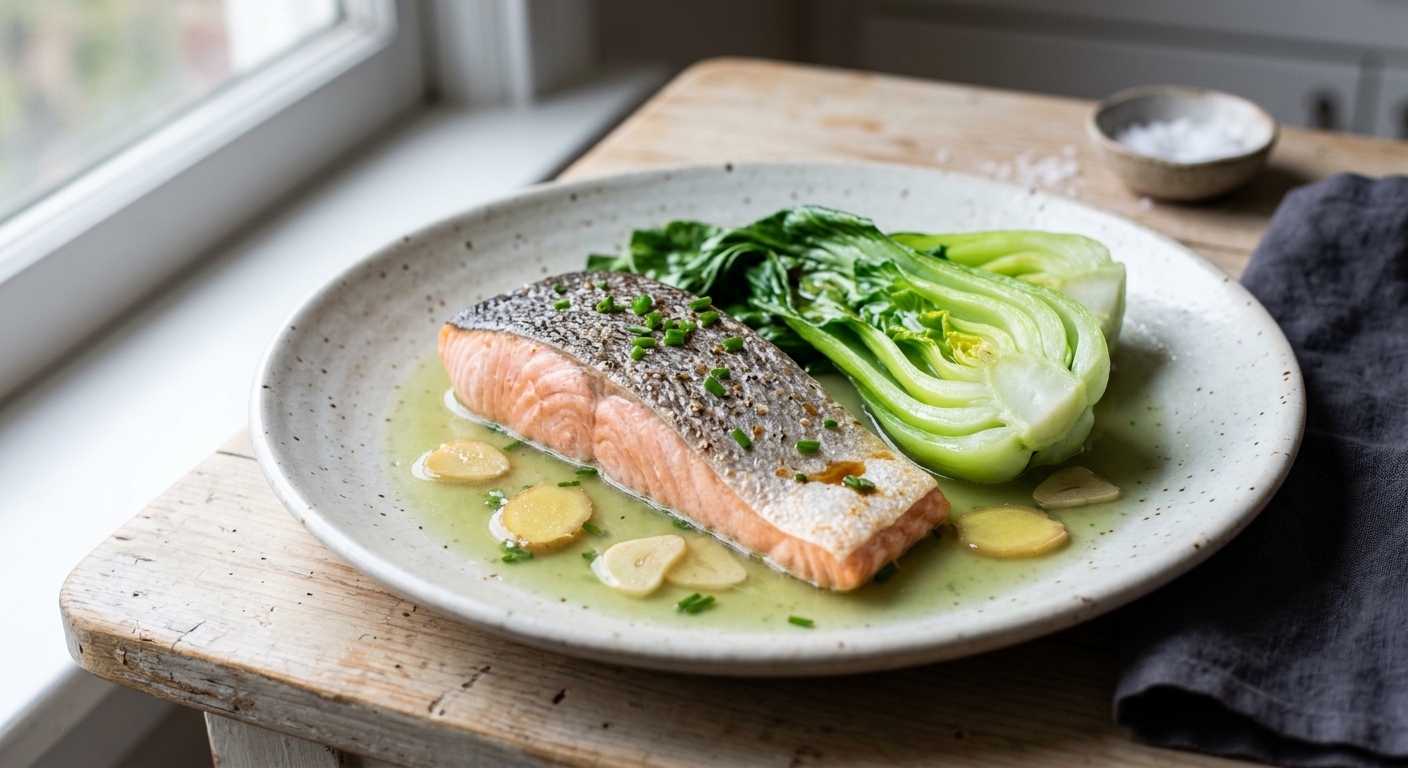
Few flavor combinations in the culinary world are as quietly transformative as green tea and salmon. The grassy, slightly astringent depth of a strong sencha or gyokuro broth acts as a perfect counterpoint to the rich, buttery fat of wild-caught salmon, while simultaneously infusing every bite with a remarkable concentration of polyphenols. This is not fusion for its own sake. This is a dish where every ingredient earns its place on both flavor and biochemical grounds.
Bok choy brings the structural contrast: its crisp white stalks and silky dark-green leaves cook at different rates, so you get two textures in every forkful. Beyond texture, those dark outer leaves are dense with vitamin K, folate, and potassium, while the cruciferous chemistry of bok choy, specifically its glucosinolates, adds a layer of anti-inflammatory activity that compounds the effect of the salmon and green tea. A base of fresh ginger and garlic rounds out the aromatics and contributes gingerols and allicin to an already impressive phytochemical profile.
At Calibrated Cuisine, we formulated this recipe to hit specific dietary reference intake targets without sacrificing a single ounce of culinary pleasure. The poaching liquid is calibrated to a temperature window that keeps the salmon moist and translucent at the center, a technique borrowed from Japanese haute cuisine and grounded in the food-science principle that salmon proteins begin to tighten and dry above 52 degrees Celsius (125 degrees Fahrenheit). The result is a restaurant-quality plate that also happens to be one of the most nutrient-dense anti-inflammatory meals you can prepare in under an hour.
4
servings
Ingredients
- 680 gwild-caught salmon fillets (4 x 170g pieces, skin-on), pin bones removed
- 1200 mlfiltered water
- 4 tsploose-leaf sencha or gyokuro green tea (or 4 high-quality tea bags)
- 300 gbaby bok choy, halved lengthwise (about 4 heads)
- 30 gfresh ginger, peeled and cut into thin coins
- 4 clovesgarlic, thinly sliced
- 3 tbsplow-sodium soy sauce (tamari for gluten-free)
- 2 tbsprice vinegar
- 1 tbsptoasted sesame oil
- 1 tbspraw honey or pure maple syrup
- 2 stalksgreen onions (scallions), thinly sliced on the bias
- 1 tspwhite sesame seeds, lightly toasted
- 1 tspred pepper flakes (optional)
- —Colima Sea SaltMicroplastic Free Salt and white pepper to taste
Instructions
Click on an item below to shop for the recommended items for this recipe on Amazon.
As an Amazon Associate, we earn from qualifying purchases.
- Bring the 1200ml of filtered water to 80 degrees Celsius (175 degrees Fahrenheit) in a medium saucepan. Add the green tea and steep for exactly 3 minutes, then remove and discard the leaves or bags. Over-steeping will make the broth bitter. Set the brewed tea aside.
- In a wide, shallow saute pan or braiser, combine the brewed green tea, ginger coins, sliced garlic, soy sauce, rice vinegar, and honey over medium heat. Bring the broth to a gentle simmer, about 85 degrees Celsius (185 degrees Fahrenheit), and cook for 5 minutes to allow the aromatics to bloom and infuse.
- Season the salmon fillets lightly with fine sea salt and white pepper on both sides. Carefully lower the fillets skin-side down into the simmering broth. Reduce the heat to medium-low so the surface of the liquid barely trembles. Cover the pan with a tight-fitting lid or a sheet of parchment paper pressed directly onto the surface (a cartouche) to trap steam.
- Poach the salmon for 8 to 10 minutes depending on thickness. The salmon is ready when it flakes easily at the thickest part but still appears slightly translucent at the very center. An instant-read thermometer should read 52 to 54 degrees Celsius (125 to 130 degrees Fahrenheit) for medium doneness.
- Two minutes before the salmon is done, nestle the halved bok choy cut-side down around the fillets. Cover and allow them to steam in the broth until the leaves are wilted and the stalks are just tender-crisp, about 2 minutes. Do not overcook; the bok choy should retain a vibrant green colour and a slight bite.
- Using a wide fish spatula, carefully transfer each salmon fillet to a shallow bowl. Arrange the bok choy alongside. Ladle 150 to 180ml of the fragrant poaching broth over each serving. Finish with a drizzle of toasted sesame oil, a scatter of sliced green onions, white sesame seeds, and red pepper flakes if using. Serve immediately.
- Brew the green tea first on the stovetop or with a kettle: heat 1200ml of water to 80 degrees Celsius (175 degrees Fahrenheit), steep the tea for 3 minutes, then discard the leaves or bags. This step must be done separately because a slow cooker cannot reach the precise temperature needed for proper tea extraction without over-steeping as the unit heats up.
- Pour the brewed green tea into the slow cooker insert. Add the ginger coins, sliced garlic, soy sauce, rice vinegar, and honey. Stir gently to dissolve the honey. Place the insert into the cooker and set it to Low. Allow the broth to come up to temperature for 20 to 25 minutes with the lid on before adding the salmon. This pre-warming step ensures the fish does not spend too long in a cold liquid.
- While the broth warms, season the salmon fillets on both sides with fine sea salt and white pepper. Once the broth is steaming gently (you should see wisps of steam when you lift the lid), lower the salmon fillets skin-side down into the liquid in a single layer. Replace the lid immediately.
- Cook on Low for 55 to 70 minutes. The precise time depends on fillet thickness (2.5cm fillets need closer to 70 minutes; thinner ones closer to 55). Resist lifting the lid during cooking as each peek drops the temperature significantly. The salmon is ready when it flakes at the edges but remains moist and slightly glossy in the center.
- Arrange the halved bok choy on top of and around the salmon fillets, cut-side up, during the final 15 minutes of cooking. Replace the lid and allow the residual heat and steam to wilt the bok choy until just tender. Because slow cookers trap steam so effectively, the bok choy will cook quickly and can become mushy if added too early.
- Gently lift each fillet and the bok choy into shallow bowls using a wide spatula. Ladle the aromatic broth over each portion. Drizzle with toasted sesame oil and finish with green onions, sesame seeds, and red pepper flakes. The broth from a slow cooker will be slightly more concentrated and deeply flavored than the stovetop version.
- Brew the green tea outside the pressure cooker: bring 1200ml of filtered water to 80 degrees Celsius in a kettle or saucepan, steep the tea for 3 minutes, and discard the leaves or bags. Add the brewed tea to the Instant Pot insert along with the ginger, garlic, soy sauce, rice vinegar, and honey. Stir to combine.
- Season the salmon fillets with fine sea salt and white pepper. Place a metal trivet or steamer rack into the Instant Pot insert over the broth. Arrange the salmon fillets on the trivet in a single layer, skin-side down. The fillets should sit above the liquid, not submerged in it; the pressurized steam does the poaching work here rather than the liquid itself, which protects the delicate texture.
- Place the halved bok choy cut-side up on top of and around the salmon on the trivet. Secure the lid and set the steam release valve to Sealing. Select the Pressure Cook or Manual function and set it to Low Pressure for 3 minutes. The unit will take approximately 8 to 10 minutes to come to pressure.
- When the cook time is complete, perform an immediate Quick Release by carefully moving the valve to Venting. Do not use Natural Release as the residual heat will continue cooking the salmon and risk overcooking it. Open the lid away from you to avoid the burst of steam.
- Use tongs and a wide spatula to transfer the salmon and bok choy to shallow bowls. The bok choy will be perfectly wilted and the salmon should be just set with a moist, silky interior. Ladle the now-intensified broth from the bottom of the insert over each serving. Drizzle with sesame oil and finish with green onions, sesame seeds, and optional red pepper flakes.
- Preheat your oven to 160 degrees Celsius (325 degrees Fahrenheit). Brew the green tea: heat 1200ml of water to 80 degrees Celsius, steep for 3 minutes, then strain. In a small saucepan over medium heat, combine the brewed tea, ginger, garlic, soy sauce, rice vinegar, and honey. Simmer for 5 minutes to concentrate slightly and develop the aromatics. Remove from heat and allow to cool for 5 minutes.
- Tear four large sheets of heavy-duty aluminium foil, each approximately 40cm x 40cm. Fold each sheet in half to create a double layer for structural integrity. Place a portion of halved bok choy (two halves per packet) in the center of each foil sheet, cut-side up, forming a bed for the salmon.
- Season each salmon fillet with fine sea salt and white pepper on both sides. Place one fillet skin-side down on top of the bok choy in each packet. Ladle 60ml (approximately 4 tablespoons) of the warm aromatic green tea broth over each fillet and bok choy portion. The broth will steam inside the sealed packet, creating a moist cooking environment.
- Fold the foil up and over the salmon, crimping and rolling the edges tightly to form a fully sealed, airtight parcel. Leave a little air space inside each packet so steam can circulate. Place the packets on a rimmed baking sheet in a single layer and transfer to the center rack of the preheated oven.
- Bake for 14 minutes for 2.5cm-thick fillets, or 16 minutes for thicker cuts. The sealed packets will puff up visibly as steam builds inside. Carefully transfer each packet to a shallow bowl or rimmed plate. At the table, cut open the top of each packet with scissors (caution: hot steam will escape). Slide the contents directly into the bowl, capturing all the aromatic broth. Finish with a drizzle of sesame oil, green onions, sesame seeds, and red pepper flakes.
Nutrition Breakdown
Per 1 serving (makes 4)
Vitamins & Minerals
% Daily Value based on a 2,000 calorie diet (FDA reference)
🧬 Essential Amino Acids
% of recommended daily intake (RDA) per serving
🛡 Antioxidant Profile
The Nutrition Science
The anti-inflammatory mechanism at work in this dish is a genuine convergence of multiple independent pathways. Salmon’s EPA and DHA omega-3 fatty acids are incorporated directly into cell membrane phospholipids, where they compete with arachidonic acid as a substrate for COX and LOX enzymes. When EPA and DHA win that competition, the resulting eicosanoids (resolvins and protectins) are pro-resolving rather than pro-inflammatory, actively switching off the inflammatory cascade rather than simply failing to trigger it. At 3.4g of combined EPA and DHA per serving, this dish delivers more than double the adequate intake level established by most national nutrition bodies.
The EGCG from green tea adds a complementary but mechanistically distinct layer of protection. EGCG is a direct inhibitor of NF-kB, the master transcription factor that upregulates production of inflammatory cytokines including TNF-alpha, IL-1 beta, and IL-6. Crucially, EGCG is fat-soluble enough to penetrate cell membranes but also functions in the aqueous cytoplasm, making it unusually broad-spectrum among polyphenols. Brewing at 80 degrees Celsius rather than boiling water preserves a meaningfully higher proportion of EGCG, since temperatures above 90 degrees Celsius degrade catechins by 10 to 30 percent. This is why the brewing temperature in this recipe is specified precisely.
Vitamin D from the salmon, at 91% of the daily value per serving, is worth specific attention in an anti-inflammatory context. Vitamin D receptors (VDRs) are expressed on virtually every immune cell, and adequate vitamin D status is associated with downregulation of Th1 and Th17 inflammatory immune responses and upregulation of T-regulatory cells. Selenium, at 95% DV, is an essential cofactor for glutathione peroxidase, the body’s primary intracellular antioxidant enzyme, creating yet another reinforcing layer of cellular protection. The combined phytochemical and micronutrient architecture of this dish represents one of the most evidence-backed anti-inflammatory food combinations achievable in a single meal.
Pro Tips
- For the most silky, evenly cooked salmon, bring the fillets to room temperature for 15 minutes before poaching. Cold salmon straight from the refrigerator creates an uneven temperature gradient that results in overcooked edges and an undercooked center.
- The quality of your green tea matters enormously to the flavor of the broth. A high-grade sencha or gyokuro will produce a clean, umami-forward broth with grassy sweetness. Avoid flavored or low-grade tea bags, which can turn bitter and medicinal. If you have dashi on hand, replacing 200ml of the water with dashi amplifies the umami depth substantially.
- Do not discard the leftover poaching broth. It is nutritionally dense and deeply flavored. Strain it through a fine-mesh sieve and refrigerate for up to 3 days. Use it as a base for miso soup, a cooking liquid for soba noodles, or a light sauce for steamed vegetables the next day.

omg the green tea poaching method is genius, ive been doing my longer training runs in the afternoons and recovery has been such a focus for me lately so this combo is literally perfect – that omega 3 load plus the anti inflammatory catechins is exactly what my body needs post-long run. and priya you’re so right about the bok choy, its such an underrated veggie for runners, the calcium plus those glucosinolates make it ideal for bone health during high mileage training. might try this the night before a race too since its easy to digest and wont sit heavy like some heavier proteins can!
The poaching temp is key here, honestly around 160-170F keeps those catechins intact while preventing that rubbery salmon texture you get with higher heat. I’ve been doing something similar with matcha broth lately and pairing it with cruciferous greens for the sulforaphane synergy, the anti-inflammatory stacking is real. Question though, are you blanching the bok choy separately or cooking it in the broth the whole time, because that’ll make a big difference in retaining the glucosinolates.
Love this approach to salmon prep! The green tea broth is such a smart move for preserving those heat-sensitive catechins while you cook. I’m curious about the bok choy choice here, too – it’s one of my favorite calcium sources for clients watching absorption (the oxalic acid is pretty low compared to other greens), and that mild flavor lets the fish shine. Do you have a sense of how much of the omega-3s and fat-soluble vitamins are retained through poaching versus higher heat cooking methods?