
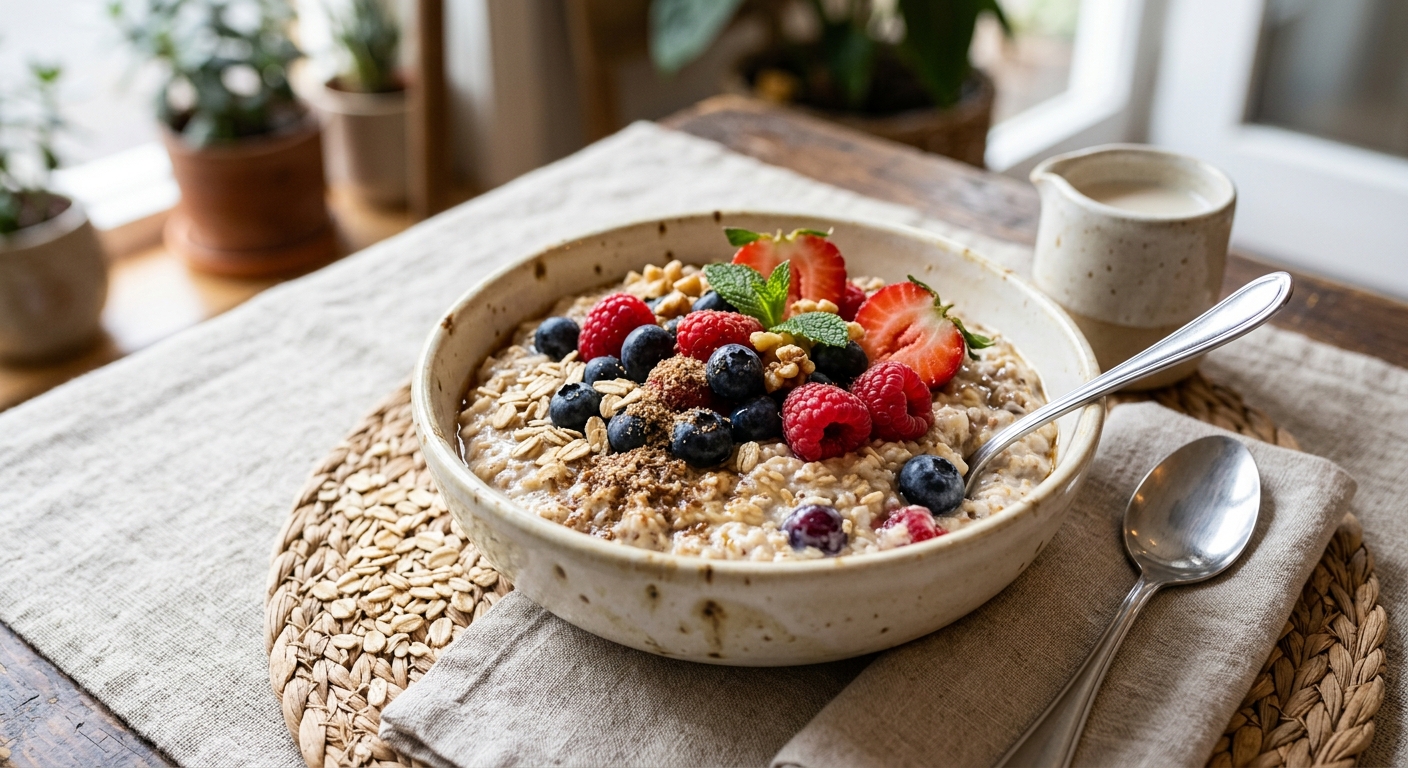
Overnight oats have earned their place in the modern breakfast canon not just for convenience, but for their remarkable nutritional density. This version elevates the concept by centering ground flaxseed as the nutritional hero: two tablespoons per serving deliver approximately 4.7 grams of alpha-linolenic acid (ALA), the plant-based omega-3 fatty acid that supports cardiovascular health, reduces systemic inflammation, and contributes to healthy cell membrane function. The body converts a portion of ALA to EPA and DHA, making this bowl a meaningful contributor to your omega-3 status, particularly for plant-based eaters.
The berry medley is not merely decorative. Blueberries, raspberries, and strawberries are among the most antioxidant-dense fruits available, providing anthocyanins, ellagic acid, and vitamin C that work synergistically to neutralise free radicals and dampen inflammatory pathways. Rolled oats add beta-glucan soluble fiber, which clinical research consistently links to lower LDL cholesterol and improved post-meal blood sugar stability. Together, these ingredients create a breakfast with genuine, measurable anti-inflammatory credentials.
What makes this recipe stand out on Calibrated Cuisine is its versatility: you can prepare it cold the night before, warm it gently on the stovetop, slow-cook a large batch for the week, or pressure-cook individual servings in minutes. Every method is calibrated to preserve the delicate ALA content and the vibrant, heat-sensitive polyphenols in the berries. The result is a bowl that looks stunning, tastes like a treat, and performs like a supplement stack.
4
servings
Ingredients
- 320 gold-fashioned rolled oats (not instant)
- 60 gground flaxseed (freshly milled or vacuum-sealed)
- 800 mlunsweetened oat milk (or almond milk)
- 200 mlplain low-fat yogurt (dairy or unsweetened coconut yogurt for vegan)
- 150 gfresh or frozen blueberries
- 100 gfresh or frozen raspberries
- 100 gfresh or frozen strawberries, hulled and halved
- 3 tbsppure maple syrup
- 2 tsppure vanilla extract
- 1 tspground cinnamon
- 30 gchia seeds
- —Pinch of Colima Sea SaltMicroplastic Free Salt
- —Fresh mint leaves and extra berries to garnish (optional)
Instructions
Click on an item below to shop for the recommended items for this recipe on Amazon.
As an Amazon Associate, we earn from qualifying purchases.
- The night before: Combine the rolled oats, ground flaxseed, chia seeds, cinnamon, vanilla extract, and a pinch of sea salt in a large mixing bowl. Stir thoroughly so the flaxseed and chia are evenly distributed throughout the oats rather than clumping at the bottom.
- Pour the oat milk and yogurt over the dry mixture and stir well for about 30 seconds, making sure no dry pockets remain. Add the maple syrup and stir again. The mixture will look loose at this stage; it thickens significantly overnight.
- Divide the mixture evenly among four airtight jars or containers (approximately 300ml capacity each). Press a loose layer of mixed berries on top of each jar, but do not stir them in yet. Seal and refrigerate for a minimum of 6 hours, ideally 8 to 10 hours.
- In the morning: If serving warm, transfer the contents of one jar to a small saucepan. Set the heat to medium-low and stir gently for 4 to 6 minutes, adding a splash of extra oat milk (2 to 3 tablespoons) to loosen the texture as the oats absorb heat. Do not boil; gentle warming preserves more of the heat-sensitive polyphenols in the berries. The target temperature is around 60 to 65 degrees Celsius, just warm enough to steam lightly.
- Remove from heat and fold in the berries from the top of the jar. Transfer to a bowl, add the garnish berries and fresh mint, and serve immediately. If serving cold, remove from the refrigerator, stir once, add fresh berries on top, and serve straight from the jar.
- Lightly spray or wipe the interior of a 4 to 6 quart slow cooker insert with a neutral oil or coconut oil. This prevents the oats from sticking and makes cleanup significantly easier.
- Add the rolled oats, chia seeds, cinnamon, vanilla extract, maple syrup, and sea salt directly to the slow cooker. Pour in the oat milk and 200ml of cold water (the extra water compensates for the longer cook time and prevents the oats from drying out against the warm walls). Stir everything together with a silicone spatula.
- Place the lid on and set the slow cooker to Low. Cook for 7 to 8 hours. Do not lift the lid during cooking; the condensation on the lid recycles moisture back into the oats and is essential to the texture. If your slow cooker runs hot, check at the 6-hour mark.
- When the cooking time is complete, open the lid and stir the oats vigorously to recombine any liquid that has separated to the edges. The texture should be thick, creamy, and porridge-like. Stir in the yogurt now, directly into the slow cooker, which adds creaminess and cools the mixture slightly.
- Ladle into four bowls. Immediately stir 15 grams of ground flaxseed into each bowl rather than cooking it with the oats. This is deliberate: the heat-sensitive ALA in flaxseed and the anthocyanins in berries are best preserved when added after the main cooking phase. Top each bowl with the fresh mixed berries, drizzle with an optional extra teaspoon of maple syrup if desired, and garnish with mint.
- Add the rolled oats, chia seeds, cinnamon, vanilla extract, maple syrup, sea salt, and oat milk to the inner pot of a 6-quart Instant Pot or electric pressure cooker. Stir briefly to combine. Do not add the yogurt, flaxseed, or berries at this stage.
- Secure the lid and set the pressure release valve to the Sealing position. Select Manual or Pressure Cook mode and set the timer for 3 minutes at High Pressure. The pot will take approximately 5 to 7 minutes to come up to pressure before the 3-minute cook time begins.
- When the cook time ends, allow the pressure to release naturally for 10 minutes. Do not switch to quick release; the residual steam continues cooking the oats gently and prevents a foamy, starchy splatter. After 10 minutes, carefully turn the valve to Venting to release any remaining pressure.
- Open the lid and stir the oats thoroughly. They will look slightly watery at first; stir for about 30 seconds and the mixture will come together into a thick, creamy porridge. Fold in the yogurt and stir until fully incorporated.
- Serve into four bowls and immediately top each bowl with a generous portion of mixed berries. Spoon 15 grams of ground flaxseed over each bowl and stir gently so it disperses through the warm oats without being fully cooked. The residual warmth of the oats is enough to release the nutty flavour of the flaxseed without degrading the ALA. Finish with mint leaves and any extra fresh berries.
- Preheat your oven to 180 degrees Celsius (350 degrees Fahrenheit). Lightly grease a 20x30cm (9×13-inch) ceramic or glass baking dish with a thin layer of coconut oil or cooking spray.
- In a large bowl, whisk together the oat milk, yogurt, maple syrup, vanilla extract, and eggs substitute (for binding: use 2 flax eggs made from 2 tablespoons of ground flaxseed mixed with 5 tablespoons of water, rested for 5 minutes). Add the remaining ground flaxseed, cinnamon, chia seeds, and sea salt and whisk until the mixture is uniform.
- Add the rolled oats to the liquid mixture and fold them in with a spatula until every oat is coated. Pour the mixture into the prepared baking dish and spread it into an even layer with the back of the spatula.
- Scatter all of the mixed berries evenly across the surface of the oat mixture, pressing them in just slightly so they are half-submerged. The berries on top will caramelise lightly and concentrate in flavour during baking while retaining more of their antioxidants than if they were buried in the batter.
- Bake uncovered in the preheated oven for 40 to 45 minutes, until the top is golden, the edges are set and pulling slightly from the dish, and the centre no longer jiggles when gently shaken. Remove from the oven and allow to cool for 10 minutes before slicing into four equal portions. Serve warm, drizzled with a small amount of additional maple syrup and a scattering of fresh berries and mint to replace the nutrients lost in the cooked berries.
Nutrition Breakdown
Per 1 serving (makes 4)
Vitamins & Minerals
% Daily Value based on a 2,000 calorie diet (FDA reference)
🧬 Essential Amino Acids
% of recommended daily intake (RDA) per serving
🛡 Antioxidant Profile
The Nutrition Science
Alpha-linolenic acid (ALA) is classified as an essential fatty acid because the human body cannot synthesise it; it must come entirely from diet. The current Adequate Intake (AI) set by the Institute of Medicine is 1.6 grams per day for adult men and 1.1 grams per day for adult women. Two tablespoons of ground flaxseed (the per-serving amount in this recipe) provide approximately 4.7 grams of ALA, making this bowl one of the most concentrated single-serving sources available in whole food form. ALA exerts anti-inflammatory effects partly independently of its conversion to EPA and DHA: it directly suppresses the production of pro-inflammatory eicosanoids and has been associated in prospective cohort studies with reduced cardiovascular event risk.
The beta-glucan soluble fiber in rolled oats deserves particular attention. Clinical evidence from multiple randomised controlled trials supports the FDA-approved health claim that 3 grams of beta-glucan per day, achievable with approximately 75 grams of rolled oats, meaningfully reduces LDL cholesterol. This recipe provides roughly 80 grams of oats per serving. The mechanism involves beta-glucan forming a viscous gel in the small intestine that traps bile acids and cholesterol, forcing the liver to draw on circulating LDL to synthesise replacement bile acids. Chia seeds compound this effect with their own soluble fiber and a further 1.7 grams of ALA per tablespoon.
Ground flaxseed matters rather than whole flaxseed. The fibrous hull of whole flaxseeds is resistant to digestion in the human gut, meaning the majority of the ALA and lignans pass through unabsorbed. Grinding or milling the seeds ruptures the hull and increases bioavailability dramatically. For maximum freshness and ALA stability, store ground flaxseed in an airtight container in the refrigerator or freezer, where the polyunsaturated fat is protected from oxidation. Pre-milled flaxseed sold in vacuum-sealed packaging is a practical alternative.
Pro Tips
- Always use freshly ground or vacuum-sealed ground flaxseed. Whole flaxseeds pass through the gut largely undigested, and pre-ground flaxseed exposed to air can oxidise within days, producing off-flavours and degraded ALA. Grind small batches weekly in a dedicated spice grinder for best results.
- For the stovetop and jar versions, layer the berries on top rather than mixing them in before the overnight rest. Berries mixed in overnight can bleed colour and soften excessively; kept on top, they maintain structural integrity and release their juices only when stirred in at serving time.
- If using frozen berries, do not thaw them before adding to the finished bowl. The cold temperature of the frozen fruit gently chills the warm oats to an ideal eating temperature and the berries thaw within two to three minutes of contact, releasing their juices as a natural sauce.


Thank you so much for this recipe, and Lorraine, I really appreciate that histamine note! I’ve been doing overnight oats with ground flaxseed for years now and they’ve been fantastic for my joint inflammation, but I’m curious if anyone else has experimented with adding turmeric or ginger to this base? I find even a quarter teaspoon of turmeric in the liquid the night before transforms it into something even more anti-inflammatory for me. Also, I sometimes swap out a portion of the berries for tart cherry juice since that’s been one of my most reliable CRP reducers, so I’d love to hear if others have had similar wins with modifications like that.
Love the omega-3 focus here! Quick histamine flag though: if you have MCAS or histamine intolerance like me, fresh berries work great, but I’d avoid any frozen/thawed varieties since the processing can increase histamine levels. Also, ground flaxseed is generally low-histamine which is awesome, but I always use it within a day or two of grinding since it oxidizes quickly. For those of us with sensitivities, this bowl is actually a solid foundation – just swap in fresh raspberries or blueberries if you’re reactive to the standard mix!
This is such valuable information, Lorraine. I’ve been experimenting with fresh versus frozen berries myself and noticed a difference in how my body responds, though I’d attributed it more to the inflammatory profile than histamine specifically. Your point about ground flaxseed oxidizing quickly is something I hadn’t considered carefully enough, and honestly it changes how I’ll approach my weekly prep. Since ALA is already fragile and oxidation can reduce its bioavailability, grinding fresh or buying smaller amounts makes real sense for maximizing the neuroinflammatory benefits. Thank you for being specific about what actually works around your sensitivities, because that practical tweaking is what actually makes recipes sustainable for those of us managing multiple things