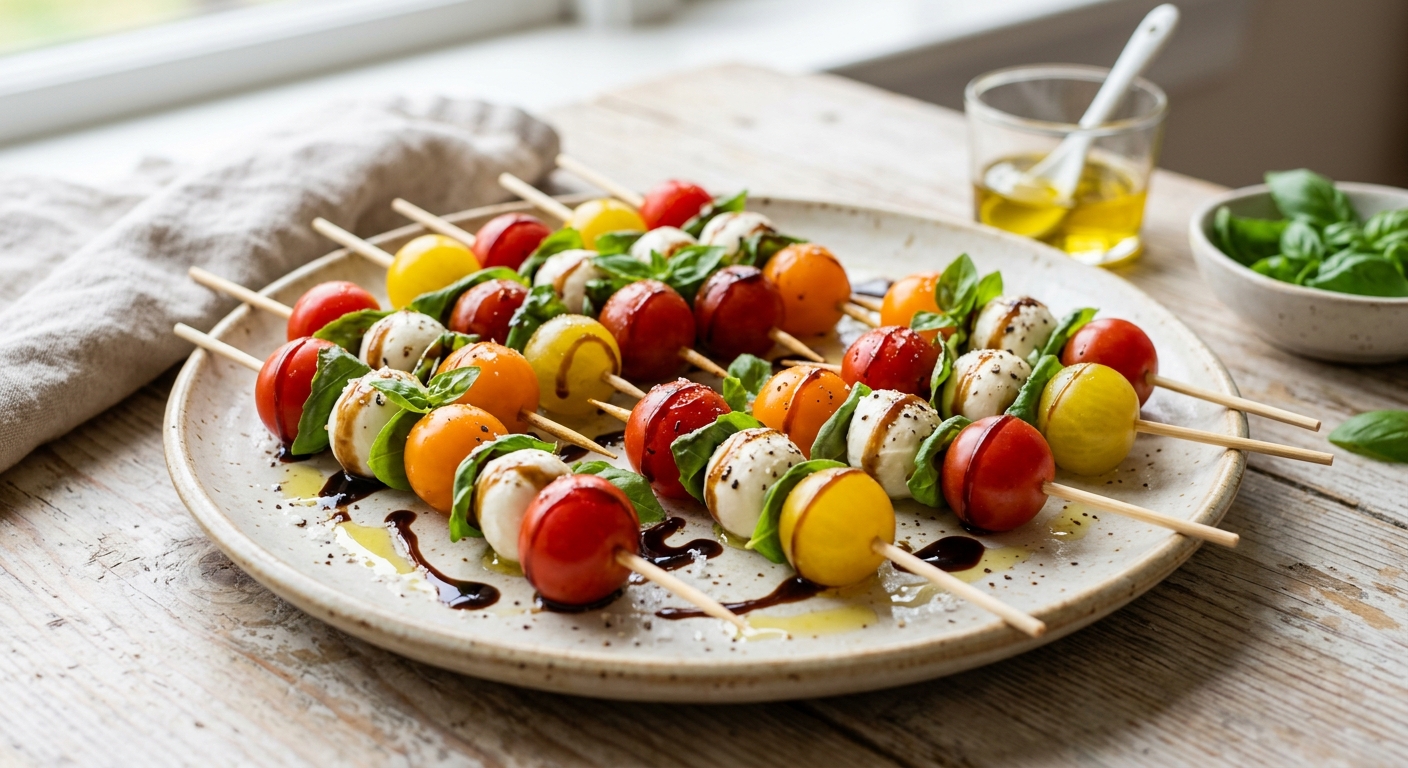
Caprese skewers are one of those rare dishes where simplicity and nutritional density converge beautifully. At their core, they are just three ingredients: milky fresh mozzarella, sun-ripened cherry tomatoes, and fresh basil. But when you assemble them with care, finish them with a properly reduced balsamic glaze, and optionally apply a gentle heat treatment, you unlock a layered flavour profile that rivals far more complicated preparations. For a bone and joint health focus, few ingredient combinations are as well-matched: the mozzarella supplies highly bioavailable calcium in a matrix of whey protein, the tomatoes flood each bite with lycopene, and the olive oil drizzle that finishes the dish significantly enhances fat-soluble carotenoid absorption.
The balsamic glaze is not merely decorative. A properly reduced high-quality balsamic vinegar concentrates polyphenols, particularly resveratrol and quercetin, which have been shown in clinical literature to modulate inflammatory pathways relevant to arthritis and cartilage degradation. The acetic acid backbone of the glaze also slightly acidifies the palate, which heightens the perception of the mozzarella’s milky sweetness and the tomato’s umami without adding sodium. The result is a dish that is simultaneously a nutritionist’s checklist and a chef’s showcase.
What makes this recipe post unusual for Calibrated Cuisine is the inclusion of multiple cooking methods for what is traditionally a completely raw dish. While the classic presentation is uncooked, gently warming the assembled skewers transforms the texture: the mozzarella softens into a molten, creamy pool, the tomato skins blister and concentrate their sugars, and the basil perfumes the entire tray. Each method below yields a genuinely distinct eating experience, from the crisp immediacy of the stovetop sear version to the slow oven blister method that caramelises the tomatoes deeply. Choose your method based on your occasion and your oven schedule.
4
servings
Ingredients
- 400 gfresh mozzarella balls (ciliegine or bocconcini), drained and patted dry
- 300 gcherry tomatoes, mixed colours if available
- 20 gfresh basil leaves, large leaves torn in half if very large
- 240 mlgood-quality balsamic vinegar (for the glaze)
- 1 tbspraw honey or light brown sugar (to accelerate glaze reduction)
- 3 tbspextra-virgin olive oil
- 1 tspColima Sea SaltMicroplastic Free Salt (such as Maldon)
- 0.5 tspfreshly cracked black pepper
- 0.5 tspdried oregano (optional, for warm methods)
- —16 to 20 small wooden or metal skewers (if wooden, soaked in water for 30 minutes)
Instructions
Click on an item below to shop for the recommended items for this recipe on Amazon.
As an Amazon Associate, we earn from qualifying purchases.
- Make the balsamic glaze first: pour the balsamic vinegar and honey into a small heavy-bottomed saucepan over medium heat. Stir to combine, then bring to a gentle simmer. Reduce heat to medium-low and cook uncovered, swirling the pan occasionally, for 12 to 15 minutes until the liquid has reduced by approximately half and coats the back of a spoon with a glossy, syrupy consistency. Remove from heat and allow to cool in the pan; it will thicken further as it cools. Transfer to a small bowl and set aside.
- While the glaze cools, assemble the skewers. Thread each skewer in the following order: one basil leaf folded in half, one cherry tomato, one mozzarella ball, one cherry tomato, and one final basil leaf folded in half. Repeat until all ingredients are used, aiming for 16 to 20 skewers. Brush each assembled skewer lightly with 1 tablespoon of the olive oil and season with half the flaky salt and all of the black pepper.
- Heat a large cast iron or stainless steel grill pan or heavy skillet over medium-high heat until it begins to smoke lightly. Add the remaining 2 tablespoons of olive oil and tilt to coat the surface. Working in two batches, lay the skewers flat in the pan. Cook undisturbed for 2 minutes so the tomatoes develop char marks and the mozzarella just begins to soften at the edges. Use tongs to turn each skewer once and cook for a further 90 seconds on the second side. The mozzarella should be visibly softening but still holding its shape.
- Transfer the cooked skewers immediately to a warmed serving platter. The residual heat will continue to melt the mozzarella for another 60 seconds, so plate promptly. Drizzle generously with the balsamic glaze in a back-and-forth motion across all the skewers.
- Scatter the remaining flaky sea salt over the top, add a few fresh basil leaves torn at the last moment, and finish with a thin thread of raw extra-virgin olive oil. Serve within 3 minutes while the mozzarella is still warm and yielding.
- Do not assemble the skewers yet. Begin by combining the cherry tomatoes, 2 tablespoons of olive oil, the balsamic vinegar, honey, dried oregano, half the flaky salt, and black pepper in the slow cooker insert. Stir gently to coat all tomatoes. Place the lid on and cook on Low for 2 hours. The tomatoes will burst, release their juices, and meld with the balsamic into a glossy, concentrated sauce. Do not cook on High, as the tomatoes will turn mushy and lose their structural integrity entirely.
- At the 1 hour 45 minute mark, check the consistency of the tomato balsamic mixture. If it looks watery, remove the lid, increase to High, and cook uncovered for the final 15 minutes to reduce excess liquid. The finished mixture should be jammy and thick, pooling around the tomatoes rather than sitting in thin liquid. Taste and adjust seasoning. Turn the slow cooker to Warm.
- Just before serving, assemble the mozzarella and basil onto skewers without tomatoes, alternating: basil leaf, mozzarella ball, basil leaf. The tomatoes are now part of the base sauce rather than threaded. Use 2 to 3 mozzarella balls per skewer.
- Ladle the warm balsamic tomato confit into a wide shallow serving bowl or individual ramekins. Nestle the mozzarella and basil skewers into the warm tomato mixture, pushing them down slightly so the mozzarella makes contact with the warm sauce and begins to soften naturally from the residual heat.
- Drizzle with the remaining 1 tablespoon of extra-virgin olive oil, scatter with fresh basil leaves, and finish with the remaining flaky sea salt. Serve immediately with toasted sourdough or focaccia to capture the confit juices.
- Set the pressure cooker or Instant Pot to Saute mode on High. Add 1 tablespoon of olive oil and heat for 1 minute. Add the cherry tomatoes and stir for 2 minutes until the skins just begin to blister and split. Add the balsamic vinegar, honey, dried oregano, half the flaky salt, and black pepper. Stir to combine, scraping any fond from the base of the pot.
- Secure the lid, set the pressure release valve to Sealing, and cook on Manual High Pressure for 5 minutes. The enclosed environment will concentrate the balsamic flavours into the tomatoes under pressure, producing a sauce that would take 25 minutes on a conventional stovetop.
- Perform a Quick Release by carefully switching the valve to Venting. Once all steam has escaped and the float valve drops, open the lid. Set the pot back to Saute mode on Medium and stir the sauce for 3 to 4 minutes to evaporate any remaining excess liquid and achieve a glossy, coating consistency. Taste for seasoning. Switch to Keep Warm.
- While the sauce finishes, assemble the cold fresh skewers: thread each skewer with a folded basil leaf, one whole cherry tomato (from a separate handful kept raw for freshness and colour contrast), one mozzarella ball, another tomato, and a final basil leaf. Season lightly with flaky salt.
- Spoon the warm balsamic tomato sauce across the base of a serving platter or board. Arrange the cold fresh skewers across the sauce so they rest in it without being submerged. Drizzle with the remaining 2 tablespoons of raw extra-virgin olive oil and add a final scatter of fresh basil. The temperature contrast between the warm, concentrated sauce and the cool, creamy mozzarella is the defining character of this version.
- Preheat the oven to 220C (425F) with a rack positioned in the upper third of the oven. Line a large rimmed baking sheet with parchment paper. Make the balsamic glaze concurrently: pour the balsamic vinegar and honey into a small saucepan over medium heat and reduce for 12 to 15 minutes until syrupy, then set aside to cool and thicken.
- Assemble all skewers as described: thread each with a folded basil leaf, one cherry tomato, one mozzarella ball, a second tomato, and a final basil leaf. Lay all assembled skewers in a single layer on the prepared baking sheet, ensuring they do not overlap. Drizzle with 2 tablespoons of olive oil, season with the flaky salt, black pepper, and dried oregano, and toss gently in place to coat.
- Roast in the preheated oven for 15 to 18 minutes. At the 10-minute mark, open the oven and check: the tomato skins should be splitting and beginning to char at the edges, and the mozzarella should be visibly melting and spreading slightly. If the mozzarella is liquefying too fast before the tomatoes have charred, switch the oven to Broil (Grill) for the final 3 minutes to blister the tomato tops.
- Remove the baking sheet from the oven. Using a wide spatula, carefully transfer the skewers to a serving platter, taking care not to drag the melted mozzarella off the skewers. Some molten mozzarella pooling on the parchment is expected and can be scraped up and spooned over the platter as a rustic garnish.
- Drizzle immediately and generously with the cooled balsamic glaze, finish with the remaining tablespoon of raw extra-virgin olive oil, scatter with fresh basil leaves torn at the last moment (the heat of the skewers will lightly wilt and perfume them), and serve within 5 minutes while still hot.
Nutrition Breakdown
Per 1 serving (makes 4)
Vitamins & Minerals
% Daily Value based on a 2,000 calorie diet (FDA reference)
🧬 Essential Amino Acids
% of recommended daily intake (RDA) per serving
🛡 Antioxidant Profile
The Nutrition Science
The calcium story in this dish is one of bioavailability, not just quantity. Fresh mozzarella made from whole milk delivers approximately 418mg of calcium per serving in a phosphoprotein matrix, meaning the mineral is bound to casein in a form that the intestinal lumen absorbs at roughly 30 to 35 percent efficiency. This is significantly better than plant-source calcium (such as that in spinach, where oxalate binding reduces absorption to under 5 percent). The olive oil drizzle serves a dual function: it supplies fat to trigger bile salt release, which in turn enhances absorption of the fat-soluble vitamin K1 from the basil, and vitamin K1 is the direct precursor to the carboxylation of osteocalcin, the protein that anchors calcium ions into the hydroxyapatite crystal structure of bone.
Lycopene in cherry tomatoes is more bioavailable after heat treatment, because cooking disrupts the plant cell walls and shifts lycopene from its all-trans configuration (less bioavailable) to the cis-isomer form (more bioavailable). The warm stovetop, oven, and pressure cooker methods in this recipe therefore deliver meaningfully more absorbable lycopene than the raw presentation would. Epidemiological data from the Framingham Osteoporosis Study found that women in the highest quartile of dietary lycopene intake had significantly lower rates of hip fracture and higher spinal bone mineral density, supporting lycopene as a genuine bone-protective compound rather than simply a cardiovascular antioxidant.
The balsamic vinegar reduction concentrates acetogenic polyphenols from the Trebbiano and Lambrusco grapes traditionally used in Modena production. Of these, resveratrol has received the most clinical attention for joint health: in a 2019 randomised controlled trial published in Nutrients, supplemental resveratrol at doses achievable through dietary intake significantly reduced serum IL-6 and TNF-alpha in patients with knee osteoarthritis compared to placebo. While the resveratrol dose in a balsamic drizzle is modest, it sits within a broader polyphenol matrix that demonstrates synergistic anti-inflammatory effects, particularly when combined with the oleocanthal from high-quality extra-virgin olive oil.
Pro Tips
- Use ciliegine (cherry-sized) mozzarella balls rather than larger bocconcini if available; their smaller mass means they soften evenly on the skewer without over-melting before the tomatoes have time to char.
- The quality of the balsamic vinegar matters enormously for the glaze. A genuine Aceto Balsamico di Modena IGP (look for the red and gold seal) will reduce to a glossy, complex syrup. A cheap imitation vinegar will reduce to a sharp, astringent paste. The extra cost is worthwhile here because the glaze is a primary flavour component.
- If your balsamic glaze solidifies too much as it cools (becomes sticky and difficult to drizzle), set the bowl over a cup of hot water for 60 seconds and stir gently; it will return to a pourable consistency immediately without losing its flavour.
The calcium and K2 combo here is exactly what I’ve been trying to dial in for bone density, so thank you for breaking down those numbers. I’m curious about the balsamic reduction process too, Anna – I’ve read that cooking tomatoes actually increases lycopene bioavailability, which matters for me since I’m managing neuroinflammation and joint issues alongside the MS. Carla, I’ve started treating these as a base and adding white beans or sardines to bump the protein up, which also gives me that omega-3 and B12 my protocol really leans on. Would love to know if you’ve tested this as a full meal with additions.
This looks beautiful, but I have to ask – are those tomatoes cooked down in the balsamic reduction or fresh? I’m AIP-modified for my Hashimoto’s so I avoid nightshades when I can, but I’ve found that cooking tomatoes down significantly reduces the alkaloid content for me personally. Also, curious about the mozzarella sourcing – does it have added iodine? I’ve had to get pretty careful about iodine levels since my thyroid diagnosis at 38, and commercial mozzarella can be tricky. Would love to adapt this with a calcium-rich substitute like a good quality ghee or coconut cream if the recipe could work that way!
ok so im def gonna make these but quick q – whats the protein situation here? im usually pairing my post-WOD meals with at least 30-40g protein and this looks more like a snack to me unless youre stacking it with something? like adding grilled chicken or maybe some white fish to the skewer would give you that complete amino acid profile plus the lycopene from the tomatoes is such a killer anti-inflammatory combo for joint recovery. have you tested it as part of a bigger meal or is it meant to stand alone?