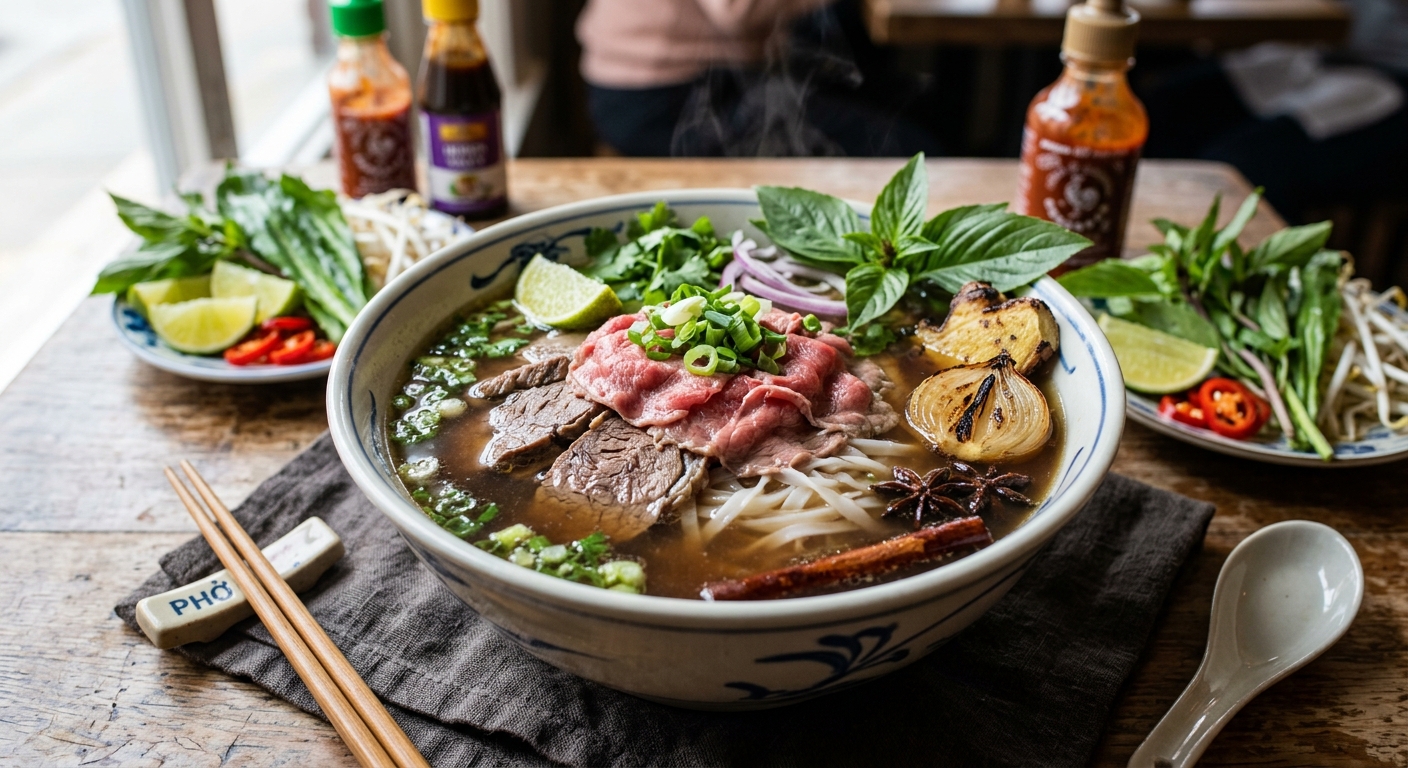
Pho is one of the most nutritionally complete dishes in the world’s culinary canon, and it is no accident that it has sustained generations of Vietnamese families through hard physical labor, illness, and recovery. The magic begins at the bone. When beef marrow bones and knuckles are simmered for hours with charred ginger and onion, the collagen locked inside the connective tissue hydrolyzes into gelatin and free amino acids, particularly glycine and proline, the precise building blocks your body uses to synthesize new cartilage, repair tendons, and maintain the structural integrity of skin. A properly made pho broth should wobble like soft jello when chilled, a sign that it is genuinely rich in gelatin rather than water flavored with soy sauce and bouillon.
This recipe is calibrated specifically to maximize bone and joint benefit without sacrificing the complex, layered flavor that makes pho one of the most beloved soups on earth. We char the onion and ginger directly over an open flame or under a broiler to develop deep Maillard compounds that add body and sweetness to the broth. We toast whole spices including star anise, cinnamon, cloves, coriander seed, and cardamom to bloom their fat-soluble aromatic compounds before they meet the water. The result is a broth that is simultaneously medicinal and profoundly delicious, one that any pho shop in Hanoi would be proud to serve. Thin-sliced sirloin draped over rice noodles absorbs the broth while adding a significant hit of heme iron, the most bioavailable form of dietary iron, alongside zinc, B12, and a complete amino acid profile.
From a nutritional engineering perspective, the pairing of vitamin C-rich bean sprouts and fresh lime with the iron-dense broth and beef is not accidental. Ascorbic acid from the garnishes can increase non-heme iron absorption by up to 300%, and the fresh herbs, basil, cilantro, and sliced chili, contribute quercetin, rutin, and beta-carotene that work synergistically with the fat in the broth to suppress systemic inflammation. Every element of this bowl, from the blanched sprouts to the final squeeze of lime, has a nutritional role to play.
4
servings
Ingredients
- 1200 gbeef marrow and knuckle bones, cut by butcher
- 400 gbeef brisket or chuck, whole piece
- 300 gbeef sirloin or eye of round, very thinly sliced (partially freeze for 30 minutes before slicing)
- 300 gdried flat rice noodles (banh pho, 3mm width)
- 2 largeyellow onions, halved
- 80 gfresh ginger, halved lengthwise
- 4 wholestar anise
- 1 stickcinnamon (approx 8cm)
- 5 wholecloves
- 1 tspwhole coriander seeds
- 2 wholeblack cardamom pods, lightly crushed
- 30 mlfish sauce, plus more to taste
- 15 grock sugar or palm sugar
- 2.5 literscold water
- 200 gfresh bean sprouts
- 30 gfresh Thai basil leaves
- 20 gfresh cilantro, roughly chopped
- 4 wholespring onions, thinly sliced
- 2 wholered bird’s eye chillies, thinly sliced
- 2 wholelimes, cut into wedges
- 30 mlhoisin sauce, for serving
- 30 mlsriracha, for serving
- —Colima Sea SaltMicroplastic Free Salt to taste
Instructions
Click on an item below to shop for the recommended items for this recipe on Amazon.
As an Amazon Associate, we earn from qualifying purchases.
- Parboil the bones: Place the marrow and knuckle bones in your largest stockpot and cover with cold water. Bring to a vigorous boil over high heat and cook for 10 minutes. You will see significant grey-brown scum rising to the surface. Drain the bones completely, rinse each one under cold running water, scrubbing away any dark residue. Clean the pot as well. This step is non-negotiable for a clear, clean broth.
- Char the aromatics: Hold each onion half and the ginger pieces directly over a gas burner on high flame using tongs, turning every 30 seconds, until the cut surfaces are deeply charred and blackened in spots, about 5 to 7 minutes total. Alternatively, place them cut-side up under a preheated broiler on a foil-lined baking sheet at maximum heat for 8 to 10 minutes. The char adds sweetness and color to the broth. Rinse lightly and set aside.
- Toast the spices: In a dry skillet over medium heat, add the star anise, cinnamon stick, cloves, coriander seeds, and cardamom pods. Toast, stirring frequently, for 2 to 3 minutes until very fragrant and lightly darkened. Immediately transfer to a spice bag or a square of cheesecloth tied with kitchen twine.
- Build the broth: Return the cleaned bones to the stockpot along with the whole brisket or chuck piece. Add the charred onion and ginger, the spice bag, fish sauce, rock sugar, and all 2.5 liters of cold water. Bring to a boil over high heat, then immediately reduce to a bare simmer where just a few bubbles break the surface. Do not let it boil hard at any point from here forward. Skim any remaining foam or fat from the surface during the first 20 minutes.
- Simmer low and slow: Maintain the bare simmer, partially covered, for 3 to 3.5 hours, skimming the surface every 30 to 45 minutes. After 1.5 hours, remove the brisket with tongs, check that it is fully tender and cooked through, then slice it thinly against the grain and set aside covered. Return any bones you can to the pot. Continue simmering the remaining bones and broth for the full time.
- Strain and season the broth: Remove and discard the spice bag, bones, onion, and ginger. Pour the broth through a fine-mesh strainer lined with cheesecloth into a clean pot. Taste and adjust seasoning with additional fish sauce for umami and depth, salt for salinity, and a pinch more rock sugar for balance. The broth should be deeply savory, slightly sweet, and aromatic with warming spice.
- Soak and cook the noodles: While the broth finishes, soak the dried rice noodles in room temperature water for 30 minutes until pliable. Bring a separate large pot of unsalted water to a boil. Drain the soaked noodles and cook in the boiling water for 30 to 60 seconds only until just tender but still with slight resistance. Do not overcook. Drain immediately and divide among four large, pre-warmed bowls.
- Assemble the bowls: Arrange a few slices of cooked brisket and the raw sirloin slices over the noodles in each bowl. Bring the finished broth to a rolling boil and ladle it over the raw sirloin immediately, at least 350 to 400ml per bowl. The boiling broth will cook the raw sirloin to medium-rare right in the bowl. Top each bowl with spring onions and cilantro. Serve immediately with a plate of bean sprouts, Thai basil, lime wedges, sliced chilli, hoisin sauce, and sriracha on the side.
- Parboil and char in advance: Follow the same parboiling step as the stovetop method (cover bones in cold water, boil 10 minutes, drain, rinse, scrub). Char the onion halves and ginger under your broiler at maximum heat, cut-side up on a foil-lined baking sheet, for 8 to 10 minutes until deeply caramelized and blackened in spots. Toast the spice blend in a dry skillet for 2 to 3 minutes until fragrant and bundle into cheesecloth. These three steps are best done the evening before if you plan to start the slow cooker overnight.
- Load the slow cooker: Place the cleaned bones in the bottom of a 6-quart or larger slow cooker. Nestle the whole brisket or chuck piece among the bones. Add the charred onion, charred ginger, and the spice bag. Pour over the fish sauce, add the rock sugar, and add enough of the measured cold water to fill the slow cooker to within 2.5cm of the rim (typically the full 2.5 liters). Do not add hot liquid, as the slow cooker needs to come up to temperature gradually to maximize collagen extraction.
- Cook on Low: Set the slow cooker to Low and cook for 10 to 12 hours. Resist opening the lid during cooking, as heat loss extends the required time significantly. After 6 hours, carefully open the lid, use tongs to locate and remove the brisket piece, test for tenderness by piercing with a fork (it should be fully yielding), slice thinly against the grain, cover, and refrigerate. Return the lid and continue cooking the bones.
- Degrease the broth: After the full cook time, turn off the slow cooker and allow the broth to cool for 20 to 30 minutes with the lid ajar. Ladle the broth through a fine-mesh strainer into a large bowl or pot and discard all solids. For the cleanest result, refrigerate the strained broth for 2 to 4 hours or overnight. The fat will solidify on the surface as a white cap and can be lifted off cleanly with a spoon, leaving a crystal-clear, deeply golden broth underneath.
- Finish and serve: Reheat the defatted broth in a pot over high heat. Taste and adjust with fish sauce, salt, and a touch more rock sugar. Soak and briefly boil the rice noodles as described in the stovetop method. Divide noodles into pre-warmed bowls, add sliced brisket and raw sirloin, then ladle the boiling broth over the top. The slow cooker method often produces an even more gelatinous, collagen-dense broth than the stovetop, as the sustained low heat is ideal for collagen hydrolysis. Serve with the full herb and condiment platter.
- Parboil the bones using the Saute function: Place the bones in the Instant Pot insert and cover with cold water. Using the Saute function on High, bring to a boil and cook for 8 minutes until scum rises. Drain through a colander in the sink, rinse the bones and the insert thoroughly under cold water. Return the clean insert to the Instant Pot base.
- Char aromatics on a gas burner or under the broiler: While the bones parboil, char the onion halves and ginger over a gas flame or under the broiler as described in the stovetop method. This step cannot be done in the pressure cooker and must be done on the stovetop or under the broiler. Toast the spice blend in a dry skillet for 2 to 3 minutes and bundle in cheesecloth.
- Build and pressure cook: Add the cleaned bones and the whole brisket piece to the insert. Add the charred aromatics, spice bag, fish sauce, rock sugar, and cold water. Do not exceed the MAX fill line, typically around 2 liters in a 6-quart pot. Seal the lid, ensure the vent is set to Sealing, and cook on Manual or Pressure Cook at High Pressure for 90 minutes. The pot will take approximately 20 to 25 minutes to come to pressure before the timer begins.
- Natural release and retrieve the brisket: Allow the pressure to release naturally for at least 20 minutes before switching the vent to Venting for a controlled quick release of remaining pressure. Open the lid carefully. The brisket will be very tender. Remove it with tongs, slice thinly against the grain once it cools slightly, cover, and set aside.
- Strain, degrease, and season: Pour the broth through a fine-mesh strainer lined with cheesecloth into a clean pot. The pressure cooker broth can appear slightly murky directly from the pot, but straining through cheesecloth restores a beautiful clarity. Use a ladle to skim visible fat from the surface, or allow to cool and remove the solidified fat cap. Taste and season aggressively with fish sauce, salt, and rock sugar. Bring back to a rolling boil.
- Assemble quickly: Soak and cook rice noodles as per the stovetop method. Divide among warmed bowls, top with brisket slices and raw sirloin, ladle boiling broth over everything, and garnish with spring onions and cilantro. Serve immediately with the herb and condiment platter. The pressure cooker broth is bold and deeply beefy, though it may have slightly less of the layered complexity of the slow-simmered version. A few extra drops of fish sauce and a longer seasoning session compensates beautifully.
- Roast the bones for depth of flavor: Preheat the oven to 220C (425F). Spread the parboiled, rinsed bones (parboil as described in the stovetop method first) in a single layer on a large, rimmed baking sheet. Roast for 25 to 30 minutes, turning once at the halfway point, until the bones are deeply browned and caramelized. This adds roasted meat flavors and dark color to the broth. Simultaneously, place the onion halves and ginger cut-side down on a separate foil-lined sheet and roast for the same 25 to 30 minutes until deeply charred.
- Transfer everything to a large Dutch oven: Move the roasted bones and the whole brisket or chuck piece into a large, heavy Dutch oven (6-quart minimum). Scrape any caramelized drippings from the bone roasting pan into the Dutch oven using a splash of the measured water to deglaze it. Add the roasted onion, roasted ginger, the toasted spice bundle, fish sauce, rock sugar, and all remaining cold water.
- Reduce oven temperature and braise low: Reduce the oven temperature to 150C (300F). Bring the Dutch oven to a simmer on the stovetop over medium-high heat, skimming any foam. Once simmering, cover the Dutch oven tightly with its lid (or seal with foil under the lid for a tighter seal) and transfer to the 150C oven. The even, all-around heat of the oven maintains a perfectly stable low simmer without any risk of boiling hard and clouding the broth.
- Cook for 4 hours, retrieve the brisket midway: After 2 hours in the oven, use oven mitts to carefully remove the Dutch oven, lift the lid away from you to avoid steam burns, and use tongs to remove the brisket piece. It should be fork-tender. Slice and set aside covered. Return the Dutch oven to the oven and continue cooking for a further 2 hours.
- Strain and season: Remove the Dutch oven from the oven and allow to cool slightly. Strain through a fine-mesh cheesecloth-lined strainer into a clean pot. Taste the broth carefully as the oven method produces a notably richer, more intensely beefy broth than the stovetop. Season with fish sauce, salt, and rock sugar, being careful not to over-salt as the concentration is higher. Skim visible fat from the surface.
- Finish and assemble: Bring the strained broth to a rolling boil on the stovetop. Prepare rice noodles as per the stovetop method. Assemble bowls with noodles, brisket slices, and raw sirloin, then ladle the boiling broth directly over the raw meat to cook it in the bowl. The oven-roasted broth has a pronounced depth and a slightly darker color that pairs especially well with a generous squeeze of lime and plenty of fresh Thai basil.
Nutrition Breakdown
Per 1 serving (makes 4)
Vitamins & Minerals
% Daily Value based on a 2,000 calorie diet (FDA reference)
🧬 Essential Amino Acids
% of recommended daily intake (RDA) per serving
🛡 Antioxidant Profile
The Nutrition Science
The defining nutritional feature of a properly made pho broth is its gelatin content, and gelatin is simply hydrolyzed collagen. Type I and Type III collagen, the primary structural proteins in bovine bone, cartilage, and connective tissue, are composed of repeating tripeptide sequences rich in glycine, proline, and hydroxyproline. When heated in water above 70C for extended periods, the hydrogen bonds holding the triple helix of collagen together break down and the protein unfolds into individual polypeptide chains (gelatin) and eventually into free amino acids. Research published in the American Journal of Clinical Nutrition has shown that consuming glycine and proline from hydrolyzed collagen stimulates chondrocytes (cartilage cells) to increase their own collagen synthesis, creating a feedback loop of joint tissue repair that is particularly relevant for individuals managing osteoarthritis or recovering from tendon injury.
The heme iron from the beef sirloin and brisket deserves special attention in the context of bone and joint health. Iron is a required cofactor for prolyl hydroxylase and lysyl hydroxylase, the two enzymes that post-translationally modify proline and lysine residues in collagen to create the stable, cross-linked collagen fiber structure. Without adequate iron, these hydroxylation reactions are impaired, producing structurally weaker collagen even if glycine and proline intake is sufficient. Heme iron from red meat is absorbed at a rate of 15 to 35%, compared to 2 to 20% for non-heme plant iron, making this bowl particularly efficient for correcting iron deficiency. The vitamin C contributed by the lime and bean sprouts further enhances non-heme iron absorption by reducing ferric iron (Fe3+) to the more absorbable ferrous form (Fe2+) in the gut lumen.
The spice blend used in pho is not merely aromatic. Star anise, cinnamon, and cloves contain trans-anethole, cinnamaldehyde, and eugenol respectively, all of which have demonstrated anti-inflammatory activity in peer-reviewed research, primarily through inhibition of the NF-kB inflammatory signaling pathway and suppression of COX-2 enzyme activity. These mechanisms mirror, to a modest but meaningful degree, the action of non-steroidal anti-inflammatory drugs, without the gastrointestinal side effects. When consumed regularly as part of a collagen-rich diet, this combination of structural amino acids, bioavailable iron, and anti-inflammatory phytochemicals creates a genuinely therapeutic nutritional environment for bone and joint tissue maintenance and repair.
Pro Tips
- The most important indicator of a collagen-rich broth is the gel test: after straining, place a small bowl of broth in the refrigerator for 20 minutes. It should set to a soft, trembling jelly. If it remains liquid, your bones lacked sufficient collagen (knuckle and neck bones yield far more gelatin than marrow bones alone) or the simmer temperature was too high and too fast.
- Partially freezing the sirloin for 25 to 30 minutes before slicing is essential for achieving paper-thin cuts that will cook through completely from the boiling broth poured over them in the bowl. A sharp slicing knife drawn in one smooth stroke, rather than a sawing motion, preserves the muscle fiber structure and prevents the meat from tearing.
- Fish sauce is the primary seasoning vehicle for pho broth, and the seasoning window is only open once the broth is fully strained and hot. Season gradually, tasting between each addition. The broth should taste assertively savory and almost slightly too salty on its own, because the noodles and the raw meat will dilute it significantly in the bowl.
oh my gosh yes, bone broth is such a game changer for my kids’ gut health and i love that youre highlighting the collagen angle! quick question though – are you soaking the beef bones first to reduce phytic acid, or does the long simmer time handle that naturally? ive been experimenting with sprouted mung beans on the side instead of regular ones and my oldest actually asked for seconds (which never happens lol), so im curious if you have thoughts on sprouting compatibility with traditional pho prep. the heme iron combo with the vitamin c from the lime is genius for absorption too!
Love the sprouted mung bean experiment, Sylvia! Quick clarification though: phytic acid is really more of a concern in plant seeds and grains than in bones themselves, so the soaking step is less critical for bones than it would be for legumes (where sprouting definitely helps reduce those chelators). That said, the long simmer does break down connective tissue beautifully and extract the good stuff – gelatin, amino acids like glycine, minerals. The sprouted mung beans are a smart move because you’re actually increasing their bioavailability while keeping that traditional flavor profile, and you’re spot on about the heme iron + vitamin C synergy from the lime hitting differently than plant-based
Pete, you’re hitting on something I’ve been thinking about a lot lately – that long simmer really is doing the heavy lifting here. I’m more focused on the protein distribution side of things, and I’ve noticed a solid pho broth gives me maybe 10-15g of protein per bowl depending on how much beef you load in, but what I’m really after is hitting that leucine threshold per meal for muscle protein synthesis, which honestly pho alone probably doesn’t quite get you there at 62. The sprouted mung beans though – that’s clever for bioavailability – but I’m always thinking, what if you bumped the beef portion to land closer to 25-30g protein per bowl?
Steve, I love that you’re thinking about leucine thresholds, that’s where the real magic happens with muscle protein synthesis! Here’s what’s been fascinating me though: that long simmer doesn’t just extract collagen, it’s also methylating and breaking down the amino acids in ways that might actually improve your one-carbon metabolism and methylation capacity, especially if you’re using grass-fed bones with higher micronutrient density. Have you noticed any difference in recovery or energy when you dial up the beef to hit that 25-30g sweet spot, and are you paying attention to whether the quality of the bone source (grass-fed vs conventional) changes how you feel post-meal?
This is exactly where my functional medicine doc and I have been digging in lately, Eddie. I’ve been tracking my homocysteine and methylation markers quarterly, and honestly the difference between grass-fed and conventional bone broth showed up in my labs after about six weeks of consistent use, which surprised me. The methylation piece you’re pointing at really matters, especially if someone has MTHFR variants or elevated inflammation like I did. I’m curious whether you’re also paying attention to the simmering temperature and duration, since I’ve read that sustained high heat might degrade some of those sensitive B vitamins and amino acids you’re trying to preserve. Do you have a specific simmer time you’ve found works best
oh man, this is right up my alley but i gotta be honest – pho has been such a mixed bag for me depending on where im at in my flare cycle. when ive got good control the slow simmered broth is genuinely healing, all that collagen and gelatin is clutch for my gut lining, but ive learned i gotta be careful with the texture of the meat and noodles when im flaring. also super curious about the spice level here because the star anise and cinnamon usually sit fine with me but i know a lot of people with crohns get triggered by the heavy spice… do you have tips for dialing it back without losing that