Fluoride rarely appears on the nutritional radar of home cooks, yet this trace mineral plays a critical role in maintaining tooth enamel integrity and supporting bone matrix density. Green tea is one of the most concentrated dietary sources of naturally occurring fluoride, providing between 0.3 and 0.5 mg per 200 ml brewed cup, and when used as a poaching liquid it infuses every slice of pear with that mineral richness while adding subtle vegetal, grassy sweetness. Rolled oats contribute a second layer of mineral complexity, bringing manganese, phosphorus, and magnesium to the bowl alongside their celebrated beta-glucan fiber.
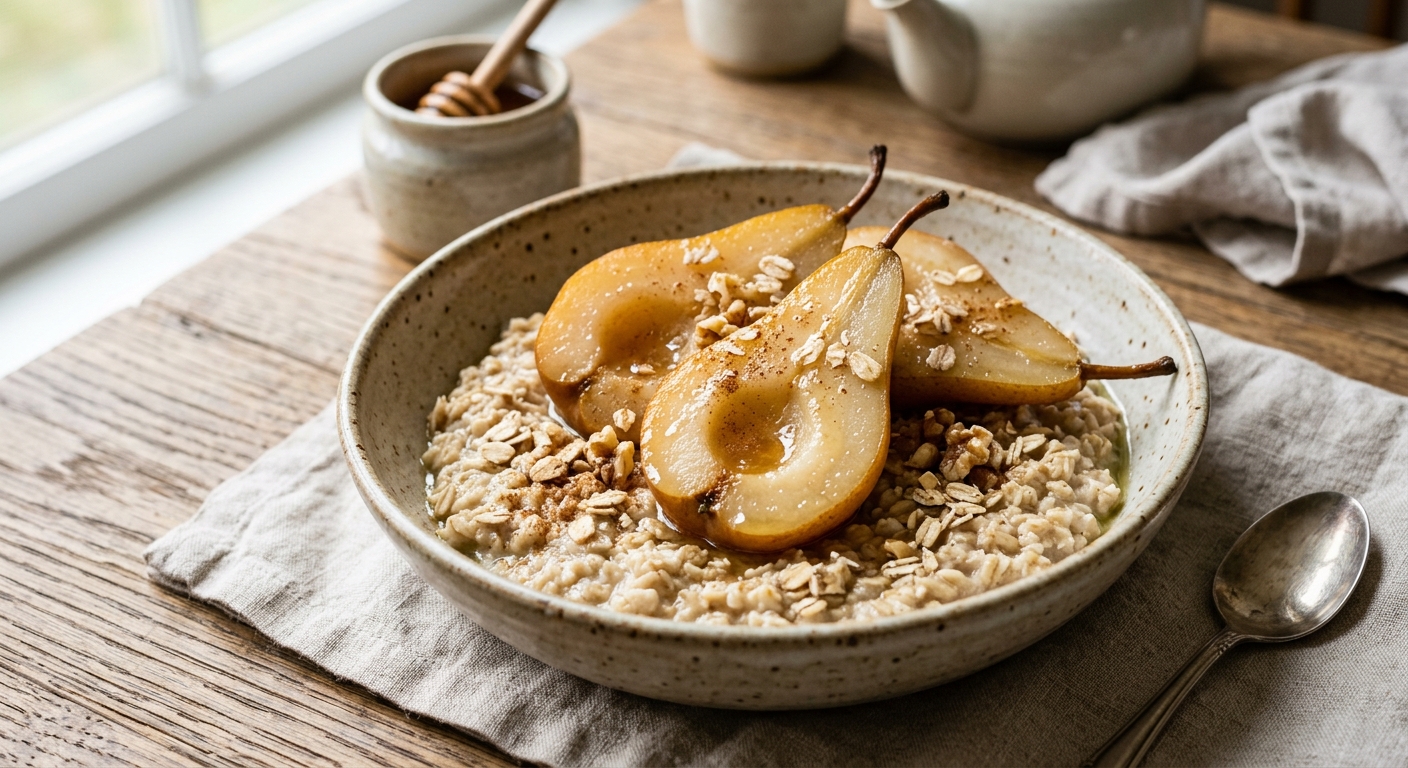
The pears themselves are the culinary star. Bosc or Anjou varieties hold their shape beautifully under gentle heat, developing a translucent, jewel-like appearance as they absorb the amber-green tea liquor. A warm spice backbone of cardamom, cinnamon, and a single strip of fresh ginger lifts the tannins of the tea and transforms what could be a plain porridge bowl into something that feels genuinely celebratory. A finishing drizzle of raw honey and a scatter of pumpkin seeds adds crunch, healthy fats, and a meaningful boost to zinc and magnesium intake.
At Calibrated Cuisine we designed this bowl to anchor the first meal of the day with slow-release carbohydrates, plant protein, and a micronutrient profile that covers meaningful percentages of your daily fluoride, manganese, magnesium, and B-vitamin needs in a single serving. Whether you prepare it briskly on the stovetop on a weekday morning, let the slow cooker do the work overnight, or use your pressure cooker to compress the process into under 20 minutes, the result is a deeply nourishing bowl that rewards both body and palate.
4
servings
Ingredients
- 4 mediumfirm Bosc or Anjou pears, peeled, halved, and cored
- 800 mlfiltered water, for brewing
- 4 tsploose-leaf green tea (or 4 quality green tea bags)
- 300 gold-fashioned rolled oats (certified gluten-free if required)
- 900 mlunsweetened oat milk (or whole milk for non-dairy-free version)
- 200 mlreserved green tea poaching liquid
- 3 tbspraw honey, plus extra to serve
- 1 tspground cinnamon
- 0.5 tspground cardamom
- 1 piecefresh ginger, 4 cm, peeled and thinly sliced
- 1 striplemon zest (pared with a vegetable peeler)
- 60 gpumpkin seeds (pepitas), lightly toasted
- 2 tbspground flaxseed
- —Pinch of Colima Sea SaltMicroplastic Free Salt
Instructions
Click on an item below to shop for the recommended items for this recipe on Amazon.
As an Amazon Associate, we earn from qualifying purchases.
- Brew the green tea: bring 800 ml filtered water to exactly 75 to 80 degrees C (avoid a full boil, which makes green tea bitter). Steep the loose-leaf tea or bags for 3 minutes, then strain into a wide, shallow saucepan or saute pan large enough to hold the pear halves in a single layer. Discard the spent leaves.
- Add the honey, cinnamon, cardamom, ginger slices, and lemon zest strip to the tea poaching liquid. Set the pan over medium heat and stir gently until the honey dissolves, about 1 minute. Taste and adjust sweetness if needed.
- Slide the peeled, halved pears cut-side down into the warm poaching liquid. The liquid should come at least halfway up the sides of the pears; add a splash of water if needed. Bring to a gentle simmer, then reduce heat to medium-low. Cover with a cartouche (a circle of baking paper pressed directly onto the surface) or a loose lid and poach for 18 to 22 minutes, turning the pears once at the halfway point, until a paring knife slides through with very little resistance. Reserve 200 ml of the poaching liquid and keep the pears warm in the remaining liquid off the heat.
- While the pears poach, make the oats. Combine the rolled oats, oat milk, 200 ml reserved poaching liquid, and a pinch of sea salt in a medium saucepan over medium heat. Stir frequently with a wooden spoon as the mixture comes to a gentle simmer. Reduce heat to low and cook for 5 to 7 minutes, stirring every minute, until the oats have absorbed most of the liquid and reached a creamy, spoonable consistency. Stir in the ground flaxseed in the final minute of cooking.
- To serve, divide the oats among four warm bowls. Place two pear halves on top of each portion, cut-side up. Spoon a tablespoon or two of the warm poaching liquid over each bowl as a fragrant sauce. Scatter toasted pumpkin seeds over the top and finish with a light drizzle of extra honey. Serve immediately.
- The evening before serving, brew the green tea by heating 800 ml water to 75 to 80 degrees C and steeping the tea for 3 minutes. Strain directly into the slow cooker insert. Stir in the honey, cinnamon, cardamom, ginger slices, and lemon zest strip until the honey dissolves.
- Switch from rolled oats to 300 g steel-cut oats for this method (steel-cut oats hold up to overnight low-heat cooking without becoming gluey). Add the steel-cut oats, oat milk, and pinch of sea salt to the slow cooker insert, stirring everything together gently. The liquid should cover the oats by at least 3 cm; top up with water if needed.
- Nestle the peeled, halved pears cut-side up on top of the oat mixture, pressing them down slightly so they are partially submerged. The residual liquid and steam will poach them gently through the night. Place a double layer of paper towels under the slow cooker lid to absorb condensation and prevent watery oats, then secure the lid.
- Cook on Low for 6 to 7 hours (overnight, approximately 10 pm to 6 am works well). In the morning, remove the lid and gently lift the pears with a slotted spoon onto a plate. Stir the ground flaxseed into the oats and let them rest uncovered for 5 minutes to thicken slightly, as slow cooker oats can release extra moisture.
- Stir the oats from the bottom of the insert to incorporate any caramelised edges (these add excellent flavour). Ladle into warm bowls, top each serving with two pear halves, and spoon over some of the aromatic tea-infused cooking liquid that will have pooled around the pears. Finish with toasted pumpkin seeds and a drizzle of honey.
- Brew the green tea directly in the pressure cooker pot: add 800 ml water at 75 to 80 degrees C and steep the tea bags or loose-leaf tea (in an infuser basket) for 3 minutes using the Saute function on Low or simply letting the residual heat work. Remove and discard the tea. Switch off Saute mode. Stir in honey, cinnamon, cardamom, ginger, and lemon zest.
- Arrange the peeled, halved pears in the tea liquid, cut-side up, in a single layer if possible (slight overlap is acceptable). Secure the lid, set the valve to Sealing, and pressure-cook on High Pressure for 4 minutes. For very ripe pears, reduce to 3 minutes; for very firm pears, increase to 5 minutes.
- Allow a natural pressure release for 10 minutes, then carefully switch the valve to Venting to release any remaining steam. Open the lid away from you. Use a slotted spoon to gently transfer the poached pears to a plate and cover loosely with foil to keep warm. Ladle out and reserve 200 ml of the fragrant poaching liquid.
- Drain the remaining poaching liquid from the pot (or pour it into a jug for use as a tea at another time). Add the rolled oats, oat milk, the 200 ml reserved poaching liquid, ground flaxseed, and sea salt to the now-empty pot. Stir to combine. Secure the lid, set to Sealing, and pressure-cook on High Pressure for 3 minutes, followed by a 5-minute natural release, then quick-release any remaining pressure.
- Open the lid and stir the oats vigorously; they will thicken as they stand for 1 to 2 minutes. Divide among four bowls, top each with two warm pear halves, spoon over a little of the reserved poaching liquid, and finish with toasted pumpkin seeds and a drizzle of honey.
- Preheat the oven to 175 degrees C (350 degrees F), fan-assisted 160 degrees C. Brew the green tea by steeping the leaves or bags in 800 ml water at 75 to 80 degrees C for 3 minutes. Strain the tea into a shallow baking or gratin dish large enough to hold all 8 pear halves in a snug single layer (approximately 30 x 22 cm). Stir in the honey, cinnamon, cardamom, ginger slices, and lemon zest until the honey dissolves.
- Arrange the peeled, halved pears cut-side down in the tea liquid in the baking dish. The liquid should reach about halfway up the sides of the pears. Cover the dish tightly with aluminium foil, crimping the edges to seal in steam.
- Transfer to the preheated oven and braise for 20 minutes. Remove the foil, carefully turn the pears cut-side up using tongs, and return uncovered to the oven for a further 12 to 15 minutes. During this uncovered phase the liquid reduces by roughly half into a glossy, amber-coloured syrup and the pear edges take on faint golden colour. The pears are done when a cake tester meets no resistance in the thickest part. Remove from the oven and rest in the dish for 5 minutes. Ladle out 200 ml of the syrupy liquid and set aside.
- While the pears finish in the oven, prepare the oats on the stovetop. Combine rolled oats, oat milk, the 200 ml reserved poaching liquid, ground flaxseed, and sea salt in a medium saucepan over medium heat. Stir frequently as the mixture simmers, then reduce to low and cook for 5 to 7 minutes until creamy.
- Spoon the oats into four bowls. Place two oven-braised pear halves on each serving and drizzle the reduced, glossy tea syrup liberally over the top; it will pool beautifully around the oats. Scatter toasted pumpkin seeds over everything and add a final drizzle of raw honey. The pears can also be served at room temperature if preparing ahead for a brunch spread.
Nutrition Breakdown
Per 1 serving (makes 4)
Vitamins & Minerals
% Daily Value based on a 2,000 calorie diet (FDA reference)
🧬 Essential Amino Acids
% of recommended daily intake (RDA) per serving
🛡 Antioxidant Profile
The Nutrition Science
Fluoride is an often-overlooked trace mineral with a well-established role in the remineralisation of tooth enamel and in inhibiting the acid-producing bacteria responsible for dental caries. The World Health Organization recommends a daily adequate intake of 3.5 mg for adult women and 4.0 mg for adult men from all sources combined. Green tea is one of the richest plant-based sources of natural fluoride because the Camellia sinensis plant is a hyperaccumulator of the mineral from soil, with a single brewed cup providing 0.3 to 0.8 mg depending on leaf grade and brewing time. By using brewed green tea as the poaching medium in this recipe, a meaningful fraction of that fluoride transfers into the fruit and is retained in the oat cooking liquid, making this a genuinely functional delivery mechanism rather than a marketing claim.
Rolled oats are one of the most nutrient-dense whole grains available, and their contribution to this bowl extends well beyond carbohydrate energy. A 75 g dry serving provides approximately 135% of the daily value for manganese, a cofactor for superoxide dismutase (the body’s primary mitochondrial antioxidant enzyme), as well as meaningful amounts of thiamine, phosphorus, magnesium, and copper. The beta-glucan soluble fiber in oats, present at roughly 2 to 3 g per 75 g dry serving, has been granted a qualified health claim by the FDA for its ability to reduce LDL cholesterol by forming a viscous gel that traps bile acids in the digestive tract, forcing the liver to synthesise new bile from circulating cholesterol.
The combination of green tea catechins (particularly EGCG) with the ferulic acid from oat bran creates a complementary antioxidant environment in the gut. EGCG has been shown in vitro to chelate iron with high affinity, which is relevant to note: consuming this bowl with a high-iron meal is not recommended, as the catechins may reduce non-heme iron absorption by up to 25%. Instead, pair it with vitamin C-rich foods at separate meals to enhance iron uptake at other points in the day. The honey drizzle is not merely a flavour note; raw honey contributes trace amounts of pinocembrin and chrysin, flavanones with documented antimicrobial and anti-inflammatory properties that complement the ginger’s 6-gingerol content.
Pro Tips
- Do not brew the green tea above 82 degrees C or the poaching liquid will become astringent and bitter, overwhelming the delicate pear flavour. A kitchen thermometer is the most reliable way to nail this temperature consistently.
- Choose pears that are just shy of ripe, with a slight resistance when pressed at the neck. Fully ripe pears will turn mushy under heat, while underripe pears will require a few extra minutes of poaching and benefit especially from the oven-braising method.
- Toast the pumpkin seeds in a dry skillet over medium heat for 3 to 4 minutes, tossing frequently, until they begin to pop and turn golden. This activates volatile pyrazine compounds that add a nutty depth to the finished bowl and also slightly increases the bioavailability of their fat-soluble antioxidants.
- The leftover poaching liquid can be strained, cooled, and refrigerated for up to 3 days. Use it as a base for iced green tea, a poaching liquid for quince or peaches, or a light sweetener for overnight oats.
- For a higher-protein version, stir a tablespoon of hemp seed protein powder into the oats during the last minute of cooking. Hemp protein is one of the few plant proteins with a complete essential amino acid profile and blends seamlessly into creamy oat porridge without graininess.



Love the fluoride angle here, it’s definitely underrated in food discussions. One quick note though: while green tea does contain fluoride (especially in higher quality loose-leaf versions), the amounts are pretty modest, and you’d need consistent consumption to meaningfully impact dental health compared to fluoridated water or toothpaste. That said, the *real* win in this dish is the polyphenol-rich tea infusing those pears with catechins and theaflavins, which have legit antimicrobial properties for oral health. The oat beta-glucans for satiety plus the pear fiber is just solid nutritional pairing. Maybe worth clarifying the fluoride contribution in the full
Oh this is RIGHT up my alley – I’ve been tracking fluoride intake alongside my gut markers for a while now, and green tea has been such a game changer for me! Pete makes a great point about needing consistency / I’ve found that brewing loose-leaf green tea daily (I use higher quality stuff specifically for this) combined with mineral-rich foods like these pears actually does show up in my digestion and overall inflammation levels over time. The oat base is *chef’s kiss* for me too – I’ve noticed rolled oats consistently help stabilize my gut barrier way better than steel-cut, which is fascinating. Would love to know if you’ve tested how the poaching liquid’s fluoride content varies
This is such a thoughtful observation about the consistency angle, Greta! What strikes me is that you’re essentially tracking your own methylation and mineral status through those gut markers, and the oats thing fascinates me too – rolled oats have less antinutrient load than steel-cut, so they’re probably allowing better absorption of those fluoride and mineral cofactors from the green tea poaching liquid itself. I’ve been curious whether the brewing time and water temperature meaningfully shift the bioavailable fluoride extraction, since I suspect a longer steep at lower temps might preserve more of the tea’s polyphenols that could actually enhance mineral uptake through the gut lining. Have you noticed any difference in your