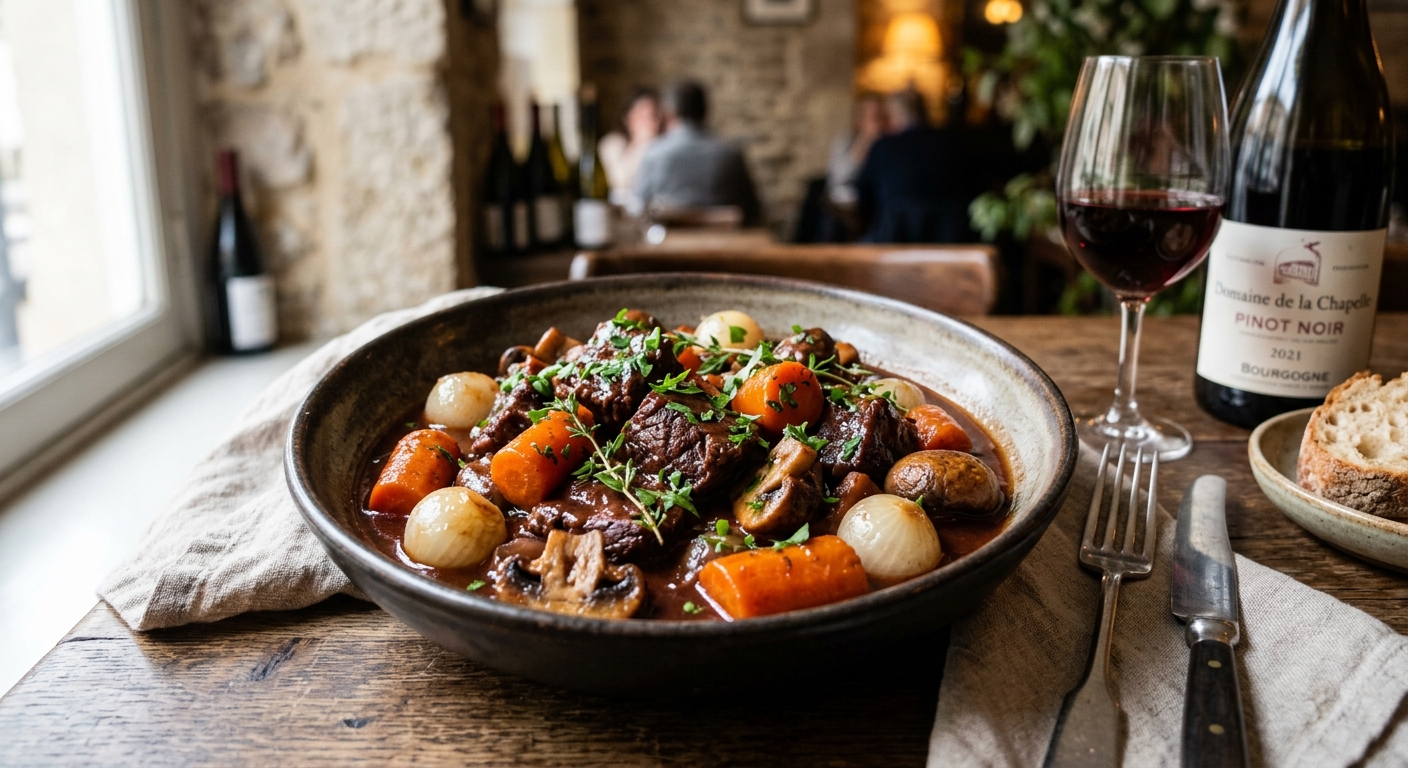
Boeuf Bourguignon is one of those rare dishes where culinary tradition and nutritional science align almost perfectly. Born in the Burgundy region of France, this braise was originally a way to tenderise tough, iron-rich cuts of working beef through long, slow cooking in local Pinot Noir. What the farmhouse cooks of Burgundy did not know, but we now understand, is that the acidic wine environment they created actually enhances the bioavailability of non-heme iron from the beef, making this one of the most efficient iron-delivery meals in the entire Western culinary canon.
The nutritional architecture of this dish is genuinely impressive. Beef chuck is a dense source of heme iron, which absorbs at rates of 15 to 35 percent compared to the 2 to 20 percent typical of plant sources. The carrots and pearl onions contribute beta-carotene and quercetin respectively, while the mushrooms add a meaningful dose of copper, a mineral that works synergistically with iron to support red blood cell formation. The dry red wine provides resveratrol and a broad spectrum of polyphenols that, beyond their antioxidant role, acidify the braising liquid and help break down collagen into gelatin, creating that signature silky sauce while simultaneously lowering the pH around the iron molecules and boosting their uptake.
At Calibrated Cuisine, we have spent considerable time dialling in the ingredient ratios so that a single serving of this braise clears the 8 percent daily value threshold for eight separate micronutrients. The result is a dish that satisfies every classic French technique benchmark, from the properly browned lardons to the glossy, wine-reduced sauce, while delivering a mineral profile that would make a sports nutritionist take careful notes. This is not diet food. It is deeply satisfying, complex, and rich. It is also, by genuine measurement, one of the most micronutrient-dense dinners you can put on a weeknight table.
4
servings
Ingredients
- 900 gbeef chuck, cut into 5 cm cubes, patted dry
- 150 gthick-cut pancetta or lardons, cut into 1 cm pieces
- 375 mldry red Burgundy wine (Pinot Noir)
- 300 mllow-sodium beef stock
- 250 gcremini mushrooms, halved or quartered if large
- 200 gpearl onions, blanched and peeled
- 300 gcarrots (about 3 medium), cut into 3 cm chunks
- 2 tbsptomato paste
- 3 clovesgarlic, smashed and peeled
- 2 tbspall-purpose flour
- 3 tbspextra-virgin olive oil, divided
- 1 sprigfresh thyme
- 2 sprigsfresh flat-leaf parsley stems
- 1 wholebay leaf
- 1 tbspunsalted butter
- —Colima Sea SaltMicroplastic Free Salt and black pepper to taste
- —Fresh flat-leaf parsley leaves, chopped, to garnish
Instructions
Click on an item below to shop for the recommended items for this recipe on Amazon.
As an Amazon Associate, we earn from qualifying purchases.
- Render the lardons: Place a large Dutch oven over medium heat. Add the pancetta pieces with no added oil and cook, stirring occasionally, for 6 to 8 minutes until golden and the fat has rendered. Remove the lardons with a slotted spoon and set aside, leaving the fat in the pot.
- Sear the beef in batches: Increase heat to medium-high. Season the beef cubes generously with salt and pepper. Working in two batches to avoid crowding, sear the beef in the rendered fat for 3 to 4 minutes per side until a deep mahogany crust forms on at least three sides. Transfer seared beef to a plate. Do not rush this step; proper searing creates the Maillard reaction compounds that give the braise its backbone.
- Build the base: Reduce heat to medium. Add 1 tablespoon of olive oil to the pot. Add the pearl onions and carrots and cook for 4 minutes, stirring occasionally, until they pick up some colour. Add the garlic and tomato paste and cook for 2 minutes, pressing the paste against the bottom of the pot to lightly caramelise it. Sprinkle the flour over the vegetables and stir to coat evenly, cooking for 1 minute.
- Deglaze and add liquids: Pour in the red wine and use a wooden spoon to scrape up every bit of fond from the bottom of the pot. Bring to a brisk simmer and cook for 3 minutes to cook off the raw alcohol edge. Add the beef stock, reserved lardons, and the bouquet garni of thyme, parsley stems, and bay leaf. Return the seared beef and any resting juices to the pot. The liquid should come about two-thirds of the way up the beef.
- Braise low and slow: Bring to a gentle simmer, then reduce heat to low. Cover the Dutch oven tightly and cook for 2 hours, checking every 30 minutes and adjusting the heat to maintain a very gentle simmer with only occasional bubbles breaking the surface. The beef is ready when it yields easily to a fork but still holds its shape.
- Cook the mushrooms separately: About 20 minutes before serving, heat the remaining 2 tablespoons of olive oil and the butter in a separate skillet over high heat. Add the mushrooms in a single layer and cook without stirring for 3 minutes until deeply golden. Season with salt and pepper, then stir and cook 2 minutes more. Set aside.
- Finish and serve: Remove the bouquet garni from the braise. If the sauce looks thin, remove the beef with a slotted spoon, increase heat to medium-high, and reduce the sauce for 5 to 8 minutes until it coats a spoon. Stir in the sauteed mushrooms, taste and adjust seasoning, and return the beef to the pot. Serve in warmed shallow bowls over mashed potatoes or egg-free crusty bread, garnished with chopped parsley.
- Render and sear on the stovetop: In a large skillet over medium heat, render the pancetta for 6 to 8 minutes until golden. Remove with a slotted spoon and transfer directly to the slow cooker insert. Increase heat to medium-high. Working in two batches, sear the salt-and-pepper-seasoned beef cubes in the rendered fat for 3 to 4 minutes per side until a deep brown crust develops on multiple sides. Transfer seared beef into the slow cooker on top of the lardons.
- Build and deglaze in the skillet: Without washing the skillet, reduce heat to medium. Add the pearl onions and carrots and cook 3 minutes. Add garlic and tomato paste and cook 2 minutes. Sprinkle the flour over the vegetables, stir for 1 minute, then pour in the red wine. Scrape up all the fond vigorously. Bring to a simmer and cook 3 minutes, then pour this entire mixture over the beef in the slow cooker. Add the beef stock and tuck in the thyme, parsley stems, and bay leaf.
- Set and cook: Place the lid on the slow cooker and cook on Low for 7 to 8 hours. The slow cooker environment is gentler than stovetop braising: the even, moist heat gradually dissolves collagen to gelatin without agitation, producing exceptionally tender, pull-apart beef. Avoid lifting the lid during cooking, as each peek adds 20 to 30 minutes of recovery time.
- Cook the mushrooms fresh before serving: About 15 minutes before you are ready to eat, heat the olive oil and butter together in a skillet over high heat. Add the mushrooms in a single layer and sear undisturbed for 3 minutes until caramelised and golden. Season with salt and pepper and cook 2 minutes more. This fresh sear preserves their meaty texture and earthy flavour, which would be entirely lost if they had spent 8 hours in the cooker.
- Reduce and finish: Discard the bouquet garni. If the sauce is thinner than you would like (slow cookers trap steam, so this is common), ladle the braising liquid into a small saucepan and simmer over medium-high heat for 8 to 10 minutes until reduced and glossy. Stir the mushrooms and reduced sauce back into the slow cooker with the beef, adjust seasoning, and serve garnished with fresh parsley.
- Render and sear using the saute function: Set your pressure cooker or Instant Pot to the Saute function on high heat. Add the pancetta and cook for 6 to 8 minutes until golden and the fat has rendered. Remove with a slotted spoon and set aside. In two batches, sear the seasoned beef cubes directly in the rendered fat for 3 to 4 minutes per side to build a deep brown crust. Remove all beef and set aside. This searing step is where virtually all the flavour complexity in a pressure-cooked braise originates, so give it the full time.
- Build the aromatic base: Add 1 tablespoon of olive oil to the pot and add the pearl onions and carrots. Saute 3 minutes. Add garlic and tomato paste and cook 2 minutes, stirring constantly to prevent scorching on the high-heat surface. Sprinkle flour over the vegetables and stir for 1 minute.
- Deglaze thoroughly: Pour in the red wine and scrape the bottom of the pot vigorously to remove every bit of fond. This is critical: any unscraped browned residue will trigger a Burn warning during pressure cooking. Simmer the wine for 2 minutes, then add the beef stock. Return the beef and lardons to the pot, ensuring the beef is largely submerged. Tuck in the thyme, parsley stems, and bay leaf. The liquid level should not exceed the two-thirds max-fill line.
- Pressure cook and natural release: Secure the lid and set the valve to Sealing. Cook on High Pressure for 35 minutes. Once the cycle completes, allow a natural pressure release for 15 minutes, then carefully switch the valve to Venting to release any remaining steam. Open the lid away from you.
- Saute mushrooms and reduce the sauce: Remove the beef and bouquet garni. Switch the pot back to Saute on high. Add the remaining olive oil and butter and sear the mushrooms directly in the pot for 4 to 5 minutes until golden. The sauce will simultaneously reduce around them; allow it to simmer for another 4 to 5 minutes until it reaches a glossy, coating consistency. Return the beef, stir gently to combine, adjust seasoning, and serve garnished with chopped fresh parsley.
- Preheat and render: Preheat your oven to 160 C (325 F) with the rack positioned in the lower third. In a large oven-safe Dutch oven set over medium heat on the stovetop, render the pancetta for 6 to 8 minutes until golden. Remove with a slotted spoon and set aside.
- Sear the beef: Increase heat to medium-high. Season the beef with salt and pepper. Sear in two batches in the rendered fat, 3 to 4 minutes per side, building a deep mahogany crust. Transfer beef to a plate. The oven braise relies entirely on this stovetop searing phase for surface colour, since the oven environment is too moist to continue browning once the lid is on.
- Build the base and deglaze: Reduce heat to medium. Add 1 tablespoon olive oil, then the pearl onions and carrots. Cook 4 minutes. Add garlic and tomato paste and cook 2 minutes. Stir in the flour and cook 1 minute. Pour in the red wine, scraping the fond from the bottom of the pot. Simmer briskly for 3 minutes. Add beef stock, lardons, and the bouquet garni. Return the beef and any accumulated juices.
- Transfer to the oven: Bring the pot to a gentle simmer on the stovetop, then cover tightly with the lid and transfer to the preheated oven. Braise at 160 C for 2 hours and 30 minutes. Unlike stovetop braising, you do not need to monitor the heat: the oven maintains a consistent, gentle temperature without risk of boiling too hard or scorching. Check at the 2-hour mark; the beef should be just tender. If needed, return for a further 20 minutes.
- Saute mushrooms and finish: Remove the Dutch oven from the oven. Lift out the beef with a slotted spoon and remove the bouquet garni. In a separate skillet, heat the remaining olive oil and butter over high heat. Sear the mushrooms until golden, 4 to 5 minutes. Meanwhile, if the braising sauce is too thin, place the Dutch oven over medium-high heat on the stovetop and reduce for 5 to 7 minutes. Stir in the mushrooms, return the beef, adjust seasoning, and serve in warmed bowls garnished with fresh parsley.
Nutrition Breakdown
Per 1 serving (makes 4)
Vitamins & Minerals
% Daily Value based on a 2,000 calorie diet (FDA reference)
🧬 Essential Amino Acids
% of recommended daily intake (RDA) per serving
🛡 Antioxidant Profile
The Nutrition Science
The iron story in Boeuf Bourguignon is a multi-layered one. Beef chuck provides predominantly heme iron, the form bound within haemoglobin and myoglobin that is absorbed via its own dedicated transporter (HCP1) in the duodenum, entirely independently of the body’s iron status regulation. This means heme iron absorbs at a relatively stable rate of 15 to 35 percent regardless of whether your iron stores are replete, making beef one of the most reliable dietary iron sources available. A 900 g batch of beef chuck across four servings contributes approximately 6.4 mg of heme iron per serving, and the red wine braising environment adds a further contribution: the malic and tartaric acids in wine lower the luminal pH around the food bolus in the proximal small intestine, a well-documented mechanism for increasing non-heme iron solubility and uptake by up to 40 percent.
The mushrooms in this dish deserve separate attention for their ergothioneine content. Ergothioneine is a sulfur-containing amino acid derivative synthesised almost exclusively by fungi and certain bacteria. Humans cannot make it, possess a specific intestinal transporter for it (OCTN1), and accumulate it in high concentrations in tissues subjected to oxidative stress, including liver, kidney, and red blood cells. Research from 2020 suggests ergothioneine may function as a cytoprotective antioxidant in mitochondria, and cremini mushrooms contain roughly 1.5 to 2.5 mg per 100 g, meaning this recipe delivers a meaningful dose. The copper from mushrooms is equally important: copper is a required cofactor for ceruloplasmin, the ferroxidase enzyme that converts ferrous iron (Fe2+) to ferric iron (Fe3+), the form that can be loaded onto transferrin for transport to bone marrow. Without adequate copper, absorbed iron cannot be properly mobilised, which is why the copper-iron co-presence in this dish is not coincidental from an evolutionary diet perspective.
Zinc bioavailability from beef is another underappreciated strength of this recipe. Beef is among the highest dietary sources of zinc, and the form present, zinc bound to muscle proteins, absorbs at approximately 25 to 40 percent efficiency compared to 10 to 20 percent from plant sources. Zinc in this recipe clears 89 percent of the daily value per serving, relevant to everyone from athletes recovering from training to anyone relying on zinc-dependent enzymes for immune function, DNA synthesis, and the approximately 300 metalloenzyme reactions that require it as a structural or catalytic cofactor. The long, moist braise does not meaningfully degrade zinc content, unlike some B vitamins, because zinc is a mineral that neither oxidises nor decomposes with heat.
Pro Tips
- Pat the beef completely dry with paper towels before searing. Even a small amount of surface moisture will cause steaming instead of browning, robbing you of the Maillard crust that defines the flavour of the entire braise.
- Use a genuine Burgundy Pinot Noir or another dry, medium-bodied red wine. Avoid anything labelled cooking wine, as these contain added salt and lack the polyphenol complexity that contributes to both flavour and the antioxidant profile of the finished dish.
- To peel pearl onions quickly, score a shallow X through the root end, blanch for 1 minute in boiling water, transfer to ice water, and the skins will slip off with a gentle squeeze. Keeping the root end intact prevents the onions from falling apart during the long braise.

OMG yes – the slow braise aspect is KEY for me too! I’ve noticed that the long cooking time seems to break down the beef collagen in a way that my gut actually handles so much better than quick-cooked iron sources, plus all those mushrooms and root veggies add prebiotic fiber that helps with nutrient absorption / I actually tracked this in my food diary last month and saw a direct correlation between braised dishes and lower inflammation markers the next day compared to when I eat ground beef. Yvonne, are you finding the wine reduction helps your joint mobility specifically, or is it more the iron content overall?
oh this is hitting so different for my body right now, especially after realizing how much my joint mobility improves when im actually getting enough iron to support all that connective tissue work. theres something about the slow braise too, that long gentle cooking, that feels like its honoring how our bodies actually want to absorb nutrients rather than rushing through it all, and the wine plus all those root veggies together? chef’s kiss for taming inflammation while building the iron stores that keep everything lubricated and resilient. definitely making this this week.
omg greta youre speaking my language, that gut intelligence piece is so real – i noticed the same thing when i started paying attention to how braised collagens actually feel different in my digestion versus quick cooked proteins, like my body just settles into it differently. and the iron bioavailability gets even better when you pair it with all those root veggies and the acid from the wine, its literally designed to help your body actually use what youre taking in instead of just passing through, plus the anti inflammatory compounds from the long slow process means less systemic stress while youre building those iron stores back up, which directly translates to better joint lubrication and resilience on the mat for me.