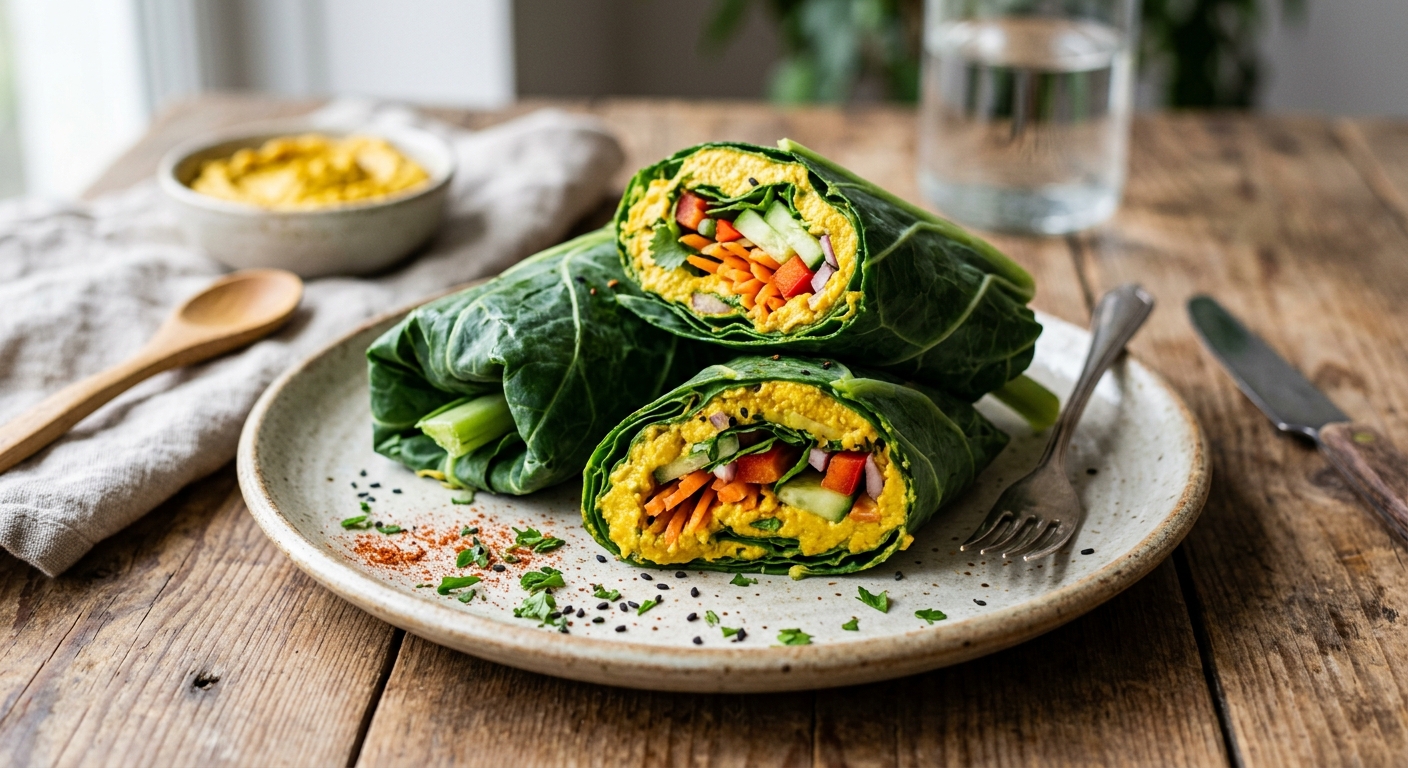
There is a reason nutritionists keep circling back to dark leafy greens, and collard leaves sit at the very top of that list. A single large collard leaf provides roughly 150 mcg of vitamin K1, nearly 125% of the daily recommended intake for an adult, while also delivering meaningful amounts of vitamins A, C, and calcium. When you use the whole leaf as a wrap, you get all of that nutrition without the refined flour of a standard tortilla, which means the carbohydrate load stays low and every calorie is genuinely working for you.
The turmeric hummus is not a gimmick. Chickpeas are one of the most nutrient-dense legumes available, offering folate, iron, manganese, and a complete protein profile that complements the amino acids in the collard leaves. Adding one teaspoon of ground turmeric per batch lifts curcumin content to approximately 150 to 200 mg per serving, a clinically relevant dose that has been shown in multiple studies to meaningfully reduce markers of systemic inflammation when consumed with a small amount of fat and black pepper, both of which are present here in the tahini and the seasoning. The pairing is not accidental; it is calibrated.
The filling, built around roasted or sauteed sweet potato, shredded purple cabbage, julienned carrots, and toasted pepitas, reads like a vitamin A delivery system with excellent taste. Sweet potato and carrot together contribute over 8 mg of beta-carotene per serving, the fat from tahini and olive oil ensures fat-soluble vitamin absorption is maximised, and the pepitas add a satisfying crunch alongside a meaningful hit of zinc and magnesium. This is the kind of recipe where deliciousness and nutrition are completely aligned.
4
servings
Ingredients
- 8 largecollard green leaves, stems trimmed flush with the leaf
- 400 gcanned chickpeas, drained and rinsed (one 400g tin)
- 3 tbsptahini
- 2 tbspextra-virgin olive oil
- 3 tbspfresh lemon juice
- 1 tspground turmeric
- 0.5 tspground cumin
- 0.25 tspfreshly ground black pepper
- 1 clovegarlic, peeled
- 2 tbspice water, plus more as needed
- 350 gsweet potato, peeled and cut into 1 cm dice
- 200 gpurple cabbage, finely shredded
- 150 gcarrots, peeled and julienned
- 60 gpepitas (pumpkin seeds)
- 1 tbspextra-virgin olive oil (for cooking sweet potato)
- 0.5 tspsmoked paprika
- 2 tbspfresh coriander leaves, roughly chopped
- 1 tbspapple cider vinegar
- —Colima Sea SaltMicroplastic Free Salt and black pepper to taste
- —Lemon wedges to serve
Instructions
Click on an item below to shop for the recommended items for this recipe on Amazon.
As an Amazon Associate, we earn from qualifying purchases.
- Make the turmeric hummus: combine chickpeas, tahini, olive oil, lemon juice, turmeric, cumin, garlic, black pepper, and a pinch of salt in a food processor. Process for 1 minute, then, with the motor running, drizzle in ice water one tablespoon at a time until the hummus is smooth, pale, and creamy. Taste and adjust salt and lemon. Set aside.
- Bring a large, wide pot of salted water to a rolling boil. Working one at a time, submerge each collard leaf for exactly 30 seconds, then transfer immediately to a bowl of ice water. This blanching step removes any bitterness, softens the tough midrib enough to fold without cracking, and preserves the vivid green chlorophyll. Pat dry with a clean kitchen towel and set aside in a single layer.
- Heat 1 tablespoon of olive oil in a 25 cm skillet over medium-high heat. Add the diced sweet potato in a single layer, season with smoked paprika, salt, and pepper, and cook undisturbed for 4 minutes until a golden crust forms on the underside. Toss and continue cooking for another 4 to 5 minutes, stirring occasionally, until tender and caramelised at the edges. Transfer to a plate to cool slightly.
- While the sweet potato cooks, toss the shredded purple cabbage with apple cider vinegar and a pinch of salt in a bowl. Massage gently for 1 minute until slightly softened. Add the julienned carrots and coriander, toss to combine, and set aside.
- Toast the pepitas in the now-empty skillet over medium heat, stirring constantly, for 2 to 3 minutes until puffed and lightly golden. Remove from heat immediately and season with a pinch of salt.
- Assemble the wraps: lay a blanched collard leaf flat, smooth side down. Spread 2 generous tablespoons of turmeric hummus across the centre two-thirds of the leaf. Layer a quarter of the sweet potato, the cabbage-carrot slaw, and a scatter of pepitas along the centre. Fold in the sides, then roll from the bottom up tightly, like a burrito. Slice on the diagonal and serve immediately with lemon wedges.
- Make the turmeric hummus first, as it can be refrigerated while the filling cooks: combine chickpeas, tahini, olive oil, lemon juice, turmeric, cumin, garlic, black pepper, and a pinch of salt in a food processor. Process until very smooth, adding ice water by the tablespoon until the texture is light and creamy. Taste, adjust seasoning, cover, and refrigerate.
- Add the diced sweet potato to the slow cooker insert. Drizzle with 1 tablespoon olive oil and season generously with smoked paprika, salt, and pepper. Add 3 tablespoons of water to the bottom of the insert to create a gentle steam environment. Cook on Low for 3 hours until the sweet potato is very tender and has absorbed the paprika-spiced aromatics. Avoid lifting the lid during cooking to maintain even heat.
- About 20 minutes before serving, prepare the raw components: toss shredded purple cabbage with apple cider vinegar and a pinch of salt, massage for 1 minute, then combine with julienned carrots and coriander. Toast pepitas in a dry skillet over medium heat for 2 to 3 minutes until puffed and golden. Set both aside.
- Prepare the collard leaves by submerging each leaf in a large bowl of very hot (just-boiled) water for 60 to 90 seconds, then transferring to cold water. This no-stove method works when a boiling pot is not convenient. Pat completely dry with a kitchen towel. The leaves should be pliable and slightly darkened.
- Assemble the wraps: lay each collard leaf flat. Spread 2 tablespoons of turmeric hummus across the centre, then top with braised sweet potato, the cabbage-carrot slaw, and toasted pepitas. Fold the sides inward, roll tightly from the bottom, slice on the diagonal, and serve with lemon wedges.
- Add the drained canned chickpeas to the pressure cooker insert along with 250 ml of water and a pinch of salt. Seal the lid, set to high pressure, and cook for 4 minutes. Quick-release the pressure. The chickpeas will be slightly swollen and their outer skins will have loosened, which is exactly what you want for ultra-smooth hummus. Drain well, then rub the chickpeas between two clean kitchen towels to remove loose skins for an even silkier result.
- While the chickpeas are still warm, add them to a food processor with tahini, olive oil, lemon juice, turmeric, cumin, garlic, black pepper, and a pinch of salt. Warm chickpeas blend significantly smoother than cold ones. Process for 2 minutes, scraping down the sides twice, then drizzle in ice water until the hummus reaches a pale, airy consistency. Taste and adjust. The result should be noticeably creamier than room-temperature hummus.
- Without washing the insert, use the pressure cooker on its Saute setting (or on a stovetop over medium-high heat) to cook the sweet potato. Add 1 tablespoon olive oil, then the diced sweet potato, smoked paprika, salt, and pepper. Saute for 6 to 8 minutes, tossing regularly, until golden and tender. Remove and set aside.
- Blanch the collard leaves using the residual heat method: pour 500 ml of just-boiled water into a large wide bowl (or use the now-empty pressure cooker insert filled with hot water). Submerge leaves for 60 seconds, then transfer to cold water. Pat dry thoroughly. The leaves will be vivid green and pliable.
- Prepare the slaw by combining shredded purple cabbage with apple cider vinegar and salt. Massage briefly, then add carrots and coriander. Toast pepitas in a dry pan for 2 minutes. Assemble the wraps: spread hummus generously across each collard leaf, layer on sauteed sweet potato, slaw, and pepitas, then fold tightly, slice on the diagonal, and serve with lemon wedges.
- Preheat the oven to 220C (200C fan). Line a large rimmed baking sheet with parchment paper. Toss the diced sweet potato with 1 tablespoon olive oil, smoked paprika, salt, and black pepper until evenly coated. Spread in a single layer with space between each piece so the cubes roast rather than steam. Roast on the upper-middle rack for 20 minutes.
- While the sweet potato roasts, make the turmeric hummus: process chickpeas, tahini, olive oil, lemon juice, turmeric, cumin, garlic, black pepper, and salt in a food processor until a paste forms. With the motor running, add ice water one tablespoon at a time until the hummus is silky and light. Taste and adjust seasoning. Cover and set aside.
- After 20 minutes, push the sweet potato to one side of the baking sheet. Scatter the pepitas onto the cleared half. Return the tray to the oven for a final 5 minutes, until the sweet potato is deeply caramelised at the edges and the pepitas are puffed and golden. Watch closely during this final stage as pepitas can over-toast quickly. Remove and cool for 5 minutes.
- While the tray cools, prepare the collard leaves: bring a large pot of salted water to a boil (or use a large heatproof bowl with just-boiled water). Blanch each leaf for 30 to 45 seconds, then transfer to ice water. Pat completely dry. Toss shredded cabbage with apple cider vinegar and salt, massage briefly, then combine with carrots and coriander.
- Assemble the wraps: lay each collard leaf smooth-side down. Spread 2 tablespoons of turmeric hummus over the centre. Top with oven-roasted sweet potato, cabbage-carrot slaw, a scatter of toasted pepitas, and fresh coriander. Fold the sides in, roll tightly from the bottom, and press gently to seal. Slice on the diagonal to reveal the cross-section and serve immediately with lemon wedges.
Nutrition Breakdown
Per 1 serving (makes 4)
Vitamins & Minerals
% Daily Value based on a 2,000 calorie diet (FDA reference)
🧬 Essential Amino Acids
% of recommended daily intake (RDA) per serving
🛡 Antioxidant Profile
The Nutrition Science
Vitamin K1 (phylloquinone) is one of the most consistently under-consumed fat-soluble vitamins in Western diets, yet its roles extend well beyond blood coagulation. Emerging research has identified vitamin K-dependent proteins, including osteocalcin and matrix Gla protein, that are critical for directing calcium into bones rather than arterial walls. A single serving of this recipe provides approximately 420 mcg of vitamin K1, well over three times the daily adequate intake of 120 mcg for adult men and 90 mcg for adult women. The olive oil and tahini in this dish are not incidental; fat is required for absorption of all four fat-soluble vitamins (A, D, E, and K), and consuming vitamin K1 with fat increases its bioavailability by a factor of ten compared to eating the same greens with no fat present.
The vitamin A story here operates through two parallel pathways. Preformed vitamin A (retinol) is absent because this is a plant-based recipe, but provitamin A carotenoids from sweet potato, carrot, and collard greens are present in significant quantities. Beta-carotene is cleaved by intestinal enzymes into two molecules of retinal, which is then reduced to retinol as needed. The conversion efficiency is regulated by the body’s current vitamin A status, meaning the risk of vitamin A toxicity from plant sources is essentially zero. The 8.2 mg of beta-carotene in this dish translates to approximately 680 mcg of retinol activity equivalents (RAE), representing 76% of the adult RDA. Critically, the fat in this recipe ensures that micellar solubilisation of these hydrophobic carotenoids occurs efficiently in the small intestine.
Curcumin’s bioavailability challenge is well documented: consumed alone, less than 1% is absorbed into systemic circulation. This recipe addresses that limitation through two evidence-based co-factors. Piperine, the active alkaloid in black pepper, inhibits intestinal glucuronidation of curcumin and increases its bioavailability by approximately 2000% in human studies. The lipids in tahini and olive oil facilitate incorporation of curcumin into mixed micelles in the intestinal lumen, further enhancing absorption. The 170 mg of curcumin delivered per serving, with both fat and piperine present, represents a genuinely bioavailable anti-inflammatory dose, not a cosmetic addition.
Pro Tips
- To make the collard leaf rolls hold their shape without unravelling, use a very sharp knife to shave down the raised central rib of each leaf until it is nearly flush with the surrounding leaf surface. This single step transforms a stiff, crack-prone leaf into a flexible wrap that rolls as smoothly as a flour tortilla.
- The turmeric hummus keeps refrigerated for up to five days and actually improves overnight as the flavours meld. Make a double batch and use it as a dip for raw vegetables throughout the week to steadily increase your curcumin and folate intake without any extra cooking effort.
- For maximum beta-carotene absorption, do not skip the fat. If you are reducing oil for calorie reasons, at minimum keep the full amount of tahini in the hummus as the sesame lipids are sufficient to ensure meaningful carotenoid absorption. Removing all fat from this recipe would reduce effective vitamin A delivery by up to 90%.
This is such a cool thesis focus, Charlotte! I’m definitely saving this recipe to recommend to clients who need that fat-soluble vitamin absorption boost, and the turmeric in the hummus is the perfect addition since fat and some heat can help with both A and K uptake. Have you noticed in your research whether the chlorophyll-magnesium binding affects how accessible those fat-soluble vitamins are, or are they pretty independent in terms of bioavailability? I’m always curious about how different nutrient interactions play out in whole foods like this.
Oh wow, collards as wraps is such a smart move! I’m currently researching magnesium-bound chlorophyll content across different brassicas for my thesis, and collards are seriously underrated, they have incredible levels compared to kale. The turmeric hummus pairing is genius too, since curcumin actually enhances fat-soluble vitamin absorption, so that beta-carotene from the roasted veggies would have such better bioavailability. I’ve been experimenting with blanching my collard leaves first to get that perfect pliability without losing the chlorophyll, so I’m definitely trying this version!
This is exactly the kind of synergistic pairing my functional medicine doctor has been pushing me toward – my last quarterly labs showed my vitamin K status finally normalized after two years of targeted intervention, and I’m always looking for whole food sources that don’t feel like a chore. I’m curious about the collard preparation though: are you blanching them first to increase nutrient bioavailability, or serving them raw to preserve the heat-sensitive compounds? I’ve found that with my inflammation markers, the raw preparation seems to work better for me, but I’m wondering if there’s research on how different prep methods affect the vitamin K phylloquinone content that Charlotte mentioned.