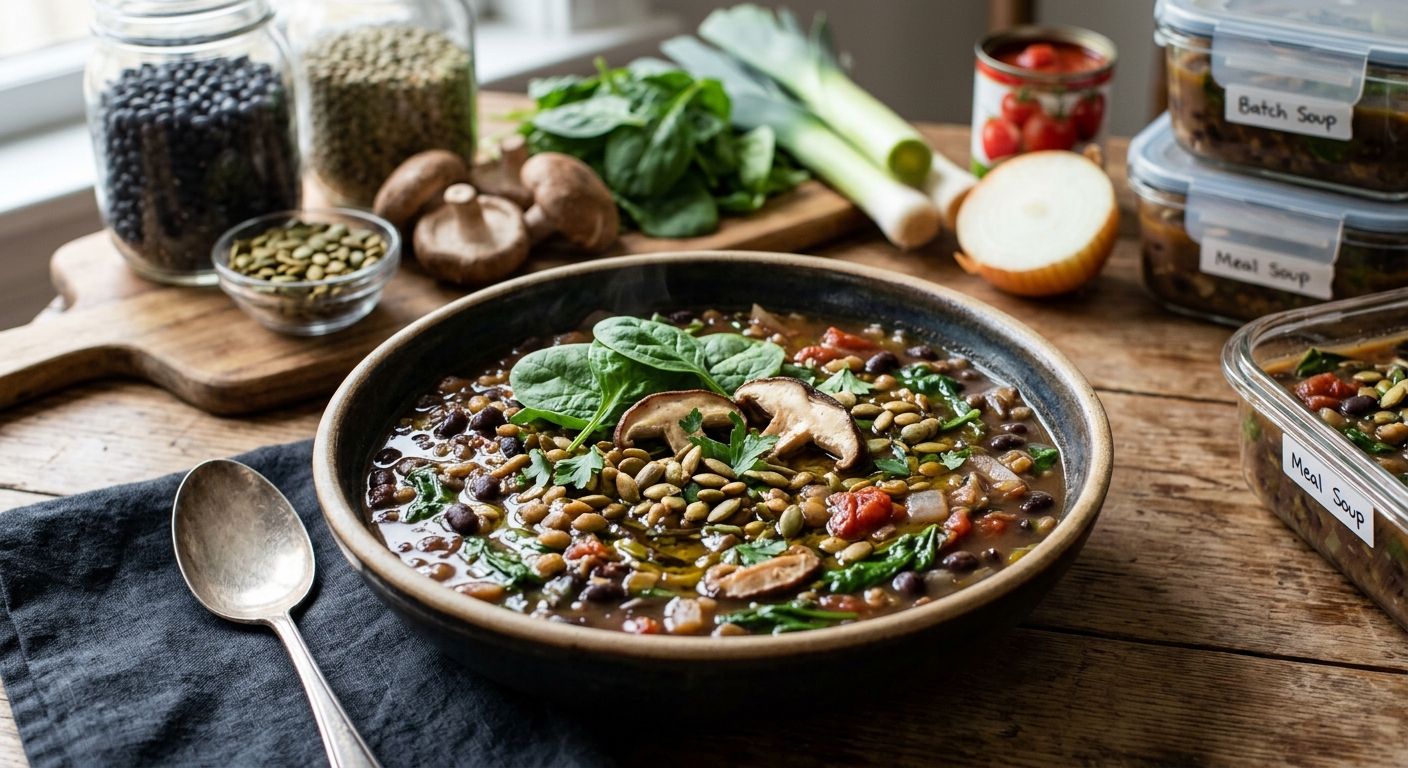
There is a certain quiet satisfaction in opening the freezer on a Wednesday evening and pulling out a container of something genuinely nourishing. This Mineral Matrix Batch Soup was designed with exactly that moment in mind. Built on a foundation of black beans, green lentils, shiitake mushrooms, pumpkin seeds, dark leafy greens, and bone-in broth, it reads like a periodic table of bioavailable minerals rather than a simple weeknight soup. Every ingredient earns its place not just for flavor but for the specific micronutrients it contributes to the finished bowl.
What separates this recipe from a generic vegetable soup is intentional stacking. Black beans and green lentils together deliver a formidable hit of non-heme iron and zinc, while the shiitake mushrooms add a layer of selenium and ergothioneine that most soups never even approach. A modest tablespoon of apple cider vinegar stirred in at the end is not a trend-chasing trick but a scientifically grounded move: the mild acidity from fermented vinegar and the tomatoes already in the pot lowers the pH of the broth, which measurably improves non-heme iron absorption by keeping the mineral in its more soluble ferrous state. Finishing with a large handful of baby spinach and a squeeze of lemon before serving boosts vitamin C content, further amplifying iron uptake on the spot.
The recipe yields eight generous servings, and every single one freezes without any loss of nutritional integrity or texture, provided you hold the leafy greens and lemon until reheating. Whether you use your largest stovetop pot, a slow cooker set before you leave for work, or a pressure cooker to get dinner on the table in under an hour, the method-specific instructions below guide you through each path with the technique that actually suits that piece of equipment, not just a copy-paste with a different timer.
8
servings
Ingredients
- 400 gdried black beans, soaked overnight and drained
- 300 gdried green lentils, rinsed and drained
- 200 gshiitake mushrooms, stems removed, caps sliced 5mm thick
- 150 graw hulled pumpkin seeds (pepitas)
- 200 gbaby spinach, loosely packed
- 400 gcanned whole San Marzano tomatoes, crushed by hand
- 1 largeyellow onion, finely diced
- 1 largeleek, white and light-green parts only, halved lengthwise and sliced
- 4 clovesgarlic, minced
- 2 mediumcarrots, peeled and cut into 1cm dice
- 2 stalkscelery, cut into 1cm dice
- 1 mediumsweet potato, peeled and cut into 2cm cubes
- 3 tbspextra-virgin olive oil
- 2 tbsptomato paste
- 1 tbspapple cider vinegar
- 2 tspground cumin
- 1 tspsmoked paprika
- 0.5 tspground turmeric
- 0.5 tspground coriander
- 0.25 tspcayenne pepper
- 2 literslow-sodium vegetable or chicken bone broth
- 2 leavesdried bay leaves
- 1 sprigfresh thyme
- 1 largelemon, cut into wedges for serving
- —Colima Sea SaltMicroplastic Free Salt and freshly cracked black pepper to taste
Instructions
Click on an item below to shop for the recommended items for this recipe on Amazon.
As an Amazon Associate, we earn from qualifying purchases.
- Set a large heavy-bottomed stockpot or Dutch oven (at least 8 liters) over medium-high heat. Add the olive oil and heat until it shimmers. Add the diced onion and sliced leek with a generous pinch of salt. Cook, stirring frequently, for 6 to 8 minutes until the onion is fully translucent and starting to turn golden at the edges.
- Add the minced garlic, carrots, and celery to the pot. Stir and cook for 3 minutes. Push the vegetables to the sides and add the tomato paste directly to the center of the pot. Let it fry in the residual oil for 90 seconds without stirring, allowing it to darken slightly and develop a deeper, more complex flavor. Stir everything together.
- Add the ground cumin, smoked paprika, turmeric, ground coriander, and cayenne. Stir continuously for 45 seconds so the spices bloom in the oil and coat the vegetables. Pour in a splash of broth to deglaze the pot, scraping up any fond from the bottom with a wooden spoon.
- Add the soaked and drained black beans, rinsed green lentils, sliced shiitake mushrooms, sweet potato cubes, crushed tomatoes, and the remaining broth. Tuck in the bay leaves and thyme sprig. Bring to a rolling boil over high heat, then skim any foam that rises to the surface during the first 5 minutes.
- Reduce the heat to a gentle simmer (small, steady bubbles). Partially cover the pot with a lid tilted to allow steam to escape. Simmer for 75 to 90 minutes, stirring every 15 minutes, until the black beans are completely tender with no chalky center and the lentils have softened into a thick, velvety body for the broth.
- Stir in the apple cider vinegar, taste, and adjust seasoning with salt and pepper. Remove the bay leaves and thyme sprig. Add the pumpkin seeds and stir through. Turn off the heat, then fold in the baby spinach in two batches, stirring until fully wilted, about 1 minute. Serve immediately with lemon wedges, or cool and portion for the freezer.
- The night before (or at least 1 hour before assembly): drain the soaked black beans and place them in a saucepan with fresh water covering by at least 5cm. Bring to a vigorous boil and boil hard for 10 full minutes. Drain and rinse well. This is a non-negotiable food safety step for black beans in a slow cooker.
- Set a large skillet over medium-high heat and add the olive oil. Saute the onion and leek for 5 minutes until softened. Add the garlic, carrots, and celery and cook for 2 more minutes. Add the tomato paste and all the dry spices, stirring vigorously for 1 minute until fragrant and slightly darkened. Deglaze the skillet with 125ml of broth, scraping up all the fond. Transfer the entire skillet contents directly into the slow cooker insert.
- Add the par-boiled black beans, rinsed green lentils, sliced shiitake mushrooms, sweet potato cubes, and crushed tomatoes to the slow cooker. Pour in the remaining broth. Tuck in the bay leaves and thyme sprig. The liquid should come to within 3 to 4cm of the top of the insert. Stir everything briefly to combine.
- Fit the lid and cook on Low for 8 to 10 hours (ideal for a workday) or on High for 5 to 6 hours. Do not lift the lid during the first 4 hours on Low or 3 hours on High, as each lid lift adds 20 to 30 minutes to the cook time.
- In the final 20 minutes of cooking, stir in the apple cider vinegar, taste, and adjust salt. Add the pumpkin seeds. The lentils should have broken down considerably, naturally thickening the broth. If the soup is thinner than desired, remove the lid for the last 20 minutes on High to allow evaporation.
- Just before serving, remove the bay leaves and thyme sprig, then fold in the baby spinach in batches directly in the slow cooker insert. Replace the lid for 3 to 4 minutes until the spinach wilts completely from residual heat. Serve with lemon wedges squeezed over each bowl.
- Select the Saute function on High. Add the olive oil and heat until the display reads ‘Hot’. Add the onion and leek with a pinch of salt and saute for 4 to 5 minutes, stirring, until softened. Add the garlic and cook for 1 minute. Add the tomato paste, cumin, smoked paprika, turmeric, coriander, and cayenne. Stir constantly for 60 seconds while the paste fries against the hot insert bottom, creating a deeply fragrant fond.
- Pour in 250ml of broth and use a wooden spoon to scrape the entire bottom of the insert clean. This step is critical for pressure cooking: any stuck fond will trigger the burn sensor and halt the cook cycle. Add the carrots, celery, and sweet potato, stirring to coat.
- Add the soaked and drained black beans (no pre-boiling needed since pressure cooking reaches temperatures that denature phytohaemagglutinin safely), rinsed green lentils, sliced shiitake mushrooms, and crushed tomatoes. Pour in the remaining broth. Tuck in the bay leaves and thyme sprig. The liquid level must not exceed the two-thirds max line.
- Press Cancel to end Saute mode. Secure the lid and set the steam release valve to Sealing. Select Pressure Cook (or Manual) on High Pressure and set the timer for 35 minutes. The pot will take approximately 12 to 15 minutes to come to full pressure before the countdown begins.
- When the cook time ends, allow the pressure to release naturally for 15 minutes without touching the valve. After 15 minutes, carefully switch the valve to Venting to release any remaining pressure. Open the lid away from you. The black beans should be completely tender and the lentils fully dissolved into the broth.
- Select Saute on Low. Remove the bay leaves and thyme sprig. Stir in the apple cider vinegar and pumpkin seeds. Taste and adjust seasoning with salt and pepper. Fold in the baby spinach in two batches until wilted, about 2 minutes total. Press Cancel and serve immediately with lemon wedges, or cool and portion for freezer storage.
- Preheat your oven to 160C (325F) with a rack positioned in the lower third. Place a 7 to 8 liter oven-safe Dutch oven over medium-high heat on the stovetop. Add the olive oil and heat until shimmering. Add the onion and leek and saute for 6 minutes until golden at the edges. Add garlic, carrots, and celery and cook for 3 minutes more.
- Spoon the tomato paste into the center of the pot and let it fry undisturbed for 90 seconds until it darkens slightly around the edges. Add all the dry spices and stir vigorously for 45 seconds. Pour in 250ml of the broth and scrape the bottom of the pot thoroughly to lift all the caramelized fond into the liquid.
- Add the soaked and drained black beans, rinsed green lentils, shiitake mushrooms, sweet potato, and crushed tomatoes. Pour in the remaining broth. Tuck in the bay leaves and thyme sprig. Bring the entire pot to a boil on the stovetop over high heat, skimming any foam.
- Once boiling, remove from the heat. Press a sheet of parchment paper directly onto the surface of the soup (this parchment cartouche reduces evaporation inside the pot and ensures an even, moist braise). Place the Dutch oven lid on top and transfer carefully to the preheated oven.
- Braise undisturbed for 2 hours 15 minutes to 2 hours 30 minutes. Check at the 2-hour mark by pressing a black bean against the side of the pot with a spoon. It should crush easily with almost no resistance. The lentils should be fully absorbed into the broth, thickening it to a velvety consistency.
- Remove the Dutch oven from the oven and place on a heatproof surface. Discard the parchment, bay leaves, and thyme sprig. Stir in the apple cider vinegar and pumpkin seeds. Season generously with salt and pepper. Fold the baby spinach through in batches, allowing the residual heat of the soup to wilt the leaves completely, about 2 minutes. Serve in deep bowls with lemon wedges squeezed over the top.
Nutrition Breakdown
Per 1 serving (makes 8)
Vitamins & Minerals
% Daily Value based on a 2,000 calorie diet (FDA reference)
🧬 Essential Amino Acids
% of recommended daily intake (RDA) per serving
🛡 Antioxidant Profile
The Nutrition Science
The mineral density of this soup is no accident. Black beans and green lentils were selected together because their mineral profiles are genuinely complementary rather than redundant. Black beans lead on zinc and copper, while green lentils contribute a larger proportion of iron and folate. Together they provide a matrix of minerals in a single serving that rivals many fortified cereals, but within a whole-food package that also delivers 16 grams of fiber and a full spectrum of B vitamins. The shiitake mushrooms add selenium, a mineral often underrepresented in plant-forward diets, as well as the unusual antioxidant ergothioneine, which humans cannot synthesize and must obtain entirely from food.
The apple cider vinegar added at the end of cooking is not a wellness trend but a calculated pH intervention. Non-heme iron, which is the form found in all plant foods, must be reduced from its ferric (Fe3+) state to its ferrous (Fe2+) state before the intestinal transporter DMT-1 can absorb it. This reduction happens more readily in an acidic environment. The tomatoes in the recipe already lower the pH of the broth, and the vinegar reinforces this. Adding a squeeze of lemon before eating provides a further boost of vitamin C, which is itself a reducing agent that directly converts ferric iron to ferrous iron in the gut lumen, independent of stomach acid. This three-layer acidification strategy (tomatoes, vinegar, lemon at the table) is one of the most evidence-supported practical techniques for improving non-heme iron bioavailability from a plant-based meal.
Pumpkin seeds are added after cooking rather than simmered in the broth for a specific reason beyond texture. Prolonged high-heat exposure can degrade the delicate polyunsaturated fatty acids in pumpkin seed oil, particularly linoleic acid, through lipid oxidation. Adding them at the end preserves the full complement of their zinc content, their gamma-tocopherol (a form of vitamin E), and their healthy fat profile. Their mild crunch also provides a textural contrast that makes the soup more satisfying, which has a measurable effect on satiety signaling and how slowly the meal is eaten, both of which benefit glycemic response.
Pro Tips
- Do not skip the overnight soak for the black beans. Soaking reduces phytic acid content by up to 50 percent, which directly improves absorption of iron, zinc, and magnesium. Change the soaking water at least once and always rinse thoroughly before cooking.
- For freezing, portion the soup into 500ml glass or BPA-free plastic containers and cool completely in the refrigerator before transferring to the freezer. Do not freeze with baby spinach already added; instead, stir in fresh spinach directly in the reheating pot. The soup keeps at peak quality for up to 3 months frozen and 5 days refrigerated.
- If you cannot find dried green lentils, Puy (French) lentils are an excellent mineral-dense substitute and hold their shape better, giving the soup a more textured consistency. Avoid red lentils for this recipe as they disintegrate completely and will produce a thicker, porridge-like texture rather than a broth-forward soup.
- To boost the manganese and zinc contribution further, swap 50g of the pumpkin seeds for an equal weight of raw hemp hearts, which also add a complete amino acid profile and additional magnesium without altering the flavor of the finished soup.





Oh Jasmine, I’m so glad you asked about the greens! I’ve been making mineral-dense soups for my classes for years, and I’ve found that collards especially hold up beautifully through freezing without getting that mushy texture you sometimes get with spinach. I’m planning to make this exact recipe next Sunday for my class and I’m thinking I’ll add a full bunch of chopped collards in the last ten minutes of cooking, just to preserve some of that wonderful bite and maximize the iron content you’re after. The beauty of batch cooking is that you can customize each container based on what your community needs most, which I think is such a kind approach to sharing nutrition knowledge!
This is such a smart move, Sue! I love that you’re thinking about texture preservation alongside nutrient density, and adding collards in the final minutes is genius for keeping that satisfying bite. I actually track my plant diversity weekly and collards are such a powerhouse for that goal, plus they freeze incredibly well. Quick question though: are you varying the greens across your class batches or sticking with collards? I’m always looking to hit different micronutrient profiles, so I’m curious if you’ve noticed how swapping between collards, lacinato kale, or even Swiss chard changes the mineral profile slightly.
This is exactly what I’ve been recommending to folks in my community who say they don’t have time for nutrient-dense eating, so I’m definitely saving this. I’d love to know if you incorporated any dark leafy greens like collards or spinach, because pairing those with legumes really amplifies the bioavailability of that iron, especially when there’s an acid component in there. I’ve found that batch cooking mineral-rich soups transforms accessibility for people juggling multiple jobs, and honestly, it connects back to how our ancestors built meal prep around seasonal, shelf-stable ingredients like beans and root vegetables.