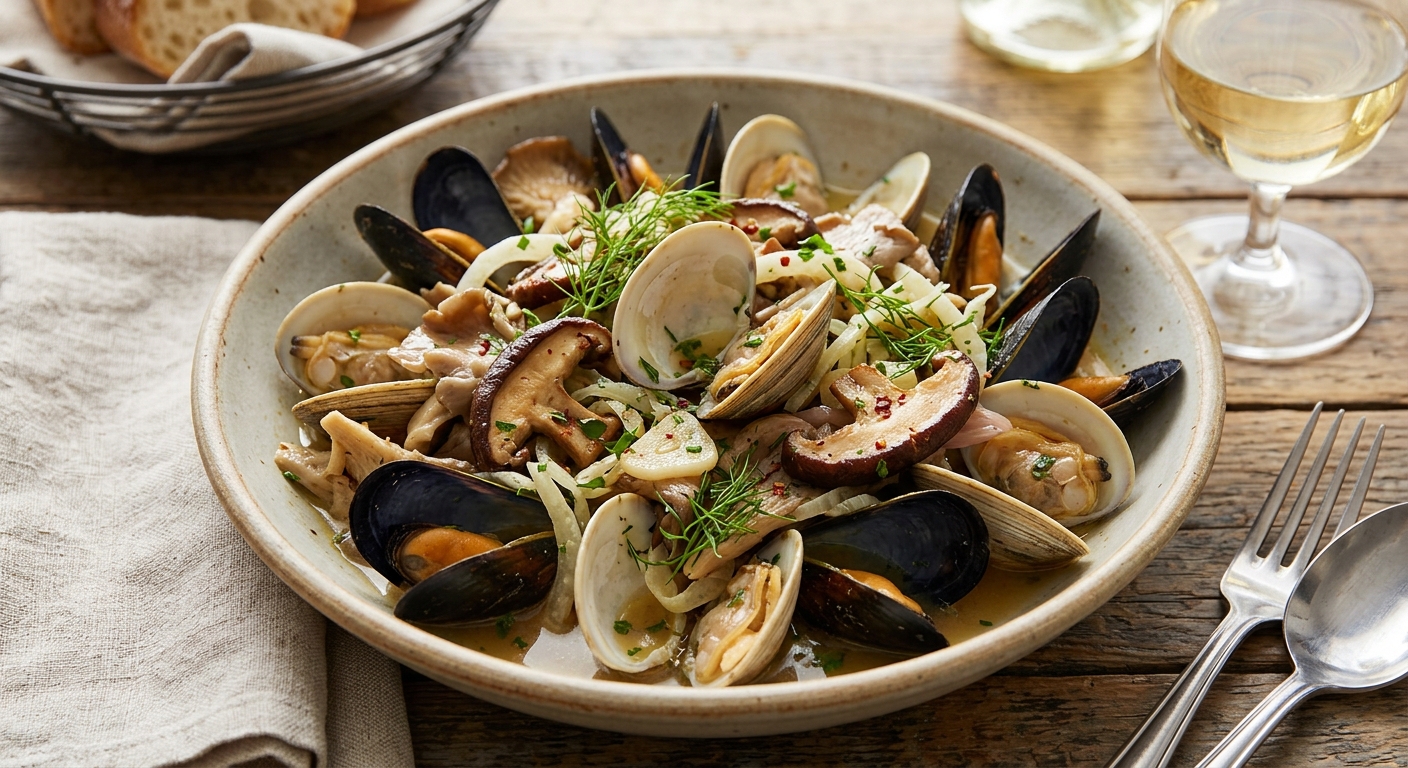
Vanadium rarely appears on nutrition labels, yet this ultra-trace mineral plays a quietly critical role in glucose metabolism, insulin signaling, and bone mineralization. The richest dietary sources are not exotic supplements but some of the most delicious ingredients in the ocean and the forest floor: shellfish such as clams, mussels, and oysters, and fungi like shiitake and oyster mushrooms. This Shellfish and Mushroom Mineral Plate was engineered from the ground up to put vanadium front and center while delivering a cascade of co-factors that amplify its biological impact.
The dish is built on a foundation of briny littleneck clams and plump black mussels, two shellfish that consistently rank among the top ten vanadium-containing foods at approximately 0.9 to 1.4 micrograms per 100 grams of cooked flesh. Layered beneath them is a generous bed of oyster and shiitake mushrooms sauteed until deeply golden, contributing additional vanadium alongside exceptional amounts of ergothioneine and selenium. A fragrant base of shallots, garlic, fennel, and white wine ties the mineral wealth together in a broth so good you will want crusty bread to catch every drop.
Beyond vanadium, every serving of this plate delivers over 100 percent of the daily value for vitamin B12, zinc, and selenium, more than 60 percent for iron and iodine, and a meaningful contribution of manganese, copper, and phosphorus. It is the kind of meal that makes a clinical nutritionist and a Michelin-trained chef equally excited, which is exactly the spirit of Calibrated Cuisine.
4
servings
Ingredients
- 800 glittleneck clams, scrubbed and purged in cold salted water for 30 minutes
- 800 gblack mussels, debearded and scrubbed
- 300 goyster mushrooms, torn into large pieces
- 200 gshiitake mushrooms, stems removed and caps thickly sliced
- 3 tbspextra-virgin olive oil
- 4 mediumshallots, finely sliced
- 6 clovesgarlic, thinly sliced
- 1 smallfennel bulb, cored and thinly sliced, fronds reserved
- 240 mldry white wine (such as Muscadet or Pinot Grigio)
- 360 mllow-sodium shellfish or vegetable stock
- 2 tbspunsalted butter
- 1 tspcrushed red pepper flakes
- 1 tspfennel seeds, lightly toasted and crushed
- 2 tbspflat-leaf parsley, roughly chopped
- 1 tbspfresh tarragon leaves
- 1 mediumlemon, zested and cut into wedges for serving
- —Colima Sea SaltMicroplastic Free Salt and cracked black pepper to taste
Instructions
Click on an item below to shop for the recommended items for this recipe on Amazon.
As an Amazon Associate, we earn from qualifying purchases.
- Set a wide, deep skillet or large saute pan (at least 32 cm) over medium-high heat and add the olive oil. Once the oil shimmers, add the sliced shallots and fennel. Season lightly with salt and cook, stirring often, for 5 to 6 minutes until the vegetables are soft, translucent, and beginning to colour at the edges.
- Add the garlic, fennel seeds, and red pepper flakes and stir for 90 seconds until intensely fragrant. Push the aromatics to the perimeter of the pan and add both the oyster and shiitake mushrooms in a single layer to the centre. Resist stirring for 3 minutes to build a deep golden sear, then toss everything together and cook for a further 2 minutes until the mushrooms are fully collapsed and their edges are crisp.
- Pour in the white wine and scrape the bottom of the pan to deglaze any fond. Raise the heat to high and let the wine reduce by half, about 2 to 3 minutes. Add the shellfish stock and bring the liquid to a vigorous simmer.
- Add the clams in a single layer, cover the pan tightly with a lid, and cook for 4 minutes. Add the mussels, replace the lid, and continue cooking for 3 to 4 minutes, shaking the pan once halfway through. Remove the lid and discard any shellfish that have not opened.
- Remove the pan from the heat. Add the butter and swirl the pan gently until it melts into the broth creating a glossy emulsion. Fold in the parsley, tarragon, and lemon zest. Taste the broth and adjust salt and pepper. Divide among four warmed shallow bowls, scatter the reserved fennel fronds over the top, and serve immediately with lemon wedges.
- Before loading the slow cooker, build the aromatic base on the stovetop for maximum flavour. Heat the olive oil in a skillet over medium-high heat. Add the shallots and fennel with a pinch of salt and cook for 5 minutes until softened. Add the garlic, fennel seeds, and red pepper flakes and stir for 1 minute. Transfer the entire aromatic mixture to the insert of a 5.5-litre (or larger) slow cooker.
- In the same skillet over high heat, add both mushroom varieties without stirring. Sear for 4 minutes until golden on one side, then transfer to the slow cooker insert on top of the aromatics. Pour the white wine into the hot skillet and let it bubble for 1 minute, scraping up any fond, then pour into the slow cooker along with the shellfish stock.
- Cover and cook on Low for 3 hours. The mushrooms will become very tender and the broth will deepen in colour and flavour. After 3 hours, stir the base gently, taste, and season the broth lightly with salt and pepper.
- Switch the slow cooker to High. Nestle the clams into the broth, replace the lid, and cook for 15 minutes. Add the mussels, cover again, and cook for a further 10 to 15 minutes. Check every 5 minutes after the mussels go in; once the majority are open, they are done. Discard any that remain firmly shut.
- Immediately remove the ceramic insert from the heating element to stop carryover cooking. Add the butter and stir gently to melt. Fold in the parsley, tarragon, and lemon zest. Ladle into warmed shallow bowls, garnish with fennel fronds, and serve with lemon wedges.
- Select the Saute function on your electric pressure cooker (or set a stovetop pressure cooker over medium-high heat without the lid). Add the olive oil and, once hot, cook the shallots and fennel for 4 to 5 minutes until softened. Add garlic, fennel seeds, and red pepper flakes and stir for 1 minute.
- Add both mushroom varieties and press them into the pot in as even a layer as possible. Saute without stirring for 3 minutes to develop colour, then stir briefly. Pour in the white wine and let it reduce for 2 minutes, scraping the bottom of the pot clean to prevent a burn warning. Add the shellfish stock.
- Add all of the clams and mussels directly to the pot. Lock the lid and set the pressure release to Sealing. Cook on High Pressure for just 3 minutes. Use a quick pressure release immediately after the cook cycle ends; do not allow natural release, as the residual heat will continue cooking the shellfish.
- Open the lid carefully. Discard any shellfish that have not opened. The broth will be intensely flavoured and slightly reduced. Use the Saute function again (or return the stovetop model to medium heat) and simmer the broth for 2 minutes if it needs further concentration.
- Turn off the heat. Add the butter and swirl or stir until fully melted and emulsified. Fold in the parsley, tarragon, and lemon zest. Taste and adjust seasoning. Ladle into warmed bowls, top with fennel fronds, and serve with lemon wedges.
- Place a rack in the centre of the oven and preheat to 230 degrees C (450 degrees F). While the oven heats, place a wide enameled cast iron braiser over medium-high heat on the stovetop. Add the olive oil and cook the shallots and fennel with a pinch of salt for 4 minutes. Add the garlic, fennel seeds, and red pepper flakes and stir for 1 minute.
- Scatter the oyster and shiitake mushrooms over the aromatics in the braiser. Do not stir. Transfer the uncovered braiser to the preheated oven and roast for 8 minutes, until the mushrooms take on roasted colour and the shallots are lightly caramelised at the edges.
- Remove the braiser from the oven carefully using heavy oven mitts. Place it back on the stovetop over medium heat. Pour in the white wine and let it sizzle and reduce for 90 seconds, then add the shellfish stock and bring to a simmer.
- Arrange the clams and mussels in a single overlapping layer across the top of the mushroom and broth base. Cover the braiser tightly with its lid and return it to the 230 degrees C oven. Roast for 10 to 12 minutes, checking at the 10-minute mark. The shellfish are done when all or nearly all have opened wide.
- Remove from the oven and discard any shellfish that remain closed. Add the butter to the hot broth and tilt the braiser gently to emulsify. Fold in the parsley, tarragon, and lemon zest and season to taste. Bring the braiser directly to the table for dramatic presentation, or ladle into bowls and garnish with fennel fronds and lemon wedges.
Nutrition Breakdown
Per 1 serving (makes 4)
Vitamins & Minerals
% Daily Value based on a 2,000 calorie diet (FDA reference)
🧬 Essential Amino Acids
% of recommended daily intake (RDA) per serving
🛡 Antioxidant Profile
The Nutrition Science
Vanadium is a transition metal present in the human body in microgram quantities, yet research published in the journals Diabetes Research and Clinical Practice and BioMetals consistently demonstrates that vanadium compounds, particularly vanadyl sulfate and vanadate, act as potent insulin mimetics. They enhance glucose uptake in skeletal muscle by activating insulin receptor substrate-1 (IRS-1) phosphorylation pathways and inhibiting the phosphatase enzymes (PTP1B) that would otherwise switch the insulin signal off. While no formal Dietary Reference Intake has been established for vanadium in humans, typical dietary intake ranges from 10 to 60 micrograms per day, and shellfish together with mushrooms are among the most reliable food sources at that level.
The synergy in this dish extends far beyond vanadium. Zinc and selenium, both present in supraphysiological but safe amounts per serving, are direct cofactors in the two most important intracellular antioxidant enzymes: copper-zinc superoxide dismutase (Cu/Zn-SOD) and glutathione peroxidase (GPx). Simultaneously, the vitamin B12 delivered by the shellfish, over ten times the recommended daily intake in a single bowl, is required for the remethylation of homocysteine to methionine, a pathway that, when impaired, is strongly associated with cardiovascular disease and cognitive decline. The B12 in shellfish is predominantly in the adenosylcobalamin and methylcobalamin forms, both bioavailable and metabolically active without the conversion step required by cyanocobalamin supplements.
The mushroom component of this dish contributes ergothioneine, a compound that has no known biosynthetic pathway in mammals and must be obtained entirely from dietary sources, primarily fungi. Ergothioneine is actively transported into cells and mitochondria via the organic cation transporter OCTN1 and appears to function as a long-residence antioxidant that specifically protects mitochondrial DNA and respiratory chain proteins from oxidative damage. A 2020 prospective study in the journal Nutrients associated higher dietary ergothioneine intake with reduced frailty and cognitive decline in older adults, lending considerable nutritional weight to the humble mushroom’s place in this mineral-focused plate.
Pro Tips
- Purge your clams properly: dissolve 30 grams of non-iodised salt in 1 litre of cold water, submerge the clams, and refrigerate for at least 30 minutes. They will expel sand and grit, which would otherwise cloud your broth and ruin the texture.
- Do not salt the broth heavily before the shellfish go in. Clams and mussels release their own briny liquid as they open and can quickly push the dish from savoury to oversalted. Taste and adjust only after all the shellfish have opened.
- For maximum vanadium and ergothioneine retention, avoid overcooking the mushrooms to the point of falling apart. A firm, golden-seared mushroom retains more of its heat-sensitive compounds than one that has stewed in liquid for extended periods, which is why even the slow cooker method uses a stovetop sear before the long cook.
This is absolutely calling my name right now, especially the B12 and iron combo for postpartum recovery. I’m curious though, how much DHA are we getting from the shellfish here, and would you happen to know the choline content of the oyster mushrooms specifically? I’ve been experimenting with pairing mineral-dense broths like this with choline-rich foods since my milk supply tanked after I cut back on eggs, and I’m finding that the synergy between trace minerals and choline seems to matter more than I initially thought. The Ayurvedic grounding angle Tiara mentioned really resonates with me too, since I’m discovering that postpartum nutrition is less about individual micro
Oh, this is beautiful. I’m always drawn to dishes that work with mineral density rather than against it, and the shellfish-mushroom pairing here feels so intelligent from an Ayurvedic perspective too, since both are considered building and grounding in nature. I’ve been incorporating more shiitake into my cooking lately and noticed they really deepen the bioavailability of minerals when cooked gently in broth like this, which is what traditional cooking wisdom has always known. One question though, does your recipe include any black pepper or warming spices in the broth itself? I ask because I’m curious whether you’re also thinking about pairing these minerals with something that might support absorption, especially the vanad
oh man you nailed it with the bioavailability angle! shiitake has this amazing compound called lentinan that actually does seem to enhance mineral absorption when simmered gently like that, so your intuition tracks with what we’re seeing in the research. and yes black pepper / piperine is such a smart addition for vanadium specifically since it can improve absorption of several trace minerals. honestly i get so excited about the shellfish-mushroom combo because oyster and shiitake both have beta-glucans that work synergistically with the minerals from the clams and mussels, like youre basically creating this mineral-enhancing matrix. the grounding energy you mentioned is legit from a