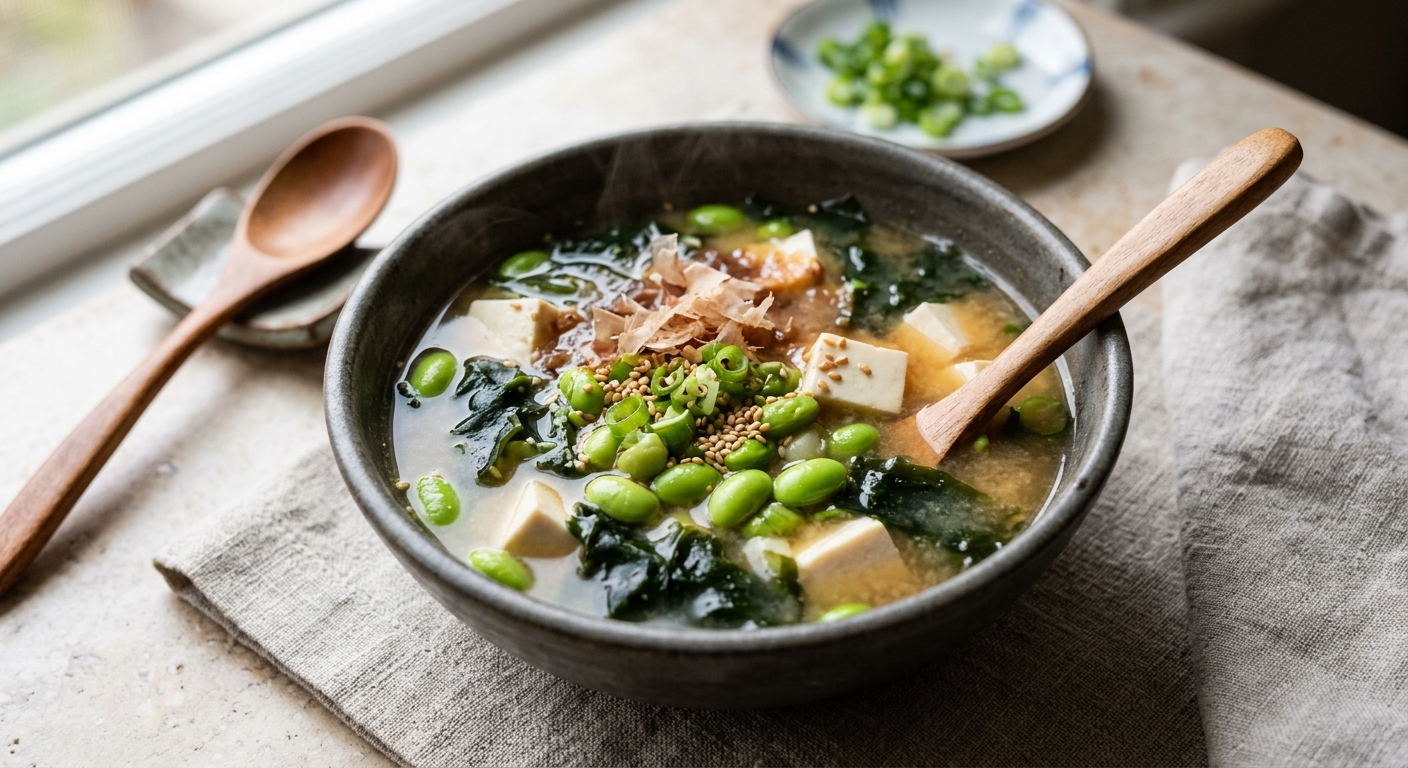
Most people think of miso soup as a light appetizer, a small bowl of warmth served before sushi. But this version is something else entirely. Built around silken tofu, shelled edamame, and rehydrated wakame seaweed in a kombu-and-bonito dashi base, this Bone Health Bowl is a clinically compelling meal that targets the two nutrients most consistently linked to skeletal integrity: calcium and vitamin K. One serving provides roughly 820mg of calcium and over 200mcg of vitamin K, both critical for bone mineral density, and both notoriously difficult to source from a single dish.
The synergy here is not accidental. Wakame seaweed is one of the most calcium-dense foods by weight on the planet, delivering around 150mg per 10g dry portion. Edamame contributes isoflavones, particularly genistein, which clinical trials have associated with reduced bone resorption in postmenopausal women. Silken tofu adds a second calcium source along with complete protein containing all nine essential amino acids, essential for maintaining the collagen matrix that gives bone its flexibility. Miso paste, fermented from soybeans, contributes vitamin K2 in the form of MK-7, the specific menaquinone form that activates osteocalcin, the protein that binds calcium into bone tissue rather than letting it drift into arterial walls.
Technically, this soup rewards attention to temperature and timing. Miso is a live fermented food and its beneficial enzymes and delicate glutamate compounds degrade above 70 degrees Celsius, so it is always stirred in off the heat. Wakame blooms from a dry tangle to silky emerald ribbons in under five minutes of soaking, and tofu needs only gentle warming to reach the right custardy texture. Each cooking method below honors these sensitivities differently, from the precise low-heat control of a stovetop finish to the slow cooker’s long gentle simmer that deepens the dashi, to the pressure cooker’s rapid broth extraction that concentrates minerals in a fraction of the time.
4
servings
Ingredients
- 1200 mlcold water
- 20 gdried kombu (kelp), wiped clean with a damp cloth
- 15 gkatsuobushi (bonito flakes)
- 200 gsilken tofu, cut into 1.5cm cubes
- 150 gfrozen shelled edamame, thawed
- 18 gdried wakame seaweed
- 80 gwhite (shiro) miso paste
- 30 gred (aka) miso paste
- 4 stalksspring onions (scallions), thinly sliced
- 2 tsptoasted sesame oil
- 1 tsplow-sodium soy sauce
- 8 gtoasted sesame seeds
- —Colima Sea SaltMicroplastic Free Salt to taste (add cautiously as miso is already salty)
Instructions
Click on an item below to shop for the recommended items for this recipe on Amazon.
As an Amazon Associate, we earn from qualifying purchases.
- Place the kombu in a medium saucepan with the 1200ml of cold water. Let it soak for 10 minutes at room temperature. This cold-start extraction draws out maximum glutamic acid and minerals without the bitter compounds that release above 60C.
- Set the saucepan over medium-low heat and slowly bring the water to 60C (use a probe thermometer if you have one, or watch for the very first tiny bubbles forming on the kombu). Hold at this temperature for 10 minutes, then remove the kombu with tongs and discard or reserve for a second use.
- Increase heat to medium-high and bring the kombu stock to a gentle boil. Remove from the heat, add the katsuobushi, and let it steep undisturbed for 3 minutes. Line a sieve with a paper towel and strain the dashi into a bowl. Discard the spent flakes. You now have approximately 1100ml of clear dashi.
- Meanwhile, place the dried wakame in a small bowl, cover with cold water, and soak for 5 minutes until it blooms into silky dark-green ribbons. Drain, gently squeeze out excess water, and roughly chop any very large pieces.
- Return the dashi to the saucepan over medium heat. Add the thawed edamame and bring to a gentle simmer. Cook for 3 minutes until the edamame are heated through and tender. Gently add the silken tofu cubes and warm for a further 2 minutes, stirring as little as possible to avoid breaking them up.
- Remove the pan completely from the heat. In a small bowl, ladle about 80ml of hot broth and whisk in the white miso and red miso until fully dissolved with no lumps. Pour this mixture back into the pan and stir gently to incorporate. Add the soy sauce and sesame oil.
- Add the rehydrated wakame to the soup and stir gently. Taste and adjust salt if needed, remembering the miso and soy carry significant sodium. Ladle into warmed bowls, garnish generously with spring onion slices and a pinch of toasted sesame seeds, and serve immediately.
- Place the dried kombu pieces directly into the slow cooker insert. Add the 1200ml of cold water. Do not add anything else yet. Set the slow cooker to Low, cover, and allow the kombu to cold-steep for 30 minutes before turning on, if your schedule allows, to start the glutamate extraction before heat is applied.
- After the cold steep (or immediately if skipping that step), switch the slow cooker to Low and let the kombu steep in the warming water for 2 hours. The temperature on Low typically reaches 75 to 85C, which is ideal for mineral extraction without bitterness. After 2 hours, remove and discard the kombu using tongs.
- Add the katsuobushi directly to the slow cooker insert. Replace the lid and continue cooking on Low for 30 minutes. The long, gentle steeping of bonito in a slow cooker produces a rounder, less sharp dashi than the quick stovetop version. After 30 minutes, strain the broth through a fine-mesh sieve back into the insert, discarding the spent flakes.
- Add the thawed edamame to the strained dashi in the slow cooker. Replace the lid and cook on Low for 45 minutes until the edamame are very tender and have begun to absorb some of the broth flavor. Gently nestle the silken tofu cubes into the broth for the last 15 minutes of cooking, replacing the lid carefully.
- While the tofu warms, place the dried wakame in a small bowl of cold water and soak for 5 minutes. Drain and roughly chop. Turn the slow cooker off and remove the lid. In a small bowl, ladle out about 80ml of the hot broth and whisk both the white and red miso pastes into it until completely smooth. Stir this miso slurry and the soy sauce back into the slow cooker insert along with the sesame oil and rehydrated wakame.
- Allow the soup to rest for 3 minutes so the miso distributes evenly and the wakame warms through without any further cooking. Ladle into bowls, top with sliced spring onions and toasted sesame seeds, and serve immediately.
- Add the kombu and 1200ml of cold water to the pressure cooker inner pot. If time allows, let it soak at room temperature for 10 minutes before sealing. This pre-soak step measurably increases glutamic acid in the final broth. Add the katsuobushi directly to the pot as well, since the pressure extraction will handle both components simultaneously.
- Seal the lid and set the valve to Sealing. Select Manual or Pressure Cook on High pressure for 5 minutes. The pot will take approximately 8 to 10 minutes to come to pressure. While it pressurizes, place the dried wakame in a bowl of cold water to soak for 5 minutes, then drain and roughly chop.
- Once the 5-minute cook time is complete, allow a Natural Pressure Release for 5 minutes, then carefully switch the valve to Venting for a Quick Release of the remaining pressure. Open the lid away from you. The broth will be a deep golden amber. Strain the dashi through a fine-mesh sieve into a bowl, pressing the spent kombu and katsuobushi gently to extract all liquid. Discard the solids and return the clear dashi to the pot.
- Switch the Instant Pot to Saute on Low (or the lowest available Saute setting). Add the thawed edamame to the dashi and cook for 2 minutes. Gently lower in the silken tofu cubes and cook for 1 further minute, moving them as little as possible. Press Cancel to turn off the heat completely.
- In a small bowl, ladle about 80ml of broth from the pot and whisk in both miso pastes until smooth and lump-free. Pour this mixture back into the pot along with the soy sauce, sesame oil, and rehydrated wakame. Stir gently to combine. The residual heat of the pot will warm the miso and wakame without cooking them further, preserving the live cultures and the seaweed’s texture.
- Taste for seasoning, then ladle into bowls. Top each serving with sliced spring onions and a pinch of toasted sesame seeds. Serve immediately while hot.
Nutrition Breakdown
Per 1 serving (makes 4)
Vitamins & Minerals
% Daily Value based on a 2,000 calorie diet (FDA reference)
🧬 Essential Amino Acids
% of recommended daily intake (RDA) per serving
🛡 Antioxidant Profile
The Nutrition Science
Bone is not inert mineral. It is a dynamic living tissue constantly being broken down by osteoclasts and rebuilt by osteoblasts in a process called bone remodeling. Two nutrients sit at the center of healthy remodeling: calcium, which provides the raw mineral for hydroxyapatite crystals, and vitamin K2 (specifically the long-chain MK-7 form), which activates the protein osteocalcin that physically embeds calcium into bone tissue rather than allowing it to remain free in the bloodstream. Without sufficient K2, calcium supplementation alone can paradoxically increase arterial calcification. This soup provides both nutrients in their most bioavailable forms: ionic calcium from wakame seaweed and MK-7 from fermented red miso paste.
The isoflavones genistein and daidzein from tofu and edamame add a third layer of skeletal protection. Multiple randomized controlled trials have demonstrated that 54mg per day of soy isoflavones, an amount comparable to what this soup provides, significantly reduces urinary markers of bone resorption, including N-telopeptide, in postmenopausal women. The mechanism is receptor-mediated: genistein binds the beta isoform of the estrogen receptor, which is expressed at high density in osteoblasts, slowing the decline in bone-forming activity that occurs with falling estrogen levels. Younger adults benefit too, as isoflavones also suppress the inflammatory cytokine RANKL, which drives osteoclast differentiation regardless of hormonal status.
Wakame seaweed brings a compound not found in any land food: fucoxanthin, a xanthophyll carotenoid responsible for its distinctive brown pigment. In vitro and animal studies demonstrate that fucoxanthin directly inhibits RANKL-induced osteoclastogenesis and activates the Wnt signaling pathway that promotes osteoblast proliferation. Additionally, kombu is among the richest dietary sources of iodine, a mineral required for thyroid hormone synthesis. Thyroid hormones play a direct role in skeletal maturation and longitudinal bone growth, and subclinical hypothyroidism is an underrecognized contributor to reduced bone mineral density, particularly in women over 40.
Pro Tips
- Never boil miso. Once added, miso should never exceed 70C or you will destroy the live Lactobacillus cultures and cause the delicate glutamate compounds to break down into bitter fragments. Always add miso off the heat using the broth-dissolving method described.
- Choose your miso ratio for nutrition: white (shiro) miso is sweeter and lower in sodium, while red (aka) miso is fermented longer and contains higher concentrations of vitamin K2-producing bacteria. The 80g to 30g split in this recipe balances flavor depth with sodium management.
- Rehydrate wakame only as long as needed. Five minutes in cold water is sufficient. Over-soaking past 15 minutes causes the seaweed to become excessively soft and slightly slimy, and some of the water-soluble minerals including calcium leach into the soaking water. Drain promptly and do not discard the tofu water either, as it contains dissolved calcium.




This is exactly the kind of recipe I’ve been searching for, honestly. The K2 point Veronika made really resonates with me because I’ve learned through my own health journey that nutrient synergy matters so much more than isolated micronutrients, especially when you’re managing inflammation and trying to support myelin integrity alongside bone health. I’m curious whether the dashi broth you’re using is iodine-rich, since that’s another piece of the neurological puzzle I’m always tracking? Either way, thank you for putting this together with such thoughtful nutrient density in mind.
This is such a smart bone-building formula, and I love that you’re highlighting the K2 angle since so many people focus solely on calcium without realizing vitamin K2 is what actually directs that calcium into bone matrix. One quick note for anyone on warfarin or other anticoagulants: the consistent vitamin K2 from regular miso soup consumption is actually great (it stabilizes INR better than erratic intake), but definitely worth discussing timing with your pharmacist if you’re adjusting doses. I started recommending this exact combo to patients whose statins were causing myalgia, since the bioavailable minerals plus the anti-inflammatory miso seemed to help without any interactions. Definitely making this
You’ve touched on something I wish more people understood, Veronika – that consistency with nutrient-dense foods like this is actually more stabilizing than avoiding them altogether, and I’m going to be bringing your warfarin point into my next class discussion because my students need to hear that from someone who works with patients directly. I’ve been making miso soup for forty years, but honestly the functional angle you’re highlighting, especially around K2 and mineral bioavailability, has completely deepened how I teach it now – I used to focus on the comfort and umami, and now I’m able to explain *why* people feel better when they eat it regularly beyond just “it’s nourishing.” This recipe