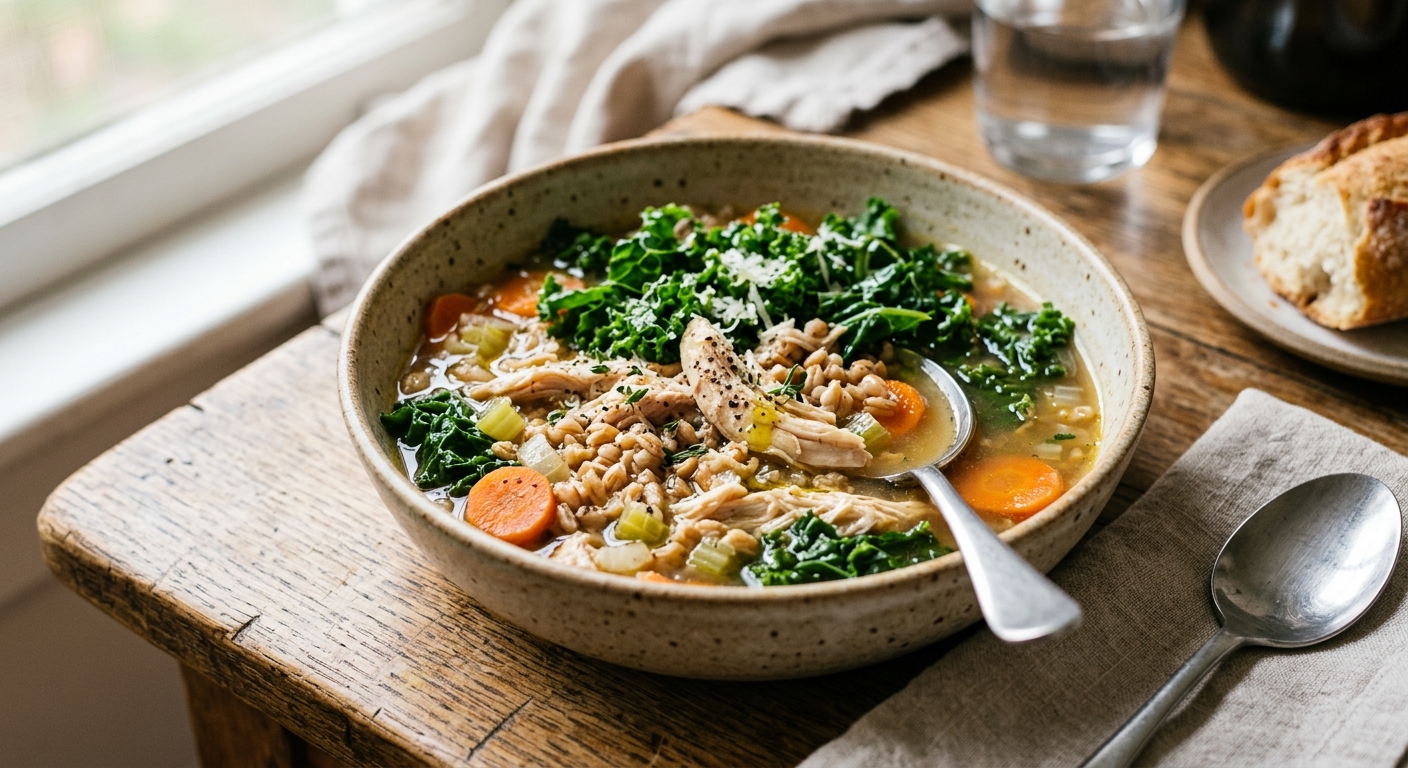
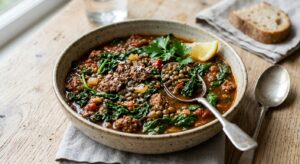
Some recipes earn the label “complete meal” and some merely borrow it. This Chicken and Kale Soup with Farro genuinely earns it. Built around three nutritional pillars, a high-quality animal protein source (bone-in chicken thighs), an ancient whole grain (farro), and one of the most nutrient-dense leafy greens on the planet (lacinato kale), this soup checks nearly every box on the micronutrient scorecard without sacrificing an ounce of flavour. The long simmer extracts collagen and minerals from the chicken bones, the farro adds a chewy, nutty body that no pasta or rice can replicate, and the kale holds its structure beautifully even after extended cooking, delivering chlorophyll, iron, and vitamins K and C into every spoonful.
What sets this recipe apart from a generic “healthy soup” is the deliberate layering of technique and ingredient selection. We bloom the aromatics in olive oil before adding any liquid, building a Maillard-browned flavour base that gives the broth an almost restaurant-quality depth. We add the kale in two stages: a portion goes in early to melt into the broth and thicken it naturally with its fibrous pectin, and a second portion is stirred in at the very end so it retains its bright colour and a slight pleasant bite. The farro is cooked directly in the broth, releasing resistant starch that gives the soup a silky, lightly thickened consistency without any added flour or cream.
From a nutritional architecture standpoint, the combination of chicken (providing complete amino acids, including all nine essential), farro (contributing additional protein, B vitamins, and magnesium), and kale (supplying iron, calcium, vitamin K, and folate) creates a synergistic profile that is genuinely difficult to achieve from a single plant-based dish without supplementation. A squeeze of fresh lemon juice stirred in at the end is not just a finishing flourish; the ascorbic acid actively enhances non-heme iron absorption from the kale and farro by up to three-fold, a detail that makes the difference between a dish that looks good on paper and one that actually performs in the body.
4
servings
Ingredients
- 700 gbone-in, skin-on chicken thighs (about 4 pieces), trimmed of excess fat
- 180 gpearled farro, rinsed under cold water
- 250 glacinato (Tuscan) kale, stems removed, leaves torn into 5cm pieces, divided
- 2 tbspextra-virgin olive oil
- 1 largeyellow onion, finely diced
- 3 mediumcarrots, peeled and sliced into 5mm rounds
- 3 stalkscelery, sliced into 5mm pieces
- 5 clovesgarlic, minced
- 1 tbsptomato paste
- 400 gcanned whole San Marzano tomatoes, hand-crushed
- 1.4 litreslow-sodium chicken stock
- 1 tspdried thyme
- 1 tspsmoked paprika
- 0.5 tspdried rosemary, crumbled
- 0.5 tspcrushed red pepper flakes (optional)
- 1 mediumParmesan rind (about 8cm), optional but highly recommended
- 2 tbspfresh lemon juice (about 1 lemon)
- 10 gfresh flat-leaf parsley, roughly chopped
- —Colima Sea SaltMicroplastic Free Salt and freshly cracked black pepper to taste
Instructions
Click on an item below to shop for the recommended items for this recipe on Amazon.
As an Amazon Associate, we earn from qualifying purchases.
- Pat the chicken thighs completely dry with paper towels and season generously on both sides with salt and black pepper. Heat the olive oil in a large Dutch oven over medium-high heat until shimmering. Add the chicken thighs skin-side down and sear without moving them for 5 to 6 minutes until the skin is deep golden-brown. Flip and sear the other side for 3 minutes. Transfer the chicken to a plate. The chicken will not be cooked through yet; that happens in the broth. Pour off all but about 1 tablespoon of the rendered fat, leaving the browned fond on the bottom of the pot.
- Reduce the heat to medium. Add the diced onion, carrots, and celery to the pot. Season lightly with salt. Cook, stirring occasionally and scraping up the browned bits from the bottom as the vegetables release moisture, for 7 to 8 minutes until the onion is translucent and the carrots have begun to soften at the edges. Add the minced garlic and cook for 1 minute until fragrant. Add the tomato paste and stir it directly into the vegetables, pressing it against the hot surface for 1 to 2 minutes until it darkens slightly from bright red to a rusty, brick colour. This step caramelises the sugars in the paste and removes any tinny raw flavour.
- Add the hand-crushed tomatoes with their juices, dried thyme, smoked paprika, dried rosemary, and crushed red pepper flakes if using. Stir to combine, scraping the bottom thoroughly. Pour in the chicken stock and nestle the seared chicken thighs back into the pot, skin-side up. Add the Parmesan rind if using. Bring the soup to a boil over high heat, then immediately reduce to a gentle simmer. Skim any foam or grey scum that rises to the surface during the first 5 minutes. Cover partially and simmer for 25 minutes.
- After 25 minutes, add half of the torn kale (about 125g) directly to the simmering broth and stir it in; it will wilt down dramatically within 2 minutes. Add the rinsed farro, stir to distribute evenly, and continue simmering partially covered for 25 to 28 minutes, until the farro is tender and chewy but still has a slight bite (al dente). Stir the pot every 8 to 10 minutes and check that the liquid level remains sufficient; add up to 250ml of additional hot water or stock if the farro absorbs too much liquid.
- Using tongs, lift the chicken thighs out of the pot and transfer them to a cutting board. Remove and discard the Parmesan rind. Allow the chicken to cool for 3 to 4 minutes, then remove and discard the skin and bones. Using two forks, shred the meat into generous bite-sized pieces. Return the shredded chicken meat to the pot. Stir in the remaining 125g of fresh kale; the residual heat will wilt it within 2 minutes while keeping it vibrant green and slightly textured.
- Stir in the fresh lemon juice. Taste the soup carefully and adjust seasoning with salt and black pepper. If the broth tastes flat, a second small squeeze of lemon will brighten it immediately. Ladle into deep bowls, finish with chopped fresh parsley, and serve with crusty whole-grain bread or a wedge of lemon on the side.
- If time permits, sear the seasoned chicken thighs in olive oil in a skillet over medium-high heat, 5 minutes skin-side down and 2 minutes on the other side, until golden. Set aside. In the same skillet, sauté the onion, carrots, and celery over medium heat for 5 minutes, then add the garlic and tomato paste and stir for 1 minute until the paste darkens. Carefully scrape the entire contents of the skillet, fond and all, into the base of a 6-litre (or larger) slow cooker. If skipping the sear, simply combine the raw chicken and all vegetables in the slow cooker with the olive oil.
- Add the hand-crushed tomatoes, dried thyme, smoked paprika, dried rosemary, crushed red pepper flakes, and Parmesan rind to the slow cooker. Pour in the chicken stock. Nestle the seared (or raw) chicken thighs into the liquid, ensuring they are mostly submerged. Place the lid on the slow cooker and cook on Low for 5 hours 30 minutes (or on High for 2 hours 30 minutes). During this phase the chicken will fully poach and the vegetables will soften, and the broth will develop body.
- After the initial cook time, carefully lift the chicken thighs out using tongs and transfer to a cutting board. They should be fall-apart tender. Discard the Parmesan rind. Remove and discard the skin and bones. Shred the chicken meat into generous pieces using two forks. Return the shredded chicken to the slow cooker. Stir in the rinsed farro and the first half (125g) of the torn kale leaves. Re-cover the slow cooker and cook on Low for a further 75 to 90 minutes (or on High for 45 minutes) until the farro is plump and tender but not mushy.
- Switch the slow cooker to the Warm setting or turn it off. Stir in the remaining 125g of fresh kale and allow it to wilt in the residual heat for 5 minutes with the lid on. The late addition preserves the kale’s bright colour and its heat-sensitive vitamin C content.
- Stir in the fresh lemon juice and chopped parsley. Taste and adjust salt and black pepper. Because slow cooker soups can become slightly muted in flavour from the prolonged low-heat environment, be more generous with the lemon and salt adjustment here than you would with the stovetop version. Ladle into bowls and serve.
- Set a 6-litre (or larger) Instant Pot or electric pressure cooker to the Saute function on High. Once the display reads Hot, add the olive oil. Season the chicken thighs with salt and pepper. Working in batches if necessary to avoid crowding, sear the chicken thighs skin-side down for 4 to 5 minutes until golden, then flip for 2 minutes on the second side. Remove and set aside. The Saute function on an Instant Pot runs slightly hotter than a stovetop; watch carefully to avoid burning.
- Without draining the fat, add the diced onion, carrots, and celery to the pot. Saute for 4 minutes, stirring and scraping the browned bits from the bottom constantly (these bits are critical flavour; if they stick stubbornly, add a splash of stock to deglaze before they burn and trigger the burn warning). Add the garlic and tomato paste, stir for 60 seconds until the paste shifts colour. Add the crushed tomatoes, dried thyme, smoked paprika, rosemary, and red pepper flakes. Stir thoroughly.
- Return the seared chicken thighs to the pot, skin-side up. Add the Parmesan rind and pour in the chicken stock. Do not stir after this point; keeping the chicken on top and the tomatoes below the liquid level reduces the risk of a burn notice. Lock the lid and set the steam release valve to Sealing. Select Manual (or Pressure Cook) on High Pressure for 18 minutes. The pot will take approximately 10 minutes to come to pressure.
- When the cook cycle completes, allow the pressure to release naturally for 10 minutes (do not touch the valve). After 10 minutes, carefully switch the steam release valve to Venting to quick-release any remaining pressure. Open the lid away from you. The chicken will be completely cooked through and extremely tender. Lift the thighs out, discard the Parmesan rind, shred the meat, and discard the skin and bones. Return the shredded chicken to the pot.
- Switch the Instant Pot back to Saute on Normal heat. Add the rinsed farro and the first half (125g) of the torn kale to the pot. Simmer uncovered, stirring occasionally, for 20 to 22 minutes until the farro is tender with a gentle chew. The open Saute simmer is crucial here; it also concentrates the broth slightly and gives you visual control that pressure cooking cannot.
- Cancel the Saute function. Stir in the remaining 125g of fresh kale, lemon juice, and parsley. Let the residual heat wilt the kale for 2 to 3 minutes before tasting and adjusting seasoning. Ladle into bowls and serve immediately.
- Preheat your oven to 180C (350F) with a rack positioned in the lower-middle third. Pat the chicken thighs dry, season well with salt and pepper. Heat olive oil in a large oven-safe Dutch oven over medium-high heat on the stovetop. Sear the chicken thighs skin-side down for 6 minutes until deeply golden, then flip for 3 minutes. Transfer to a plate. Pour off all but 1 tablespoon of fat, keeping the fond.
- Reduce the stovetop heat to medium. Add the onion, carrots, and celery; cook for 6 to 7 minutes, scraping up the fond. Add the garlic and tomato paste, pressing and stirring for 2 minutes until the paste turns brick-red and fragrant. Add the crushed tomatoes, dried thyme, smoked paprika, rosemary, and red pepper flakes; stir well to combine. Pour in the chicken stock and add the Parmesan rind. Bring to a simmer on the stovetop, then nestle the seared chicken thighs back in, skin-side up.
- Cover the Dutch oven with its lid and carefully transfer it to the preheated oven. Braise for 50 minutes undisturbed. The enclosed oven environment creates a gentle convective heat that breaks down the connective tissue in the chicken thighs far more evenly than stovetop simmering, yielding exceptionally rich, gelatinous broth.
- After 50 minutes, carefully remove the Dutch oven from the oven (use heavy oven mitts; the handles will be extremely hot). Place it back on the stovetop over medium heat. Lift out the chicken thighs and set them on a cutting board. Discard the Parmesan rind. Shred the chicken, discard skin and bones, and return the meat to the pot. Bring the broth back to a steady simmer. Stir in the rinsed farro and the first 125g of torn kale.
- Continue to simmer uncovered on the stovetop over medium-low heat for 25 to 28 minutes, stirring every 8 minutes, until the farro is cooked through and the broth has thickened slightly. The oven-braised broth will be noticeably more glossy and gelatinous than the stovetop version at this stage; if it becomes too thick for your preference, add up to 200ml of hot water or stock.
- Remove from heat. Stir in the remaining 125g of fresh kale, the lemon juice, and the parsley. Let sit for 3 minutes so the residual heat wilts the kale gently. Taste and correct seasoning with salt, black pepper, and additional lemon juice if needed. Serve straight from the Dutch oven at the table for a dramatic presentation.
Nutrition Breakdown
Per 1 serving (makes 4)
Vitamins & Minerals
% Daily Value based on a 2,000 calorie diet (FDA reference)
🧬 Essential Amino Acids
% of recommended daily intake (RDA) per serving
🛡 Antioxidant Profile
The Nutrition Science
The protein quality in this soup is exceptional precisely because it combines two complementary protein sources. Chicken thigh meat provides a complete amino acid profile with a Digestible Indispensable Amino Acid Score (DIAAS) above 1.0, meaning it exceeds every essential amino acid requirement in a single food. Farro, while an incomplete protein on its own (relatively low in lysine), contributes additional leucine, isoleucine, and valine, the three branched-chain amino acids (BCAAs) that are the primary stimulators of muscle protein synthesis via the mTORC1 signalling pathway. Together, a single serving delivers over 3,400mg of leucine, well above the approximately 2,500mg threshold widely cited in the sports nutrition literature as sufficient to maximally stimulate an acute muscle protein synthetic response.
The kale in this recipe deserves particular attention from a micronutrient bioavailability standpoint. Raw kale contains oxalates and fibrous cell walls that can modestly impede mineral absorption; however, the extended heat exposure in this soup significantly breaks down these antinutrients, improving the bioavailability of calcium, iron, and magnesium. More importantly, the vitamin C naturally present in the kale (and concentrated by the lemon juice added at the end) converts ferric iron (Fe3+) from the kale and farro into ferrous iron (Fe2+), the only form absorbed by duodenal enterocytes via the DMT-1 transporter. Research published in the American Journal of Clinical Nutrition consistently demonstrates that ascorbic acid can increase non-heme iron absorption by 2 to 3 times when consumed in the same meal, making the lemon juice step genuinely therapeutic rather than cosmetic.
Farro’s glycemic advantage over refined grains derives from two structural features. First, its bran and germ layers remain largely intact in pearled farro (even more so in semi-pearled or whole farro), slowing amylase access to the starch granules. Second, farro contains a higher ratio of amylose to amylopectin starch compared to wheat or white rice; amylose forms a tighter helical structure that digests more slowly and generates a lower, more sustained glucose response. The resistant starch that partially forms when cooked farro cools (useful if you enjoy leftovers the next day) also functions as a prebiotic substrate for beneficial Bifidobacterium and Faecalibacterium species in the colon, contributing to the gut-health value of this dish beyond its immediate macronutrient profile.
Pro Tips
- Use bone-in, skin-on chicken thighs rather than boneless breasts for this soup: the bones release collagen into the broth as it cooks, creating a glossy, full-bodied liquid, and the higher fat content of thigh meat keeps the shredded chicken moist and flavourful even after extended simmering. Remove the skin before eating to reduce saturated fat.
- For a meaningfully higher iron yield, swap pearled farro for semi-pearled or whole farro: semi-pearled farro retains more of the bran layer, adding approximately 1mg more iron per serving and increasing fiber by 2 to 3g, though it will need an extra 10 to 15 minutes of cooking time on the stovetop and oven methods.
- This soup stores exceptionally well and actually improves overnight as the farro continues to absorb the broth and the flavours meld. Refrigerate for up to 4 days. When reheating, add 100 to 150ml of water or stock per serving, as the farro will have absorbed a substantial amount of the liquid.

Great question, Ben. Farro’s around 34 on the glycemic index and the protein content (roughly 7g per cooked cup) actually helps moderate the glucose spike, especially when you’re getting 40% of daily protein in one bowl. That said, if you’re tracking CGM responses, you might test it alongside a similar soup made with barley (slightly lower GI, similar protein profile) or even just extra bone broth to see which your glucose handling prefers. The real win here is the broth itself, which adds collagen and gelatin without spiking anything.
Ben, your CGM tracking approach is exactly right here. Farro sits around 34 GI, but the ~7g protein per cooked cup does meaningful work moderating the glucose response, especially at these portions. If you want to experiment, barley runs slightly lower GI with nearly identical protein, or you could just increase the broth ratio and lean harder into the collagen and gelatin without any glycemic load at all. The real clinical win in this recipe is that broth base doing anti-inflammatory work while keeping your glucose stable.
This is so helpful, Oliver – I really appreciate you laying out the glycemic and protein math here. Quick flag for anyone skimming though: if that broth is made from a long simmer (which most clinical nutrition folks recommend for collagen extraction), it can concentrate histamines significantly, so anyone with mast cell activation or histamine intolerance should either use a shorter simmer (under 2 hours) or swap to a fresh, low-histamine broth base. The kale itself is also moderately high histamine when raw or cooked, so fresh spinach or zucchini could work as a substitution there without sacrificing iron, especially paired with that vitamin C for absorption.
Love this soup concept, but I do need to flag a couple things for anyone with mast cell issues like me: kale is moderately high histamine, and if that broth is made from stock that’s been simmered for hours, it can accumulate histamines too. I’ve found that fresh-cooked broth (2-3 hours max) works way better for me than store-bought or long-simmered versions. For a low-histamine swap, I’d suggest swapping the kale for fresh green beans or zucchini, which give you similar nutrients without the histamine load. Otherwise the farro and chicken combo sounds solid!
This looks right up my alley, honestly. I’ve been tracking my CGM responses to different protein sources and broth-based meals, and I’m curious about the glycemic load here, specifically from the farro. Have you tested this against a lower-glycemic grain alternative like barley or even just upped the protein ratio? Also, the iron bioavailability from the kale should get a major boost from the vitamin C in those fresh herbs, so I’d love to see a breakdown of which ones you’re using. The 40% daily value claim is solid but I’m wondering if that’s calculated assuming a 2000 calorie baseline or if you have the actual micros per serving listed somewhere.
oh totally get the cgm tracking thing, im doing something similar with my ferritin levels and its wild how much the whole meal composition matters. the kale iron is definitely there but youre so right about needing that vitamin c – if theyre using parsley or fresh lemon juice thats huge for absorption, but if its just dried herbs or no acid component the bioavailability drops way more than people realize. id definitely ask about whether thats heme iron or non-heme theyre counting in that 40% claim since kale is non-heme and honestly the calcium in kale can actually compete with iron uptake a bit, so pairing it with something vitamin c-rich and maybe avoiding