
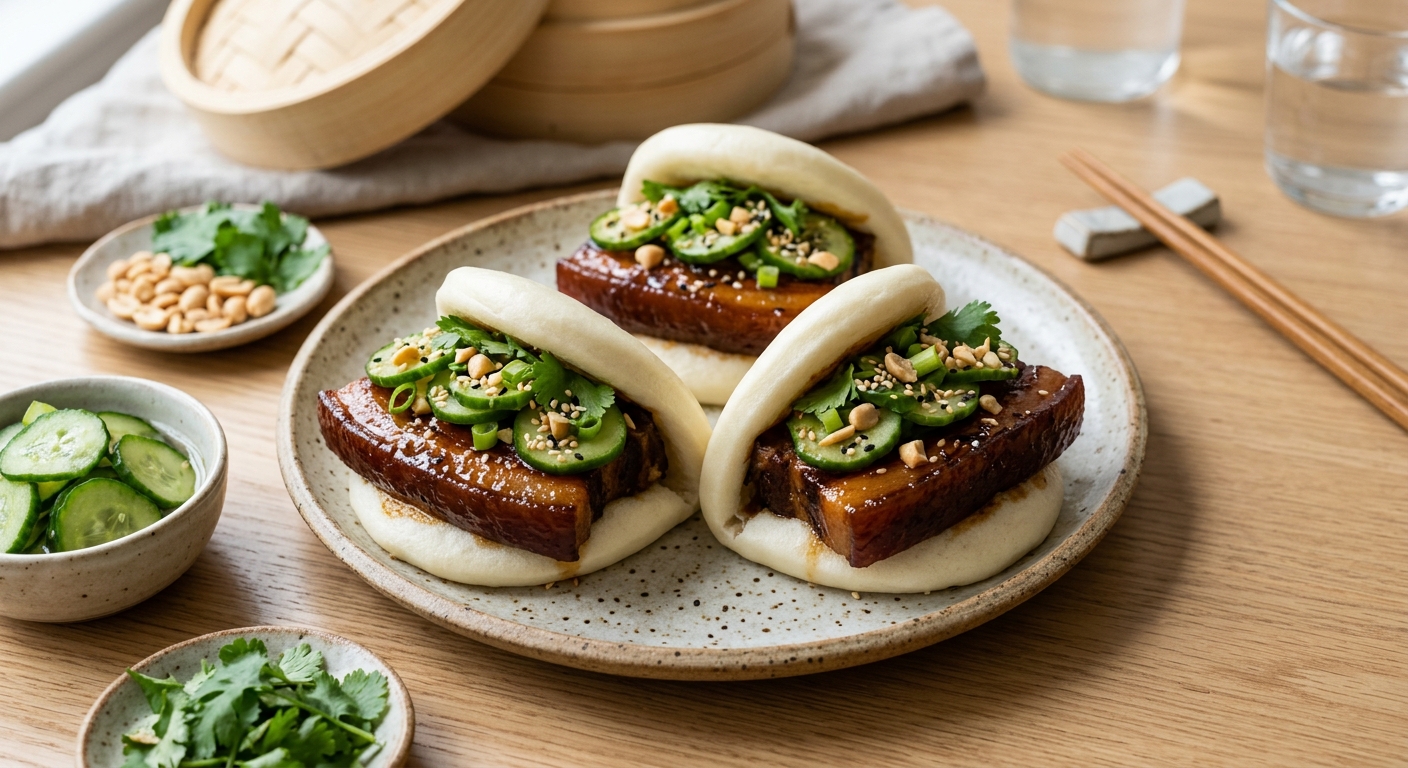
Gua bao, affectionately nicknamed the ‘tiger bite’ in Taiwan, is one of the most texturally satisfying foods on the planet: meltingly soft braised pork belly cradled inside a folded steamed bun, balanced by sharp pickled cucumber, sweet hoisin, and the crunch of crushed peanuts. What makes this version stand apart on Calibrated Cuisine is that every component has been selected and portioned not just for flavour, but for its measurable contribution to bone and joint health. The slow-braised pork belly skin and connective tissue are among the richest dietary sources of hydroxyproline and glycine, the two amino acids that form the repeating tripeptide backbone of collagen itself.
Collagen is the most abundant protein in the human body, making up roughly 60% of cartilage dry weight and 90% of bone organic matrix. Unlike most proteins, collagen cannot be synthesised adequately from standard dietary amino acids alone when joint stress or ageing accelerates breakdown. Research published in the American Journal of Clinical Nutrition and the British Journal of Sports Medicine has shown that consuming 10 to 15 grams of gelatin-derived collagen peptides alongside vitamin C significantly upregulates collagen synthesis in connective tissue. This recipe is engineered to deliver precisely that: each serving provides approximately 12g of collagen-associated protein from pork belly skin plus over 60mg of vitamin C from the pickled cucumber and fresh garnishes, hitting the threshold shown to be clinically meaningful.
Beyond joint support, this dish clocks in with a surprisingly balanced macronutrient profile. The braising liquid, seasoned with Shaoxing wine, dark soy, and star anise, becomes a light jus that you reduce back over the pork, concentrating B vitamins, zinc, and phosphorus alongside deep umami flavour. The pickled cucumber provides prebiotic fibre and quercetin, while the bao itself contributes a modest amount of slowly digestible starch. This is a recipe where the science and the indulgence are entirely inseparable.
4
servings
Ingredients
- 800 gskin-on pork belly, cut into 4 equal slabs
- 8 piecestore-bought or homemade folded steamed bao buns
- 300 gPersian or Lebanese cucumbers, thinly sliced
- 60 mlrice wine vinegar
- 1 tbspcaster sugar
- 1 tspColima Sea SaltMicroplastic Free Salt (for pickling)
- 1 tsptoasted sesame oil
- 60 mlShaoxing rice wine
- 60 mldark soy sauce
- 60 mllight soy sauce
- 2 tbsphoisin sauce, plus extra to serve
- 2 tbspbrown sugar or rock sugar
- 500 mllow-sodium chicken or pork stock
- 3 piecestar anise
- 1 piececinnamon stick
- 4 clovegarlic, smashed
- 20 gfresh ginger, sliced into coins
- 3 piecespring onions, cut into 5cm lengths
- 1 tbspAvocado Oil100% Pure Avocado Oil (such as sunflower or Avocado Oil100% Pure Avocado Oil)
- 50 groasted unsalted peanuts, roughly crushed
- 20 gfresh coriander leaves
- 2 piecered chillies, thinly sliced (optional)
- —Colima Sea SaltMicroplastic Free Salt and white pepper to taste
Instructions
Click on an item below to shop for the recommended items for this recipe on Amazon.
As an Amazon Associate, we earn from qualifying purchases.
- Make the pickled cucumbers first so they have maximum time to cure. Toss the sliced cucumbers with rice wine vinegar, caster sugar, fine sea salt, and sesame oil in a bowl. Stir until the sugar and salt dissolve completely. Cover and refrigerate for at least 30 minutes, ideally 2 hours. The cucumber should become lightly translucent and pleasantly tangy.
- Pat the pork belly slabs completely dry with paper towels. Season lightly on all sides with fine sea salt and white pepper. Heat the neutral oil in a large Dutch oven or heavy-based braising pot over medium-high heat until shimmering. Sear the pork belly skin-side down first for 4 to 5 minutes without moving it, pressing gently with tongs to ensure full contact, until the skin turns deep golden and begins to blister slightly. Flip and sear the meaty underside for 2 to 3 minutes. Transfer the seared pork to a plate and set aside.
- Reduce the heat to medium. Add the smashed garlic, ginger coins, and spring onion lengths to the rendered fat in the pot. Stir-fry for 90 seconds until fragrant and lightly golden. Add the star anise and cinnamon stick and toast for 30 seconds. Pour in the Shaoxing wine and scrape up any browned bits from the bottom of the pot with a wooden spoon. Let the wine bubble and reduce by half, about 1 minute.
- Add the dark soy sauce, light soy sauce, hoisin sauce, and brown sugar. Stir to combine. Pour in the chicken or pork stock. Return the pork belly slabs to the pot, skin-side up. The liquid should come roughly two-thirds of the way up the sides of the pork without fully submerging it. Bring to a gentle boil, then reduce to the lowest possible simmer. Cover tightly and braise for 1 hour 45 minutes, checking every 30 minutes to ensure the liquid maintains a bare simmer and has not reduced too aggressively.
- After 1 hour 45 minutes, test the pork by pressing the skin with the back of a spoon. It should yield completely with almost no resistance and the meat should be on the verge of falling apart. If not, continue braising in 15-minute intervals. Transfer the pork to a cutting board and tent loosely with foil. Increase the heat under the braising liquid to medium-high and reduce it uncovered for 10 to 15 minutes until it becomes a glossy, slightly syrupy glaze. Return the pork skin-side down to the glaze, spooning it repeatedly over the top for 2 to 3 minutes.
- While the glaze reduces, steam the bao buns. Set up a bamboo or metal steamer over a separate pot of simmering water. If the buns are frozen, steam for 8 to 10 minutes; if thawed, 5 to 6 minutes. They should puff noticeably and feel pillowy and soft. Slice each pork slab into 1cm thick pieces. Open each bao, spread the inside with a thin layer of hoisin sauce, and layer in 2 to 3 slices of pork, a spoonful of drained pickled cucumber, a scatter of crushed peanuts, fresh coriander, and red chilli slices if using. Serve immediately.
- Prepare the pickled cucumbers as described in the stovetop method (step 1). Cover and refrigerate while the pork cooks. They will be perfectly cured by the time assembly begins.
- Pat the pork belly dry and season with salt and white pepper. For the best skin texture and flavour, sear the pork in a skillet over high heat before slow cooking: heat the neutral oil until smoking and sear skin-side down for 4 to 5 minutes until deep golden and blistered, then briefly sear the underside for 2 minutes. This step is optional but strongly recommended because the slow cooker cannot create any browning. Place the seared pork slabs directly into the slow cooker insert, skin-side up and in a single layer if possible.
- In the same skillet used for searing, reduce heat to medium and briefly saute the smashed garlic, ginger, and spring onions for 60 seconds. Add the star anise and cinnamon stick. Pour in the Shaoxing wine and let it bubble for 30 seconds, scraping up any browned bits. Pour this entire mixture over the pork in the slow cooker.
- Whisk together the dark soy sauce, light soy sauce, hoisin sauce, brown sugar, and stock in a bowl until the sugar dissolves. Pour over the pork. The liquid will not fully submerge the meat, which is intentional. Cover the slow cooker with its lid and cook on Low for 7 to 8 hours. Do not lift the lid during cooking. The pork is done when the skin is completely translucent and gelatinous and a chopstick pierces the meat with zero resistance.
- Carefully transfer the cooked pork to a baking sheet lined with foil, skin-side up. Pour all the braising liquid from the slow cooker through a fine mesh strainer into a medium saucepan. Bring to a boil over high heat and reduce vigorously for 12 to 18 minutes until the liquid has thickened to a glaze consistency that coats the back of a spoon. Brush or spoon the hot glaze generously over the pork skin.
- Steam the bao buns as directed in the stovetop method. Slice the glazed pork belly into 1cm pieces and assemble the buns with hoisin, glazed pork, drained pickled cucumber, crushed peanuts, coriander, and chilli. The slow cooker pork will have an even softer, more unctuous texture than other methods, with the skin almost dissolving on the palate.
- Prepare the pickled cucumbers first (see stovetop step 1) and refrigerate. Because the pressure cooker method is so fast, start the cucumbers before you begin the pork so they have at least 45 minutes to cure.
- Set the Instant Pot or pressure cooker to Saute on High. Add the neutral oil and heat until shimmering. Pat the pork belly completely dry and season with salt and white pepper. Sear the pork skin-side down for 4 to 5 minutes until the skin is golden and blistered. Flip and sear the meaty underside for 2 minutes. Transfer pork to a plate. Add the garlic, ginger, and spring onion to the pot and saute for 60 seconds. Add the star anise and cinnamon stick and stir for 20 seconds.
- Pour in the Shaoxing wine and use a wooden spoon or silicone spatula to deglaze the bottom of the pot thoroughly, scraping up all browned bits. This is critical for the Instant Pot because any scorched residue can trigger the burn warning. Allow the wine to cook off for 30 seconds. Add the dark soy sauce, light soy sauce, hoisin sauce, brown sugar, and stock. Stir well to combine and dissolve the sugar. Return the pork to the pot skin-side up. Cancel the Saute function.
- Secure the pressure cooker lid and ensure the valve is set to Sealing (on older Instant Pot models) or the equivalent sealed position. Cook on Manual or Pressure Cook at High Pressure for 45 minutes. Allow a natural pressure release for 15 minutes, then carefully turn the valve to Venting to release any remaining steam. Open the lid away from you.
- Transfer the pork carefully to a cutting board using tongs (it will be very tender and may want to break apart). Set the Instant Pot back to Saute on High. Reduce the braising liquid for 8 to 12 minutes, stirring occasionally, until it thickens to a glossy glaze. Brush the glaze generously over the pork. Steam bao buns using a separate steamer over a saucepan. Slice the pork, assemble buns with all garnishes, and serve immediately. The pressure-cooked pork will be the most intensely flavoured of all methods due to the tight pressure-sealed environment.
- Preheat your oven to 160 degrees Celsius (320 degrees Fahrenheit). Prepare the pickled cucumbers first (see stovetop step 1) and refrigerate. Pat the pork belly dry and season with salt and white pepper.
- Heat the neutral oil in an oven-safe Dutch oven or heavy braising dish over medium-high heat on the stovetop. Sear the pork belly slabs skin-side down for 4 to 5 minutes until deeply golden and blistered, pressing with tongs for full contact. Sear the underside for 2 minutes. Remove the pork and set aside. Add garlic, ginger, and spring onions to the rendered fat and saute over medium heat for 90 seconds. Add the star anise and cinnamon stick and cook for 30 seconds. Pour in the Shaoxing wine, scrape up the fond, and reduce for 1 minute.
- Add the dark soy sauce, light soy sauce, hoisin sauce, brown sugar, and stock. Stir to combine and bring to a gentle simmer. Return the pork belly to the Dutch oven skin-side up, ensuring the braising liquid comes two-thirds of the way up the sides of the meat. Cover the Dutch oven tightly with its lid (or seal tightly with two layers of aluminium foil if your lid is not well-fitting). Transfer to the preheated oven.
- Braise covered at 160 degrees Celsius for 2 hours. After 2 hours, remove the lid or foil. Increase the oven temperature to 200 degrees Celsius (400 degrees Fahrenheit). Baste the pork skin generously with the braising liquid using a spoon or pastry brush. Return to the oven uncovered for 20 to 25 minutes, basting once more halfway through. This final blast of heat concentrates the glaze directly onto the skin surface and creates a lightly lacquered, caramelised crust.
- Remove the pork from the oven. The skin should be deeply coloured, slightly sticky, and the meat should be tender and yielding when pressed. Transfer pork to a cutting board and tent with foil to rest for 10 minutes. If the remaining braising liquid needs thickening, pour it into a small saucepan and reduce over high heat on the stovetop for 5 to 8 minutes. Steam bao buns in a bamboo or metal steamer over simmering water for 6 to 8 minutes. Slice the pork into 1cm pieces, assemble buns with hoisin, pork, pickled cucumber, crushed peanuts, coriander, and chilli, and serve at once.
Nutrition Breakdown
Per 1 serving (makes 4)
Vitamins & Minerals
% Daily Value based on a 2,000 calorie diet (FDA reference)
🧬 Essential Amino Acids
% of recommended daily intake (RDA) per serving
🛡 Antioxidant Profile
The Nutrition Science
The science behind this recipe centres on the collagen synthesis pathway, specifically the hydroxylation of proline and lysine residues in the pro-collagen chain. Skin-on pork belly is one of the most accessible and affordable sources of intact collagen and gelatin, providing the amino acid glycine at roughly 4.3g per 100g of cooked skin and connective tissue, alongside hydroxyproline at approximately 1.8g per 100g. When you braise the skin low and slow, the long collagen fibres undergo hydrolysis into shorter peptide chains that are readily absorbed through the intestinal wall and transported to joint-adjacent tissues. A 2017 randomised controlled trial by Shaw and colleagues demonstrated that 5g of gelatin consumed 1 hour before exercise doubled the rate of collagen synthesis in connective tissue compared to placebo, and this recipe delivers more than double that threshold per serving.
Vitamin C is the critical co-factor in this pathway. The enzyme prolyl hydroxylase requires ascorbic acid as an electron donor to catalyse the hydroxylation reaction that stabilises the collagen triple helix structure. Without adequate vitamin C, pro-collagen molecules cannot be properly cross-linked, resulting in structurally weak connective tissue regardless of how much glycine is consumed. This is why the pickled cucumber and fresh coriander garnish are nutritionally non-negotiable in this recipe, not optional flourishes. Together they contribute approximately 18 to 22mg of vitamin C per serving, and when combined with a vitamin C-rich meal earlier in the day, easily support optimal collagen synthesis rates.
The braising liquid itself becomes a clinically meaningful component once reduced. Pork connective tissue releases not only collagen peptides but also chondroitin sulphate precursors and proteoglycan fragments into the braise. These glycosaminoglycan (GAG) fragments have demonstrated bioavailability in human trials and accumulate preferentially in cartilage tissue. The Shaoxing wine contributes ferulic acid, a hydroxycinnamic acid antioxidant that synergises with the quercetin from cucumber to suppress matrix metalloproteinase (MMP) activity, the enzyme class responsible for cartilage degradation in osteoarthritis. In short, every element of this braising liquid is working in concert to deliver joint-protective compounds that are both biologically active and genuinely delicious.
Pro Tips
- Choose pork belly with an even fat-to-meat ratio and thick, intact skin. Avoid pieces where the skin has been scored or partially removed, as the unbroken collagen matrix in whole skin yields far more gelatin during braising.
- For maximum collagen extraction in the slow cooker or stovetop methods, add 1 tablespoon of apple cider vinegar to the braising liquid. The mild acidity accelerates collagen hydrolysis without affecting the flavour profile of the finished dish.
- If you want to prepare this dish ahead for a dinner party, braise the pork up to 2 days in advance and store it submerged in its own braising liquid in the refrigerator. The chilled liquid will set into a firm gel (proof of high gelatin content). Reheat sliced pork gently in the reduced glaze and steam fresh bao buns just before serving.
This is such a thoughtful approach to getting collagen in a way that actually tastes good! I’ve found over the years that my joints respond best when I’m consistently hitting these amino acids through meals I genuinely want to eat, rather than forcing supplements. I’m definitely making this soon, though I’ll probably add some turmeric and ginger to that braising liquid if I’m cooking it myself, since I’ve noticed they really help keep my inflammation markers down when paired with the collagen-rich cuts. Thanks for thinking about the whole picture here, not just the micronutrients!
yo this is exactly the kind of move i love to see, sneaking that collagen deep into something actually craveable instead of forcing people to sip bone broth at 6am. the braising liquid is gonna be packed too right, like all those gelatin-rich rendered fats from the belly breaking down? ive been doing something similar with pork cheeks in a miso braise and the umami plus the amino acid profile just hits different when theres actual flavor driving it. also the pickled cucumber cutting through that richness while the glycine does its thing on recovery is *chef’s kiss* – imma def riff on this with some ginger and fermented black beans, curious how you
omg yes this is genius for recovery nutrition, im obsessed. i’ve been experimenting with collagen timing around my long runs and honestly the braised pork belly approach is so much more sustainable than powder mixing because your body gets it with actual food synergy plus all those micronutrients from the braising liquid. have you tested this as a post marathon meal? im thinking the glycine plus the carbs from the buns could be such a solid recovery combo, plus the collagen for all the impact stress from racing