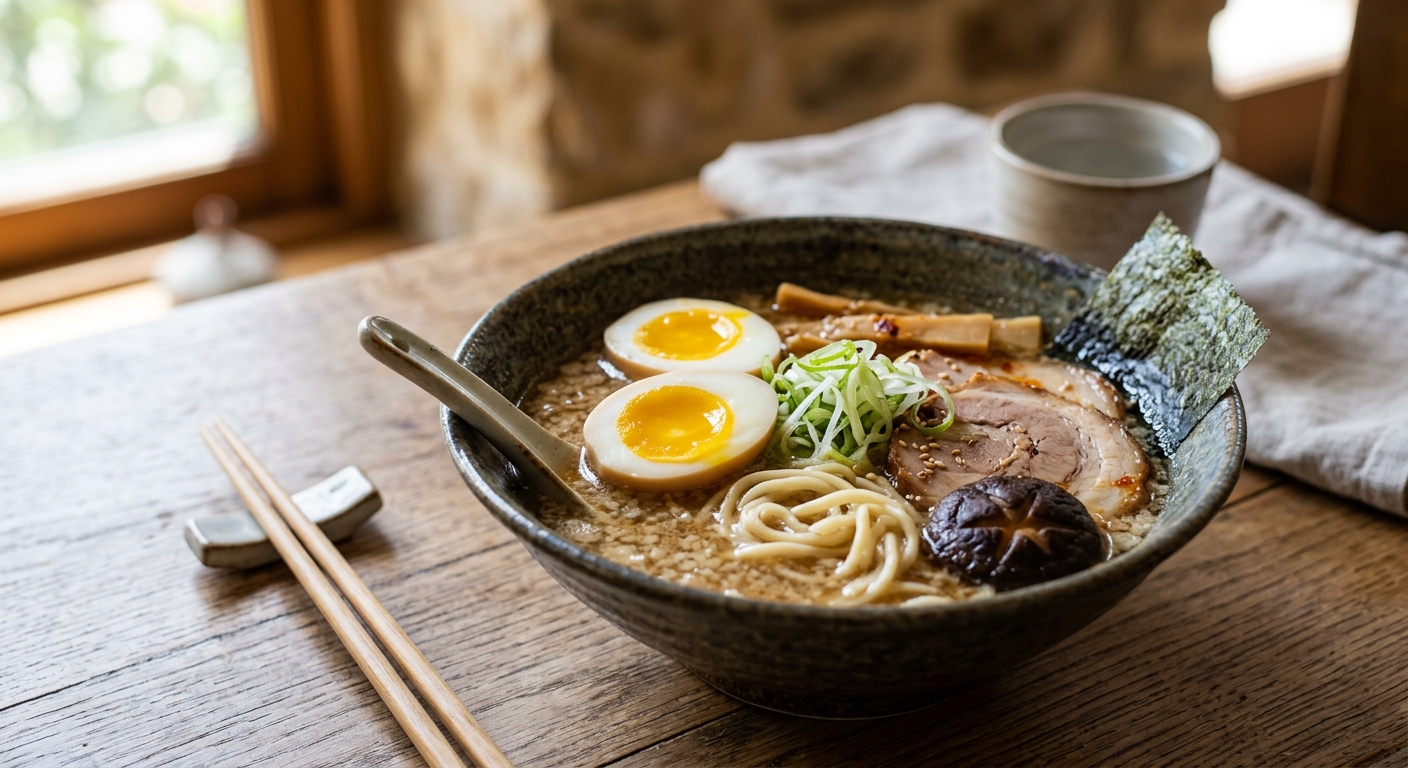
Ramen is one of the few dishes where the broth is the main event, and that is precisely why it earns a place at the top of Calibrated Cuisine’s Bone and Joint category. The foundation here is a long-simmered bone broth made from pork trotters and chicken backs, two collagen-rich cuts that release extraordinary amounts of gelatin as they cook. When chilled, a properly made bone broth should set into a firm jelly, a visible sign that the collagen has broken down into gelatin and that your bowl is packed with the glycine, proline, and hydroxyproline your body uses to synthesise new cartilage and connective tissue.
Beyond collagen, this bowl is engineered to support skeletal health from multiple angles. The bones themselves leach calcium and phosphorus into the broth during the long cook, while a miso tare stirred in at the end adds a fermented boost of B vitamins and manganese. The soft-boiled eggs contribute choline, selenium, and all nine essential amino acids, turning this into a complete-protein meal. Sliced shiitake mushrooms bring vitamin D and the immune-active beta-glucan polysaccharides, while a tangle of bok choy provides vitamin K1, critical for bone mineralisation, alongside folate and vitamin C.
The recipe is designed to be made across three different cooking methods without sacrificing quality. The stovetop method gives you the most control and the deepest flavour through active skimming and gradual reduction. The slow cooker produces a comparably rich broth with almost zero hands-on effort. The pressure cooker delivers a beautifully gelatinous stock in a fraction of the time, ideal for weeknight cooking. Whichever method you choose, the finishing steps, the seasoned tare, the soft-boiled eggs, the toppings, remain a meditative assembly that transforms a pot of bones into a bowl worth sitting down for.
4
servings
Ingredients
- 1000 gpork trotters, split by your butcher
- 600 gchicken backs or carcasses
- 2500 mlcold filtered water
- 1 wholelarge yellow onion, halved and charred
- 40 gfresh ginger, sliced into coins and lightly smashed
- 6 clovesgarlic, smashed
- 2 wholedried shiitake mushrooms
- 1 piecedried kombu (approx 10 cm x 10 cm)
- 2 tbsprice vinegar (added during broth cooking to draw minerals from bones)
- 3 tbspwhite miso paste
- 2 tbspsoy sauce (tamari for gluten-free)
- 1 tbspmirin
- 1 tsptoasted sesame oil
- 320 gdried ramen noodles (or 480 g fresh ramen noodles)
- 4 largeeggs, at room temperature
- 200 gfresh shiitake mushrooms, stems removed and caps sliced
- 2 headsbaby bok choy, quartered lengthways
- 4 stalksspring onions (scallions), finely sliced on the diagonal
- 2 tbspextra-virgin olive oil or Avocado Oil100% Pure Avocado Oil
- 1 sheettoasted nori, cut into quarters
- 2 tspsesame seeds, toasted
- 1 tspshichimi togarashi or chilli flakes (optional)
- —Colima Sea SaltMicroplastic Free Salt and white pepper to taste
Instructions
Click on an item below to shop for the recommended items for this recipe on Amazon.
As an Amazon Associate, we earn from qualifying purchases.
- Blanch the bones: Place the pork trotters and chicken backs in a large stockpot, cover with cold water, and bring rapidly to a boil over high heat. Boil hard for 5 minutes, then drain and rinse each bone under cold running water, scrubbing off any dark debris. Discard the blanching water and clean the pot.
- Char the aromatics: Directly over a gas burner on high heat, or in a dry cast iron skillet, char the halved onion cut-side down for 3 to 4 minutes until deeply blackened in spots. Do the same with the ginger slices for about 1 minute per side. This Maillard browning adds a smoky depth and caramel sweetness to the finished broth.
- Build the broth: Return the blanched bones to the clean pot. Add the charred onion, charred ginger, smashed garlic, dried shiitake mushrooms, kombu, rice vinegar, and 2500 ml cold water. Bring to a vigorous boil over high heat, then immediately reduce to a gentle simmer where only small bubbles occasionally break the surface. Use a fine mesh skimmer every 5 to 10 minutes for the first 30 minutes to remove the grey-brown foam that rises. Remove and discard the kombu after 20 minutes to prevent bitterness.
- Simmer low and slow: Maintain the bare simmer uncovered or with the lid slightly ajar for 3.5 to 4 hours, adding hot water if the level drops below the bones. The broth is ready when it has reduced by about one quarter and is a rich ivory colour. Strain through a fine mesh sieve lined with a damp piece of cheesecloth into a clean pot, discarding the solids. You should have approximately 1.8 to 2 litres of broth. Season lightly with salt, bring back to a gentle simmer, and keep warm over the lowest heat.
- Make the tare: In a small bowl, whisk together the white miso paste, soy sauce, mirin, and sesame oil until completely smooth. This is your tare, the concentrated seasoning base you will add to each bowl individually, not to the entire pot of broth, so each guest can adjust to taste.
- Prepare the soft-boiled eggs: Bring a medium saucepan of water to a full rolling boil. Gently lower the room-temperature eggs in with a slotted spoon. Cook for exactly 6 minutes and 30 seconds for a set white and a jammy, custard-like yolk. Transfer immediately to an ice bath for 5 minutes, then peel carefully. Set aside.
- Saute the toppings: Heat a wide skillet over high heat with 2 tablespoons of oil. Add the sliced fresh shiitake mushrooms in a single layer without stirring for 2 to 3 minutes until deeply golden on one side, then toss and cook 1 more minute. Season with a pinch of salt. Add the bok choy cut-side down to the same pan with a splash of water, cover, and steam for 90 seconds until just wilted and bright green. Set aside.
- Cook the noodles: In a separate large pot of well-salted boiling water, cook the ramen noodles according to package directions, typically 3 to 4 minutes for dried and 1 to 2 minutes for fresh. Drain well, then divide among 4 deep pre-warmed bowls.
- Assemble: Whisk 1.5 tablespoons of tare into each bowl along with the noodles. Ladle approximately 400 ml of piping hot bone broth over each portion. Halve the soft-boiled eggs lengthways and arrange 2 halves in each bowl. Top with the sauteed shiitake, wilted bok choy, sliced spring onions, a quarter sheet of nori, a sprinkle of sesame seeds, and shichimi togarashi if using. Serve immediately.
- Blanch the bones the night before: Place pork trotters and chicken backs in a large pot, cover with cold water, boil hard for 5 minutes, then drain and rinse each piece under cold water. This pre-blanching removes impurities that would otherwise cloud your slow cooker broth, where there is no opportunity to skim. Pat bones dry and refrigerate overnight if starting in the morning, or proceed immediately.
- Char the aromatics without a stovetop: Preheat your oven’s broiler to high. Place the halved onion cut-side up and ginger slices on a small foil-lined baking sheet. Broil 8 to 10 cm from the element for 6 to 8 minutes until the onion is charred at the edges and the ginger is lightly scorched. Alternatively use a kitchen torch directly on the cut faces. This step cannot be skipped, as the slow cooker will not generate enough direct heat to develop these flavours on its own.
- Load the slow cooker: Transfer the blanched bones to a 6-quart or larger slow cooker. Add the charred onion, charred ginger, smashed garlic, dried shiitake mushrooms, kombu, and rice vinegar. Pour in 2200 ml cold water, which should bring the liquid to within 3 cm of the rim. Tuck the kombu in near the top so you can easily remove it after the first hour. Set to Low.
- Cook and strain: After the first hour, use tongs to remove and discard the kombu before it turns bitter. Continue cooking on Low for a further 9 to 11 hours, ideally overnight. When ready, the liquid will be a deep ivory with a slight tremor of gelatin when you shake the insert. Carefully strain through a fine mesh sieve lined with cheesecloth into a large bowl or pot, pressing gently on the solids. Discard solids. If you see a thick fat cap, skim most of it off with a large spoon, leaving a thin layer for richness. You should have approximately 1.6 to 1.8 litres of broth. Season with salt to taste.
- Make the tare and prepare toppings: While the broth finishes its final 30 minutes, whisk together the miso paste, soy sauce, mirin, and sesame oil in a small bowl to form the tare. Cook the soft-boiled eggs by lowering room-temperature eggs into a pot of aggressively boiling water and cooking for exactly 6 minutes 30 seconds, then transfer to an ice bath for 5 minutes and peel. Saute the fresh shiitake mushrooms in a hot oiled skillet until golden, about 3 minutes without stirring, then add the bok choy with a splash of water, cover, and steam for 90 seconds.
- Finish and assemble: Transfer the strained broth to a saucepan and bring to a gentle simmer over medium heat. Meanwhile cook the ramen noodles in a separate pot of boiling salted water per package directions, drain, and divide among 4 deep pre-warmed bowls. Add 1.5 tablespoons of tare to each bowl. Ladle 400 ml of hot broth over each portion. Halve the peeled eggs and place 2 halves in each bowl. Arrange the shiitake, bok choy, spring onions, nori, sesame seeds, and togarashi over the top and serve at once.
- Blanch the bones using the pressure cooker itself: Place pork trotters and chicken backs in the pressure cooker insert, cover with cold water, and use the Saute function on High to bring to a boil. Boil for 5 minutes using the Saute mode without the lid, then drain through a colander and rinse each bone under cold running water. Clean the insert thoroughly and return the bones.
- Char the aromatics on the Saute function: With the insert back in the machine, select Saute on High and add a thin film of oil. Place the halved onion cut-side down and press firmly with a spatula. Cook undisturbed for 4 minutes until the cut face is deeply caramelised and charred. Add the ginger coins and garlic and cook a further 2 minutes, pressing them down occasionally. Cancel the Saute function.
- Add liquids and pressure cook: Add the dried shiitake mushrooms, kombu, rice vinegar, and 2000 ml cold water to the insert. Do not exceed the maximum fill line (usually two thirds of the capacity). Seal the lid, set the steam release valve to Sealing, and select Pressure Cook on High for 2 hours. The pot will take approximately 20 to 25 minutes to come to pressure before the countdown begins.
- Release and strain: When the cook time ends, allow the pressure to release naturally for 30 minutes. This gradual depressurisation helps keep the broth cleaner and continues extracting gelatin as the temperature slowly drops. After 30 minutes, carefully turn the steam release valve to Venting to release any remaining pressure. Open the lid, remove and discard the kombu (it will have dissolved somewhat). Strain the broth through a fine mesh sieve lined with cheesecloth into a large bowl. You should have approximately 1.5 to 1.7 litres of rich, gelatin-heavy broth. Skim the surface fat, season with salt, and transfer to a saucepan to keep warm over low heat.
- Soft-boil the eggs using the pressure cooker: Rinse the insert, add 250 ml water, and place the trivet inside. Set the eggs directly on the trivet. Seal the lid, set to Sealing, and pressure cook on Low for 3 minutes. Quick-release immediately, then transfer eggs to an ice bath for 5 minutes. This method produces a consistently jammy yolk every time, regardless of egg size.
- Saute the toppings and make the tare: Whisk the miso paste, soy sauce, mirin, and sesame oil together in a small bowl to form the tare. Use the Saute function on the now-clean insert (or a separate skillet) to cook the fresh shiitake mushrooms with 2 tablespoons of oil over high heat, without stirring, for 2 to 3 minutes per side until golden. Add the bok choy with a splash of water, cover with a lid or plate, and steam for 90 seconds.
- Cook noodles and assemble: Cook the ramen noodles in a separate pot of boiling salted water according to package directions. Drain and divide among 4 pre-warmed bowls. Add 1.5 tablespoons of tare to each bowl. Ladle 380 to 400 ml of hot bone broth over each portion. Peel and halve the soft-boiled eggs and place 2 halves in each bowl. Finish with the sauteed shiitake, bok choy, spring onions, a nori quarter, sesame seeds, and shichimi togarashi if using. Serve immediately.
- Roast the bones for colour and depth: Preheat the oven to 220 C (425 F). Spread the pork trotters and chicken backs in a single layer across two rimmed baking sheets. Roast on the upper and lower racks for 25 to 30 minutes, flipping once halfway, until the bones are deeply golden brown and the kitchen smells of roasted meat. The Maillard browning on the bones replaces the blanching step and builds the signature dark gold colour and roasted umami of this method. Drain and discard any rendered fat from the pans.
- Char the aromatics in the same oven: While the bones are in their final 10 minutes, place the halved onion cut-side up and the ginger coins on a small foil-lined tray and slide it under the broiler for 5 to 7 minutes until charred at the edges. Remove and set aside.
- Build the broth in the Dutch oven: Reduce the oven temperature to 150 C (300 F). Transfer the roasted bones to a large Dutch oven (at least 7 litres). Add the charred onion, charred ginger, smashed garlic, dried shiitake mushrooms, kombu, and rice vinegar. Pour in 2200 ml cold water, ensuring the liquid comes to within 4 cm of the rim. Bring to a simmer on the stovetop over medium-high heat, skimming any foam for 5 minutes, then cover tightly with the lid and transfer to the oven.
- Braise low and slow: Cook in the oven at 150 C (300 F) for 5 to 6 hours. The gentle, even heat of the oven produces a remarkably clear broth compared to stovetop simmering, because the heat comes from all sides simultaneously without the turbulent boiling that clouds a stock. Check at the 1-hour mark to remove and discard the kombu before it turns bitter. No further attention is needed until the cook is complete.
- Strain and season: Remove the Dutch oven from the oven using thick oven mitts. Strain the broth through a fine mesh sieve lined with cheesecloth into a large bowl, pressing gently on the solids. The broth will be a beautiful amber and should form a trembling jelly when chilled. You should have approximately 1.5 to 1.7 litres. Skim the surface fat and season with salt to taste. Return the strained broth to a clean saucepan and keep warm over low heat while you prepare the toppings.
- Prepare the eggs, tare, and toppings: Whisk the miso paste, soy sauce, mirin, and sesame oil into a smooth tare in a small bowl. Soft-boil the eggs by lowering them into aggressively boiling water and cooking for exactly 6 minutes 30 seconds, then transfer to an ice bath for 5 minutes and peel. Saute the fresh shiitake mushrooms in a hot oiled skillet over high heat, undisturbed for 2 to 3 minutes until golden, then add the bok choy with a splash of water, cover, and steam for 90 seconds.
- Cook noodles and assemble: Cook the ramen noodles in a separate large pot of well-salted boiling water per package directions. Drain and divide among 4 deep pre-warmed bowls. Stir 1.5 tablespoons of tare into each bowl. Ladle 400 ml of the hot amber bone broth over each portion. Halve the peeled eggs and place 2 halves in each bowl. Add the sauteed shiitake, wilted bok choy, spring onions, a nori quarter, sesame seeds, and togarashi if desired. Serve immediately.
Nutrition Breakdown
Per 1 serving (makes 4)
Vitamins & Minerals
% Daily Value based on a 2,000 calorie diet (FDA reference)
🧬 Essential Amino Acids
% of recommended daily intake (RDA) per serving
🛡 Antioxidant Profile
The Nutrition Science
Collagen accounts for approximately 90% of the organic matrix of bone and roughly 60% of cartilage dry weight, yet the body’s endogenous collagen synthesis declines measurably from the mid-twenties onward. Dietary collagen hydrolysate and gelatin, both derived from the same animal connective tissues used in this recipe, have been shown in multiple randomised controlled trials to increase circulating markers of type II collagen synthesis, including C-terminal propeptide of type I procollagen (PINP). The key is the unusually high glycine and proline content: these two amino acids represent over 50% of collagen’s primary sequence, and while glycine is technically non-essential, demand during active tissue repair and ageing frequently outpaces endogenous biosynthesis, classifying it as conditionally essential. One serving of this broth delivers approximately 3200 mg of glycine from the gelatinised collagen alone.
Vitamin K2 is a nutrient most people associate with green vegetables, but its bone-specific form, menaquinone-7 (MK-7), is found primarily in fermented foods such as the miso tare used here. Vitamin K acts as a cofactor for the enzyme gamma-glutamyl carboxylase, which activates osteocalcin, a protein that binds calcium ions into the hydroxyapatite crystal lattice of bone. Without adequate carboxylation, osteocalcin cannot bind calcium effectively, and the mineral is lost in urine rather than incorporated into bone matrix. The bok choy in this bowl contributes additional vitamin K1, which the liver uses for coagulation, providing a full-spectrum K contribution across a single meal.
The rice vinegar added to the broth during cooking is not merely a culinary choice; it serves a measurable biochemical function. Acetic acid lowers the pH of the cooking water, and a mildly acidic environment significantly increases the solubility of calcium, phosphorus, magnesium, and zinc from bone mineral, leaching these ions into the broth where they remain bioavailable. Research by the Monash University Food Science department has confirmed that bone broths prepared with an acidifying agent contain statistically higher mineral concentrations than those prepared in neutral water. Combined with the vitamin D from the shiitake mushrooms (which synthesise ergocalciferol, D2, when exposed to UV light before drying), this bowl provides a comprehensive nutritional argument for prioritising bone broth as a functional food rather than a nostalgic one.
Pro Tips
- For maximum gelatin yield, ask your butcher to split the pork trotters lengthways rather than crossways: this exposes more marrow and bone surface area to the cooking liquid, dramatically increasing the gelatin content and producing a broth that sets firmly when chilled.
- The tare is deliberately concentrated so you can season each bowl to individual preference: start with 1 tablespoon per bowl for a lighter seasoning and increase to 2 tablespoons for a deeply savoury, restaurant-style intensity. Never add the tare directly to the communal pot, as it cannot be undone.
- Broth freezes exceptionally well and actually improves with freezing as the gelatin structure becomes more concentrated upon thawing. Freeze in 400 ml portions in zip-lock bags laid flat, and you can defrost a single-serving ramen broth in 10 minutes in a bowl of warm water, making weeknight assembly a 20-minute affair.


yeah eddie nails it – eggs are absolutely carrying weight here, especially if theyre pastured. the soft yolk specifically is hitting you with bioavailable choline plus that B6 from the yolk which most people sleep on for hormone balance. but honestly the real win is the combo, the broth is your zinc and collagen scaffold, the eggs lock in absorption with their fat content. i tested my own levels before and after swapping in bone broth regularly and my magnesium utilization actually improved, prob because of the glycine helping with methylation like you mentioned. this meal design is seriously dialed in.
This is exactly the kind of meal I’ve been experimenting with in my kitchen, and I’m convinced the soft-boiled eggs are doing more heavy lifting than people realize – the choline and folate they’re providing are critical methyl donors that support proper DNA methylation, which means your body can actually express those collagen genes more effectively. I’ve noticed my joint mobility improved noticeably after about 3 weeks of adding this type of bone broth bowl 2-3 times a week, and I’m curious whether you’ve observed any patterns in how your readers respond to the glycine content specifically, since glycine is both a methylation substrate AND a collagen building block – it’s like a two-for
This is such a thoughtful observation about the methylation angle, Eddie – I haven’t seen enough people connect those dots between the eggs’ choline and collagen synthesis through gene expression. I’ve been tracking my own response to glycine-rich broths for about two years now, and while I notice less joint stiffness, I’m more curious about the neuroinflammation piece since my MS makes me hyperaware of how my diet shifts my symptoms within days. The soft yolk plus the broth’s glycine combination might be doing double duty for both bone support and myelin stability, which honestly feels like a rare win for a single meal. Have you noticed any cognitive or neurological benefits alongside the joint mobility improvements,