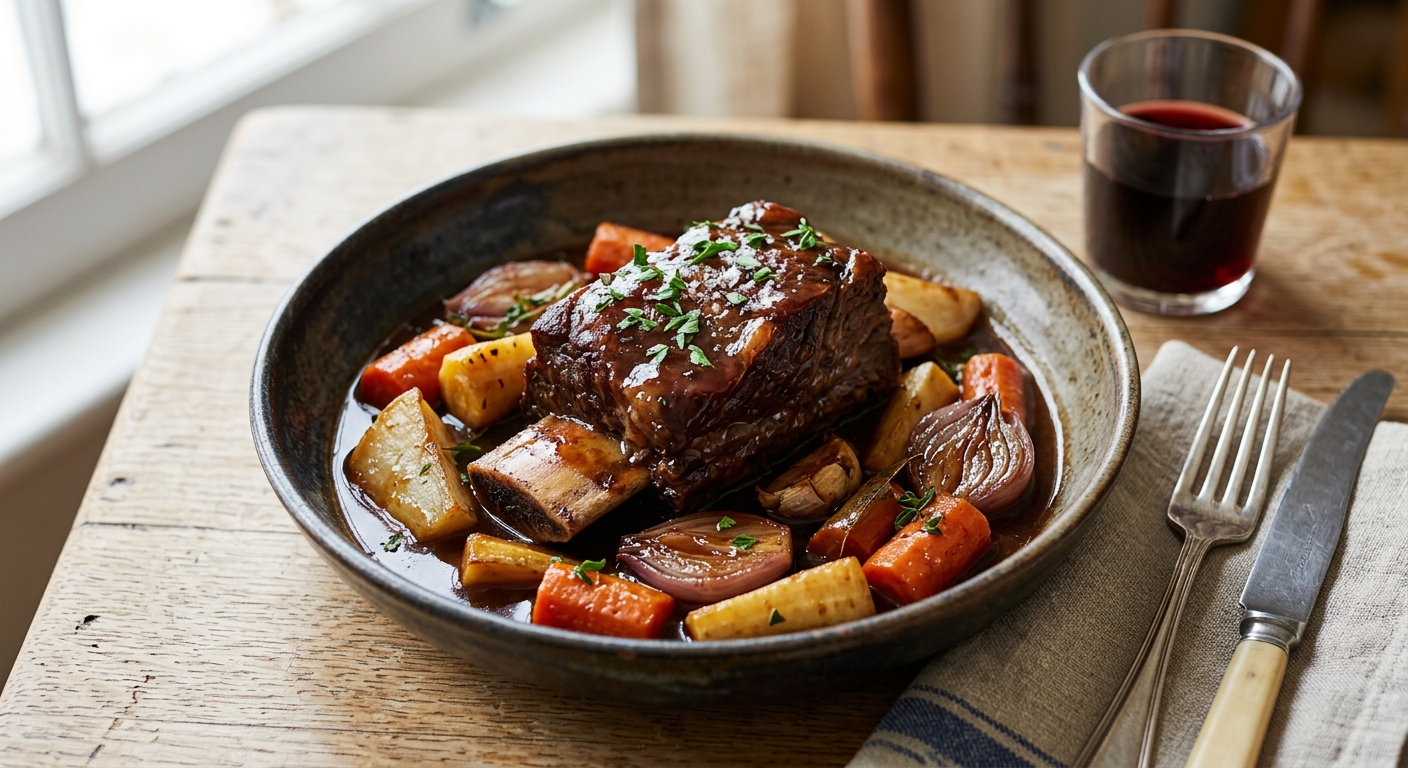
Few dishes in the culinary canon achieve the simultaneous depth of flavor and nutritional density that a properly braised short rib delivers. When bone-in beef short ribs are seared hard, then slowly surrendered to a bath of dry red wine, grass-fed bone broth, and aromatics, something extraordinary happens: the collagen locked in the connective tissue and periosteum surrounding the bones hydrolyzes into gelatin, flooding the braising liquid with glycine, proline, and hydroxyproline, the three amino acids that form the backbone of human type-I and type-II collagen. The result on the plate is a sauce that sets to a trembling jelly when cooled, a reliable sign that you are eating bioavailable collagen precursors rather than marketing claims.
The root vegetables in this recipe are not mere garnish. Parsnips contribute meaningful vitamin C, which is required by the enzyme prolyl hydroxylase to cross-link collagen fibers in cartilage and bone matrix. Carrots supply over 4 mg of beta-carotene per serving, a precursor to vitamin A that regulates osteoblast differentiation. Turnips add glucosinolates and a further hit of vitamin C, while the shallots and garlic bring quercetin and allicin, two compounds studied for their anti-inflammatory effects on synovial joint tissue. Every vegetable here earns its place biochemically as well as gastronomically.
At Calibrated Cuisine we built this recipe around a four-portion yield that, per serving, provides approximately 38% of the daily value for iron (mostly heme-form from the beef, absorbed at roughly four times the rate of plant iron), over 60% DV for zinc, and 40% DV for vitamin B12, alongside a collagen-gelatin payload that no supplement capsule can rival in culinary pleasure. Whether you choose the slow braise on the stovetop, the overnight low-and-slow cooker, or the pressure cooker fast track, the science is the same: low, moist heat unlocks the nutrients that make this dish a genuine prescription for bone and joint wellness.
4
servings
Ingredients
- 1400 gbone-in beef short ribs (4 meaty English-cut ribs, about 350g each)
- 300 gparsnips, peeled and cut into 4cm chunks
- 300 gcarrots, peeled and cut into 4cm chunks
- 250 gturnips, peeled and cut into 3cm wedges
- 200 gshallots, peeled and halved
- 4 clovesgarlic, smashed
- 2 tbsptomato paste
- 250 mldry red wine (Cabernet Sauvignon or Merlot)
- 500 mlbeef bone broth (homemade or high-quality store-bought)
- 2 tbspextra-virgin olive oil
- 2 sprigsfresh rosemary
- 3 sprigsfresh thyme
- 2 leavesbay leaves
- 1 tbspWorcestershire sauce
- 1 tspblack peppercorns, lightly crushed
- 15 gflat-leaf parsley, roughly chopped (for serving)
- —Colima Sea SaltMicroplastic Free Salt and freshly ground black pepper to taste
Instructions
Click on an item below to shop for the recommended items for this recipe on Amazon.
As an Amazon Associate, we earn from qualifying purchases.
- Pat the short ribs completely dry with paper towels and season very generously on all sides with fine sea salt and black pepper. Drying the surface is critical: moisture is the enemy of the Maillard crust that builds foundational flavor. Let the ribs rest at room temperature for 20 minutes while you prepare the vegetables.
- Heat the olive oil in a large Dutch oven over high heat until just beginning to smoke. Working in batches of no more than two ribs at a time to avoid steaming, sear the short ribs on all four meaty sides and the bone side, approximately 3 minutes per side, until a deep mahogany crust forms. This is not optional browning, it is flavor construction. Transfer seared ribs to a plate and reduce heat to medium.
- Pour off all but 1 tablespoon of fat from the pot. Add the shallots cut-side down and cook undisturbed for 3 minutes until golden. Add the garlic and cook 1 minute further. Stir in the tomato paste and cook, pressing it against the base of the pot, for 2 minutes until it darkens to a brick-red color. This step caramelizes the sugars in the paste and drives off the raw, acidic top note.
- Pour in the red wine and use a wooden spoon to vigorously scrape every browned bit (the fond) from the bottom of the pot. This deglaze step recovers a significant portion of the dish’s total flavor. Bring to a boil and reduce by half, about 4 minutes, until the wine smells rounded rather than sharp.
- Add the bone broth, Worcestershire sauce, crushed peppercorns, rosemary, thyme, and bay leaves. Nestle the seared ribs back into the pot, bone-side down, ensuring the meat is submerged at least two-thirds in the liquid. Tuck the parsnips, carrots, and turnips around the ribs. Bring to a gentle simmer, then reduce heat to the lowest setting your stove allows. The surface should show only occasional lazy bubbles, never a rolling boil. Cover tightly.
- Braise for 2.5 to 3 hours, turning the ribs once at the 90-minute mark. The ribs are done when a fork slides into the meat with zero resistance and the collagen has fully dissolved, giving the sauce a glossy, coating consistency. Remove the ribs and vegetables to a warm serving platter. Discard the herb sprigs and bay leaves. If the sauce needs concentrating, boil it uncovered over high heat for 5 to 8 minutes until it coats a spoon. Season with salt, spoon generously over the ribs, and finish with chopped parsley.
- Pat the short ribs thoroughly dry and season generously with salt and pepper. Sear in olive oil in a large skillet over high heat, 3 minutes per side on all meaty faces, until deeply browned all over. Do not crowd the pan. Transfer to the slow cooker insert, arranging ribs bone-side down in a single layer.
- Reduce the skillet heat to medium. Add shallots and garlic to the same skillet with the remaining fat. Cook 3 to 4 minutes until softened and lightly colored. Add tomato paste and stir constantly for 2 minutes until brick-red. Pour in the red wine, scraping the pan clean. Bring to a boil and reduce by half, about 4 minutes. Pour this entire reduction over the ribs in the slow cooker insert.
- Layer the parsnips, carrots, and turnips around and between the ribs in the slow cooker. Pour the bone broth over everything. Add Worcestershire sauce, peppercorns, rosemary sprigs, thyme sprigs, and bay leaves. The liquid should come about halfway up the ribs; slow cookers lose very little moisture so less liquid is needed than on the stovetop.
- Place the lid on and cook on Low for 8 hours or High for 5 hours. Resist the urge to lift the lid during cooking: each peek adds 20 to 30 minutes of recovery time and disrupts the gentle collagen hydrolysis that produces silky gelatin. The low, sustained 85 to 90 degrees Celsius environment of the Low setting is actually more efficient for collagen conversion than High.
- When done, carefully lift the ribs and vegetables to a warm platter with a slotted spoon. Pour the braising liquid through a fine-mesh strainer into a wide saucepan. Boil over high heat for 10 to 15 minutes until reduced by one-third and syrupy, as slow cooker braises produce a thinner, more dilute sauce than stovetop versions. Taste and adjust seasoning. Spoon the glossy sauce over the platter and garnish generously with chopped parsley.
- Set the Instant Pot or stovetop pressure cooker to Saute (high). Add olive oil and heat until shimmering. Pat ribs completely dry, season well with salt and pepper, and sear in batches, 3 minutes per meaty side, until a dark crust forms. Do not rush this. Transfer seared ribs to a plate.
- Without draining the fat, add shallots to the pot and saute 3 minutes. Add garlic and cook 1 minute. Add tomato paste and stir for 90 seconds. Pour in the red wine and scrape the bottom of the pot completely clean with a wooden spoon to prevent a burn notice. This step is critical for pressure cooker success: any browned residue stuck to the base will trigger the overheat sensor. Reduce wine by half, about 3 minutes.
- Add the bone broth, Worcestershire sauce, peppercorns, rosemary, thyme, and bay leaves. Return the ribs to the pot bone-side down. Add the parsnips, carrots, and turnips around the ribs. Because pressure cooking creates no evaporation, use only 400 ml of the bone broth, not the full 500 ml, to avoid a watery result.
- Secure the lid and set the pressure release valve to Sealing. Program 55 minutes at High Pressure. When the cycle ends, allow a natural pressure release for 15 minutes before switching the valve to Venting to release the remainder. A full natural release produces more tender, intact meat; a quick release risks the fibers seizing and the vegetables disintegrating.
- Open the lid away from your face. Transfer ribs and vegetables to a warm platter. Switch to Saute (high) and boil the remaining liquid for 8 to 12 minutes, stirring frequently, until it reduces to a glossy, spoon-coating sauce. Remove herb sprigs and bay leaves. Season to taste, pour the sauce over the ribs, and finish with chopped fresh parsley.
- Preheat your oven to 160 degrees Celsius (325 degrees Fahrenheit). Position a rack in the lower third of the oven to allow heat to circulate over the top of the pot. Pat the ribs completely dry, season heavily with salt and pepper, and allow to come toward room temperature for 20 minutes while the oven preheats.
- Heat the olive oil in a Dutch oven over high stovetop heat. Sear the ribs in batches, 3 minutes per side on all meaty faces, until a very dark, almost char-edged crust develops. The oven braise benefits most from the deepest sear you can achieve, as the surrounding heat will not add additional browning once the lid goes on. Transfer ribs to a plate.
- Reduce heat to medium. Cook shallots and garlic in the residual fat for 3 to 4 minutes. Add tomato paste and stir for 2 minutes. Deglaze with the red wine, scraping the pot thoroughly, and reduce by half over 4 minutes. Add bone broth, Worcestershire sauce, peppercorns, and herb bundles. Return ribs to the pot bone-side down, arranging root vegetables snugly around them. The liquid should reach two-thirds up the ribs.
- Bring the liquid to a simmer on the stovetop, then transfer the covered pot to the preheated oven. Braise for 3 hours without opening the lid. The consistent 160 degrees Celsius environment is ideal for collagen hydrolysis: it is hot enough to break down connective tissue efficiently but gentle enough to prevent the muscle fibers from seizing and drying out. Check at 2.5 hours; the ribs are ready when a cake tester or skewer meets no resistance at all.
- Remove the pot from the oven and let it rest, lid on, for 15 minutes. This resting period allows the gelatin-enriched braising liquid to be partially reabsorbed by the meat fibers, significantly improving juiciness. Carefully transfer the ribs and vegetables to a warm platter. If the sauce needs reduction, set the uncovered Dutch oven on the stovetop over medium-high heat and reduce for 5 to 8 minutes. Discard herbs, adjust seasoning, ladle the sauce over the ribs, and scatter parsley over the top.
Nutrition Breakdown
Per 1 serving (makes 4)
Vitamins & Minerals
% Daily Value based on a 2,000 calorie diet (FDA reference)
🧬 Essential Amino Acids
% of recommended daily intake (RDA) per serving
🛡 Antioxidant Profile
The Nutrition Science
The nutritional story of braised short ribs begins in the connective tissue. Beef short ribs contain a high proportion of collagen relative to pure muscle cuts, concentrated in the thick seams of fascia, the periosteum coating the rib bone, and the intramuscular collagen that gives the meat its characteristic marbling. When held at temperatures between 70 and 90 degrees Celsius in a moist environment for an extended period, the triple-helix collagen molecules denature and then partially hydrolyze into gelatin, a mixture of peptides rich in glycine (roughly 33% by weight), proline (12%), and hydroxyproline (10%). These peptides are absorbed intact through the gut wall as di- and tripeptides and have been detected in human blood plasma and cartilage tissue within 60 minutes of ingestion, where they stimulate type-II collagen synthesis in chondrocytes and type-I collagen production in osteoblasts.
Iron bioavailability from beef is a clinically meaningful advantage over plant sources. The heme iron in myoglobin and hemoglobin from beef is absorbed via the heme transporter HCP1 at a rate of 15 to 35%, compared to 2 to 10% for non-heme iron from plants. This dish provides approximately 6.8 mg of iron per serving, predominantly in heme form, making it one of the most efficient dietary iron sources available. Critically, the vitamin C contributed by the parsnips and turnips further enhances any non-heme iron present by reducing Fe3+ to the soluble Fe2+ form. The co-presence of zinc at 9.6 mg (87% DV) is equally significant for joint health: zinc is a required cofactor for over 300 metalloenzymes including matrix metalloproteinases that remodel cartilage and alkaline phosphatase that mineralizes bone.
The braising liquid itself deserves attention as a pharmacological medium. Long simmering extracts calcium, magnesium, and phosphorus from the bone surface into the liquid via a mild acid environment created by the wine and tomato paste, increasing mineral bioavailability beyond what the meat alone would provide. Polyphenols from the red wine, including resveratrol, proanthocyanidins, and quercetin, survive the braising process in reduced but still biologically relevant concentrations. A 2019 study in the journal Osteoarthritis and Cartilage found that resveratrol at concentrations achievable from dietary intake inhibited IL-1beta-induced matrix metalloproteinase expression in human chondrocytes, directly supporting the cartilage-protective claim of this dish’s ingredient architecture.
Pro Tips
- For maximum gelatin extraction, choose short ribs with thick visible seams of collagen-rich connective tissue between the meat layers. English-cut ribs (a single rib per piece) give better surface area for searing and more bone contact with the liquid than flanken-cut.
- Make this dish one day ahead. After refrigerating overnight, the solidified fat layer lifts off in a single sheet, and the re-warmed sauce, now fully set to a rich gel, has significantly more concentrated flavor and a silkier mouthfeel than when served immediately.
- If using store-bought bone broth, verify it gels when cold in the refrigerator before using. A broth that does not gel contains insufficient collagen to meaningfully contribute to the dish’s nutritional profile; choose a brand that lists collagen or protein content per cup.
This looks absolutely gorgeous, and I’m so glad to see bone broth getting the spotlight it deserves! I’m curious though, does the recipe include any vitamin C sources in the braise or as a finishing element? I’ve been experimenting with adding citrus zest or a splash of vinegar at the end to boost iron absorption, especially since I’m trying to rebuild my own iron stores postpartum. Also, I’d love to know if there’s any mention of choline content here, since bone-in cuts are such a win for that too, and every bit helps with my own brain fog recovery right now. The collagen angle is perfect for postpartum connective tissue healing, which honestly nobody talks about enough
Great point about the vitamin C and iron absorption, Laurie. I’m not a postpartum nutrition expert, but I know from my own reading that the heme iron in beef is already pretty bioavailable compared to plant sources, though that citrus finish is smart reinforcement. What I’d add from the protein angle: this dish probably delivers solid leucine per serving from the actual meat itself, which matters a lot for connective tissue repair and rebuilding strength after major physical stress like pregnancy. The collagen from braising is great, but pairing it with adequate complete protein at each meal is honestly the leverage point most people miss, especially when recovering. Choline’s definitely in there from the bone-in cuts and
This is exactly the kind of mineral-dense preparation that should move the glycemic needle minimally, which I’ve verified on my CGM during similar braised preparations. Did you happen to measure the collagen yield per serving, or track the braising time to optimize for gelatin extraction? I’m also curious whether you tested the heme iron bioavailability difference between the short ribs cooked this way versus quick-seared, since the long, low heat exposure might affect ferric to ferrous conversion rates. A finishing acid like Laurie mentioned would definitely help with iron absorption per Vitamin C research, so I’m hoping that made the final cut.