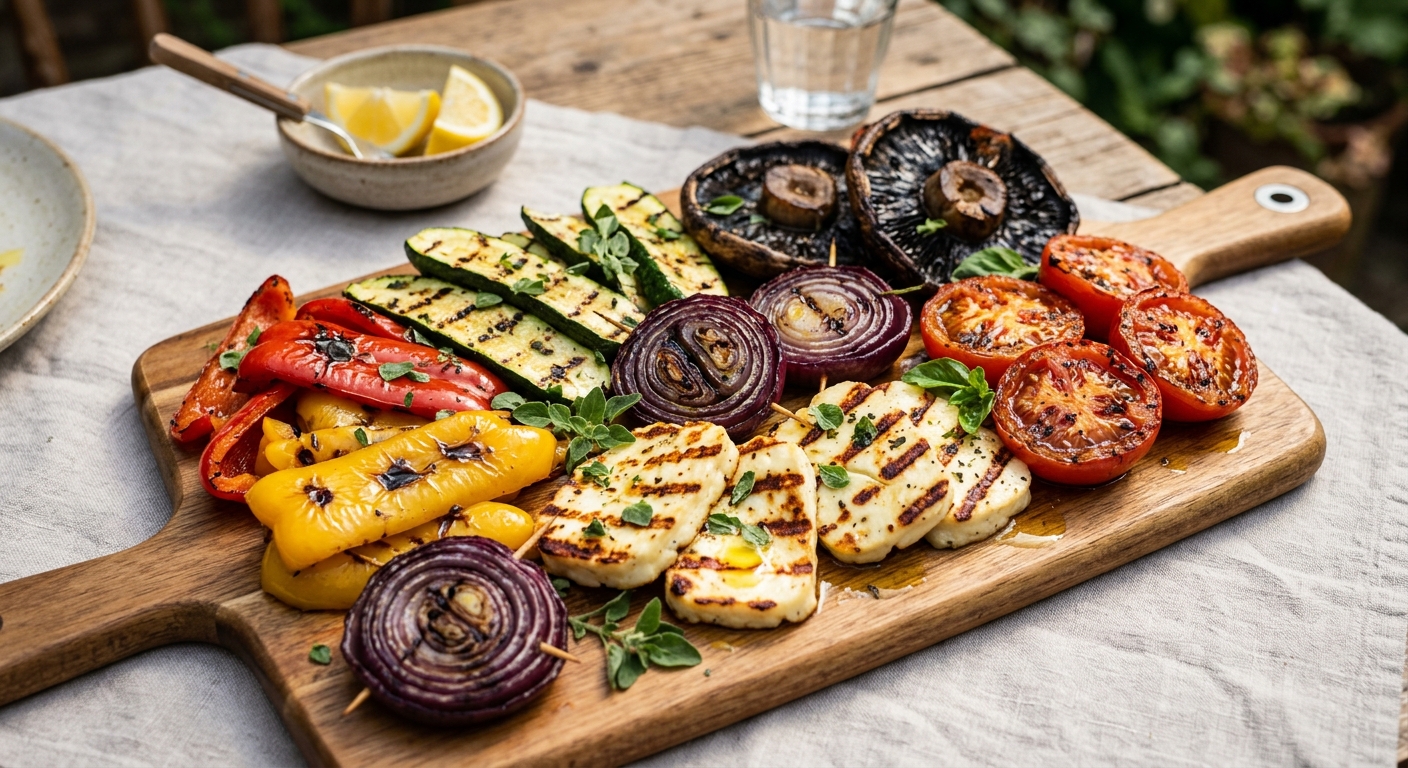
There are few dishes that capture the spirit of summer as effortlessly as a generous platter of grilled vegetables and halloumi. The squeaky, golden-crusted cheese holds its shape under high heat and becomes the centrepiece of a meal that is simultaneously rustic and refined. What makes this version special is that every component has been selected and portioned with your skeletal system in mind: halloumi for calcium and phosphorus, courgette for vitamin K, red pepper for vitamin C to enhance calcium absorption, and portobello mushrooms for a rare plant-adjacent source of vitamin D when sun-exposed.
Bone health is not just about calcium in isolation. The science is clear that vitamin K2 activates osteocalcin, the protein that anchors calcium into bone matrix, while vitamin C is essential for collagen synthesis that gives bone its tensile strength. Manganese activates enzymes involved in cartilage and bone formation, and magnesium regulates calcium transport across cell membranes. This platter delivers all five of these co-factors in meaningful quantities, making it genuinely calibrated rather than just nutritionally adjacent to good intentions.
We have developed four distinct cooking methods so you can enjoy this dish whether you are firing up the outdoor grill on a summer evening, working a stovetop grill pan in a small kitchen, using your oven for a hands-off approach, or even producing a softly braised slow-cooker version on days when the heat is not the goal. Each method produces a different textural experience while preserving the nutrient integrity of the ingredients.
4
servings
Ingredients
- 500 ghalloumi cheese, sliced 1cm thick
- 2 mediumcourgettes (zucchini), sliced on the diagonal 1cm thick
- 2 largered bell peppers, deseeded and cut into wide strips
- 1 largeyellow bell pepper, deseeded and cut into wide strips
- 4 largeportobello mushrooms, stems trimmed
- 1 largered onion, cut into 1.5cm rounds, secured with toothpicks
- 2 mediumripe tomatoes, halved
- 3 tbspextra-virgin olive oil
- 2 tbspfresh lemon juice
- 2 clovesgarlic, finely minced
- 1 tbspfresh thyme leaves
- 2 tbspfresh flat-leaf parsley, roughly chopped
- 1 tspdried oregano
- 0.5 tspsweet smoked paprika
- 1 tbsphoney or agave syrup
- 30 gpine nuts, lightly toasted
- 10 gfresh basil leaves, torn
- —Colima Sea SaltMicroplastic Free Salt and cracked black pepper to taste
- —Lemon wedges to serve
Instructions
Click on an item below to shop for the recommended items for this recipe on Amazon.
As an Amazon Associate, we earn from qualifying purchases.
- Whisk together 2 tablespoons of the olive oil, 1 tablespoon of lemon juice, the minced garlic, dried oregano, smoked paprika, and a generous pinch of salt and pepper in a large bowl. Add the courgette slices, pepper strips, red onion rounds, portobello mushrooms, and tomato halves. Toss well to coat and allow to marinate at room temperature for at least 10 minutes while you heat the pan.
- Place a cast-iron grill pan over high heat and allow it to preheat for 3 to 4 minutes until it is visibly smoking. Do not add any oil to the pan. Brush the pan very lightly with a folded piece of paper towel dipped in a small amount of olive oil, holding it with tongs to avoid burns.
- Working in batches to avoid crowding, cook the vegetables in the following order: start with the red onion rounds (4 to 5 minutes per side), then the peppers (3 to 4 minutes per side), then the portobello mushrooms gill-side down first (3 to 4 minutes per side), then the courgette slices (2 to 3 minutes per side), and finally the tomato halves cut-side down only (2 to 3 minutes, do not flip). Arrange each finished batch on a large platter and tent loosely with foil.
- Once all the vegetables are cooked, reduce the heat to medium-high and wipe the pan quickly with a clean, lightly oiled paper towel. Add the halloumi slices in a single layer, working in two batches if needed. Cook for 2 to 3 minutes per side without moving them until a deep golden-brown crust forms and the cheese softens slightly at the edges. Remove immediately as halloumi toughens if it cools in the pan.
- Arrange the warm halloumi over the vegetable platter. Whisk together the remaining tablespoon of olive oil, remaining tablespoon of lemon juice, and the honey or agave, then drizzle over everything. Scatter the toasted pine nuts, torn basil, and flat-leaf parsley over the top. Finish with fresh thyme leaves, a final crack of black pepper, and serve immediately with lemon wedges.
- Preheat your oven to 230C (450F) with convection/fan if available. Line two large rimmed baking sheets with parchment paper and place them in the oven during preheating so they become hot, which helps caramelise the vegetables from underneath.
- Whisk together 2 tablespoons of olive oil, 1 tablespoon of lemon juice, the minced garlic, dried oregano, smoked paprika, salt, and pepper in a large bowl. Add all the vegetables (courgette, peppers, onion, mushrooms, and tomatoes) and toss thoroughly. Spread the vegetables in a single, uncrowded layer across the two preheated baking sheets, keeping the tomatoes cut-side up.
- Roast on the upper and lower oven racks for 20 to 25 minutes, rotating the pans and flipping the vegetables halfway through cooking. The peppers and courgettes should have lightly charred edges, the onion rounds should be tender and caramelised, and the mushrooms should be deeply browned and slightly shrunken. Transfer all cooked vegetables to a large serving platter.
- Switch the oven to broil (grill) on its highest setting. Push any remaining vegetables to the edges of one pan and lay the halloumi slices in the centre of that pan in a single layer. Brush the top of each slice lightly with the remaining tablespoon of olive oil. Broil for 3 to 5 minutes on the top rack, watching closely, until the halloumi tops are golden and blistered. Unlike the stovetop method, you will only brown one side under the broiler; the bottom will steam-cook against the hot pan, keeping the interior soft.
- Slide the broiled halloumi over the vegetable platter. Whisk together the remaining tablespoon of lemon juice with the honey or agave and drizzle over the entire platter. Scatter the toasted pine nuts, torn basil, and parsley over the top, finish with fresh thyme, and serve directly from the platter with lemon wedges on the side.
- In the base of the slow cooker insert, whisk together all 3 tablespoons of olive oil, both tablespoons of lemon juice, the minced garlic, dried oregano, smoked paprika, honey or agave, thyme leaves, a generous pinch of salt, and cracked black pepper to form a flavourful braising base.
- Add the red onion rounds (remove the toothpicks and separate into rings), pepper strips, and portobello mushrooms to the slow cooker. Cut the mushrooms into thick slices rather than leaving them whole, as they will not fit neatly when braising. Nestle the tomato halves among the other vegetables, cut-side up so the juices contribute to the braise. Add the courgette slices on top as they are more delicate and benefit from being higher in the cooker.
- Place the lid on and cook on Low for 2.5 to 3 hours. The vegetables should be very tender, lightly collapsed, and swimming in an aromatic, tomato-enriched braising liquid. If there is more than about 1cm of liquid pooling at the bottom after 2.5 hours, remove the lid and increase to High for the last 30 minutes to concentrate the juices.
- Lay the halloumi slices in a single layer directly on top of the braised vegetables in the slow cooker during the last 20 minutes of cooking, replace the lid, and continue on Low. The residual steam and gentle heat will soften the halloumi through and allow it to absorb the herb and garlic flavours without grilling. It will not form a crust, but will become yielding and warm throughout.
- Using a wide spatula or slotted spoon, carefully transfer the braised vegetables to a wide, shallow serving bowl, followed by the softened halloumi slices on top. Spoon several tablespoons of the reduced braising juices over everything. Scatter the toasted pine nuts, torn basil, and flat-leaf parsley generously over the dish, and serve warm with crusty bread to soak up the juices and lemon wedges on the side.
- Set your Instant Pot or electric pressure cooker to Saute mode on High. Add 1 tablespoon of olive oil and, once shimmering, add the red onion rings and pepper strips. Saute for 3 minutes, stirring occasionally, until they just begin to soften at the edges and pick up a little colour. This Maillard browning step cannot happen under pressure and must be done upfront for flavour depth. Press Cancel to stop the Saute function.
- Pour 60ml (quarter cup) of water into the pot to deglaze, scraping up any browned bits from the bottom with a wooden spoon. This step is critical to prevent a burn warning. Add the courgette slices, sliced portobello mushrooms, tomato halves, minced garlic, dried oregano, smoked paprika, 1 tablespoon of olive oil, 1 tablespoon of lemon juice, thyme, honey or agave, salt, and pepper. Stir briefly to distribute.
- Secure the lid and set the pressure release valve to Sealing. Cook on Manual High Pressure for 3 minutes. When the cook time is complete, perform a quick release by carefully turning the valve to Venting. The vegetables will be perfectly tender but not mushy, and the pot will contain a concentrated, deeply flavoured broth.
- While the pressure releases, heat a dry non-stick or cast-iron skillet over high heat until very hot. Add the halloumi slices in a single layer and press down gently with a spatula. Cook for 2 minutes per side without moving until a golden-brown, slightly crisp crust forms. This hot, dry-sear creates the textural contrast that pressure-cooked vegetables cannot deliver on their own. Work in batches if needed.
- Transfer the pressure-cooked vegetables to a wide serving platter using a slotted spoon, leaving excess liquid in the pot. Reduce the remaining braising liquid on Saute mode for 2 to 3 minutes until slightly syrupy, then drizzle it over the vegetables along with the remaining tablespoon each of olive oil and lemon juice. Lay the seared halloumi over the vegetables, scatter with toasted pine nuts, torn basil, and parsley, and finish with fresh thyme leaves and lemon wedges.
Nutrition Breakdown
Per 1 serving (makes 4)
Vitamins & Minerals
% Daily Value based on a 2,000 calorie diet (FDA reference)
🧬 Essential Amino Acids
% of recommended daily intake (RDA) per serving
🛡 Antioxidant Profile
The Nutrition Science
The bone-building power of this platter rests on a carefully constructed nutrient matrix rather than any single ingredient. Halloumi supplies 94% of the daily value for calcium per serving, but calcium alone cannot build bone without its co-factors. Vitamin K, delivered by courgette and parsley, activates osteocalcin, the Gla-protein that acts as a molecular anchor binding calcium ions into hydroxyapatite crystals within the bone matrix. Without sufficient vitamin K, newly absorbed calcium remains in circulation and cannot be properly deposited into bone tissue.
Equally important is vitamin C, which this dish provides at 187% of the daily value from the generous quantity of red and yellow bell peppers. Vitamin C is the essential cofactor for prolyl hydroxylase and lysyl hydroxylase, the enzymes that cross-link collagen fibres. Bone is not simply a calcium crystal; approximately 30% of its dry weight is collagen, which provides the tensile scaffold into which mineral is deposited. A diet rich in calcium but deficient in vitamin C produces brittle, poorly structured bone. The lycopene from cooked tomatoes adds another layer of protection by inhibiting osteoclastogenesis, the cellular process by which bone-resorbing osteoclasts are formed and activated.
The manganese contributed by pine nuts and mushrooms is frequently overlooked in bone health discussions but plays a fundamental structural role: it activates glycosyltransferases, the enzymes responsible for synthesising proteoglycans in cartilage. Proteoglycans are the shock-absorbing molecules in articular cartilage that allow joints to withstand compressive loads. Chronic manganese insufficiency is associated with reduced cartilage proteoglycan content and accelerated joint degeneration, making the pine nut garnish here far more than a textural afterthought.
Pro Tips
- Sun-expose your portobello mushrooms gill-side up in direct sunlight for 30 to 60 minutes before cooking. UV-B radiation converts ergosterol in the mushroom flesh to vitamin D2, significantly boosting the vitamin D content of the finished dish.
- Pat the halloumi slices completely dry with paper towels before cooking, regardless of method. Surface moisture creates steam that prevents the Maillard browning reaction and results in pale, rubbery cheese instead of the golden crust that makes halloumi irresistible.
- For maximum vitamin C retention, avoid overcooking the bell peppers. Vitamin C is heat-labile and water-soluble; a light char with a still-crisp interior preserves significantly more of the 187% DV than a fully softened, long-cooked pepper. In all methods, treat peppers as the most delicate component.
This sounds like a beautifully balanced plate, and I’m curious about the herb choices here, especially since parsley and oregano bring both flavor and some serious micronutrient density to the mix. I’ve found that the vitamin K angle is often overlooked in bone health conversations, so I appreciate you highlighting that connection, I’ve noticed my own bone biomarkers improved significantly when I started pairing calcium-rich foods like this with K-rich greens and adaptogens like reishi (which seems to support mineral absorption). Are the herbs you’re using sourced fresh, or are you leaning into dried for concentration? The charred vegetables are genius for bioavailability too.
omg yes the herb angle is SO good! i’ve been doing a lot of experimenting with dried oregano in my fermented veggie brines and the flavor just gets so much richer over time, plus you’re totally right about that vitamin K density. actually been thinking about layering this exact concept into a quick-pickled vegetable situation with the halloumi – like if you lacto ferment those grilled veggies for a few days with some of those herbs, you get the micronutrients plus all those beneficial lactobacillus cultures that help with calcium absorption. have you ever played around with fermented condiments alongside dishes like this?
This looks amazing, and I’m really curious about the specific vegetables you chose for the grilling! I have Hashimoto’s and try to avoid nightshades when I can, so I’m wondering if there are any peppers or tomatoes in the mix that I’d need to swap out, or if this is already nightshade-free? Also, I’ve found that while halloumi is such a great calcium source, I’ve had better thyroid outcomes pairing it with lower-iodine preparations, so I’m wondering if you have thoughts on sourcing or preparation methods that might help with iodine levels for anyone managing thyroid stuff like I am.