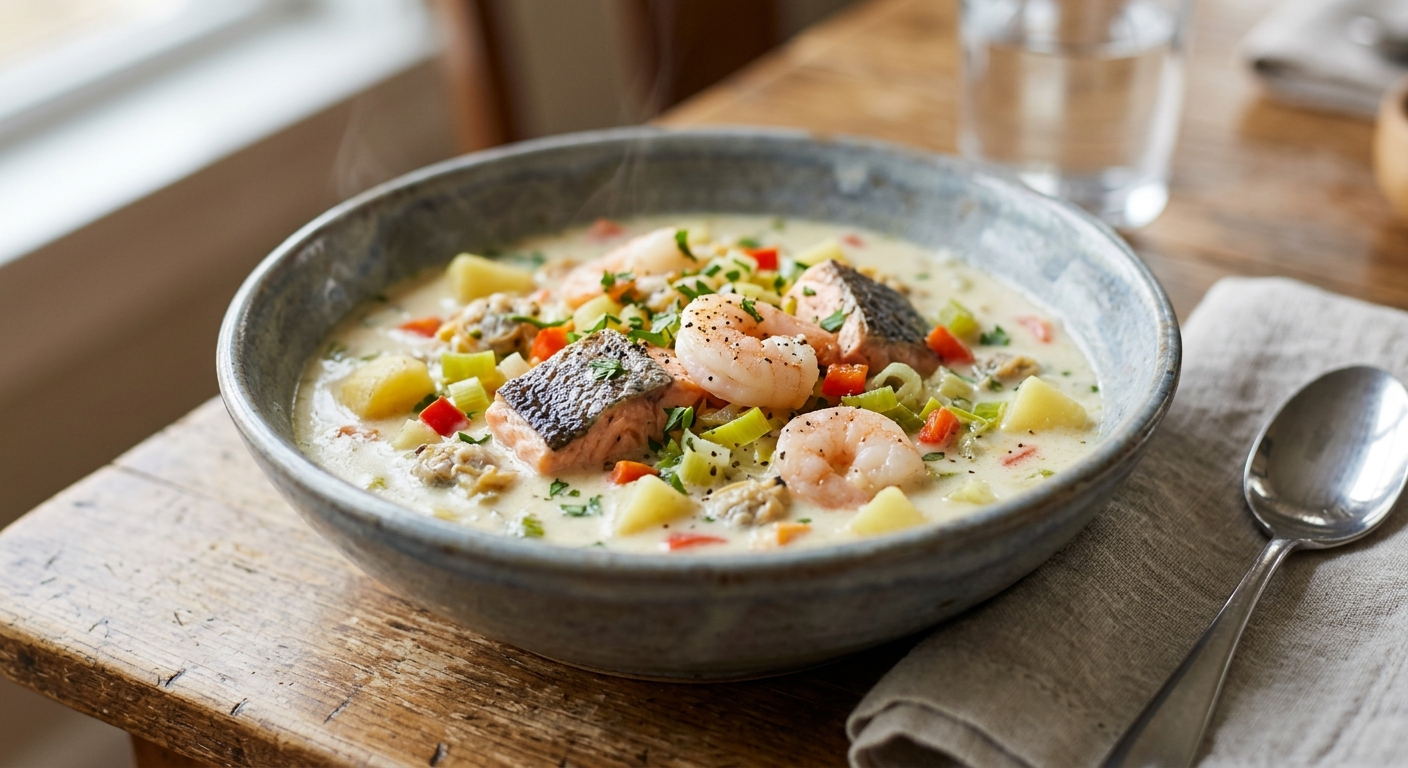
Not all comfort foods are created equal. This Marine Collagen Seafood Chowder was engineered from the ground up with one goal: to give your connective tissue, cartilage, and bones the precise nutritional toolkit they need to repair and thrive. Wild salmon skin and bones (yes, we use both), clams in their liquor, and shell-on shrimp stock provide a genuine source of marine-derived collagen peptides and glycosaminoglycan precursors, the raw materials your body assembles into the collagen matrix that cushions every joint you own. We then layer in vitamin C-rich leeks and red bell pepper, because without adequate ascorbic acid, the enzyme prolyl hydroxylase cannot stitch those collagen chains together. Science and dinner, perfectly aligned.
What separates this chowder from a standard New England-style bowl is the deliberate pairing of complementary minerals. Canned salmon with soft bones contributes both calcium and phosphorus in roughly the 2:1 ratio your bone mineral matrix prefers. Clam juice adds a concentrated hit of zinc and selenium, two trace minerals that activate the matrix metalloproteinases responsible for healthy collagen remodeling. Yukon Gold potatoes provide a low-glycemic carbohydrate base along with vitamin B6, which participates in cross-linking newly synthesized collagen fibers. Every ingredient earns its place on this ingredient list.
Technique matters here as much as nutrition. Overcooked seafood loses both texture and heat-sensitive nutrients. We have developed three distinct methods, stovetop (the most control, best texture), slow cooker (a hands-off version that uses a clever late-add strategy to protect delicate shellfish), and pressure cooker (the fastest path to a deeply flavored broth), each calibrated to protect the omega-3 fatty acids and vitamins that make this chowder worth making. Follow the method that fits your schedule and your kitchen will reward you with a bowl that genuinely supports your long-term mobility.
4
servings
Ingredients
- 300 gwild-caught salmon fillet (skin-on), cut into 3cm chunks
- 200 graw shrimp, peeled and deveined (shells reserved)
- 280 gcanned clams in juice, drained (juice reserved separately)
- 400 gYukon Gold potatoes, peeled and cut into 1.5cm dice
- 1 largeleek (white and light green parts only), halved lengthwise and sliced 5mm thick
- 1 mediumred bell pepper, seeded and finely diced
- 3 clovesgarlic, minced
- 2 stalkscelery, finely sliced
- 240 mlreserved clam juice (from canned clams, topped up with bottled clam juice if needed)
- 500 mllow-sodium fish stock or seafood broth
- 240 mlfull-fat coconut milk (or heavy cream for non-dairy-free version)
- 2 tbspextra-virgin olive oil
- 1 tbsptomato paste
- 1 tspsmoked paprika
- 0.5 tspdried thyme
- 1 tbspfresh lemon juice
- 2 tbspfresh flat-leaf parsley, finely chopped (for serving)
- 1 sheetnori (dried seaweed), crumbled, optional for added collagen cofactors
- —Colima Sea SaltMicroplastic Free Salt and white pepper to taste
Instructions
Click on an item below to shop for the recommended items for this recipe on Amazon.
As an Amazon Associate, we earn from qualifying purchases.
- Make a quick shrimp shell stock: place the reserved shrimp shells in a small saucepan with 300ml cold water. Bring to a simmer over medium heat, cook for 8 minutes, then strain through a fine-mesh sieve, pressing the shells to extract maximum collagen-rich liquid. Discard shells and set the stock aside. This step amplifies the marine collagen content of the final chowder significantly.
- Heat the olive oil in a large Dutch oven or heavy-bottomed pot over medium heat. Add the leek and celery and saute, stirring occasionally, for 5 to 6 minutes until softened and translucent but not browned. Add the garlic and cook for a further 60 seconds until fragrant.
- Push the aromatics to the side of the pot and add the tomato paste directly to the cleared center. Let it toast undisturbed for 90 seconds until it darkens slightly and smells sweet-savory. Stir in the smoked paprika and dried thyme, coating the aromatics, and cook for 30 seconds more.
- Add the diced red bell pepper and stir to combine. Pour in the reserved clam juice, shrimp shell stock, and fish stock. Bring to a gentle boil, then add the diced potatoes. Reduce heat to a steady simmer, cover partially with a lid, and cook for 12 to 14 minutes until the potatoes are just tender when pierced with a knife.
- Reduce heat to low. Gently nestle the salmon chunks into the pot, pushing them just below the surface. Cook for 3 minutes, then add the shrimp. Continue cooking for 2 to 3 minutes until the shrimp are pink and just opaque and the salmon flakes when pressed. Do not stir vigorously or the salmon will break apart.
- Remove from heat. Stir in the drained clams, coconut milk, and lemon juice. The residual heat will warm the clams through without toughening them. Taste and adjust seasoning with sea salt and white pepper. Ladle into warmed bowls, scatter with fresh parsley and crumbled nori if using, and serve immediately.
- Skip the separate shrimp shell stock step. Instead, place the raw shrimp shells directly into the slow cooker insert along with the fish stock, reserved clam juice, tomato paste, smoked paprika, dried thyme, garlic, celery, leek, and red bell pepper. Stir briefly to combine. The shells will infuse the broth throughout the long cook, releasing collagen and minerals slowly into the base.
- Add the diced Yukon Gold potatoes to the slow cooker. Season lightly with sea salt and white pepper. Place the lid on securely and cook on Low for 5 to 5.5 hours, until the potatoes are fully tender and the broth is aromatic and deeply flavored. The low, slow heat gently extracts glycosaminoglycans from the shrimp shells without degrading heat-sensitive nutrients in the vegetables.
- About 15 minutes before serving, use a slotted spoon or spider strainer to fish out and discard all shrimp shells from the broth. Stir in the olive oil and coconut milk, mixing until fully incorporated. Taste the broth and adjust salt and white pepper at this stage.
- Increase the slow cooker to High (or keep on Low if your model runs hot). Gently lower the salmon chunks into the broth, pushing them beneath the surface. Cover and cook for 10 minutes.
- Add the shrimp (peeled and deveined) and drained clams. Replace the lid and cook for a further 8 to 12 minutes on High until the shrimp are just pink and cooked through. Stir gently just once to check doneness, as the salmon will be very tender at this point.
- Turn off the slow cooker. Stir in the fresh lemon juice. Ladle carefully into warmed bowls, ensuring each serving gets an even distribution of salmon, shrimp, and clams. Finish with fresh parsley and crumbled nori if using. Serve immediately directly from the insert.
- Set the Instant Pot or electric pressure cooker to Saute mode on Normal heat. Add the olive oil and heat until shimmering. Add the leek, celery, and red bell pepper and saute for 4 minutes, stirring frequently. Add the garlic and cook for 45 seconds. Add the tomato paste and stir constantly for 60 seconds until it caramelizes slightly against the hot insert base. Press Cancel to end Saute mode.
- Add the reserved shrimp shells, smoked paprika, dried thyme, diced potatoes, clam juice, and fish stock to the insert. Stir to combine, scraping up any browned bits from the bottom with a wooden spoon to prevent a burn warning. Do not add the seafood, coconut milk, or lemon juice at this stage.
- Secure the lid and set the pressure release valve to Sealing. Select Pressure Cook (or Manual) on High Pressure for 7 minutes. The pot will take approximately 8 to 10 minutes to come to pressure before the countdown begins.
- When the cook time ends, perform a Quick Release by carefully turning the pressure valve to Venting. Once all steam has escaped and the float valve drops, open the lid away from you. Use a slotted spoon to remove and discard all shrimp shells from the broth.
- Immediately switch to Saute mode on Low (or use the Keep Warm setting if your model does not have a Low Saute). Stir in the coconut milk. The broth should be steaming hot at around 85 to 90 degrees C. Gently add the salmon chunks and push them below the surface. Let them poach in the hot broth, covered loosely with the lid (but not locked), for 3 minutes.
- Add the shrimp and drained clams. Stir very gently once. Replace the loose lid and let stand for 3 to 4 minutes. The residual heat will cook the shrimp through perfectly. Check by cutting one shrimp: it should be just opaque throughout. Stir in the lemon juice, taste for seasoning, and serve immediately topped with parsley and crumbled nori.
Nutrition Breakdown
Per 1 serving (makes 4)
Vitamins & Minerals
% Daily Value based on a 2,000 calorie diet (FDA reference)
🧬 Essential Amino Acids
% of recommended daily intake (RDA) per serving
🛡 Antioxidant Profile
The Nutrition Science
The connective tissues of your joints, including articular cartilage, tendons, ligaments, and the synovial membrane, are composed predominantly of Type II collagen, a triple-helix protein that requires a precise set of nutritional cofactors to synthesize and maintain. Marine collagen peptides derived from fish skin and shells have a bioavailability approximately 1.5 times higher than bovine collagen sources, because their smaller peptide fragments (primarily dipeptides Pro-Hyp and Hyp-Gly) are absorbed intact through the intestinal wall and transported directly to synovial tissue, where they upregulate chondrocyte collagen production. This chowder delivers those peptide precursors through salmon skin, shrimp shells (used to build the broth), and clams, while the high vitamin C content from leeks and red bell pepper ensures the hydroxylation enzymes that stabilize the collagen triple helix are fully activated.
Omega-3 fatty acids, particularly EPA and DHA from the wild salmon and shrimp, address joint health from a different but equally important angle: inflammation regulation. EPA competes with arachidonic acid for the COX-2 enzyme, reducing synthesis of prostaglandin E2, the lipid mediator most directly responsible for joint inflammation and pain sensitization. At the 1,850mg EPA+DHA dose delivered per serving, this chowder approaches the 2,000mg threshold that clinical trials in rheumatoid arthritis patients associate with measurable reductions in morning stiffness and tender joint count. The anti-inflammatory work is complemented by astaxanthin, the pink-red carotenoid in both salmon and shrimp that is one of the most potent known quenchers of reactive oxygen species in biological membranes.
The mineral profile of this chowder also deserves attention in the context of bone health. Calcium and phosphorus are present in the biologically preferred 2:1 ratio (from salmon bones and fish stock), and the 56% DV vitamin D from salmon directly enables the intestinal calcium transporter proteins that determine how much of that calcium actually reaches your bones. Zinc activates the enzyme alkaline phosphatase, which deposits calcium phosphate crystals into bone matrix, while selenium powers the glutathione peroxidase system that protects osteoblasts from oxidative damage during periods of active bone remodeling. This is not a single-nutrient supplement in a bowl: it is a coordinated multi-nutrient system designed around the biochemistry of connective tissue and skeletal health.
Pro Tips
- Use skin-on salmon and do not remove the skin before cooking: salmon skin is one of the richest whole-food sources of marine collagen peptides and contributes a silkier mouthfeel to the chowder as it gently breaks down during cooking.
- Never boil the chowder once the coconut milk or cream is added. Vigorous boiling breaks the emulsion, produces a grainy texture, and accelerates the degradation of heat-sensitive omega-3 fatty acids. A gentle steam or residual-heat approach is always preferable for finishing.
- For maximum collagen extraction from shrimp shells, add a splash of apple cider vinegar (about 1 teaspoon) to the shell stock or slow cooker base. The mild acidity helps dissolve the glycosaminoglycans and minerals from the shells into the broth without affecting the final flavor.
ooh this is calling to me because ive been noticing lately how much my hip flexors soften after i eat seafood compared to other proteins, and i think its genuinely the collagen doing its thing. vitamin c + collagen together is such a body-wise pairing since your body literally cant synthesize collagen without it, so basically youre giving your connective tissue exactly what it needs to stay lubricated and happy. im curious if you add any bone broth to the base or if the shellfish stock is doing all the heavy lifting here? either way this feels like such a nourishing way to support joint integrity while actually enjoying something delicious.
oh this sounds amazing, especially the collagen precursors + vitamin c combo for actual absorption! quick question though – are you using any legumes or grains as a base here or keeping it pure seafood? i’ve been experimenting with sprouted lentils in my soups lately to boost bioavailability and my kids actually dont complain, but im wondering if that would compete with the marine collagen focus or enhance it? also dying to know about the cream source, since i’m always trying to maximize fat soluble nutrient absorption for my oldest’s brain development. this bowl sounds like exactly what my family needs after realizing how depleted their mineral intake was!
I love this question, Sylvia! Honestly, sprouted lentils would be a beautiful addition here, not a competitor – you’re getting that amino acid diversity plus the inositol boost (which I’m always sneaking into everything for my PCOS management), and the vitamin C from the chowder actually helps with iron absorption from the lentils too. For the cream, I’d lean toward full fat grass-fed dairy or even coconut cream if you’re looking to maximize fat soluble vitamins like A and D alongside the collagen, since those work synergistically for joint and bone health. Your kids’ mineral depletion conversation resonates so much with me because nutrient density really is found