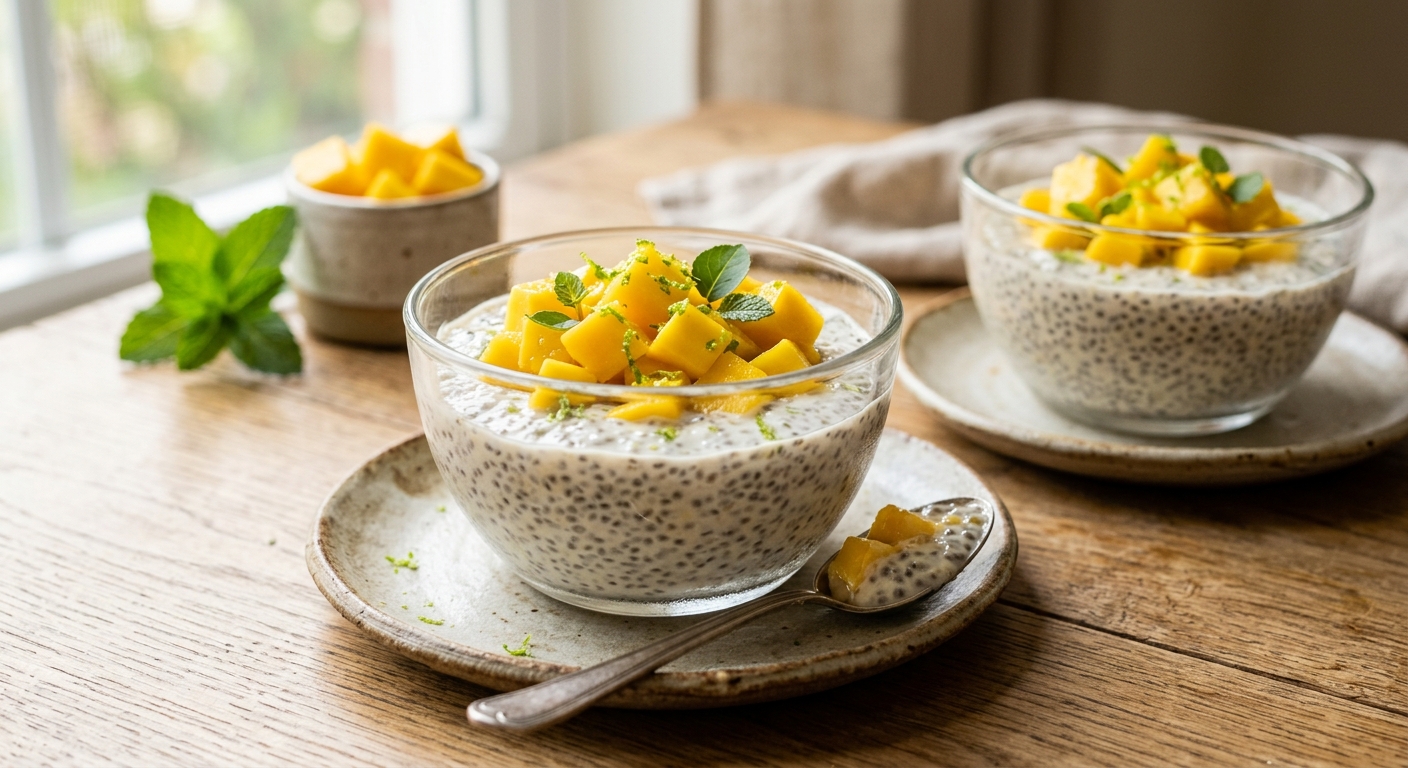
There are desserts that feel virtuous and desserts that actually are. Chia seed pudding with mango is the rare specimen that belongs firmly in the second category. Each tablespoon of chia seeds carries roughly 180 milligrams of calcium and 2.5 grams of plant-based omega-3 fatty acids (ALA), making this humble pudding one of the most concentrated bone-nourishing foods you can prepare without a prescription. Layered with fresh Ataulfo mango, which contributes vitamin C to drive collagen synthesis and beta-carotene for cartilage protection, this dish earns its place on the Calibrated Cuisine Bone and Joint menu with genuine scientific credentials.
What makes this recipe particularly clever is the synergy between its key players. The calcium in chia seeds is highly bioavailable, especially when paired with the magnesium and phosphorus also present in the seeds, because these minerals work cooperatively in bone mineralisation. Fortified coconut milk adds a meaningful hit of vitamin D, the nutrient that acts as calcium’s essential escort, ensuring absorption rather than excretion. The result is a dish where every component has a structural role not just in flavour, but in your skeletal health.
From a culinary standpoint, chia pudding rewards patience and technique. The seeds must hydrate fully to develop that signature tapioca-like gel, and the ratio of seeds to liquid is critical: too little liquid and the pudding seizes into a dense mass, too much and it never sets. We have tested four preparation methods, each producing a subtly different texture, from the classic overnight cold-set to a gently warmed stovetop version with a creamier, more custard-like body. Whichever method you choose, the mango topping is prepared fresh at serving time to preserve its volatile aromatics and enzyme activity.
4
servings
Ingredients
- 120 gwhite or black chia seeds
- 800 mlfortified coconut milk (from a carton, not full-fat canned), well shaken
- 60 mlpure maple syrup
- 5 mlpure vanilla extract
- 1 pinchColima Sea SaltMicroplastic Free Salt
- 2 largeripe Ataulfo (honey) mangoes, peeled and diced into 1 cm cubes (approximately 400g flesh)
- 15 mlfresh lime juice
- 5 glime zest (from approximately 1 lime)
- 30 gunsweetened toasted coconut flakes, for garnish
- 10 gfresh mint leaves, for garnish
- —Extra maple syrup to taste, for serving
Instructions
Click on an item below to shop for the recommended items for this recipe on Amazon.
As an Amazon Associate, we earn from qualifying purchases.
- Pour the fortified coconut milk into a medium heavy-bottomed saucepan and set over medium-low heat. Add the maple syrup, vanilla extract, and pinch of sea salt. Whisk to combine and heat until the mixture is steaming and just beginning to simmer at the edges, about 4 to 5 minutes. Do not boil.
- Remove the pan from the heat and let the milk cool for 3 minutes until it reads approximately 70 degrees C on an instant-read thermometer. Adding chia seeds to boiling liquid can cause uneven gelling and a slightly bitter flavour.
- Whisk in the chia seeds in a slow, steady stream, stirring vigorously for 90 seconds to ensure no clumps form. Return the pan to the lowest heat setting and stir continuously with a silicone spatula for 4 to 5 minutes, until the mixture visibly thickens and the seeds are evenly distributed throughout.
- Remove from heat and divide the pudding evenly among four serving glasses or ramekins (approximately 230ml capacity each). Allow to cool at room temperature for 10 minutes, then press a piece of plastic wrap directly against the surface of each pudding to prevent a skin from forming.
- Refrigerate for a minimum of 2 hours, or until fully set and chilled. While the pudding chills, toss the diced mango with lime juice and lime zest in a small bowl. Cover and refrigerate until needed.
- When ready to serve, uncover each pudding and spoon the mango salsa generously over the top. Finish with toasted coconut flakes and a few fresh mint leaves. Serve immediately.
- Lightly grease the insert of a 3 to 4 litre slow cooker with a neutral oil or a small piece of damp paper towel. This prevents the chia gel from sticking to the sides and makes cleaning easier.
- Combine the fortified coconut milk, maple syrup, vanilla extract, and sea salt directly in the slow cooker insert. Whisk well. Gradually pour in the chia seeds, whisking continuously for 2 full minutes to disperse the seeds and prevent any clumping before the heat begins to activate their gelling properties.
- Set the slow cooker to Low. After 20 minutes, lift the lid and stir the mixture thoroughly with a silicone spatula, scraping the sides and bottom. This is a critical step: the seeds near the heat source gel faster and must be redistributed. Repeat this stir at the 45-minute mark.
- Cook on Low for a total of 1 hour and 30 minutes, stirring once more at the 1-hour mark. The finished pudding should be thick enough to coat the spatula and hold its shape when a small amount is placed on a cold plate.
- Turn off the slow cooker. Carefully ladle the hot pudding into four serving glasses or ramekins. Let cool uncovered for 15 minutes, then cover the surface of each pudding directly with plastic wrap. Refrigerate for at least 3 hours until fully chilled and set. The longer chill time compensates for the greater residual heat compared to the stovetop method.
- Prepare the mango topping by tossing the diced mango with lime juice and lime zest. Refrigerate until serving. When ready to serve, top each pudding with the mango mixture, toasted coconut flakes, and fresh mint.
- Prepare four 240ml wide-mouth mason jars (or heatproof ramekins that fit inside your pressure cooker pot). In a large measuring jug, combine the fortified coconut milk, maple syrup, vanilla extract, and sea salt. Whisk thoroughly, then add the chia seeds in a thin stream, whisking vigorously for 2 minutes. Allow the mixture to rest for 3 minutes, then whisk again to break up any clumps that have formed.
- Divide the chia mixture evenly among the four mason jars, filling each to about 2 cm below the rim. The mixture will look thin at this stage; it will gel fully during and after cooking. Seal each jar finger-tight with its lid. Do not overtighten, as steam needs to vent slightly.
- Pour 250ml of water into the pressure cooker inner pot. Place the trivet inside. Arrange the sealed jars on the trivet; if your cooker is large enough, you can stack a second layer using a second trivet. Close and seal the pressure cooker lid.
- Cook on High Pressure for 5 minutes. Allow a natural pressure release for 10 minutes, then carefully switch to a quick release to vent remaining pressure. Open the lid, tilting it away from you to direct steam away from your face.
- Using jar lifters or silicone oven mitts, carefully remove the jars from the pot. The pudding will appear slightly liquidy and pale at this stage, which is normal. Let the jars cool on a wire rack, uncovered, for 15 minutes. The mixture will begin to set as it cools. Then refrigerate, uncovered, for 30 minutes before sealing the lids and chilling for at least 2 hours 30 minutes more.
- When ready to serve, unscrew the jar lids. If serving in the jars, top directly with the lime-dressed mango, toasted coconut flakes, and mint. Alternatively, run a thin knife around the inside of each jar and invert onto a shallow bowl for an elegant unmoulded presentation.
- Preheat your oven to 160 degrees C (325 degrees F) conventional, or 140 degrees C (285 degrees F) fan-forced. Place four 200ml ceramic ramekins inside a deep roasting pan or baking dish large enough to hold them without touching.
- In a medium bowl, whisk together the fortified coconut milk, maple syrup, vanilla extract, and sea salt until fully combined. Add the chia seeds in a slow stream, whisking vigorously for 2 to 3 minutes to ensure even distribution. Let the mixture rest for 5 minutes, then whisk again. This double-whisk technique is essential for the baked version because you cannot stir once it enters the oven.
- Ladle the chia mixture evenly into the four ramekins. Transfer the roasting pan carefully to the oven rack pulled halfway out. Pour enough boiling water into the roasting pan to reach halfway up the sides of the ramekins, being careful not to splash water into the puddings.
- Slide the rack gently into the oven and bake for 38 to 42 minutes. The puddings are done when the edges are fully set but the centre 2 cm still has a slight wobble when the pan is nudged. The residual heat and refrigerator chill will finish the set.
- Remove the roasting pan from the oven. Lift the ramekins from the water bath using tongs and a folded kitchen towel. Allow to cool on a wire rack for 20 minutes, then press a piece of plastic wrap against the surface of each pudding. Refrigerate for at least 2 hours until fully cold and set.
- While the puddings chill, toss the diced mango with lime juice and lime zest. Refrigerate. To serve, remove the plastic wrap from each ramekin and spoon the mango generously over the top, followed by toasted coconut flakes and fresh mint leaves. These can also be served warm directly from the oven, in which case skip the chilling step and serve immediately after the cooling period.
Nutrition Breakdown
Per 1 serving (makes 4)
Vitamins & Minerals
% Daily Value based on a 2,000 calorie diet (FDA reference)
🧬 Essential Amino Acids
% of recommended daily intake (RDA) per serving
🛡 Antioxidant Profile
The Nutrition Science
Chia seeds (Salvia hispanica) contain approximately 631mg of calcium per 100g, a figure that rivals whole milk gram-for-gram, and their calcium bioavailability has been measured at around 36%, comparable to that of dairy in controlled studies. This matters because many plant calcium sources are rendered inaccessible by high oxalate content. Chia seeds are low in oxalates, allowing their mineral content to be genuinely absorbed at the intestinal level. When combined with the vitamin D provided by fortified coconut milk (which supports active calcium transport across the intestinal wall via calcitriol-mediated protein channels), this pudding creates the full calcium absorption cascade in a single dish.
The omega-3 fatty acids in chia seeds exist exclusively as alpha-linolenic acid (ALA), which is the precursor to the longer-chain EPA and DHA. While the conversion rate from ALA to EPA is modest in humans (typically 5 to 15%), the sheer quantity of ALA in chia seeds, approximately 17.8g per 100g of seeds, means that even a conservative conversion yields meaningful anti-inflammatory EPA. In the joint health context, this matters because EPA and DHA suppress the NF-kB signalling pathway that drives the production of cartilage-degrading enzymes (MMPs) in rheumatoid and osteoarthritic joints. The mangiferin and quercetin from fresh mango operate through a complementary pathway, inhibiting COX-2 enzyme activity in a manner structurally similar to non-steroidal anti-inflammatory drugs, but without gastrointestinal side effects.
Magnesium, often overlooked in bone health discussions, is the cofactor for over 300 enzymatic reactions, including the activation of vitamin D itself. Without adequate magnesium, supplemental vitamin D is metabolically inert because the enzymes that hydroxylate vitamin D into its active form (calcitriol) require magnesium to function. Each serving of this pudding provides 138mg of magnesium, roughly one-third of the daily RDA, primarily from the chia seeds, making this one of the few desserts that can genuinely claim to support bone mineralisation at the enzymatic level rather than simply delivering calcium in isolation.
Pro Tips
- For the smoothest pudding in any method, use white chia seeds rather than black. They have an identical nutritional profile but produce a pale, cream-coloured pudding that makes the mango topping pop visually.
- If your pudding develops a thick skin or lumps after refrigeration, blend it briefly with an immersion blender before serving. The gel structure breaks down and reforms within minutes, restoring a silky, uniform texture.
- Select Ataulfo (honey) mangoes over Tommy Atkins or Kent varieties when possible. Ataulfo mangoes have nearly double the beta-carotene content, a creamier texture that complements the pudding, and virtually no fibrous strands, making for a cleaner dice.
This sounds wonderful for bone support, especially since I’ve been focusing on calcium bioavailability after my Hashimoto’s diagnosis. Quick clarification though: is the mango the only fruit in this recipe, and does it use any nightshades in the base? I’m following AIP and want to make sure the liquid component doesn’t sneak in anything inflammatory. Also curious about Chris’s temperature tip, since I’ve noticed chia seems to gel better when I use warmed coconut milk instead of cold, so that tracks with what you’re describing!
Love the framing here, but quick question on your method: are you soaking the chia in room temp liquid or chilling it first? I’ve found that a brief warm soak (not hot, just 110-115F) before chilling actually improves mucilage release and bioavailability of those minerals, plus you get better texture. The mango pairing is smart too since that vitamin C is going to significantly boost calcium absorption. Just plated a variation with coconut milk and a touch of cardamom for my clients last week and the difference in how it performs nutritionally is noticeable.
Oh, this is such a smart combo for hormone balance too! I’ve found that chia seeds have been a game changer for my PCOS since they’re loaded with fiber and those omega-3s help manage inflammation and insulin sensitivity. One thing I’d love to know: does the recipe include any inositol-rich additions like coconut milk or ground flax? I usually add a sprinkle of cinnamon to mine for that extra blood sugar support, and it pairs beautifully with mango’s natural sweetness without spiking my insulin the way other desserts do. Thanks for highlighting the bioavailability angle, Anna, because that metabolic piece matters so much for those of us managing horm